Cannabis-Infused Honey Recipe: Drizzle on Everything
Cannabis-infused honey, made right: decarb, a coconut-oil and lecithin carrier, low-temp infusion, dosing math, storage, and troubleshooting.

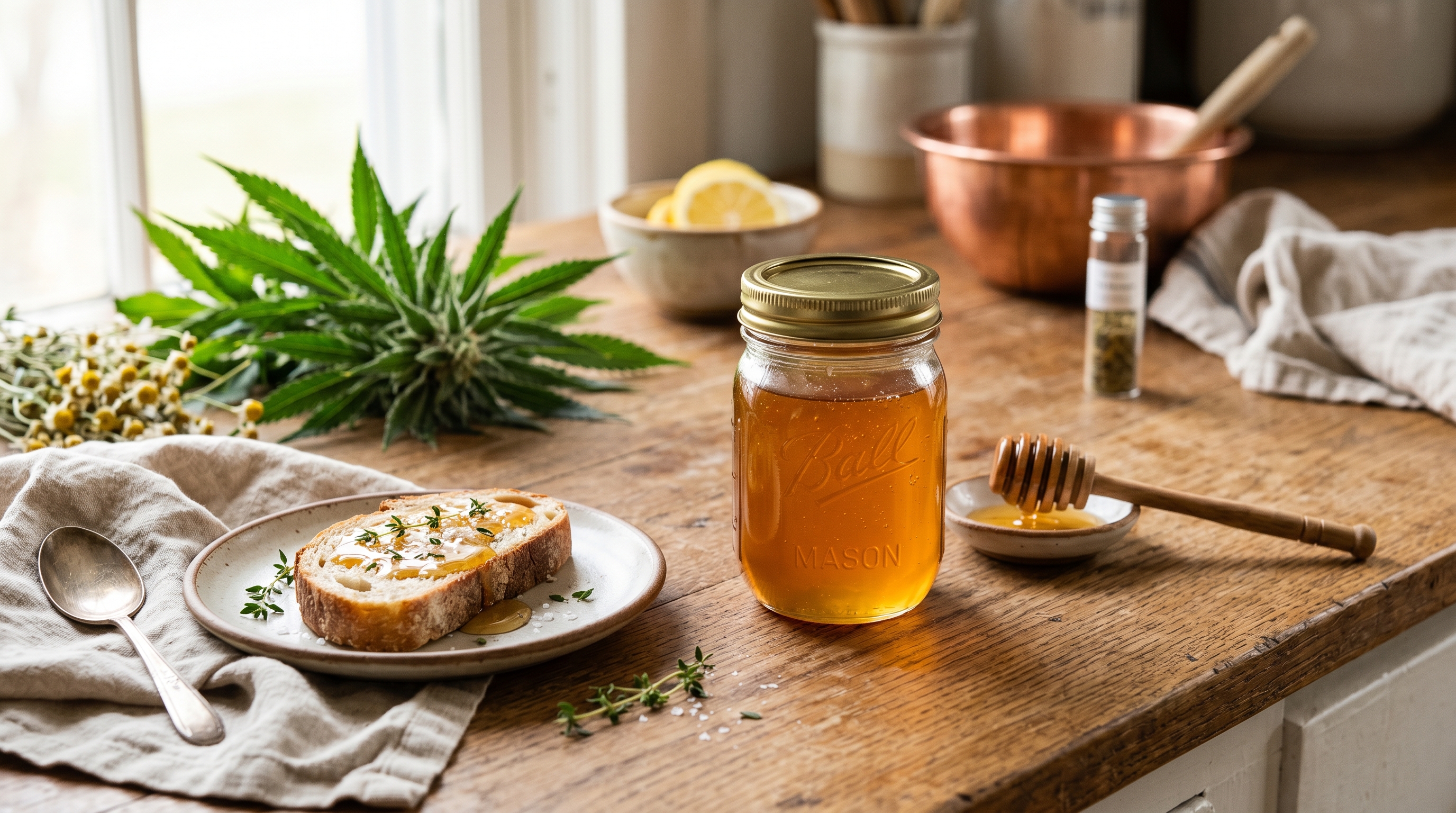
There is something satisfying about a jar of golden, infused honey on your counter. A spoonful in tea. A drizzle over a cheese board. A swirl into morning oatmeal. Honey is the most flexible edible base in any kitchen. It keeps for ages, it tastes wonderful, and it fits recipes where butter or oil would feel out of place.
But here is the part most “cannahoney” recipes skip over. Honey and cannabinoids do not naturally get along. If you just stir decarbed flower into raw honey, you will end up with weak, uneven honey and a lot of wasted flower. The chemistry is working against you.
So let’s do it the honest way. I’ll walk you through why honey infusion is tricky, the small fix that solves it, a low-temperature method that protects the honey, and the dosing math so you know what’s in each spoonful.
Why honey infusion is genuinely tricky
Here’s the core problem in one sentence: cannabinoids are fat-soluble, and honey is water-based.
THC, CBD, and their cousins are lipophilic. That means they dissolve into fats and oils, not water. Honey, despite its thick texture, is mostly a concentrated water-and-sugar solution. So when you drop oily, decarbed cannabis into it, the two refuse to mix. The cannabinoids cling to the plant material instead of spreading through the honey. Most of your potency stays locked in the flower you later strain out.
This fat-soluble behavior is exactly why cannabinoids are best delivered through a lipid carrier [Russo, 2011], and it’s the same binding challenge behind every edible. If you’ve read our guide on why edibles hit harder and the science of decarboxylation, you already know cannabinoids need two things: heat to activate them, and a fat to carry them. Honey provides neither on its own.
There are two honest ways around this:
- Add a fat carrier plus an emulsifier. A tablespoon of coconut oil gives the cannabinoids something to bind to, and sunflower lecithin acts as an emulsifier — a molecular matchmaker that lets oil and water-based honey stay blended instead of separating. This is the method most home cooks land on.
- Infuse a fat first, then fold it in. Make cannabutter, cannabis coconut oil, or a tincture first, then stir that pre-infused fat into warm honey with lecithin. No straining required because the cannabinoids are already extracted.
Both work. The recipe below uses the first method because it’s the most beginner-friendly and uses raw flower directly. If you already keep infused oil on hand, skip to the “Concentrate shortcut” note.
Professor High note: The lecithin is the unsung hero here. It does not add potency by magic, but by keeping everything emulsified it makes far more of your cannabinoids actually reach your bloodstream — and it keeps the honey from separating into an oily layer on top.
Ingredients and equipment
Ingredients (makes about 1 cup / 16 tablespoons):
- 1 cup (about 340 g) raw, unfiltered honey — quality matters; raw honey keeps its enzymes and flavor
- 3.5–7 g decarboxylated cannabis flower, finely ground (more on dosing below)
- 1 tablespoon coconut oil (or MCT oil for a thinner pour)
- 1 teaspoon to 1 tablespoon sunflower lecithin (start small — it has a flavor)
Equipment:
- Oven and baking sheet (for decarbing)
- Grinder
- Double boiler, or a heatproof bowl set over a pot of simmering water
- Kitchen thermometer (strongly recommended)
- Whisk or hand mixer
- Cheesecloth and a fine strainer (only if infusing raw flower)
- Clean glass jar with a tight lid
A thermometer is the single most useful tool on this list. Honey’s beneficial enzymes and delicate flavor start to degrade above roughly 185°F, so keeping the temperature low is what separates good honey from scorched syrup.
Step-by-step recipe
Step 1 — Decarboxylate the flower
Raw cannabis is full of THCA, not THC. Heat converts it. Spread your ground flower on a parchment-lined baking sheet and bake at 240°F (115°C) for 40–60 minutes, stirring once or twice, until it turns a toasty golden-brown. Let it cool completely.
If you want the full chemistry on time and temperature trade-offs, our decarboxylation explainer covers it in depth. Skipping or rushing this step is the number-one reason homemade edibles come out weak.
Step 2 — Make the carrier paste
In a small bowl, combine the coconut oil, sunflower lecithin, and your decarbed ground flower. Stir until it’s a smooth, lump-free paste. This pre-binds the cannabinoids to the fat before the honey ever enters the picture — which is exactly the head start the chemistry needs.
Step 3 — Warm the honey gently
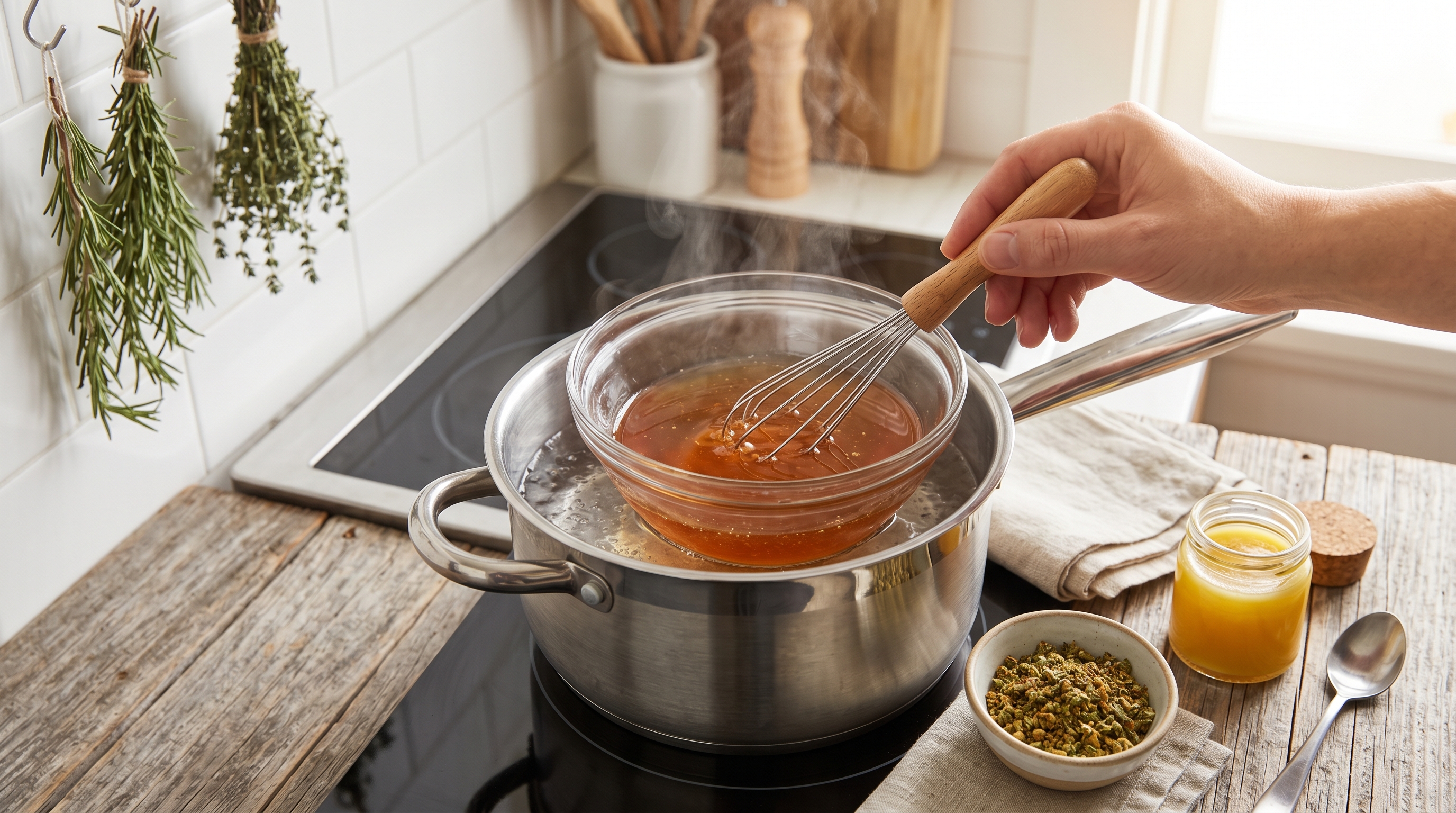
Set up your double boiler with about two inches of water in the bottom pot. Add the honey to the top bowl and warm it until it loosens and stirs easily. Keep it between 160°F and 185°F. Never let honey boil — direct high heat scorches it and destroys its character. The water bath is what makes gentle, even heat possible.
Step 4 — Infuse
Stir the carrier paste into the warm honey and whisk thoroughly so it’s fully incorporated. Hold the temperature in that 160–185°F window and let it infuse gently for 30 minutes to 2 hours, stirring every 15–30 minutes. Longer infusion times pull more cannabinoids into the carrier. If you used a slow cooker on its lowest setting, you can extend this to several hours.
Step 5 — Strain (raw-flower method only)
If you infused raw flower, pour the warm honey through cheesecloth set in a fine strainer over your jar. Be patient — warm honey strains slowly. Squeeze the cheesecloth gently to recover the last of it. (Skip this step entirely if you used a pre-infused oil or tincture; there’s no plant matter to remove.)
Step 6 — Jar and cool
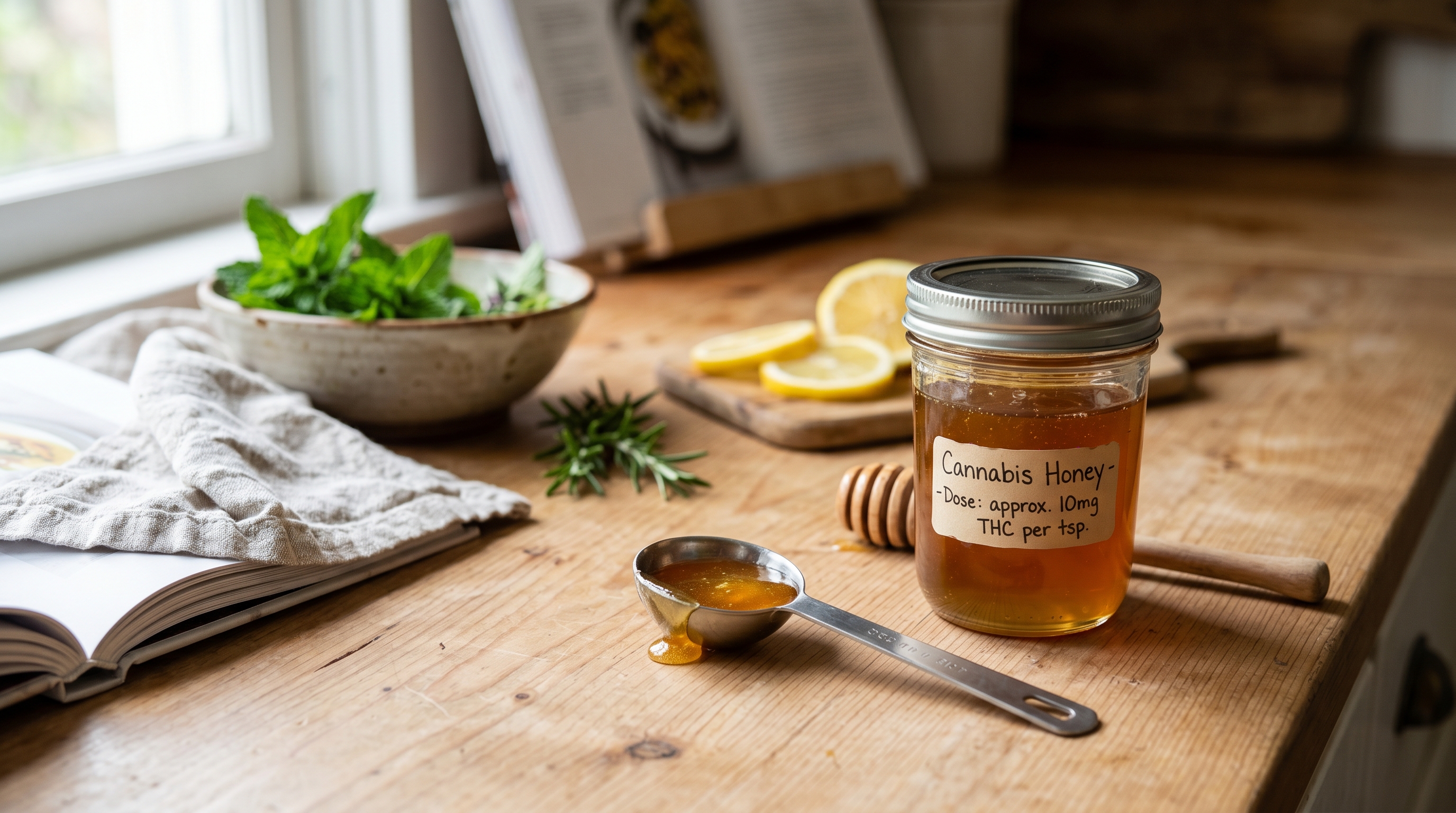
Transfer to a clean glass jar. As it cools, shake or stir the jar every 5–15 minutes for the first hour or so to keep the oil and honey from separating while the lecithin sets. Then label it clearly with the date and your dose estimate, and store it away from kids, pets, and confused houseguests.
Concentrate shortcut: If you’d rather skip decarbing and straining, dissolve a measured cannabis concentrate or a few droppers of homemade tincture into the tablespoon of warm coconut oil, then proceed from Step 3. Cleaner, faster, and easier to dose precisely.
Dosing math: know your tablespoon
This is the part you can’t eyeball. Here’s how to estimate potency.
Start with total THC in your flower:
Grams of flower × THC% × 1000 = total mg of THC (before losses)
For example, 7 g of flower at 20% THC = 7 × 0.20 × 1000 = 1,400 mg total THC. But you never capture all of it. Between decarb conversion and extraction efficiency, a realistic home yield with lecithin is roughly 60–70%. So figure about 840–980 mg actually makes it into your jar.
Divide by the number of tablespoons in the batch. One cup of honey is about 16 tablespoons, so:
- ~900 mg ÷ 16 ≈ ~56 mg THC per tablespoon
That’s potent. Most people will dose by the teaspoon (a tablespoon is three teaspoons), so that same honey lands around ~19 mg per teaspoon. If you want gentler honey, use 3.5 g of flower instead of 7 g, which roughly halves everything.
Suggested starting servings:
- Beginner: 1/2 teaspoon (~9–10 mg in the example above)
- Moderate: 1 teaspoon (~19 mg)
- Experienced: 1 tablespoon (~56 mg)
These are estimates, not lab results — home infusion varies batch to batch. Treat your first taste as a test. If you’re new to edibles, please read edible dosing for beginners and our beginner’s dosing chart before you drizzle. The two-hour rule matters more with honey than almost anything, because it’s so easy to keep adding “just a little more.”
How to use it
Honey’s whole appeal is versatility. A few favorites:
- Tea and coffee. A teaspoon stirred into hot tea is the classic. For a fuller morning ritual, see cannabis-infused coffee and tea and the science behind the cannabis-and-coffee pairing. Heat helps you actually taste it, too.
- Charcuterie and cheese boards. A drizzle over a sharp blue cheese or a baked brie is genuinely elegant — and a great way to portion a small, social dose.
- Breakfast. Oatmeal, yogurt, toast, biscuits. Honey shines anywhere sugar would.
- Baking and glazes. Brush it on roasted carrots or use it in dressings — but remember high oven heat can degrade cannabinoids, so glaze near the end.
- Microdosing. A precise half-teaspoon makes honey a tidy microdosing vehicle.
If honey is your first step into kitchen infusions, our cannabis cooking 101 guide and the roundup of best strains for culinary creativity are natural places to go next, and the chefs in cannabis fine dining lean on infused honey constantly.
Storage and shelf life
Good news: honey is one of the most stable foods on the planet. Its low water content and natural acidity give it well-documented antimicrobial properties [Mandal, 2011], so infused honey keeps for many months to a year or more in a sealed glass jar at room temperature, away from light and moisture. Refrigeration isn’t necessary and can speed up crystallization.
The cannabis itself doesn’t meaningfully spoil the honey, but cannabinoids slowly degrade with light, heat, and air over time — THC gradually converts toward CBN — so potency may soften over many months even as the honey stays edible. Keep the lid tight and the jar in a cool, dark cupboard.
Troubleshooting
It’s too weak. Usually one of four culprits: incomplete decarb, no lecithin, infusion temperature too low, or infusion time too short. The carrier-paste step and lecithin matter most.
The oil separated into a layer on top. The emulsion broke, often from skipping lecithin or not stirring while it cooled. Stir it back together before each use — it’s still perfectly good. Next batch, add a bit more lecithin and shake during cooling.
It tastes too “weedy.” You either used too much flower for the honey volume or didn’t strain finely enough. The concentrate or tincture method removes most plant flavor — see how to make edibles without the weedy taste.
It crystallized. Totally normal for raw honey. Set the jar in a bowl of warm (not hot) water until it re-liquefies. This doesn’t affect potency.
It scorched or tastes bitter. The temperature got too high. Use a thermometer and a water bath next time, and never let honey boil.
FAQ
Can I just stir decarbed flower into raw honey with no oil? You can, but it’s the least effective method — most cannabinoids never leave the plant material. If you go this route, add lecithin and accept that potency will be low and inconsistent.
Is lecithin really necessary? Not strictly, but it noticeably improves both potency and texture by keeping the oil and honey emulsified. Sunflower lecithin is the common choice. Start with a small amount because it has its own flavor.
Does honey “absorb” THC without heat? No. Cannabinoids must be decarboxylated first, and they need a fat to bind to. Honey alone provides neither.
How is this different from making infused butter or oil? With cannabutter or oil, the fat does all the binding directly. With honey you’re adding a small fat carrier plus an emulsifier to bridge the water/oil gap. Many people make capsules or gummies from the same infused oil.
Can I use it in cold drinks? Yes, but stir well — it disperses more easily in warm liquids. The lecithin helps it blend into cold ones. See our guide to cannabis-infused beverages.
Will heating my tea destroy the THC? Normal beverage temperatures are fine. Cannabinoids degrade with prolonged high heat, not a hot cup of tea.
Honey infusion isn’t hard once you respect the chemistry. Activate your flower. Give the cannabinoids a fat to ride on. Emulsify with lecithin. Keep the heat gentle. Do that and you’ll have a jar that’s genuinely useful, and genuinely delicious, on just about everything. As always, start low, go slow, and label that jar.
Key takeaways
- Honey is water-based; cannabinoids are fat-soluble. They won’t mix on their own, so a fat carrier is the key to potent honey.
- Use a coconut-oil carrier plus sunflower lecithin. The oil binds the cannabinoids and the lecithin keeps everything emulsified.
- Decarb first, then keep the heat low. Activate your flower at 240°F, and hold the honey between 160°F and 185°F to protect its flavor and enzymes.
- Do the dosing math. Estimate total THC, assume 60–70% efficiency, and divide by tablespoons. Then dose by the teaspoon.
- Store it sealed in a cool, dark place. Honey is naturally stable and keeps for many months.
Sources
- MunchMakers — How to Make Cannabis Honey: Infused Honey Recipe. guides.munchmakers.com
- Reveal Cannabis — How to Make Cannabis-Infused Honey (THC or CBD Honey). revealcannabis.com
- HØJ — How to Make Cannabis Honey. hoj.life
- NuggMD — The Ultimate Cannabis Infused Honey Recipe. nuggmd.com
- InfusionLab — How To Make Cannahoney Recipe. infusionlab.org
- [Mandal, 2011] Mandal MD, Mandal S. Honey: its medicinal property and antibacterial activity. Asian Pac J Trop Biomed. PubMed
- [Russo, 2011] Russo EB. Taming THC: potential cannabis synergy and phytocannabinoid-terpenoid entourage effects. Br J Pharmacol. PubMed
This article is educational and not medical advice. Cannabis affects everyone differently. Follow the laws in your area, keep edibles away from children and pets, and consult a healthcare provider with questions about your health.


