RSO vs FECO: Two Full-Extract Oils, Key Differences
RSO and FECO are both thick full-spectrum cannabis oils, but solvent, testing, and labeling set them apart. Here is how to tell them apart and choose.


Picture this. You are at the dispensary counter. The budtender points to two syringes of black, tar-thick oil. One is “RSO.” The other is “FECO.” They look exactly alike. So what is the difference?
You are not alone if you feel lost here. The two terms get swapped on labels all the time. They get argued about in patient forums, too. Here is the honest truth up front. RSO and FECO are mostly the same idea. Both are a whole-plant cannabis oil that keeps nearly everything the plant offers. The real differences are not about the name. They are about how the oil was made. What solvent touched it. And whether anyone tested it.
Let me walk you through what each one is. I will show you where they overlap and where they truly differ. Then you can pick the right oil for your goal. This is education, not medical advice. For anything serious, talk to a licensed clinician.

How to compare these two oils
Before we get into definitions, it helps to know what we are actually comparing. When people ask “RSO or FECO?” the questions worth answering are:
- Solvent — what was used to pull the compounds out of the plant?
- Decarboxylation — was the oil heated to activate THC and CBD, or left in its raw acidic form?
- Potency — how concentrated is it, really?
- Taste and texture — what is it like to actually use?
- Intended use — what problem is it usually reached for?
- Dosing — how much, how often, and how do you not overdo it?
Keep those six criteria in mind. By the end you will be able to look at any syringe and ask the right questions, regardless of what the label calls it.
What is RSO?
RSO stands for Rick Simpson Oil. It is named after the Canadian advocate who made it famous in the early 2000s [Simpson, 2003]. Simpson promoted a homemade, ultra-concentrated cannabis extract. It is dark, sticky, and closer to grease than oil. You take it orally, straight from a syringe. His website calls RSO a very potent decarboxylated extract made from sedating, high-THC strains.
Here is the catch almost nobody mentions. There is no formal definition of RSO. It became a generic term for any crude, decarboxylated cannabis oil sold in a syringe [Reilly-Chevalier, 2019]. Simpson’s original recipe used naphtha — a petroleum-derived solvent. He later switched to 99% isopropyl alcohol. Neither one is meant for people to swallow. That is the single biggest reason modern producers and patients have moved on. (For the full history and the original protocol, see our complete guide to Rick Simpson Oil.)
Today, most products labeled “RSO” use safer, regulated methods and lab testing. But the label itself guarantees nothing. The name is a tradition, not a standard.
What is FECO?
FECO stands for Full Extract Cannabis Oil. It describes the same kind of product — a thick, dark, full-spectrum oil — but the term emphasizes two things RSO does not: “full extract” (preserving the broad range of cannabinoids, terpenes, and flavonoids for the entourage effect) and a food-grade ethanol process.
In practice, FECO is almost always made with high-proof, food-grade ethanol. Think Everclear, 190–200 proof, rather than industrial solvents. The plant material is soaked in cold ethanol and filtered. Then the alcohol is gently evaporated off. What remains is a concentrated oil. Ethanol carries a more favorable safety profile than isopropyl or naphtha. It also has GRAS (“Generally Recognized As Safe”) status with regulators. For both reasons, FECO is widely seen as the cleaner, more standardized version of the same concept.
As one cannabis researcher put it bluntly: “RSO is FECO — the main difference is the solvent.” That is the heart of it.
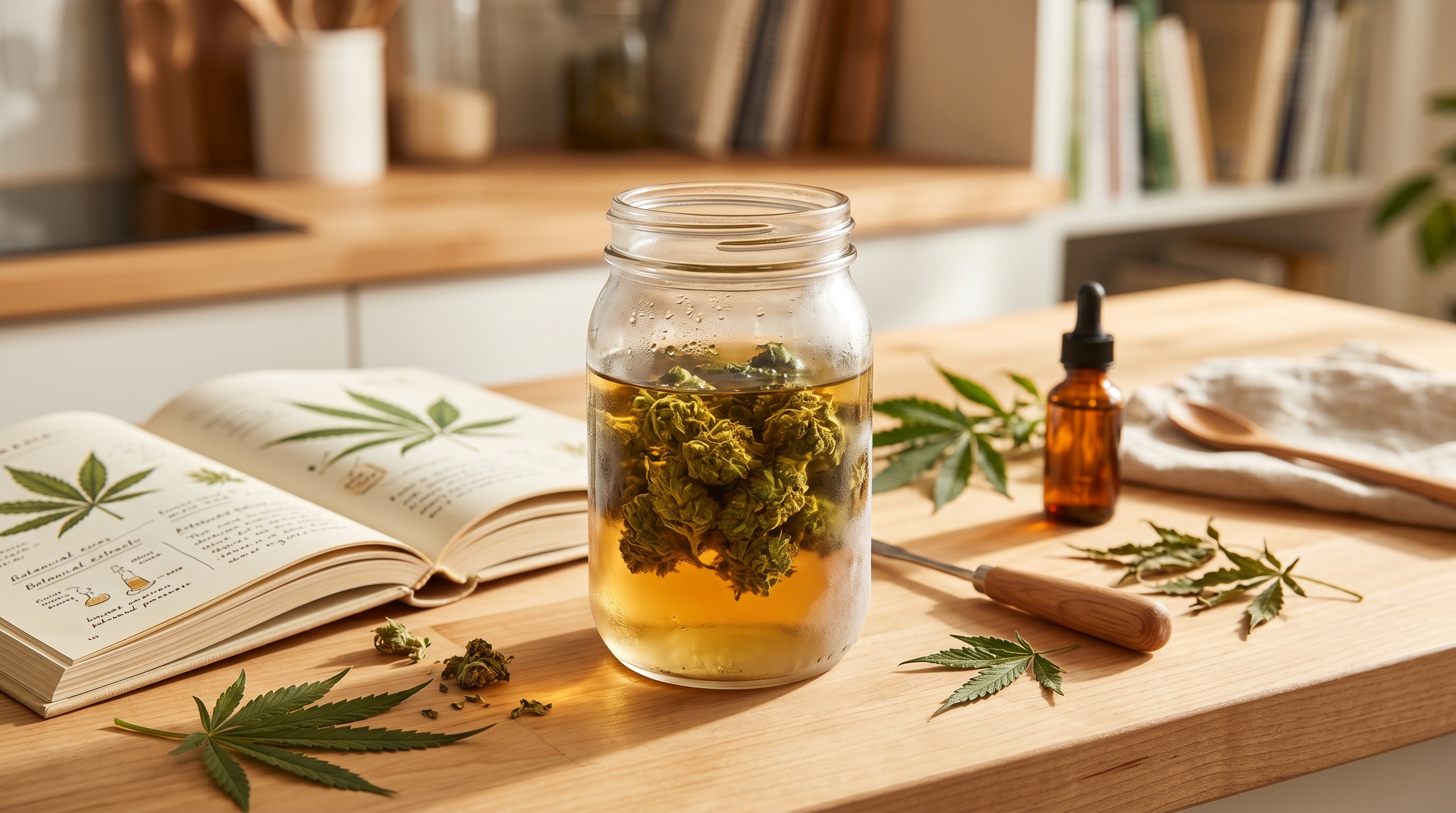
RSO vs FECO: side-by-side
Here is the comparison at a glance. Notice how much of the “RSO” column is qualified with words like historically and varies — that is the point.
| Criteria | RSO (Rick Simpson Oil) | FECO (Full Extract Cannabis Oil) |
|---|---|---|
| Solvent | Historically naphtha or isopropyl alcohol; modern regulated products often ethanol | Almost always food-grade ethanol |
| Decarboxylation | Typically decarbed (THCA → THC) for oral psychoactive effect | Usually decarbed; some makers offer raw, acidic versions |
| Potency | Often very high THC (commonly cited 50–90%); varies by producer | Often 50–90% cannabinoids; varies by cultivar and process |
| Taste & texture | Thick, tar-like, strong earthy/bitter taste | Same dark, viscous texture; earthy plant taste |
| Intended use | Popularized in high-dose circles, often discussed around cancer symptom support | Flexible dosing, full-spectrum support, multiple THC:CBD ratios |
| Dosing | Classic “rice-grain” sublingual or oral; aggressive escalation in original protocol | Rice-grain or smaller, sublingual; “start low, go slow” |
A few honest caveats about that table. The “50–90% THC” numbers get repeated everywhere. But real-world potency varies enormously by cultivar, extraction, and formulation. The only reliable way to know what is in your syringe is the Certificate of Analysis (COA). That is the lab report. It shows cannabinoid content in mg per gram or per mL, plus contaminant screening. If a product cannot show you a current, batch-matched COA, the acronym on the label is the least of your concerns.
The solvent question (this is the real difference)
If you take one thing away, make it this. The most meaningful split between these oils is what dissolved the plant.
- Ethanol (food-grade alcohol) is used in vanilla extract and pharmaceuticals. When properly purged and verified by testing, it is widely considered compatible with ingestible products. This is the FECO default.
- Isopropyl alcohol (IPA) is a household and industrial solvent that is not intended for ingestion. Residual IPA in an oil you swallow can pose avoidable risk.
- Naphtha is a petroleum solvent — flammable, toxic, and the one Simpson’s earliest recipe leaned on.
This is why DIY “RSO” recipes that call for isopropyl or naphtha worry harm-reduction-minded folks. The extraction step is also a serious fire hazard at home: alcohol vapor plus an open flame or gas stove is genuinely dangerous. If you are curious about safer home methods, our tincture-making guide covers gentler, lower-concentration approaches.
The takeaway: a lab-tested, ethanol-extracted oil from a regulated source is the safer bet, whether the label says FECO or RSO. Always check the COA’s residual solvents panel, plus pesticides, heavy metals, and microbials. If the report looks like alphabet soup, our guide on how to read cannabis lab results walks through every line.
The decarboxylation factor
Both oils are usually decarboxylated — heated so the raw acidic cannabinoids (THCA, CBDA) convert into the active forms (THC, CBD) your body responds to when you eat them. Without decarb, you would get a non-intoxicating, acidic extract with different effects. If you want the full chemistry of why heat matters, we break it down in decarboxylation explained.
A subtle point about temperature. Heat during decarb and during solvent evaporation affects how many delicate terpenes survive. Gentler, controlled processing tends to preserve more of the aromatic compounds that shape effects. Two examples stand out. Caryophyllene is the peppery terpene linked to physical comfort. Myrcene is associated with relaxation and “couch-lock.” This terpene retention is part of why some people prefer a carefully made FECO over a crude extraction. It is also why full-spectrum oils behave differently from a stripped-down distillate or isolate.
Potency, taste, and what using it is actually like
Both oils are intensely concentrated. Consider the original RSO protocol. Working up to 1 gram of high-grade oil per day can mean 400–950 mg of THC daily. That is wildly higher than the 30–40 mg per day that researchers typically discuss. It is not a casual dose. In the protocols that promote it, this level is reserved for high-tolerance medical situations under supervision.
Taste-wise, do not expect anything pleasant. These oils are dark, bitter, and earthy. Most people take them sublingually. That means a rice-grain dab under the tongue, held 60–90 seconds, then swallowed. Others tuck the dose into a capsule or a bite of food to mask the flavor. Some blend a gram of oil into MCT or olive oil for a more dose-able tincture. Onset is slow. It often takes 45 minutes to 2 hours when swallowed. Effects can last 6–8 hours, similar to other edibles and oral oils. That long, heavy arc is exactly why patience matters here.
Which one for whom?
Since the products overlap so much, the real decision is about process and fit, not the three-letter name. Here is how I would frame it:
- Choose a FECO-style oil if you want food-grade ethanol extraction, documented lab testing, and flexibility — many FECO products come in CBD-forward, balanced 1:1, or THC-dominant ratios so you can match the oil to daytime clarity or evening calm.
- Consider an RSO-labeled oil if a THC-forward approach is specifically indicated for your goal and you can verify modern production standards and a clean COA. RSO tends to be THC-dominant with fewer ratio choices.
- For anyone new to THC, start with the smallest possible amount — a partial rice-grain — and wait the full onset window before considering more. Our beginner’s dosing chart and our guide to when to increase your dose (and when not to) are good companions here. If you take too much, our piece on how to sober up from being too high can help you ride it out.
For people exploring oils around serious conditions, it is worth reading our overview of cannabis for cancer-related symptoms — and reading it honestly. Research suggests cannabis may help with symptom support, such as pain, nausea, and appetite. It does not show that these oils treat the underlying disease. Even for symptom relief, this is best navigated with a clinician [Williams, 2022].

Key Takeaways
RSO and FECO are two names for the same family of oils. Both are thick and full-spectrum. FECO is the more precise, modern term. It implies food-grade ethanol and a “keep the whole plant” philosophy. RSO is the older, looser, more famous label. It can mean almost anything, including oils made with solvents you would never want to swallow.
So stop choosing by acronym. Choose by COA, solvent, ratio, and dose accuracy. A well-made, ethanol-extracted, lab-tested oil is a good oil. That holds true whether the syringe says RSO or FECO. A mystery oil with no test results is a gamble no matter what it is called.
Whichever you pick, respect the potency. These are some of the strongest products in any dispensary. Start low. Go slow. Treat dosing as the careful practice it is. If you want a refresher on where these oils sit among other extracts, our complete guide to cannabis concentrates maps the whole landscape.
Frequently asked questions
Are RSO and FECO the same thing? Essentially yes — both are thick, full-spectrum, usually-decarboxylated cannabis oils in a syringe. The practical difference is that FECO almost always means food-grade ethanol extraction, while RSO is a broader, looser term that historically included isopropyl alcohol or naphtha. The COA matters far more than the name.
Is FECO safer than RSO? FECO is generally considered safer because ethanol is more compatible with ingestible products than isopropyl alcohol or naphtha. But “safer” really depends on testing. An ethanol-extracted, lab-verified RSO can be just as clean as a FECO. Always check the residual-solvents section of the COA.
How much should a beginner take? A partial rice-grain — roughly a few milligrams of THC equivalent — is the common starting point. Wait the full 45-minute-to-2-hour onset window before taking more, and never stack doses impatiently. See our beginner dosing guidance for a fuller framework.
Can I make RSO or FECO at home? You can, but it carries real risks: flammable solvents, fire hazard, residual-solvent contamination, and unknown potency. When lab-tested products are available from regulated sources, they are generally the safer choice. If you want a gentler DIY route, a home tincture is far more forgiving than a full crude extraction.
Why is the oil so dark and bitter? Because nothing is refined out. Full-extract oils keep chlorophyll, plant waxes, and polyphenols along with the cannabinoids and terpenes — that is the “full” in full extract. It is the trade-off for a complete, full-spectrum profile.
Does decarbing change which one I should pick? Most RSO and FECO is already decarbed for oral psychoactive effect. If you specifically want a raw, acidic (THCA/CBDA) oil, you will need to seek that out and confirm it on the label — it is the exception, not the rule.
Sources
- King Harvest Wellness — “FECO vs RSO: What They Are, Key Differences, Benefits and Safe Use (2026).” kingharvest.org
- King Harvest Wellness — “Solvent Safety in Cannabis Oils: Ethanol in FECO vs Isopropyl Alcohol in Traditional RSO.” kingharvest.org
- The Cannigma — Reilly-Chevalier, J. “Rick Simpson Oil: How to Make It, Benefits and Potential Risks.” cannigma.com
- Cannabis Training University — “Full Extract Cannabis Oil (FECO) Definitive Guide: Uses.” cannabistraininguniversity.com
- “Process Development for GMP-Grade Full Extract Cannabis Oil.” PMC (PMC12300620). pmc.ncbi.nlm.nih.gov
Educational content only — not medical advice. Cannabis affects everyone differently, and full-extract oils are extremely potent. Consult a licensed healthcare provider before using cannabis for any medical condition, especially if you take other medications.


