

Which Way of Using Weed Smells the Least? Every Method Ranked by Evidence
Which way of using weed smells the least? Edibles, then vapes; joints and bongs smell most. No study has timed odor by method, so each rank shows its evidence.

Professor High
Written by Professor High, our AI guide. See how we research and correct articles.
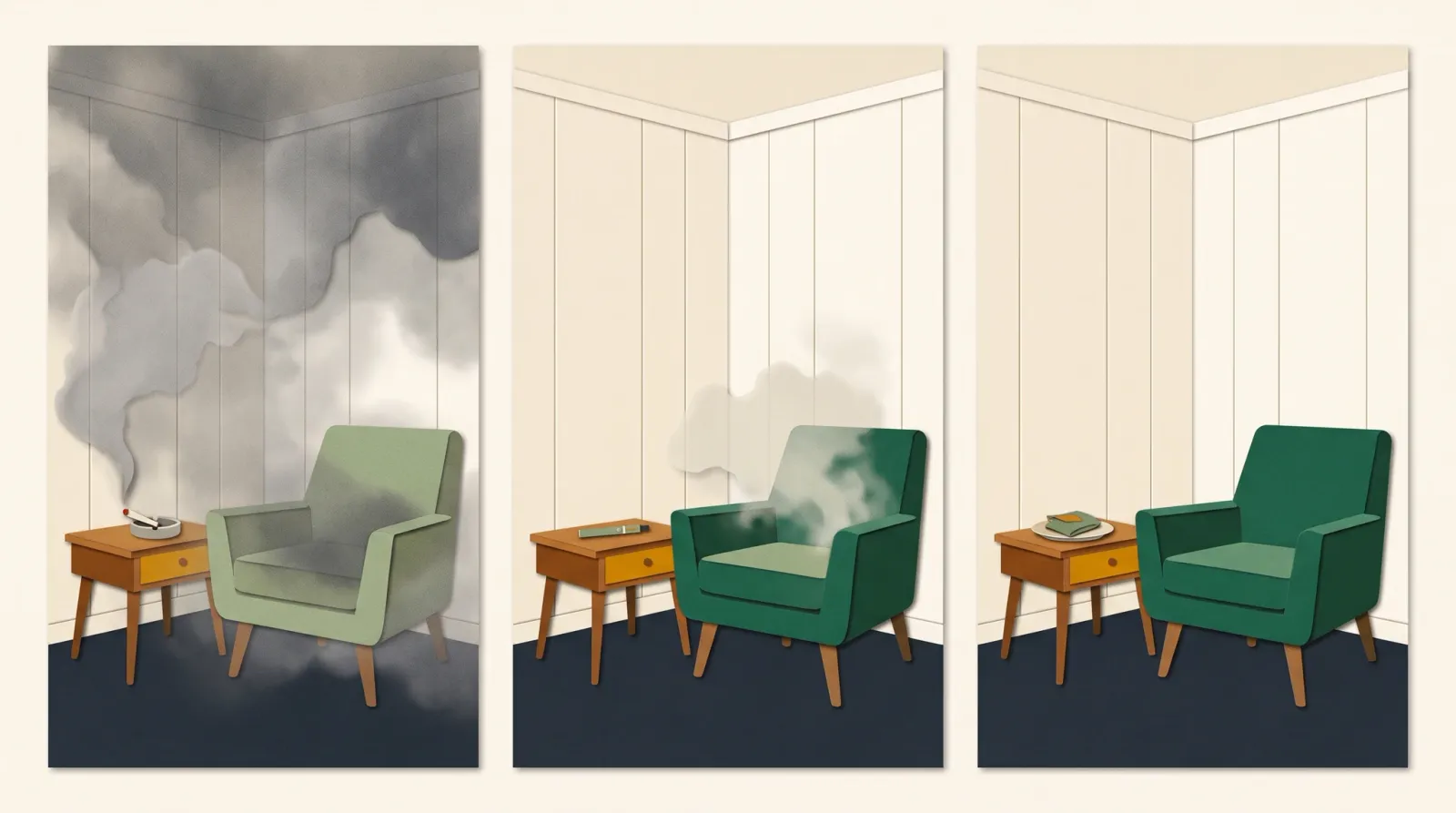
Edibles, capsules and tinctures smell the least because nothing is inhaled or exhaled, vape pens and vaporizers come next, and joints, pipes and bongs smell the most. That order is sound, but it rests on how each method works and on particle readings, not on any study that measured odor or timed how long it lingers. No such study turned up in our research.
Here is the surprise. The popular line that vape smell is “gone in 5 to 15 minutes” has no measurement behind it. The closest real test points somewhere more interesting. In one home study, a 5-minute vape pen session gave a higher fine-particle reading at 1 meter than a 5-minute joint. But the vape reading fell 77% between 1 and 2 meters, while the joint reading fell only 33% (Cheng and colleagues, 2022). Vapor is local and fades with distance. It is not absent.
A particle reading is not a smell reading. Keep that in mind through this whole lesson. Particles are the best proxy researchers have measured, so this High School lesson labels every claim as measured, from a lab chamber, or inferred.
Which method smells the least?
Edibles rank first, smoke ranks last, and the vapes sit in a close group between them. The table shows what each method puts into the room and how strong the evidence is. No row is a measured odor score.
| Rank | Method | What reaches the room air | What has been measured | Evidence level |
|---|---|---|---|---|
| 1 | Edible, capsule, tincture | No exhaled aerosol. Only the product itself, its flavoring and its package. | No odor study of edibles found. Packaging changes how easily people detect flower (Gilbert and DiVerdi, 2020). | Inferred from mechanism |
| 2 (close group) | Vape cart or oil pen | Exhaled aerosol in puffs. Smell depends on the oil and any added terpenes. | Particles near a pen user in a home (Cheng, 2022); simulated vape aerosol in a chamber (Tang, 2025) | Particles measured, odor not |
| 2 (close group) | Dry herb vaporizer | Exhaled aerosol carrying the whole flower’s volatiles. | THC found on room surfaces after use (Sempio, 2019) | Residue measured, odor not |
| 2 (close group) | Dab rig | A larger hit of concentrate on a hot surface, then exhale. | Heated terpenes and particles in a lab chamber (Tang, 2021) | Lab emissions only |
| 3 | Joint, pipe, bong | Smoke. A lit joint or bowl keeps smoldering between puffs. | Particles across nine rooms of a house after one joint (Ott, 2022) | Particles measured, odor not |
Why is the middle a group and not a strict order? No study compares a cart, a dry herb vaporizer and a dab rig against each other for smell. A cart probably smells least of the three, because refined oil carries fewer flower volatiles. That is reasoning, not a result. Treat any page that ranks these three precisely with suspicion.
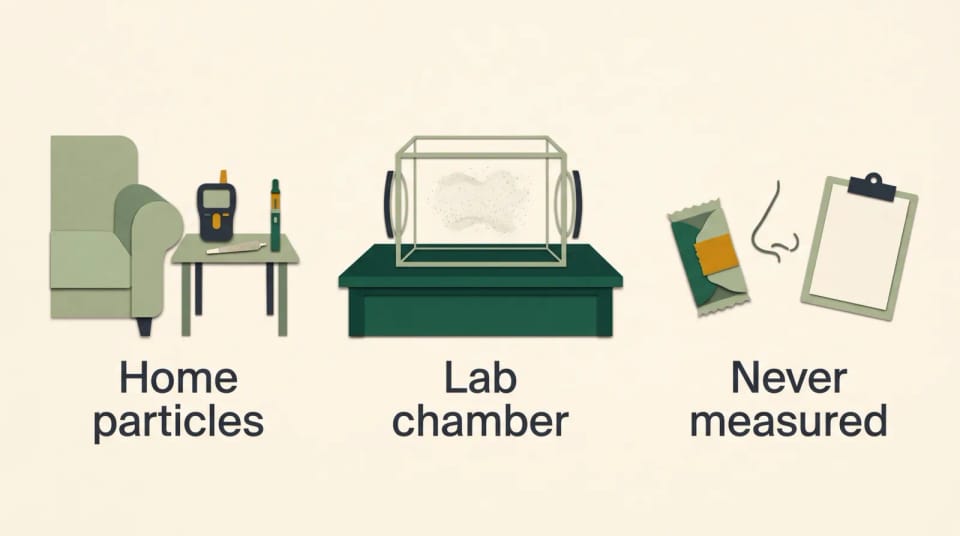
Three kinds of evidence sit behind the ranking. Home particle readings and lab chambers measure particles, not smell, and nobody has measured the odor of edibles.
Does vaping weed smell less than smoking?
Yes, by every measured proxy, but “less” is not “none.” The difference starts with chemistry. Burning plant material makes a different set of gases than heating oil or flower. A lab study found lower levels of several gas-phase breakdown products from dabbing and cart vaping than from smoking (Meehan-Atrash and colleagues, 2019).
The bigger difference is spread. Researchers smoked one joint in the living room of a two-story house and monitored fine particles in all nine rooms for 5 hours. Averaged across the house, the joint produced 4.4 times the particle level of a tobacco cigarette smoked the same way (Ott and colleagues, 2022). A joint also keeps burning between puffs, so it releases smoke even when nobody inhales.
Vape exhale behaves differently near the user. The Cheng home study found that vape particles were dense at arm’s length and then thinned fast. Smoke was less dense up close but carried farther (Cheng, 2022).
People who vape also believe it smells less. In a 2015 online survey of 55 people who vaped cannabis, respondents described vaping as more discreet than smoking, with less odor (Etter, 2015). That is perception from a small, self-selected group, not a measurement.
Do dab pens and carts smell?
Yes. A cart or dab pen smells like whatever is in it, and some carts contain a lot of aroma. The tank holds concentrate, often blended with terpenes for flavor. When the coil heats it, those compounds leave with your exhale.
Two findings matter here:
- Added terpenes change the output. In the Meehan-Atrash lab work, adding terpenes to the concentrate raised the levels of breakdown products in the vapor (2019). More aroma in the tank means more aroma chemistry in the air.
- Heated terpenes stay in the air. When researchers heated terpene mixtures like those in vape concentrates, more than half of the emitted monoterpenes stayed in the chamber air. Ultrafine particles stayed airborne for at least 3 hours (Tang and colleagues, 2021). That was a closed chamber with no people, so it is not a room timer.
Hardware settings matter too. Hotter coils tend to produce more vapor, but the voltage on a battery does not tell you the coil temperature. Our lesson on why vape voltage is not coil temperature explains that gap, and the terpene percentage and vape emissions lesson covers what more terpenes in a cart does and does not mean. Choosing between pen types? See cartridge versus disposable vape.
A dab rig sits close to carts in the ranking but usually delivers a bigger single hit of concentrate. If you are new to rigs, start with our dabbing basics. For flower vaporizers, lower settings produce lighter vapor; our dry herb vaporizer temperature guide walks through the ranges.
How long does weed smell last by method?
Nobody has measured it. No study found in our research times cannabis odor by method, for smoke or vapor. Any page that gives you minutes is guessing. What researchers have measured is how long particles and residue last:
- Smoke in a house. Particles from one joint were measured across nine rooms for 5 hours. Opening three windows about 5 inches cut the marijuana particle levels by 67% (Ott, 2022).
- Vape aerosol in a closed chamber. One hour after a simulated vape release, particle counts were still 21% to 57% of their peak (Tang and colleagues, 2025). Real rooms leak air, so a real room may clear faster.
- Outdoors versus indoors. In the Cheng study, smoking or vaping outdoors cut average exposure to under 5% of indoor levels at each distance (2022).
Particles and smell are not the same clock. A particle monitor counts tiny droplets and solids. Your nose responds to a handful of gases, some of which register at very low levels. A room can read clean on a monitor and still smell, or the reverse.
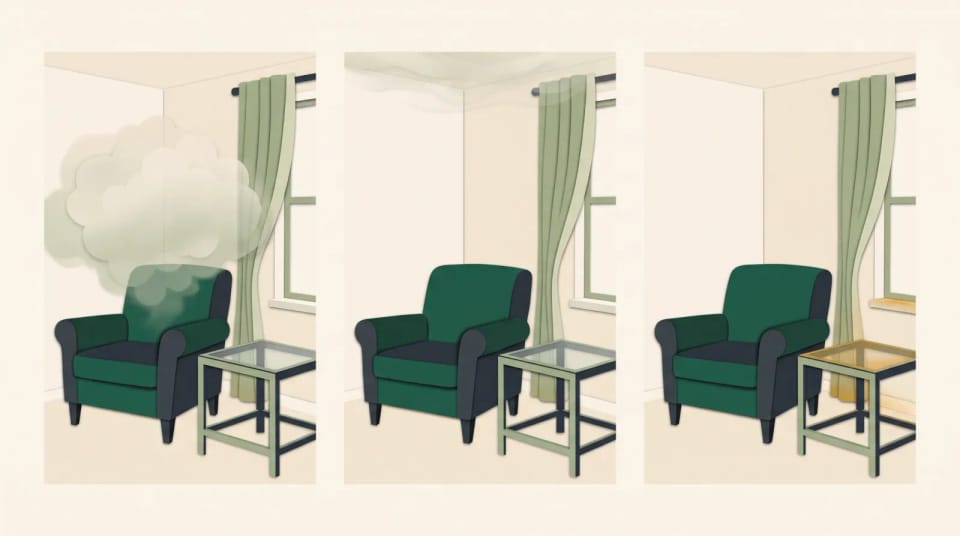
Air clears before surfaces do. Researchers have measured particles and surface residue over time, but no study has timed how long the smell lasts.
Does vapor leave a smell on walls and clothes?
It can leave residue, and residue is not proof of smell. In a controlled room with very fast ventilation, researchers used a flower vaporizer and then wiped hard surfaces. They found THC on 6 of 15 samples, even though the room’s air was replaced in under 2 minutes (Sempio and colleagues, 2019). They did not test for odor.
So the honest answer is that vapor is not “clean” of residue, and nobody has compared vape residue odor with smoke residue odor. For more on what builds up after smoke or vapor, read what stays on surfaces after smoke or vapor. If the smell is already in your home, car or clothes, our guide on how to remove cannabis smell from a room, car and clothes covers what works.
Do edibles smell?
Eating cannabis puts no smoke or vapor into the room, so the method itself adds almost nothing to the air. The product can still smell. Infused oils, butter and some gummies carry a plant aroma, and an open package releases it.
Packaging decides a lot. In one test, untrained volunteers identified flower in open or casual packaging with high accuracy, but they could not tell double vacuum-sealed packages apart from empty ones (Gilbert and DiVerdi, 2020). That study used flower, not edibles. No similar test of edibles was found. For people who choose a no-smoke route, cannabis capsules and pills and our comparison of flower, edibles or concentrates explain how onset and dosing differ. Edibles take longer to work, which is a separate trade-off from smell.
What changes the smell more than the method?
The method sets a baseline. Several other things can move the result just as much:
- The product’s aroma chemistry. The smell of cannabis comes from a small number of potent trace compounds. Only 29% of the chemicals in flower’s headspace registered any odor at all in one analysis, and the strongest smells did not come from the most abundant chemicals (Rice and Koziel, 2015). Our lesson on why every strain smells different goes deeper.
- Added terpenes and flavoring in carts. More aroma in the oil means more aroma in the exhale.
- Where you are. Outdoors cut particle exposure to under 5% of indoor levels in the Cheng study. Indoors, an open window made a large difference in the Ott study.
- Storage and packaging. Sealed containers keep flower aroma in before and after use.
- Distance and the building. Vape particles thin quickly with distance, but air also moves through shared walls and vents. See how odor travels between apartments.
Your own nose is the worst judge here. People adapt to smells they live with, which is why you may not notice what a visitor does. Read why you cannot smell weed on yourself for the reason.
None of this is a promise that a method will go unnoticed. Use cannabis only where it is legal and where your lease or household allows it.
When should you talk to a clinician?
Talk to a clinician if smoke or vapor at home is linked to coughing, wheezing, chest tightness or headaches for you or anyone you live with. This matters more for children, pregnant people and anyone with asthma or heart disease. Smell is a comfort question; breathing symptoms are a health question. Our article on secondhand cannabis smoke covers what the exposure research shows.
Key takeaways
- Edibles smell least, smoke smells most, and the vape methods form a close group between them.
- No study has measured odor strength or linger time by method. Minute-by-minute timers are guesses.
- Vape particles were denser at arm’s length than smoke in one home test, but they thinned much faster with distance.
- Vapor still leaves residue on surfaces, and added terpenes in carts add aroma.
- Outdoors and open windows changed particle levels more than any single device choice.
FAQ
Do dab pens smell on clothes?
They can, but nobody has measured it. Vapor from a flower vaporizer left THC residue on room surfaces in a controlled study, so exhaled aerosol does settle. Fabric was not tested, and residue is not the same as a smell you notice.
Does a bong smell less than a joint?
Not by any measurement found. A bong still burns flower and produces smoke, and no study found compares bong and joint odor. One difference is that a bowl can be put out between hits, while a lit joint keeps smoldering.
Can people smell a vape from another room?
Sometimes. In a home study, vape particles fell by 77% between 1 and 2 meters, so the plume is mostly local. Air still moves through doorways, vents and shared walls, and some carts carry strong added aromas.
How long does vape smell last in a room?
No study has timed it. In a closed test chamber, simulated vape particles were still 21% to 57% of their peak after one hour, but real rooms exchange air and the study did not measure smell. Ventilation and distance make the biggest measured difference.
Do distillate carts smell?
Yes, usually less than flower but not zero. Distillate is refined, but many carts add terpenes back for flavor, and those compounds leave with your exhale. A cart’s smell depends more on what is in the oil than on the hardware.
Sources
- Cheng KC, Ott W, Wallace L, Zhu Y, Hildemann L. “PM2.5 exposure close to marijuana smoking and vaping: A case study in residential indoor and outdoor settings.” Science of the Total Environment, 2022. doi:10.1016/j.scitotenv.2021.149897
- Ott WR, Wallace LA, Cheng KC, Hildemann LM. “Measuring PM2.5 concentrations from secondhand tobacco vs. marijuana smoke in 9 rooms of a detached 2-story house.” Science of the Total Environment, 2022. doi:10.1016/j.scitotenv.2022.158244
- Tang X, Cancelada L, Rapp VH, et al. “Emissions from Heated Terpenoids Present in Vaporizable Cannabis Concentrates.” Environmental Science & Technology, 2021. doi:10.1021/acs.est.1c00351
- Tang X, Rapp VH, Chen S, Russell ML, Destaillats H. “Secondhand Exposure to Simulated Cannabis Vaping Aerosols.” Environmental Science & Technology, 2025. doi:10.1021/acs.est.4c14328
- Sempio C, Lindley E, Klawitter J, et al. “Surface Detection of THC Attributable to Vaporizer Use in the Indoor Environment.” Scientific Reports, 2019. doi:10.1038/s41598-019-55151-5
- Rice S, Koziel JA. “Characterizing the Smell of Marijuana by Odor Impact of Volatile Compounds.” PLOS ONE, 2015. doi:10.1371/journal.pone.0144160
- Meehan-Atrash J, Luo W, McWhirter KJ, Strongin RM. “Aerosol Gas-Phase Components from Cannabis E-Cigarettes and Dabbing.” ACS Omega, 2019. doi:10.1021/acsomega.9b02301
- Gilbert AN, DiVerdi JA. “Human olfactory detection of packaged cannabis.” Science & Justice, 2020. doi:10.1016/j.scijus.2019.10.007
- Etter JF. “Electronic cigarettes and cannabis: an exploratory study.” European Addiction Research, 2015. doi:10.1159/000369791



