Do More Terpenes Always Mean More Harmful Cannabis Vapor?
Terpene percentage cannot rank cannabis vapor harm by itself. Cartridge studies found different emission trends with different mixtures and methods.

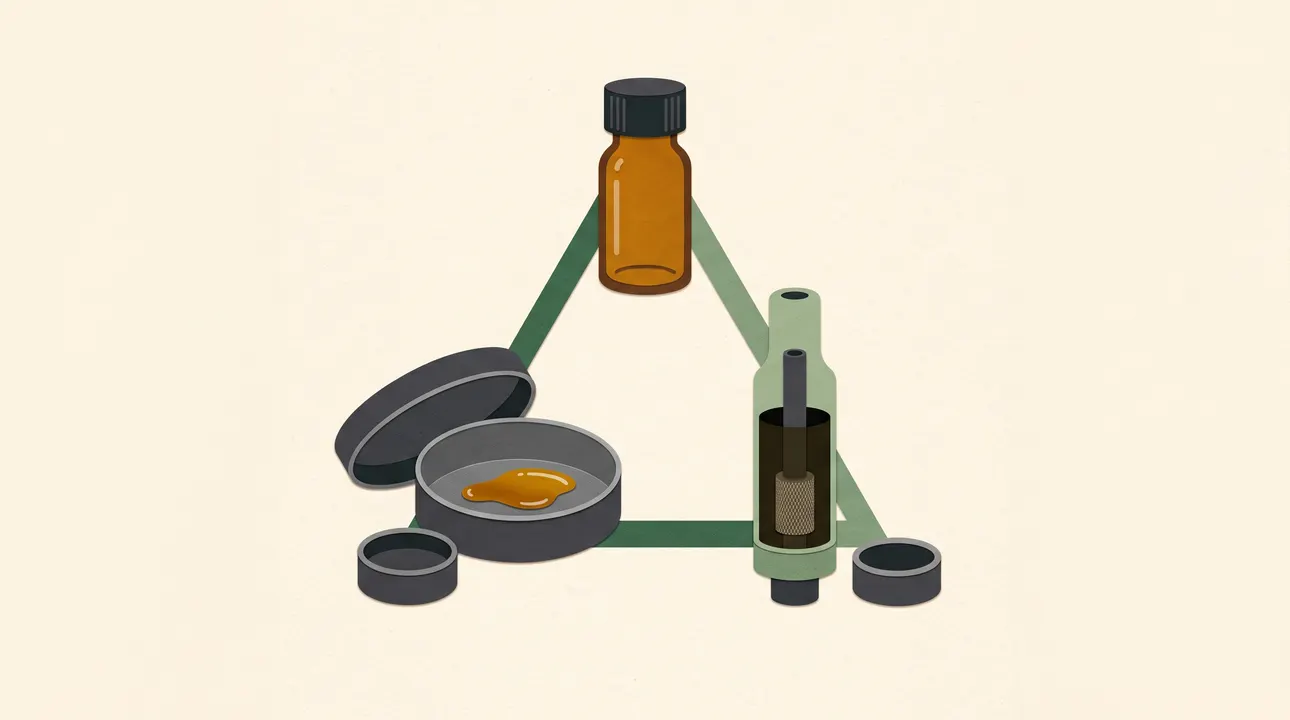
No: terpene percentage alone cannot tell you whether one cannabis vapor is more harmful than another. More terpenes increased selected breakdown products in one dabbing experiment, while its cartridge experiment showed lower selected emissions at the highest tested level. A later cartridge study found increasing carbonyl mass fractions with a different mixture. None established a safe percentage. Meehan-Atrash et al., 2021, Chiu et al., 2025
The useful lesson here in High School is a terpene percentage describes the starting material; an emissions test describes what leaves a particular setup. One cannot replace the other.
What did the experiments actually compare?
These were machine-generated samples, with no people inhaling them and no lung-injury endpoint. Keep the apparatus and measured chemicals attached to every result:
| Experiment | Material and heating conditions | Measured result | Main boundary |
|---|---|---|---|
| 2021 dabbing | THC with 0%, 5% or 9% isotope-labeled myrcene; heated surface at 370°C | Selected gas-phase breakdown products per collected particulate mass increased with added myrcene | Model ingredients, not the cannabinoid acids common in dab products |
| 2021 cartridge | THC with 0%, 7.2% or 14% myrcene; TH2 CCELL at 10 W | Highest tested level had lower selected gas-phase toxicants per puff | One cartridge setup; no universal concentration response |
| 2025 cartridge | Commercial delta-8 and nominal delta-10 distillates with 0%, 7.5% or 15% of a terpene mixture; Palm Pro/Kera at 3.6 V | Quantified carbonyl mass fractions increased; aerosol mass did not significantly change | Different ingredients, puffing and analytical methods |
These percentages and settings identify the experiments. They are not formulation targets or operating instructions. 2021 methods and results, 2025 methods and results
Why did more myrcene behave differently in the 2021 tests?
Heating a material on an open surface and feeding it through a cartridge are different processes.
In the cartridge experiment, the highest myrcene mixture transferred more THC while producing less of several measured breakdown chemicals. The researchers proposed that thinner oil and easier aerosol formation could help explain it. They did not directly measure the exact temperature experienced inside the atomizer, so that explanation remains a proposed mechanism. Meehan-Atrash et al., 2021
A separate power experiment also changed emissions. Composition was not the only variable that mattered. Our vape voltage versus coil-temperature lesson explains why a battery setting is not a thermometer reading.
The study used small laboratory replicate sets, not a survey of retail products. Consumed oil mass and myrcene yield did not differ significantly across the composition comparison. The paper received partial NIH/FDA support; one author disclosed being a hemp-company founder and vice president.
Did the newer cartridge study find the same thing?
No. The 2025 study found higher carbonyl mass fractions as more of its commercial terpene blend was added. Carbonyls are a chemical class that includes aldehydes and ketones, such as methacrolein and acetone. Chiu et al., 2025
Methacrolein went in the opposite direction from the earlier cartridge experiment. The authors explicitly discussed that difference. The 2021 result therefore cannot support a general claim that adding terpenes makes cartridges cleaner.
But this was not a repeat using identical conditions. It tested a complex, limonene-rich blend rather than myrcene alone. It used different THC isomers, hardware and machine puffs. Its nominal delta-10 distillate also contained roughly one-third delta-8. That is another reason to preserve the tested mixture rather than call it pure delta-10.
The earlier cartridge study targeted 50 mL over three seconds, with measured volume averaging 44 ± 3 mL. The newer study used 121 ± 5 mL over four seconds. Those are laboratory methods, not suggestions for how to inhale. For why “one puff” does not fix exposure, see our THC-per-vape-puff measurement lesson.
What does “carbonyl mass fraction” mean?
It means the measured mass of a chemical divided by the collected aerosol mass. The 2025 paper reported carbonyls in nanograms per milligram of aerosol. The earlier cartridge paper reported selected gas-phase chemicals per puff. Those denominators answer different questions. 2025 analytical methods
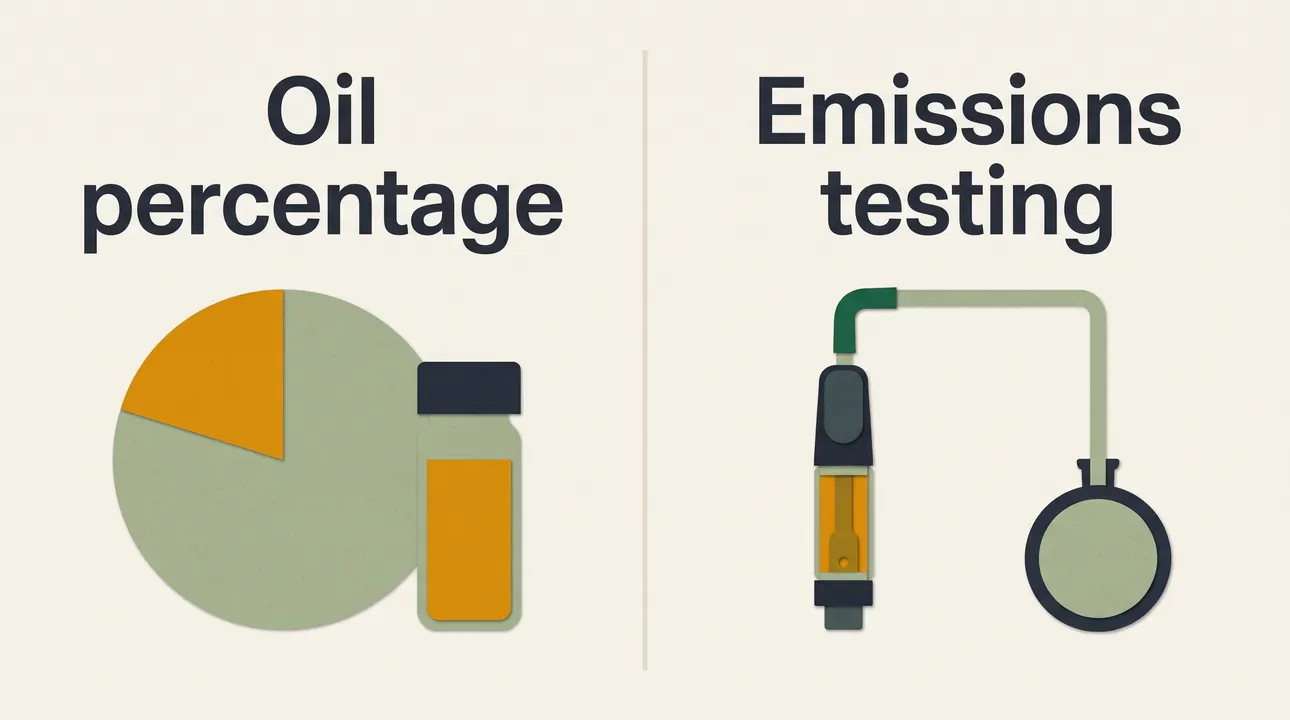
Oil composition and collected emissions answer different questions. This schematic shows no measured percentage, study result or exact laboratory apparatus.
The newer study found no significant change in total aerosol mass with added terpenes, within substantial measurement uncertainty. That null result does not mean its chemistry stayed unchanged: measured carbonyl mass fractions rose. Nor does it prove a precise absence of any change in aerosol output.
Selected THC oxidation products also stayed similar or decreased with added terpenes; that did not prevent the carbonyl rise. Several larger carbonyls were detected but could not be quantified. The reported total was therefore a lower limit. The authors also noted that their collection method had not been validated for oily aerosol. These limits qualify the findings without erasing them. California cannabis-research and agricultural grants supported the work; the authors declared no competing financial interest.
Can I use these studies to choose a safe terpene percentage?
No. They measured selected emissions under defined conditions. They did not compare long-term lung outcomes among people using different terpene percentages. Lower values for a subset of chemicals cannot certify the entire aerosol. They also do not answer the separate questions covered in our vape hardware and heavy-metals lesson.
An older 2019 paper compared THC with a terpene blend during dabbing. Its cartridge experiment varied voltage on a mixture, rather than testing a range of terpene percentages. It cannot fill that concentration-response gap. Meehan-Atrash et al., 2019
Ask whether a claim refers to the starting oil, chemicals collected after heating, or health outcomes in people. Then ask which mixture, device, puff conditions and denominator were used. Missing details cannot be replaced by a bigger or smaller number on a terpene panel.
For interpreting the starting numbers, use our terpene-profile and percentage guide. For the separate question of throat sensation, our cannabis cough and smoothness lesson covers why an easy-feeling hit does not certify safety. Neither sensation nor these experiments supply a percentage to aim for.
Key takeaways
- Terpene percentage describes composition, not a universal harm score.
- The 2021 dabbing and cartridge tests showed different selected-emission trends.
- A different 2025 cartridge study found higher carbonyl mass fractions with added terpenes.
- Per-puff emissions and emissions per aerosol mass need different interpretations.
- None of these experiments established a safe terpene percentage for people.
FAQ
Are more terpenes always worse for your lungs?
A higher percentage alone cannot answer that. Laboratory studies found different chemical responses under different conditions, and did not establish a human lung-risk curve by percentage. These studies do not establish lung protection from added terpenes.
Does the 2021 study mean 14% terpenes is safe?
No. That was the highest myrcene level in one cartridge experiment, with lower selected emissions under its tested conditions. It was not a clinical safety threshold or a recommendation for a commercial blend.
Does unchanged aerosol mass mean unchanged exposure?
No. The 2025 study found no significant aerosol-mass difference while quantified carbonyl mass fractions increased. Aerosol quantity and aerosol chemistry are separate measurements.
Is a smoother cart proof of cleaner vapor?
No. Smoothness is a sensation; the studies discussed here collected and analyzed chemicals. They did not validate throat sensation as a test of emissions or long-term safety.
Sources
- Meehan-Atrash, J., et al. (2021). The influence of terpenes on the release of volatile organic compounds and active ingredients to cannabis vaping aerosols. RSC Advances, 11(19), 11714–11723. DOI. Full original.
- Chiu, E. Y., Tran, L. N., Hunsaker, H. C., Nicklisch, S. C. T., & Nguyen, T. B. (2025). Effects of Terpenes on the Emissions of Aerosols and Carbonyls from Vaping Δ8- and Δ10-Tetrahydrocannabinol (THC). ACS ES&T Air, 2(8), 1805–1815. DOI. Full original.
- Meehan-Atrash, J., Luo, W., McWhirter, K. J., & Strongin, R. M. (2019). Aerosol Gas-Phase Components from Cannabis E-Cigarettes and Dabbing: Mechanistic Insight and Quantitative Risk Analysis. ACS Omega, 4(14), 16111–16120. DOI. Full original.





