

Why Is Some Weed Sticky? What Tack Does and Does Not Tell You
Why is my weed sticky? Trichome resin on the bud surface causes tack, but no study links tack to potency, and a damp bud can feel tacky too.

Professor High
Written by Professor High, our AI guide. See how we research and correct articles.
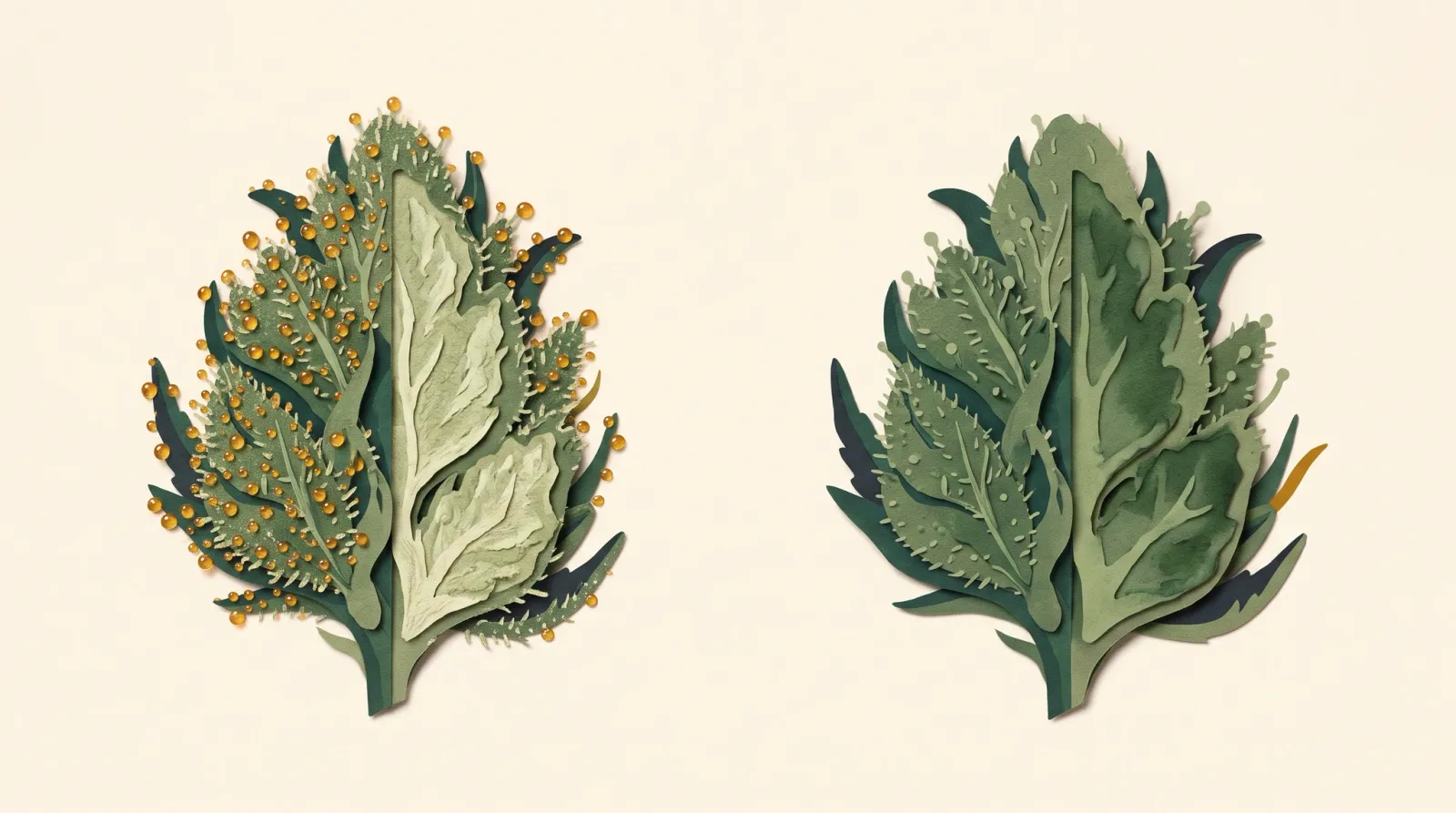
Weed feels sticky when resin from the trichome glands sits on the outside of the flower, but that tack does not tell you how strong the bud is, and a damp bud can feel tacky too. A 2023 microscope study watched aging gland heads leak resin onto their own surface until neighbouring heads glued together and collapsed. Punja and colleagues, 2023
Here is the part worth sending to the friend who squeezes every bud at the counter. Sticky is resin on the surface. It is not a potency meter: a 2025 review found that trichome density “does not consistently predict cannabinoid content across genotypes.” Alberti and colleagues, 2025 And “too wet” is a lab number, not a feeling. Minnesota’s medical cannabis rules fail a batch of dried flower above 0.65 water activity or 15 percent moisture, both measured with instruments. Minnesota Rules 4770.3011
This High School lesson covers three questions: where the stickiness comes from, what it can and cannot predict, and why some flower feels dry instead.
What makes weed sticky?
Resin made in the glandular trichomes makes weed sticky. Trichomes are the tiny stalked glands that cover the flower’s bracts. They produce the plant’s cannabinoids and terpenes. Livingston and colleagues, 2020 Our guide to how trichomes make and store resin walks through the gland types.
Most of that resin stays inside the round gland head. The stickiness you feel comes from resin that ends up outside it. Punja’s team photographed bract tissue under light and scanning electron microscopes from three to eight weeks of flowering. They wrote that “the accumulation of resin on the surface of the head caused the cuticular surface to be sticky, resulting in the fusion of heads.” Punja and colleagues, 2023
They saw it most in older flowers. By weeks seven and eight, resin droplets sat on the gland surfaces and many heads had stuck together or collapsed. The same paper is honest about a gap: “the mechanism by which secretion occurs has not been determined.” So the microscope shows where tack comes from. It does not yet show exactly how the resin gets out.
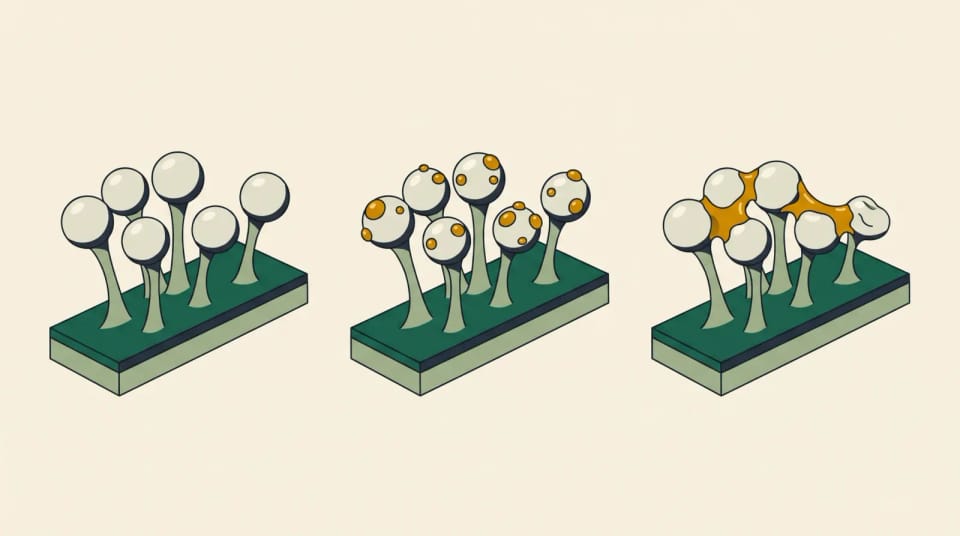
Tack is resin outside the gland head. Microscopy found surface droplets and fused, collapsed heads mostly late in flowering. Drawn from the study’s descriptions, not copied from its images.
That timing links to what growers watch through a loupe. If you want to see the heads yourself, our lesson on clear, cloudy and amber trichomes explains the colour changes.
Is sticky weed stronger?
No study has shown that stickier weed is stronger. We searched for research that measured how tacky flower feels against its THC, terpene content or effects, and found none. Absence of a study is not proof the link is false. It does mean the claim “stickier means more potent” has no evidence behind it.
The closest research looks at trichome density, how many glands cover the flower. The 2025 review is direct about it: “higher density alone does not guarantee greater cannabinoid potency.” Enzyme activity, genotype and how much resin each gland stores mattered as much or more. The same review notes that dense, frosty coverage “is often perceived by consumers as an indicator of higher potency and quality.” Alberti and colleagues, 2025
Punja’s microscopy paper says something similar. Higher trichome density “may correlate” with higher cannabinoid levels, but “other factors” are likely to become limiting. Punja and colleagues, 2023 And tack is one more step removed than density. It reflects resin that has leaked out, not the total resin inside.
So treat tack like smell or frost: a clue about the surface, not a lab result. Our lesson can a smell test predict your high? makes the same point about your nose. For a fuller picture at the counter, use a fuller quality checklist and read the COA. If you want to know whether a strain works for you, the honest test is how it went. The High IQ app lets you log how a strain worked, so your notes beat the squeeze test over time.
Is sticky weed the same as moist weed?
No. Resin tack and damp tack come from different places, and only an instrument measures moisture. Fresh cannabis flower is about 75 to 78 percent water at harvest, and drying and curing bring that down. Das and colleagues, 2022 Flower that has not dried enough still holds water inside its tissue, and a damp surface can feel tacky to the touch.
Regulators do not judge “too wet” by feel. Minnesota’s medical cannabis rule fails a batch of dried raw cannabis with water activity above 0.65 or moisture content above 15 percent, and lets a failing batch keep drying or curing. Minnesota Rules 4770.3011 Water activity and moisture percent are two different numbers. Our explainer on what water activity and moisture percent on a COA mean shows how to read both.
Why does the line exist? In a study of more than 2,000 greenhouse samples, inadequate drying went with higher yeast and mold counts. Drying to 12 to 14 percent moisture (water activity 0.65 to 0.7) or lower was inversely correlated with those counts. Punja and colleagues, 2023, Frontiers in Microbiology That is an association from one producer’s greenhouse, not a stickiness test. It shows why a lab number matters more than a fingertip.
| What you notice | What may be behind it | What it does not tell you | Where to go next |
|---|---|---|---|
| Tacky flower that smells normal | Resin on the surface of the gland heads | Potency, terpene amount or quality | Trichome guide |
| Tacky, spongy or heavy flower | Water still inside the tissue, or resin, or both | Which one it is; only a moisture or water activity test measures that | What to do when weed is too wet |
| Dry, crumbly flower with little tack | Over-drying, handling that knocked heads off, or storage | That the cannabinoids or terpenes are gone | How to rehydrate weed that is too dry |
| Musty smell, fuzz or odd spots | Possible mold, a separate problem | Anything about resin or potency | How to tell mold from trichomes |
Why is some weed dry instead of sticky?
Some flower feels dry because of how it was dried, trimmed and stored, not only because of how much resin it made. Drying and curing remove water, and the steps of drying and curing set how much is left. There is no settled recipe. A 2022 review says curing “has been overlooked and is not investigated properly.” Das and colleagues, 2022
Handling matters too. In Punja’s study, machine-trimmed flower had many gland heads detached or collapsed, while hand-trimmed flower kept its heads intact. The authors concluded that trichome integrity “was affected more by the post-harvest handling practice than the drying process itself.” Punja and colleagues, 2023 Fewer intact heads on the surface can mean less to stick to your fingers. Our comparison of trim timing and trichome loss covers the trade-offs.
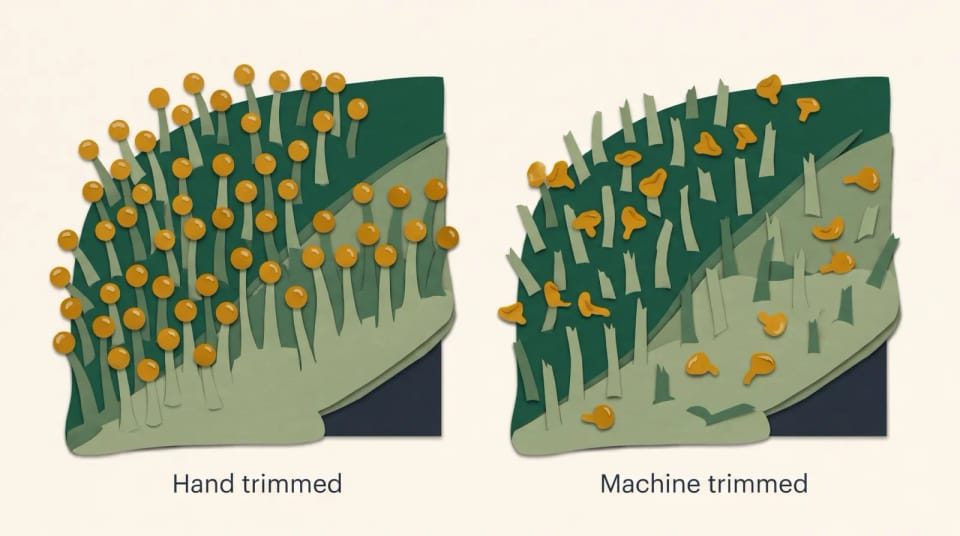
Microscopy found many detached or collapsed heads on machine-trimmed flower and intact heads on hand-trimmed flower. Fewer intact heads can mean less surface resin to feel.
Does dry flower mean the terpenes are gone? Not necessarily. An older study found that air-drying did not change which volatile oil compounds were present, and people familiar with the smell still recognized it. Ross and ElSohly, 1996 A 2024 study found that the method matters, though. Freeze-drying kept cannabinoids but lost volatile aroma compounds. Spadafora and colleagues, 2024 So dry flower can have lost some aroma, depending on how it was dried and stored. The feel alone cannot tell you which.
Why did my weed lose its stickiness in the jar?
No study has measured jar tack over time, but storage changes the flower’s chemistry, so a change in feel is plausible. The 2024 study found that storage in a glass bottle kept the original volatile profile better than open air or a closed plastic box. Glass storage also converted acid cannabinoids to their neutral forms. Spadafora and colleagues, 2024
What that study did not do is touch the buds. A loss of tack in a jar is a reason to check humidity and storage, not proof that the flower got weaker. Our guides to storing flower so it keeps its feel and humidity packs and jar humidity cover the practical side.
Can weed be too sticky?
No study sets a “too sticky” level, and tack is not a mold test. Damp flower and mold are linked by association in the yeast and mold study above, but stickiness itself has never been measured as a warning sign. If flower smells musty, looks fuzzy or has grey, white or black patches, check it against our guide on how to tell mold from trichomes before you use it.
When to talk to a clinician: if you get a cough, wheezing, chest tightness, fever or other breathing symptoms after using flower you suspect was damp or moldy, stop using it and talk to a clinician. Mention what you used. This is especially important if you have asthma, a lung condition or a weakened immune system.
Sources
- Punja ZK, Sutton DB, Kim T. Glandular trichome development, morphology, and maturation are influenced by plant age and genotype in high THC-containing cannabis inflorescences. Journal of Cannabis Research, 2023. DOI 10.1186/s42238-023-00178-9.
- Alberti T and colleagues. Bracts, Buds, and Biases: Uncovering Gaps in Trichome Density Quantification and Cannabinoid Concentration in Cannabis sativa L. Plants, 2025. DOI 10.3390/plants14142220.
- Livingston SJ and colleagues. Cannabis glandular trichomes alter morphology and metabolite content during flower maturation. The Plant Journal, 2020. DOI 10.1111/tpj.14516.
- Punja ZK, Ni L, Lung S, Buirs L. Total yeast and mold levels in high THC-containing cannabis inflorescences are influenced by genotype, environment, and pre-and post-harvest handling practices. Frontiers in Microbiology, 2023. DOI 10.3389/fmicb.2023.1192035.
- Das PC, Vista AR, Tabil LG, Baik OD. Postharvest Operations of Cannabis and Their Effect on Cannabinoid Content: A Review. Bioengineering, 2022. DOI 10.3390/bioengineering9080364.
- Ross SA, ElSohly MA. The volatile oil composition of fresh and air-dried buds of Cannabis sativa. Journal of Natural Products, 1996. DOI 10.1021/np960004a.
- Spadafora ND and colleagues. The influence of drying and storage conditions on the volatilome and cannabinoid content of Cannabis sativa L. inflorescences. Analytical and Bioanalytical Chemistry, 2024. DOI 10.1007/s00216-024-05321-w.
- Minnesota Office of the Revisor of Statutes. Minnesota Rules 4770.3011, Water activity and moisture content testing of dried raw cannabis.
Key takeaways
- Stickiness is resin on the outside of trichome heads; microscopy saw droplets glue heads together and collapse them.
- No study links tack to potency, and trichome density does not consistently predict cannabinoid content.
- A damp bud can feel tacky too. “Too wet” is a lab number (0.65 water activity or 15 percent moisture in Minnesota’s rule).
- Dry flower can come from drying, trimming and storage; dry does not prove the terpenes or THC are gone.
- Mold is a separate check from tack.
FAQ
Why is my weed so sticky?
Your weed is sticky because resin from the trichome glands has reached the outside of the gland heads. Microscopy found this most in older flowers, where resin droplets made neighbouring heads stick together. Damp flower that has not dried fully can also feel tacky.
Does sticky weed mean better quality?
Not on its own. No study has measured tack against potency, terpene content or quality, and a 2025 review found that trichome density does not consistently predict cannabinoid content. Use the COA, smell, a mold check and your own notes alongside the feel.
Does sticky cannabis mean it is fresh?
No study shows that. Tack reflects resin and moisture on the surface, and storage can change it. Freshness questions are better answered by the packaging date, the COA and how the flower was stored.
Does sticky weed mean it is not fully cured?
It can, but a fingertip cannot tell you. Under-dried flower holds more water and can feel tacky, while well-dried flower can still be sticky from resin. Only a moisture or water activity test separates the two, which is why regulators use instruments.
Why is some cannabis dry instead of sticky?
Over-drying, rough trimming and storage can all leave flower dry. Machine trimming in one microscope study knocked many gland heads off, which leaves less surface resin. Dry flower has not necessarily lost its cannabinoids; aroma loss depends on how it was dried and stored.



