

Do Charcoal Joint Filters Remove THC? What Was Measured
Charcoal joint filters left THC and harmful compounds in a machine test. See what one hybrid filter changed, and why smoke results cannot predict risk.

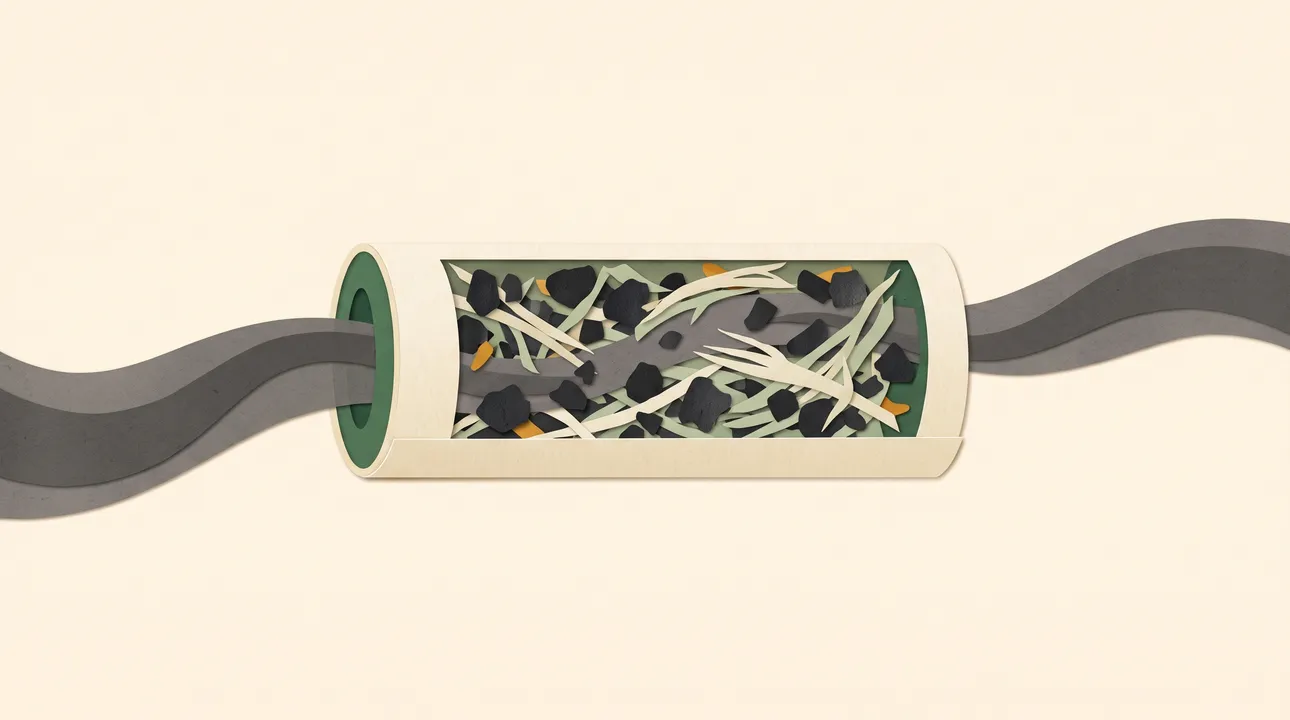
In one machine test, THC remained after a charcoal-and-cellulose joint filter, while some toxicant concentrations were lower. The result challenges both “filters catch all the THC” and “all harmful compounds are filtered out.” It measured smoke chemistry, not someone’s high or lung health, and cannot supply a universal removal percentage.
What did the cannabis joint-filter test actually measure?
It compared a combined cellulose/activated-carbon filter with a cardboard-tip control using dried cannabis flower without tobacco. The filter was Hybrid Supreme, 30 mm long and 6.4 mm wide. That identifies the tested product; it is not a recommendation or a result for every charcoal tip.
| Part of the experiment | What it means for the answer |
|---|---|
| Medium: one combined cellulose/activated-carbon filter versus a cardboard tip | A plain cotton filter, pure-carbon tip or other design was not this comparison |
| Route: machine-generated smoke from cannabis-only joints | Results do not cover tobacco-containing spliffs, edibles or vaping |
| Endpoint: compounds collected in smoke, reported per gram of cannabis | These are emissions, not THC absorbed into a person’s blood |
| Main limit: one flower source, one filter and laboratory puffing | No personal high, overall health benefit or all-filter efficiency was measured |
The original Sambiagio and colleagues’ final report is dated June 23, 2023. The Swiss Federal Office of Public Health funded it. It is an experimental report, rather than a peer-reviewed journal article.
For the tobacco distinction, see joints, blunts and spliffs. The machine drew 55 mL puffs for two seconds, every 30 seconds, until a 28 mm butt remained. Different people do not all smoke that way. The broader distinction between flower inventory and delivered THC is explained in how much THC is in a joint.
Did the filter stop THC from passing through?
No. Table 11 of the report measured delta-9 THC in smoke collected after both setups:
| Setup | Delta-9 THC in collected smoke |
|---|---|
| Cardboard-tip control | 54.6 ± 5.68 mg per gram of cannabis |
| Tested combined filter | 44.3 ± 7.2 mg per gram of cannabis |
The figures are means ± standard deviations, which describe variation around each mean. They are not confidence intervals or absorbed doses. The filtered mean was lower, and substantial THC remained in the collected smoke. Neither number predicts how much someone would absorb or how strong their high would feel. Original report, p.47.
There is a source problem to keep visible: the report’s prose describes cannabinoid delivery as similar, while its THC-delivery efficiency percentages disagree across sections. That makes a tidy “this filter preserves exactly X%” claim unreliable. “Similar” also does not establish identical delivery or a statistically demonstrated absence of a difference.
A lower collected-smoke mean is not a measurement of THC caught inside the filter. Puffing, burning, collection and analysis all sit between the flower and the reported result. This is why counting vape puffs also fails to provide a dependable THC dose.
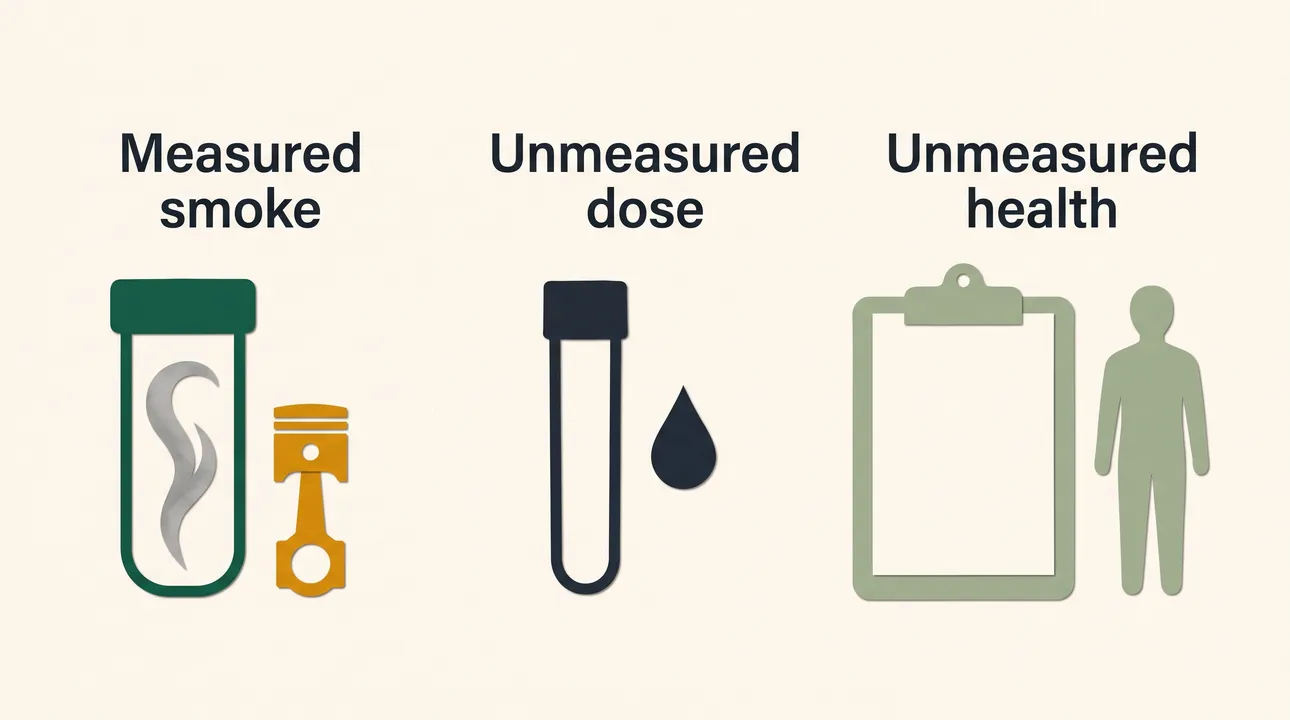
Conceptual evidence map: the experiment collected smoke. It did not measure blood THC or health outcomes.
Which harmful compounds were lower—and which were not?
The result depended on the compound. For example, Table 17 reported formaldehyde at 252 ± 112 versus 127 ± 28.2 micrograms per gram of cannabis, and acetaldehyde at 3,077 ± 392 versus 1,056 ± 212. The first number in each pair is the cardboard-tip control; the second is the tested filter. Both use mean ± standard deviation. Lower concentrations still left these compounds measurable. Original report, p.58.
The chemical exceptions matter just as much:
- Many volatile organic compounds and phenols were lower, but p-cresol and glycidol had higher measured concentrations in filtered samples.
- Measured polycyclic aromatic hydrocarbons, or PAHs, were lower, with harmful compounds still present. Poor recovery of some compounds and later analysis of frozen samples limited interpretation.
- Aromatic amine concentrations did not decrease. Those analyses also had timing and analytical limitations.
- Metals were not compared in filtered smoke, because control-smoke concentrations were below the method’s quantification limits. That does not show that the filter removed metals.
The report notes that some filtered and control samples were generated and analyzed at different times. Instrument variation and sample handling may help explain the exceptions; a higher value does not establish that the filter created a compound. These limits prevent both “everything decreases” and a simple ranking of health protection. Original report, pp.65, 76, 80 and 115.
“Below quantification” means the method could not report a reliable amount under its limit. It does not mean a compound was proven absent. The study also did not measure ammonia or hydrogen cyanide, and acrylonitrile could not be measured because calibration failed.
Does lower smoke chemistry mean smoking becomes safe?
No. An emissions experiment cannot give a percentage reduction in a person’s disease risk. It did not measure symptoms, lung function, blood exposure or long-term outcomes. It also did not measure whether people changed their puffing when using the filter.
The CDC’s lung-health guidance states that smoked cannabis can harm lung tissue, regardless of how it is smoked. Specific lung-cancer and other respiratory-disease effects still need more research. A filter result does not resolve those uncertainties.
Keep the same measurement boundary in other gear debates. Hot versus cold bong water separates cooling from cleaning. Vaping versus smoking cannabis compares different ways of producing an inhaled aerosol. Neither a smoother sensation nor a different device supplies a personal risk percentage.
Key takeaways
- One tested combined filter left THC in collected smoke; its result is not a rule for every tip.
- Some measured toxicants were lower, with exceptions and important analysis limits.
- Emitted amounts, absorbed THC and health outcomes are different questions.
FAQ
Does a charcoal filter remove all the THC from a joint?
The tested charcoal-and-cellulose filter did not. Delta-9 THC remained measurable in the collected smoke. This experiment cannot predict the THC delivery of every filter or a particular person’s high.
Is a cardboard tip the same as the tested filter?
No. The study’s control used a cardboard tip, while the experimental filter combined cellulose and activated carbon. A result for that combination cannot automatically describe cotton-only or pure-carbon filters.
Can I calculate how much healthier a filtered joint is?
No percentage of health improvement follows from this study. It measured selected emissions, with several exceptions and compounds it could not quantify or did not test. It did not measure disease risk in people.
Did this study show that filters remove terpenes?
No. The report did not analyze terpenes. It cannot settle how much aroma was removed, how flavor changed or whether the filter changed the subjective high.
Sources
- Sambiagio, N.; Aires Guerra Iria, D.; Auer, R.; Schöni, A.; Berthet, A. Toxicological assessment of aerosols emitted by cannabis inhalation methods: Does cannabis vaping using Electronic Non-Nicotine Delivery Systems (ENNDS) and vaporizers reduce exposure to toxicants compared to cannabis smoking? Final report, June 23, 2023. Funded by the Swiss Federal Office of Public Health. Original report.
- Centers for Disease Control and Prevention. Cannabis and Lung Health. Official guidance, February 15, 2024. Original page.





