Does Weed Make You Sweat? Anxiety, Heat and Withdrawal Explained
Does weed make you sweat? Not through a proven sweat switch. Sweat while high tracks anxiety, a racing heart or heat; after quitting, it is a withdrawal sign.

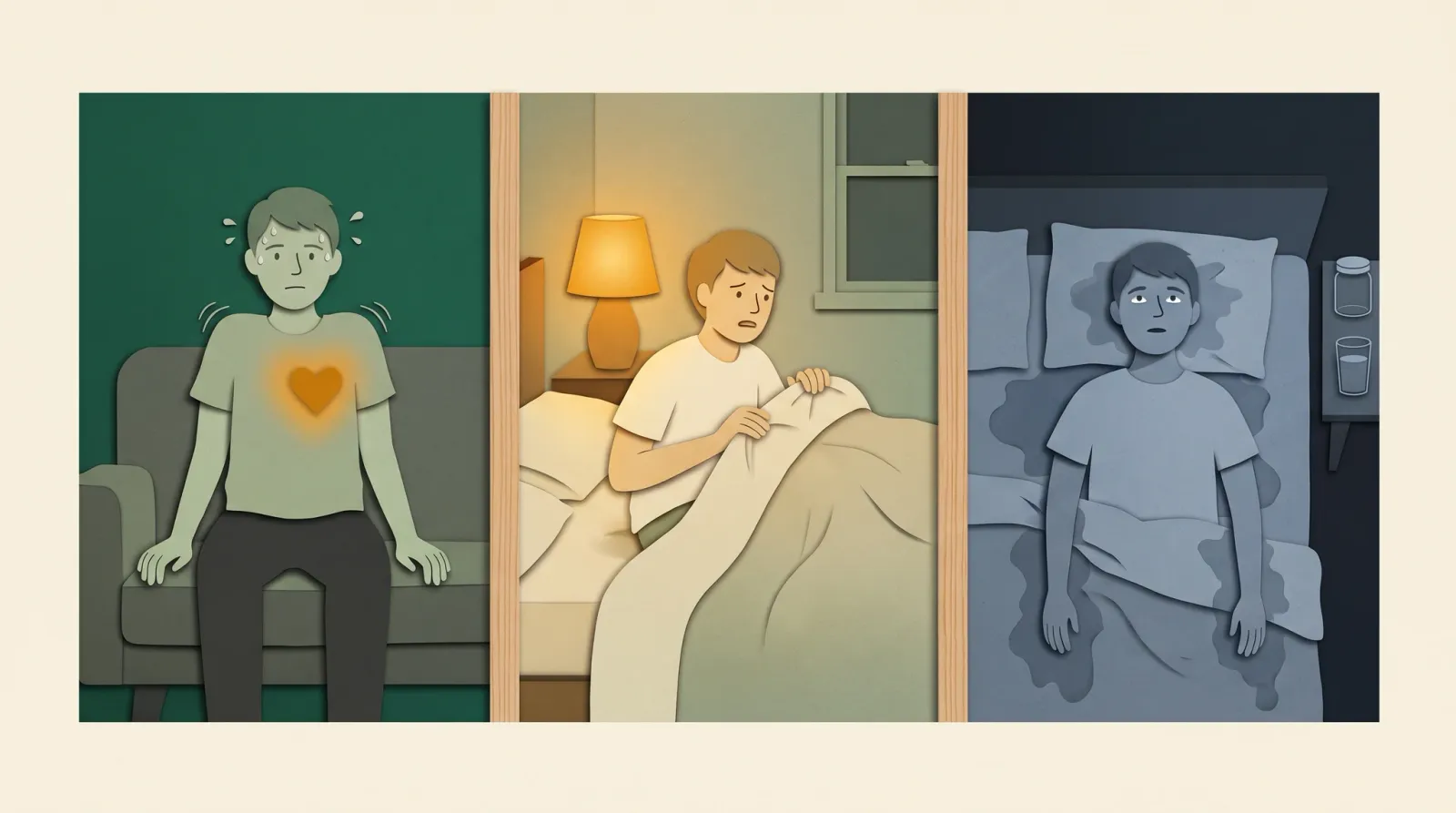
Weed has no proven direct “sweat switch” in people: sweating while high usually rides along with a faster heart rate, anxiety or a warm room, and sweating after you stop is a recognized but less common withdrawal symptom. That makes “weed makes me sweat” three different situations, each with its own cause. Soaking night sweats that keep coming back deserve a clinician, whether or not you use cannabis.
Here is the part that surprises people. Sweating sits on the official DSM-5 list of cannabis withdrawal symptoms. Connor et al., 2022 Yet the only lab study we found that measured sweat directly after cannabinoids found less sweat, not more, and that was in mice. Murataeva et al., 2026 So the popular story, that THC flips your brain’s thermostat and makes you drip, is not backed by direct sweat data.
This High School lesson splits the question the way your body does: sweat while high, sweat the same night, and sweat after quitting.
Does weed make you sweat, or stop you sweating?
Neither, in any simple way that has been shown in people. The direct evidence runs in an unexpected direction.
In a 2026 study, researchers measured skin conductance, a standard stand-in for sweating, on the paws of awake mice. A drug that activates the CB1 cannabinoid receptor lowered sweating in both males and females. THC lowered it too, while CBD did nothing. The team also found CB1 receptors on nerve fibers right next to the paw sweat glands. Murataeva et al., 2026
Read that result with care:
- It is a mouse result, from paw glands, after large injected doses.
- People rely on sweating for cooling far more than mice do.
- The study measured resting sweat, with no heat, exercise or anxiety.
- The authors themselves say it “remains to be determined” whether this translates to humans.
A few tiny clinical reports point the same way. One patient with severe, treatment-resistant hyperhidrosis reported a large drop in sweat on cannabinoids. Kaemmerer et al., 2023 Small case series described cancer patients whose night sweats eased on the prescription cannabinoids dronabinol and nabilone. Carr et al., 2019; Maida, 2008 These are one, five and four people, with no comparison group. They are not evidence of a sweating remedy. What they suggest is that “THC makes you sweat” is too simple.
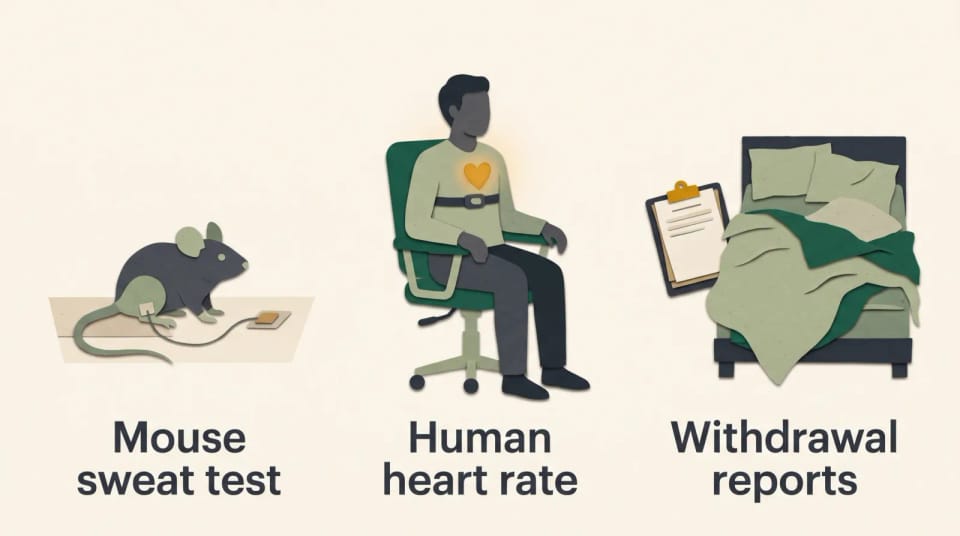
Three kinds of evidence, three different questions. The only direct sweat measurement was in mice and showed less sweat; human lab studies measured heart rate and anxiety, not sweat.
Does smoking weed make you sweat more while you are high?
It can feel that way, and the likely reason is your heart and your nerves, not a direct effect on sweat glands.
In a double-blind lab study of 37 healthy women who used cannabis occasionally, oral THC (7.5 mg or 15 mg) raised heart rate in a dose-dependent way. It also lowered the calming, parasympathetic side of heart control and raised ratings of anxiety. Pabon et al., 2021 Blood pressure and the study’s measure of the “fight or flight” heart signal did not change much at those doses. The researchers did not measure sweat.
A faster heart and a jolt of anxiety are classic companions of sweating. Federal health guidance lists a pounding heart, sweating, chills and trembling together as signs of a panic attack. NIMH So if a strong edible or a big hit leaves you clammy and on edge, anxiety is a reasonable suspect. If that is your pattern, our lessons on cannabis paranoia and on finding your footing with cannabis and anxiety go deeper. Curious what your own heart does? See what heart rate and HRV data show after THC.
Two other things to rule out:
- Too much, too fast. Pale, clammy, sweaty skin with nausea is a hallmark of greening out, which is a different event from everyday sweat.
- Heat and other drugs. In a lab study of 16 volunteers, THC raised heart rate without raising stress hormones. Combined with MDMA, it delayed and prolonged the rise in body temperature. Dumont et al., 2009 Mixing substances in a hot, crowded room stacks the odds.
What about the claim that THC “directly hijacks” your body temperature? An older human study had men smoke cannabis before sitting in cold water or cold air. Core temperature did not change, though heat production and heart rate rose. Hanna et al., 1976 That was a cold test, not a sweat test, and only 10 people. It still gives no support to the “thermostat reset” story. Shivering is its own topic, covered in why weed gives you the shakes.
Why do I wake up sweaty after smoking weed?
Start with the boring explanation: the room. The NHS notes that it is normal to sweat at night if your bedroom or bedding is too hot. NHS Couch-lock under a heavy blanket, a late snack and a closed window can do the job without any help from THC.
Next, check what else went in that evening. The same NHS page lists alcohol or drug use, anxiety, medicines and low blood sugar among the causes of night sweats. A drink alongside a joint is common, and alcohol is a well-known sweat trigger on its own. Our lesson on mixing cannabis and alcohol covers that combination.
No study we found measured night sweats on the same night as cannabis use. That is a gap in the evidence, not proof that a link exists or does not exist. If you want to see your own pattern, note the room, the dose and anything else you took. The High IQ app lets you log how a session went, which makes repeats easier to spot.
For sleep more broadly, see what research shows about cannabis and sleep.
Can quitting weed cause night sweats?
Yes, it can. Sweating is part of cannabis withdrawal, but it is not one of the main symptoms.
The DSM-5 criteria for cannabis withdrawal include at least one physical symptom from a short list: stomach pain, shakiness, sweating, fever, chills or headache. ICD-11 lists “sweating or chills.” A 2022 clinical review calls sweating one of the “less common physical symptoms.” It says the early phase brings insomnia, irritability, low appetite and shakiness, and “less often, sweating and chills.” Connor et al., 2022
Other studies agree on the ranking:
- In 36 people treated for cannabis dependence, sweating, hot flashes, chills and shakiness were higher during abstinence than at follow-up. Arendt et al., 2008
- Among frequent users in a large U.S. survey, the most common withdrawal symptoms were nervousness or anxiety, hostility, sleep trouble and low mood. Livne et al., 2019
- Two careful outpatient studies of heavy users tracked withdrawal day by day. Sweating did not make either list of reliable symptoms. Budney et al., 2003; Budney et al., 2001
How long does it last? Withdrawal symptoms typically start 24 to 48 hours after stopping and mostly peak between days 2 and 6. Some last two to three weeks or longer in heavy users. Connor et al., 2022 Studies in inpatient detox and closed research units found a similar early peak. Bonnet et al., 2014; Lee et al., 2014 No source gives a separate timeline for sweating, so treat any “sweats peak at one week” claim with suspicion.
How common is withdrawal overall? A meta-analysis of 47 studies estimated it in about 47% of people with regular or dependent use, with huge variation between groups. Bahji et al., 2020 That number is for the whole syndrome. It is not the share of people who sweat.
The review describes care for sweating and chills as supportive. Connor et al., 2022 For the full picture of what to expect, read cannabis withdrawal is real and milder than you think, and for the bigger dependence question, is cannabis addictive?
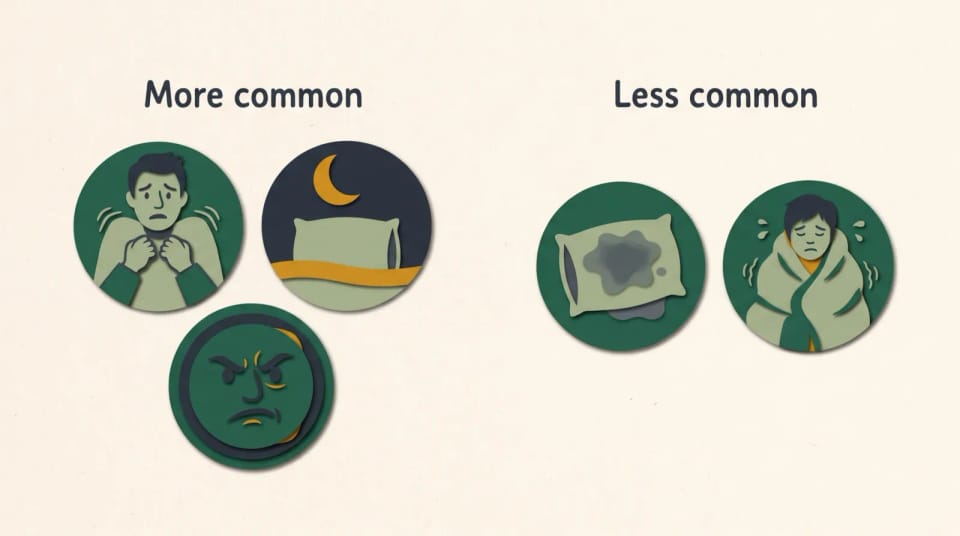
Clinical reviews and surveys list anxiety, irritability and sleep trouble as the main withdrawal symptoms and sweating as less common. The picture shows categories, not how many people have each symptom.
Which kind of weed sweat do you have?
Use the timing to sort it. This table summarizes what the sources above support.
| Situation | Most likely drivers | What the evidence says |
|---|---|---|
| Sweaty while high | Faster heart rate, anxiety, too high a dose, a hot room, other drugs | THC raises heart rate and anxiety in lab studies; no human study we found measured sweat directly |
| Waking up sweaty the same night | Hot room or bedding, alcohol, other drugs, medicines | NHS lists these as common night-sweat causes; no same-night cannabis study found |
| Night sweats after quitting | Cannabis withdrawal | Official DSM-5 symptom, but less common than anxiety, irritability and sleep trouble; usually early and temporary |
If the sweating is part of an episode where you feel too high, our guide on how to sober up from being too high covers the practical basics. For the receptor background behind all of this, see the endocannabinoid system guide.
When should sweating send you to a clinician?
Cannabis is not a diagnosis, and it does not rule anything else out. The NHS advises seeing a GP if night sweats:
- happen regularly and wake you up, or worry you
- come with a very high temperature, a cough or diarrhea
- come with weight loss you cannot explain
Get urgent help if sweating comes with chest pain, fainting, trouble breathing or confusion. If anxiety attacks with a pounding heart keep happening, with or without cannabis, a clinician can help sort out what is going on.
Key takeaways
- No study we found shows THC directly makes people sweat. The one direct sweat study, in mice, found less sweat.
- Sweat while high most plausibly tracks a faster heart rate and anxiety, both of which THC raises in lab studies.
- Waking up sweaty is often the room, the bedding or alcohol.
- Sweating is an official but less common withdrawal symptom, usually in the early days after stopping.
- Regular, soaking night sweats need a clinician, whatever you use.
FAQ
Does weed make you sweat in your sleep?
Not in any way a study has shown on the same night. A warm room, heavy bedding or alcohol are more common culprits, according to NHS guidance. Night sweats that start after you stop using can be part of withdrawal.
Can weed cause hyperhidrosis?
No source we found shows that cannabis causes hyperhidrosis. Hyperhidrosis is its own medical condition with many causes. A single case report even described less sweating on cannabinoids, but one patient proves nothing either way, and it is not a reason to self-treat.
How long do weed withdrawal sweats last?
No source gives sweating its own timeline. Withdrawal symptoms in general start 24 to 48 hours after stopping, mostly peak between days 2 and 6, and settle within a few weeks for most people. Sweats that persist well beyond that deserve a medical check.
Is sweating after smoking weed a bad sign?
Usually not on its own, especially if you feel anxious, overheated or too high and it passes as the high fades. It is a warning sign if it comes with chest pain, fainting, trouble breathing or confusion, so get urgent help then. Repeated soaking night sweats also need a clinician.
Sources
- Murataeva N, Youkilis J, Rao Y, Straiker A. (2026). Don’t sweat it: cannabinoid CB1 receptors reduce sweating in a mouse model. The FASEB Journal, 40(12), e72051. PMC
- Connor JP, Stjepanovic D, Budney AJ, Le Foll B, Hall WD. (2022). Clinical management of cannabis withdrawal. Addiction, 117(7), 2075-2095. PMC
- Pabon E, Rockwood F, Norman GJ, de Wit H. (2022). Acute effects of oral delta-9-tetrahydrocannabinol (THC) on autonomic cardiac activity and their relation to subjective and anxiogenic effects. Psychophysiology, 59(2), e13955. PMC
- Kaemmerer T, Clanner-Engelshofen BM, Lesmeister T, French LE. (2023). Cannabinoids in hyperhidrosis. Journal of Dermatological Treatment, 34(1), 2127308. PubMed
- Carr C, Vertelney H, Fronk J. (2019). Dronabinol for the treatment of paraneoplastic night sweats in cancer patients: a report of five cases. Journal of Palliative Medicine, 22(10), 1221-1223. PubMed
- Maida V. (2008). Nabilone for the treatment of paraneoplastic night sweats: a report of four cases. Journal of Palliative Medicine. PubMed
- Bahji A, Stephenson C, Tyo R, et al. (2020). Prevalence of cannabis withdrawal symptoms among people with regular or dependent use of cannabinoids: a systematic review and meta-analysis. JAMA Network Open, 3(4), e202370. PubMed
- Livne O, Shmulewitz D, Lev-Ran S, et al. (2019). DSM-5 cannabis withdrawal syndrome: demographic and clinical correlates in U.S. adults. Drug and Alcohol Dependence, 195, 170-177. PubMed
- Arendt M, Rosenberg R, Foldager L, et al. (2008). Withdrawal symptoms do not predict relapse among subjects treated for cannabis dependence. American Journal on Addictions. PubMed
- Budney AJ, Moore BA, Vandrey RG, et al. (2003). The time course and significance of cannabis withdrawal. Journal of Abnormal Psychology. PubMed
- Budney AJ, Hughes JR, Moore BA, et al. (2001). Marijuana abstinence effects in marijuana smokers maintained in their home environment. Archives of General Psychiatry. PubMed
- Bonnet U, Specka M, Stratmann U, et al. (2014). Abstinence phenomena of chronic cannabis-addicts prospectively monitored during controlled inpatient detoxification. Drug and Alcohol Dependence, 143, 189-197. PubMed
- Lee D, Schroeder JR, Karschner EL, et al. (2014). Cannabis withdrawal in chronic, frequent cannabis smokers during sustained abstinence within a closed residential environment. American Journal on Addictions. PubMed
- Dumont GJ, Kramers C, Sweep FC, et al. (2009). Cannabis coadministration potentiates the effects of “ecstasy” on heart rate and temperature in humans. Clinical Pharmacology and Therapeutics. PubMed
- Hanna JM, Strauss RH, Itagaki B, Kwon WJ. (1976). Marijuana smoking and cold tolerance in man. Aviation, Space, and Environmental Medicine. PubMed
- NHS. Night sweats. Page last reviewed 9 November 2023. NHS
- National Institute of Mental Health. Panic disorder: what you need to know. NIMH





