Why Does Weed Give You the Shakes? Cold, Adrenaline and Other Causes
Why does weed make you shake? The best-supported causes are anxiety, which makes hands tremble, and shivering in the cold. Here is what the evidence shows.

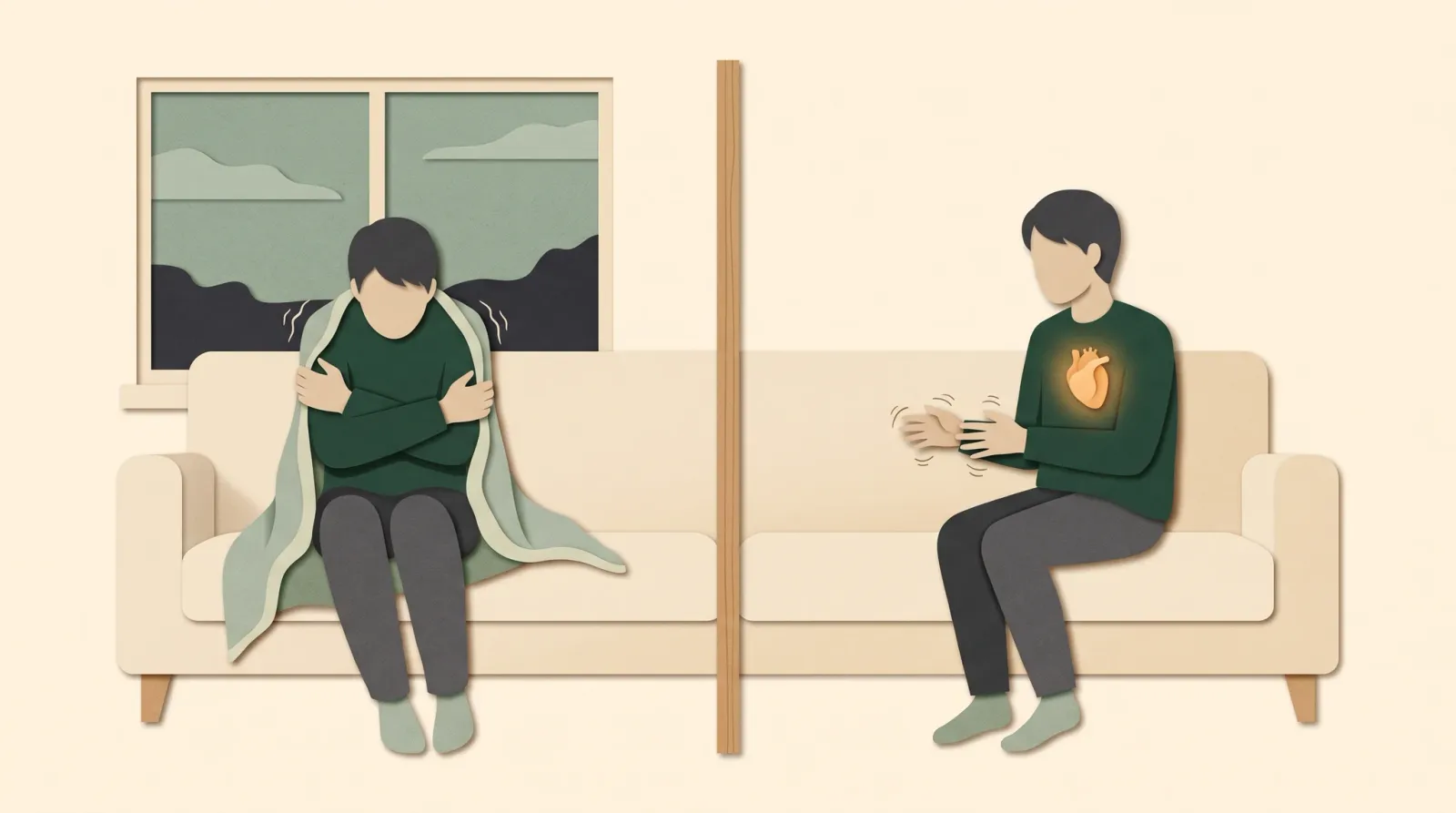
Shaking after weed most plausibly comes from one of two things: anxiety that makes your hands tremble, or shivering because you are cool, and no study has measured how often either happens. Both are usually short-lived. Neither is a sign that cannabis is damaging your nerves.
Here is the part most pages get wrong. Weed shivers are not your body temperature crashing. In the one controlled human cold test, 10 marijuana users kept their core temperature steady, but their heat production jumped, which the authors read as marijuana stimulating shivering. Hanna et al., 1976
That study is small, old and done in the cold. Here in High School, this lesson separates what is measured from what is inferred, and covers what shaking is not: withdrawal, a mislabeled product, or a seizure.
What do people mean by “weed shakes”?
People use one phrase for three different things. Telling them apart is the first step, because the likely cause differs.
| What you notice | What it looks like | Best-supported explanation | Strength of evidence |
|---|---|---|---|
| Whole-body shivering or chills | Teeth chatter, arms wrapped around you, feeling cold | Shivering, which marijuana appeared to stimulate in a cold test | One human study, 10 men, 1976 |
| Fine hand tremor | Hands buzz or shake when you hold a phone or a cup | Anxiety, with adrenaline-type signals making the normal hand tremor bigger | Inference from separate anxiety and tremor studies |
| Leg or jaw trembling, jittery body | Bouncing legs, clenched or chattering jaw, restlessness | Usually the same anxiety or cold routes; no cannabis study separates it | Not studied directly |
One caution: no controlled study has made shaking after cannabis its main outcome, and large emergency-room series did not track tremor. So “most weed shakes come from X” is a claim nobody can back yet, including us.
Why do I shiver after smoking weed?
You probably shiver because your body is making extra heat, not because THC has dropped your temperature. That is what the one controlled human study found.
In 1976, researchers put 10 male marijuana users in cold water at 28 °C for an hour and in cool air at 20 °C for two hours. They tested each man after marijuana smoke, placebo smoke, and no smoking. Hanna et al., 1976
After marijuana:
- Rectal temperature and most skin temperatures did not change, so body heat content was not greatly altered.
- Temperatures over muscles involved in shivering rose.
- Heat production “greatly increased”, which the authors said suggests stimulated shivering.
- Heart rate rose too.
The authors called the mechanism unclear, with some sign of sympathetic (fight-or-flight) involvement.
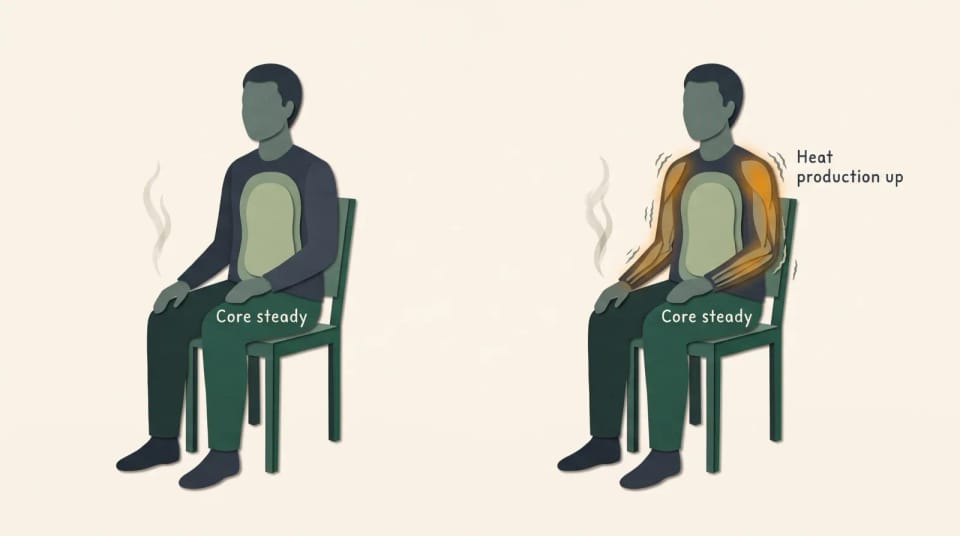
In a 1976 cold-exposure study of 10 marijuana users, core temperature held steady while heat production rose, which the authors read as stimulated shivering. It was not tested in a warm room.
Where does “weed lowers your body temperature” come from? Mostly from animals. In rats, THC tended to lower brain and muscle temperature at every dose, but true hypothermia showed up only at the largest injected dose. Smirnov and Kiyatkin, 2008 Injected per-kilogram doses in rats do not translate to a joint.
What this means in practice: if you are cool, lightly dressed, outside at night, or just out of a pool, cannabis may tip you into shivering sooner. It does not mean your core is crashing. If you combine cannabis with deliberate cold, read our guide to cannabis and cold exposure first.
Does anxiety from weed make you shake?
Very plausibly, yes, and it is the best-supported explanation for trembling hands. The chain has three links, and only the first one has been measured in cannabis users.
- THC can make people anxious and give them a racing heart. In a randomized, placebo-controlled trial, 24 recreational users smoked joints with 29, 49 or 69 mg of THC. THC raised palpitations, dizziness and feeling anxious, and the anxiety lasted up to 8 hours. Hunault et al., 2014 Oral THC also raised heart rate and anxiety ratings in occasional users. Pabon et al., 2022 The CDC lists anxiety, panic and a fast heart rate among the signs of too much cannabis. CDC
- Anxiety tremor is mostly a hand tremor. In 120 people with tremor and generalized anxiety disorder, the tremor was in the upper limbs and looked like an enhanced version of the normal physiological tremor everyone has. Milanov, 2007
- Adrenaline-type signals make that normal tremor bigger. In healthy adults, an inhaled drug that acts like adrenaline on beta receptors significantly increased tremor size. Baker and Baker, 2012
Put together, anxious after a strong hit, heart pounding, hands buzzing is a coherent story. But label it correctly: it is an inference that links separate studies. No one has measured tremor in anxious cannabis users.
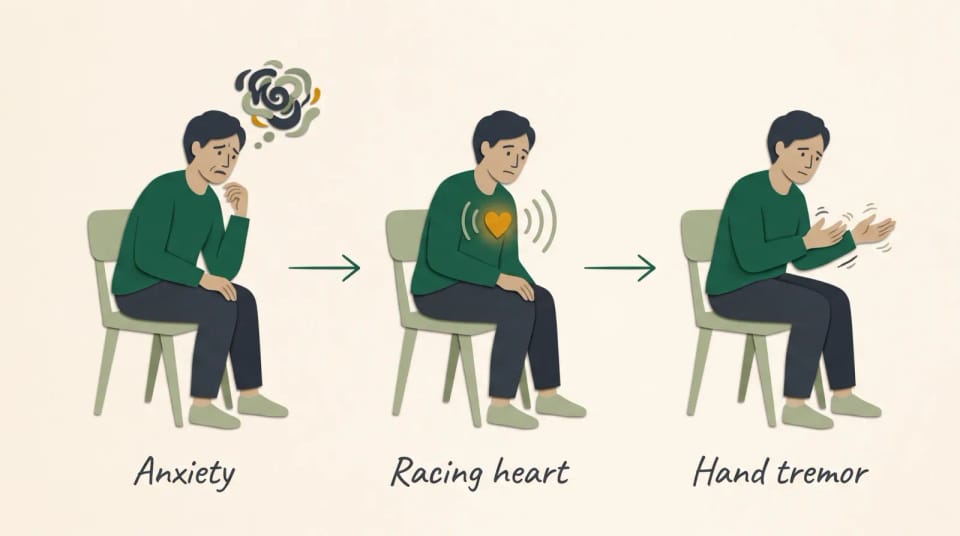
This chain links separate studies on THC and anxiety, anxiety tremor, and adrenaline-type signals. No study has measured it directly in cannabis users.
One detail matters here. In the oral THC study, a heart measure of sympathetic (adrenaline-type) drive did not change, even though heart rate and anxiety rose. Pabon et al., 2022 So “THC floods you with adrenaline” goes too far. The safer statement: THC can make you anxious, and anxiety is the likely driver of the shaking.
If anxious thoughts are the main event, our lesson on cannabis paranoia covers why it happens and the warning signs that need urgent help. If your heart races with the shaking, see what heart rate data shows after cannabis.
Why do I shake after an edible?
Edibles cause the same anxiety and cold routes, but the timing catches people off guard. The CDC notes that edibles can take up to 2 hours to take effect. CDC People who take a second piece because “nothing is happening” can end up with far more THC than they meant to, and the anxiety and racing heart arrive later and last longer.
Higher THC doses produced more anxiety in the smoked-joint trial, and that anxiety lasted hours. Hunault et al., 2014 The trial did not test edibles, so it does not tell you how long edible shakes last. No source we found gives a reliable duration. Our guide to the 2-hour rule for edibles explains how to avoid stacking doses.
When shaking comes with sweating, nausea, vomiting and a spinning room, you are likely greening out. If the main problem is feeling faint or unsteady, our lesson on feeling dizzy or faint after weed separates those symptoms.
Do caffeine or tobacco make weed shakes worse?
Each one can make hand tremor bigger on its own; nobody has tested them together with cannabis.
- Caffeine. In young men who were moderate coffee drinkers, caffeine at 3 mg per kg of body weight increased arm tremor; 1 mg per kg did not. Miller et al., 1998
- Nicotine. Smoking two cigarettes increased hand tremor, and 4 mg nicotine gum matched a cigarette, while a 2 mg dose had no effect. Shiffman et al., 1983
So a strong coffee followed by a spliff stacks two things that are each known to enlarge hand tremor. That is a fair reason to suspect them if you only shake on those days. It is not proof that the combination causes shaking. For more on what tobacco in a joint changes, see our separate lesson.
Does low blood sugar cause weed shakes?
There is no evidence that it does. Several pages list low blood sugar, an empty stomach, dehydration or “THC leaving your body” as causes. We searched and found no study linking cannabis use to shaking through any of these routes. Popular remedies sit in the same place: our searches found no study testing water or CBD for the shakes.
That does not prove them wrong. It means nobody has shown them.
Does weed cause tremors long term?
The small amount of evidence says no. In one study that measured finger tremor with sensors, tremor during movement was larger in people who had used ecstasy, but it was unaffected in a group of 12 cannabis users. Flavel et al., 2012 That is a small group, tested while not high, so it cannot rule out an effect.
A separate study found regular users swayed more while standing still. Bolbecker et al., 2018 Its “trembling” is a signal-analysis term for fast shifts in balance, not visible shaking, and the study shows an association, not a cause.
Can quitting weed cause shaking?
Yes. If shaking starts a day or more after you stop regular use, withdrawal is a likely candidate. In a study of 18 heavy users who stopped for 45 days, the withdrawal pattern included shakiness along with irritability, anxiety, sleep problems and stomach pain. Symptoms began in days 1 to 3 and peaked in days 2 to 6. Budney et al., 2003
A review estimates that about half of regular and dependent users get withdrawal after stopping or cutting down, with chills and sweating among the less common physical symptoms. Connor et al., 2022 Our lesson on cannabis withdrawal covers the timeline in detail.
If you keep getting shaky after sessions and cannot tell which route is yours, a simple log helps. In the High IQ app, you can track how each session went, so you can compare the amount, the method and the setting instead of relying on memory.
Is shaking after weed dangerous?
Ordinary shaking from anxiety or cold is usually short-lived, but some shaking is not a cannabis “high” at all. The CDC says a fatal overdose from cannabis alone is unlikely, and it also says cannabis is not harmless. CDC
Emergency-room data puts this in proportion. In a European series of 4,268 cannabis-only ER visits, anxiety appeared in 28% and seizures in 2%. Tremor was not one of the 12 features tracked. Schmid et al., 2022 A Swiss series of lone-cannabis cases found seizures in 5%. Schmid et al., 2020 These are shares of people sick enough to go to an ER, not your personal risk. Our article on what the ER data shows about weed overdose goes deeper.
Three things can look like weed shakes and are not:
| If this fits | Consider | Why |
|---|---|---|
| Jerking or convulsing, not responding, then confused afterward | A seizure | Seizures appear in a few percent of cannabis ER visits and need urgent help |
| The product was unknown, sold as “spice” or K2, or hit very differently | A synthetic cannabinoid or contaminated product | Synthetic cannabinoid cases had higher rates of seizures, agitation and coma than cannabis cases Waters et al., 2024 |
| Shakiness started days after you stopped daily use | Withdrawal | Shakiness is part of the withdrawal pattern, peaking in days 2 to 6 |
When to talk to a clinician
Call 9-1-1 if someone has a seizure, collapses, has chest pain, is confused, or has trouble breathing. The CDC gives this advice for synthetic cannabinoid reactions too. CDC In the US, Poison Control is 1-800-222-1222 for advice on a bad reaction.
Talk to a doctor if you have a tremor when you are not using cannabis, if shaking keeps happening, or if it comes with other new symptoms. A tremor that shows up sober has many possible causes, and a clinician is the right person to sort them out.
What can you do while the shakes pass?
Nothing here is a treatment. These steps follow the CDC’s guidance and the two routes above.
- Stop using more. Another hit or another edible will not settle anxiety or warm you up.
- Get warm and settle somewhere calm. Sit down in a warm, quiet room and add a layer if you are cool.
- Know when to call for help. Use 9-1-1 for the red-flag signs above, or Poison Control for advice.
Our guide on how to come down when you are too high has more on getting through a strong high.
Key takeaways
- “Weed shakes” can mean whole-body shivering, a fine hand tremor, or jittery legs and jaw.
- The two best-supported explanations are shivering when cool and anxiety-driven hand tremor; no study ranks them.
- In the one human cold study, core temperature held steady while heat production rose. Weed shivers are not a temperature crash.
- The anxiety-to-tremor link is a reasonable inference from separate studies, not a measured cannabis result.
- Caffeine and nicotine can each enlarge hand tremor; low blood sugar has no evidence behind it.
- Seizures, collapse, chest pain, confusion or breathing trouble need 9-1-1.
FAQ
Does weed cause tremors?
Not in any lasting way that research has shown. A small sensor study found finger tremor unaffected in regular cannabis users, though it was not done while they were high. Short-lived trembling during a high most plausibly comes from anxiety or from being cold.
Is it bad to twitch when high?
A brief twitch or trembling hands during an anxious or cold moment is common and usually passes. Jerking or convulsing that you cannot stop, especially with unresponsiveness or confusion afterward, may be a seizure. That needs 9-1-1.
Is shaking after smoking weed dangerous?
Usually not, when it comes from anxiety or feeling cold and fades as the high wears off. It needs urgent help when it comes with a seizure, collapse, chest pain, confusion or trouble breathing. An unknown or synthetic product raises the risk of seizures.
Why do I shake after eating an edible?
Edibles can take up to 2 hours to kick in, so people often take more before the first dose lands. The larger dose can bring stronger anxiety and a racing heart, which are the likely drivers of trembling. No reliable source gives a set duration for edible shakes.
Can quitting weed make you shake?
Yes. Shakiness is part of the cannabis withdrawal pattern in heavy users, usually starting within a few days of stopping and peaking around days 2 to 6. If you have a tremor when sober that does not fade, talk to a doctor.
Sources
- Hanna JM, Strauss RH, Itagaki B, et al. (1976). Marijuana smoking and cold tolerance in man. Aviation, Space, and Environmental Medicine, 47(6), 634-639. PubMed
- Smirnov MS, Kiyatkin EA. (2008). Behavioral and temperature effects of delta 9-tetrahydrocannabinol in human-relevant doses in rats. Brain Research. PubMed
- Hunault CC, Bocker KB, Stellato RK, et al. (2014). Acute subjective effects after smoking joints containing up to 69 mg Delta9-tetrahydrocannabinol in recreational users. Psychopharmacology, 231(24), 4723-4733. PubMed
- Pabon E, Rockwood F, Norman GJ, de Wit H. (2022). Acute effects of oral delta-9-tetrahydrocannabinol (THC) on autonomic cardiac activity and their relation to subjective and anxiogenic effects. Psychophysiology, 59(2), e13955. PubMed
- Milanov I. (2007). Clinical and electromyographic characteristics of tremor in patients with generalized anxiety disorder. Electromyography and Clinical Neurophysiology, 47(1), 3-9. PubMed
- Baker MR, Baker SN. (2012). Beta-adrenergic modulation of tremor and corticomuscular coherence in humans. PLoS ONE, 7(11), e49088. PubMed
- Miller LS, Lombardo TW, Fowler SC. (1998). Caffeine, but not time of day, increases whole-arm physiological tremor in non-smoking moderate users. Clinical and Experimental Pharmacology and Physiology, 25, 131-133. PubMed
- Shiffman SM, Gritz ER, Maltese J, et al. (1983). Effects of cigarette smoking and oral nicotine on hand tremor. Clinical Pharmacology and Therapeutics, 33, 800-805. PubMed
- Flavel SC, Koch JD, White JM, Todd G. (2012). Illicit stimulant use in humans is associated with a long-term increase in tremor. PLoS ONE, 7, e52025. PubMed
- Bolbecker AR, Apthorp D, Martin AS, et al. (2018). Disturbances of postural sway components in cannabis users. Drug and Alcohol Dependence, 190, 54-61. PubMed
- Budney AJ, Moore BA, Vandrey RG, Hughes JR. (2003). The time course and significance of cannabis withdrawal. Journal of Abnormal Psychology, 112(3), 393-402. PubMed
- Connor JP, Stjepanovic D, Budney AJ, Le Foll B, Hall WD. (2022). Clinical management of cannabis withdrawal. Addiction. PubMed
- Schmid Y, Galicia M, Vogt SB, et al. (2022). Differences in clinical features associated with cannabis intoxication in presentations to European emergency departments according to patient age and sex. Clinical Toxicology, 60(8), 912-919. PubMed
- Schmid Y, Scholz I, Mueller L, et al. (2020). Emergency department presentations related to acute toxicity following recreational use of cannabis products in Switzerland. Drug and Alcohol Dependence, 206, 107726. PubMed
- Waters ML, Dargan PI, Yates C, et al. (2024). Clinical effects of cannabis compared to synthetic cannabinoid receptor agonists (SCRAs): a retrospective cohort study of presentations with acute toxicity to European hospitals between 2013 and 2020. Clinical Toxicology, 62, 378-384. PubMed
- Centers for Disease Control and Prevention. Cannabis Frequently Asked Questions. Reviewed January 31, 2025. CDC





