

How to Clean a Banger and Dab Rig: Rinse the Salt Off First
To clean a banger, swab it warm, soak quartz and glass in 91 to 99% isopropyl alcohol, then rinse off every trace of salt and alcohol before you torch it.

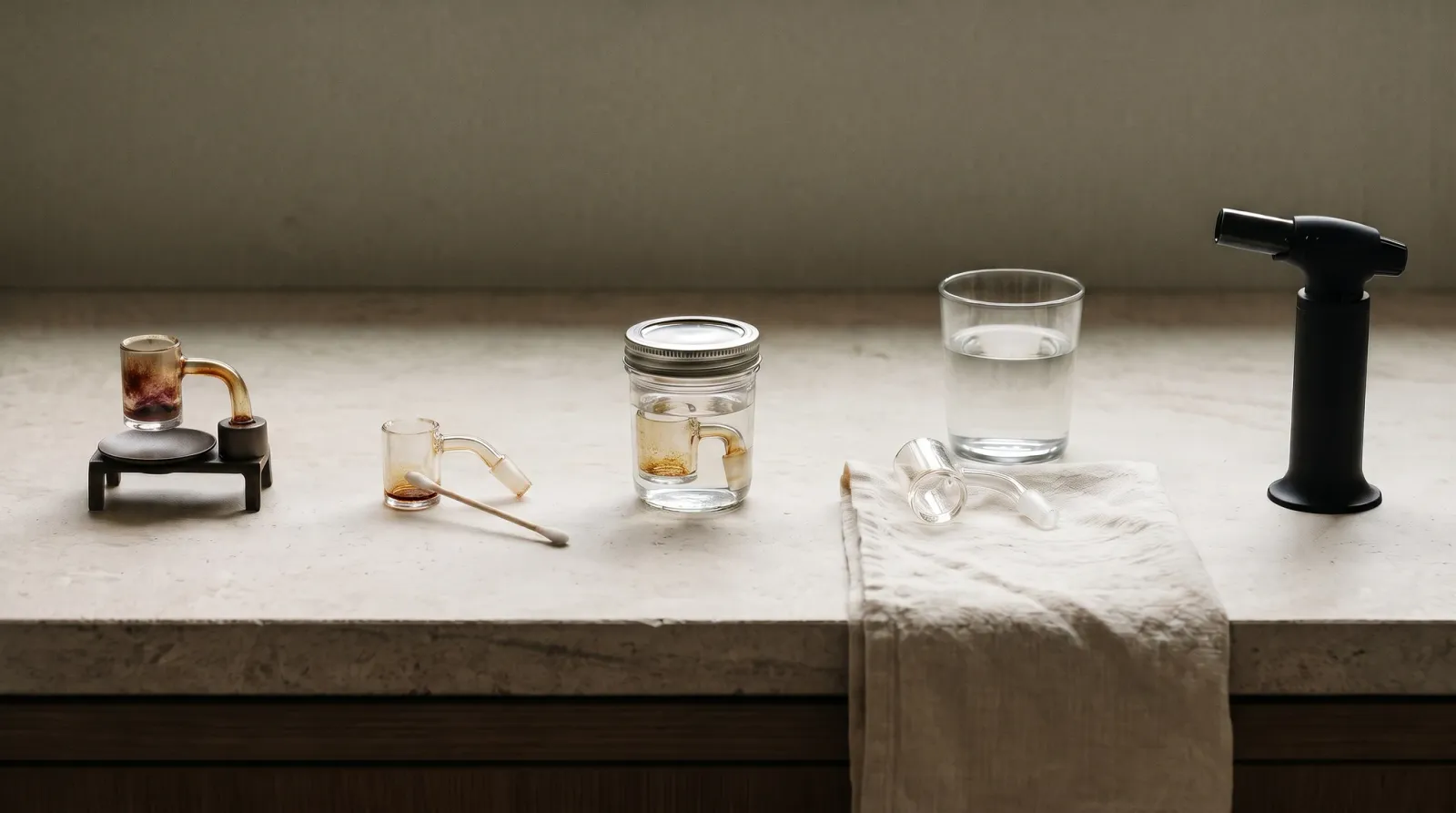
To clean a banger and dab rig, swab the banger once it is only warm, soak quartz and glass parts in 91 to 99% isopropyl alcohol, then rinse off every trace of alcohol and salt and let each part dry fully before it meets a torch. The alcohol and salt do the scrubbing. The rinse and the dry are the steps that protect you and the quartz.
Here is the twist most cleaning guides skip. The classic recipe calls for coarse salt, yet fused quartz makers name salt as the contamination to keep off quartz that will be heated. One manufacturer writes that “alkaline solutions, salts or vapors are particularly deleterious” and that surface contamination “promotes nucleation of the cristobalite”, the crystal growth that turns heated quartz cloudy (Momentive usage guidelines). That guidance is for industrial quartz at furnace temperatures, and nobody has tested a salt soak on a dab banger. The practical lesson is still simple: use salt on the glass body if you like, and rinse it all off anything made of quartz.
This guide covers glass rigs with a quartz banger and a carb cap. For coil care on an electric setup, see our e-nail coil cleaning section. For an e-rig or dab pen, follow the maker’s manual.
What do you need to clean a dab rig and banger?
You need very little, and none of it is special.
- Isopropyl alcohol, 91% or 99%. Seventy percent works, but it is 30% water, while 99% is about 1% water. That is arithmetic, not a cleaning test.
- Cotton swabs and a few paper towels.
- A small glass jar with a lid, or a zip bag, for soaking the banger and carb cap.
- Coarse salt, for the glass rig body only.
- Something to plug the rig’s openings: silicone caps, or your thumbs.
- Gloves if your skin is sensitive. The NIOSH pocket guide lists dry, cracking skin among the effects of repeated contact.
How do you clean a banger after every dab?
Swab it when it is warm, not hot. What you are wiping out is reclaim, “the leftover, unvaporized oil that collects in rigs and dropdowns” (MCR Labs). Common practice is to catch it while it is still soft.
- Turn the torch off and set it out of reach. Alcohol and an open flame should never share the bench.
- Wait until the banger is warm to the hand. There is no tested “right” temperature for a banger swab. The goal is a part that cannot ignite the alcohol.
- Wipe the inside with a cotton swab lightly dampened with alcohol. A dry swab after that picks up what is left. Use a few drops, not a soaked swab.
- Let the alcohol evaporate fully before the next heat-up.
Many people use only a dry swab after the dab and save alcohol for the deep clean.
Why the caution? Isopropyl alcohol has a flash point of 53 °F, which means it gives off enough vapor to ignite at room temperature. Its autoignition temperature, the point where it can ignite with no spark at all, is listed at about 750 °F (399 °C) (NOAA CAMEO Chemicals). The international safety card for the chemical says it plainly: “NO open flames, NO sparks” (ICSC 0554). That figure comes from lab test conditions, not a safe banger temperature, so let the quartz cool rather than guess.
How do you deep clean a banger and carb cap?
Soak them in alcohol, then rinse them in water. That is the whole method.
- Take the cool banger and carb cap off the rig. Never put a hot banger into cold liquid. Quartz expands very little with heat (Technical Glass Products property data), but a fused joint and a sudden temperature change are a gamble you do not need.
- Drop them into a small jar or bag of 91 to 99% alcohol and close it. A closed container cuts down on vapor in the room.
- Wait until the residue loosens. Common practice is anywhere from twenty minutes to a few hours. No one has tested an ideal soak time, so watch the residue, not the clock.
- Work loose spots with a cotton swab. Soft tools only; skip metal picks on the inside of the bucket.
- Rinse with clean, warm water until the alcohol smell is gone. Isopropyl alcohol is fully miscible with water (NIOSH), so water carries it off.
- Dry completely. Stand the banger upside down on a towel. No droplets should remain when it goes back on the rig.
Carb caps, terp pearls and quartz inserts get the same soak and rinse. Our terp pearls guide covers how those small parts work. A silicone carb cap or silicone rig is washed with warm soapy water instead; our glass and silicone materials guide explains the difference.
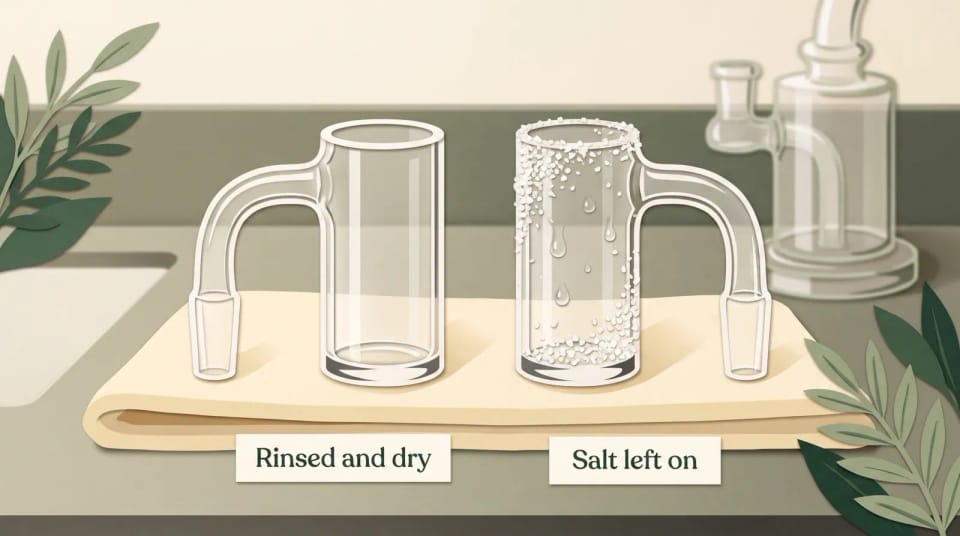
Fused quartz makers warn that salts and standing water on heated quartz promote clouding. Their guidance is for industrial quartz at furnace temperatures, so treat it as a reason to rinse, not as proof a salt soak ruins a banger.
Is salt bad for a quartz banger?
Salt is fine for scrubbing glass. On quartz, the honest answer is: rinse it all off, and here is why.
Fused quartz can slowly change from glass into a crystal form called cristobalite. Manufacturers call this devitrification, and it shows up as cloudiness. A second quartz fabricator says it can start “when it is heated while impurities adhere to its surface”, and that with contamination it “may even occur at temperatures of 1000 °C or less”, while perfectly clean quartz usually needs 1200 °C or more (Technical Glass Products usage guide). Both makers single out sodium and potassium, which is why they also warn that bare fingerprints leave alkali behind. Momentive even notes that standing water drops “promote devitrified spots and watermarks”, and tells users to rinse in clean water and dry quickly (Momentive).
Now the caveat, and it matters. Those temperatures are far hotter than a banger used the normal way. The guidance was written for furnace tubes, not dab gear. No source we found tests whether a salt soak clouds a banger, or explains exactly what the cloudiness on a used banger is. So we are not telling you a salt soak will wreck your quartz. We are telling you the people who make quartz want salt and water spots off it before it is heated, and a rinse costs you nothing.
The manufacturers’ own deep-cleaning method is an industrial acid etch. Do not try it at home.
How do you clean the dab rig body and water?
Clean the glass body like a small bong: alcohol, coarse salt, shake, rinse.
- Dump the old water and remove the banger and any removable parts.
- Pour in enough alcohol to slosh and add a spoonful of coarse salt.
- Plug the openings and shake until the residue lets go. Gentle swirling works for delicate percolators.
- Rinse with warm water until no salt grit and no alcohol smell remain.
- Air dry, then refill with fresh water.
Our bong cleaning guide walks through the full alcohol-and-salt method for the glass body, including tricky percolators. The salt caveat above is about heated quartz. The rig’s water chamber never gets torched.
Why change the water often? No study we found has sampled water from cannabis dab rigs. Studies of tobacco water pipes did look, and they found plenty of bacteria. In one Saudi study, 69.69% of water-bowl samples grew bacteria, compared with 10.6% of mouthpiece samples (Alaidarous et al., 2017). In rural Laos, 95% of water samples from communal pipes tested positive on a general bacterial count, and 38% for coliforms; most pipes were rarely cleaned and held warm brown water (Sinclair et al., 2021). A pilot study of ten hookah bars found bacteria on pipe parts, with the highest diversity on mouthpieces (Martinasek et al., 2018). These are hookahs and traditional pipes, and they measured contamination, not illness. They are still a sensible reason to dump the water after each session and wash the chamber regularly. Our water filtration explainer covers what the water does and does not do to vapor.
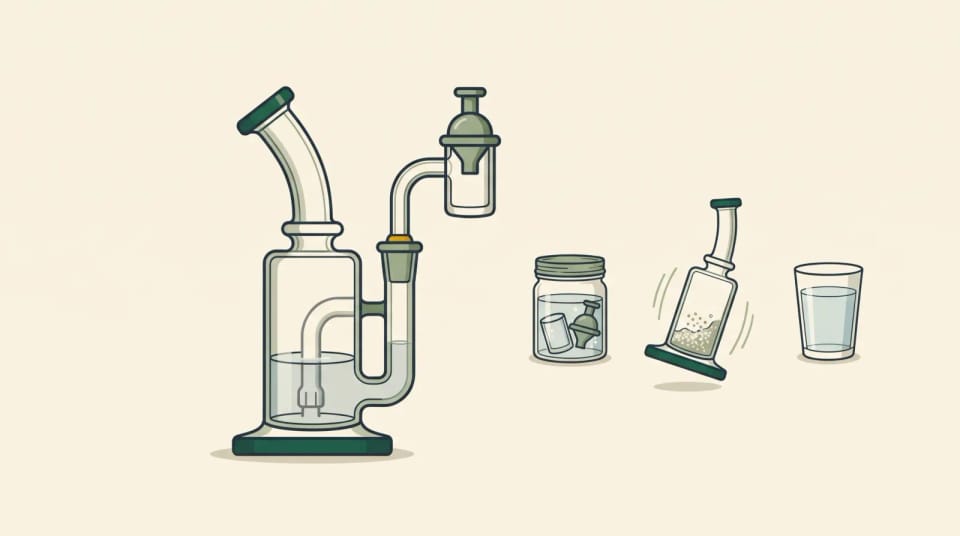
Three parts, three jobs. Quartz and the carb cap soak in alcohol, the glass body takes alcohol and salt, and the water is replaced. Every part ends with a clean-water rinse and a full dry.
Can you torch the residue off a banger or boil it?
No source we found tested either method on a banger, so there is no evidence to settle the argument.
What the quartz makers do say points toward caution. Quartz conducts heat poorly, so a flame held on one spot heats that spot fast, and direct flame contact can crack it (Technical Glass Products). Torching a dirty banger also heats whatever is stuck to the surface. A bench study found that heating terpenes under simulated dabbing formed other compounds, including benzene (Meehan-Atrash et al., 2017). That study used pure terpenes, not old residue, so it does not tell you what torching a dirty banger releases. It does show that heat changes what is on the quartz.
Boiling raises a different question: a sudden change in temperature. A classroom demonstration from the Ceramic and Glass Industry Foundation found that fused silica rods did not crack when quenched from a flame into ice water, borosilicate cracked less than ordinary glass, and soda-lime glass cracked (thermal shock lesson). That is about bare rods, not a banger with a welded joint. The safe habit stays the same: change temperature slowly, and let the soak do the work.
How often should you clean a dab rig?
There is no tested schedule. What follows is common practice, not evidence.
| Part | Common practice | Reason with a source | Practice only |
|---|---|---|---|
| Banger | Swab after each session; soak when residue builds up | Alcohol is flammable, so cool first and keep the torch away | Soak frequency and time |
| Carb cap and pearls | Soak with the banger | Same quartz and salt guidance if they are quartz | How often |
| Rig glass body | Alcohol and salt shake when it looks dirty | None specific to rigs | Weekly or less |
| Rig water | Replace after each session | Tobacco water-pipe studies found bacteria in stale water | Exact interval |
Our dab rig buyer’s guide covers how parts and materials differ, and choosing a quartz banger explains why banger thickness and material affect how you handle it. New to all of this? Start with how dabbing works and what gear you need here in High School.
When should you talk to a clinician?
Alcohol vapor irritates the eyes, nose and throat, and can cause dizziness, headache and drowsiness (NIOSH). Clean in a ventilated room and step outside if you feel off. If you burn your hand on hot quartz, get alcohol in your eyes, or have breathing irritation or a burn that does not settle, contact a clinician or poison control rather than waiting it out.
Key takeaways
- Let the banger cool and move the torch away before alcohol comes near it.
- Soak quartz and the carb cap in alcohol; shake the glass body with alcohol and salt.
- Rinse every part with clean water until no salt and no alcohol remain, then dry fully.
- Quartz makers warn that salts and water spots on heated quartz promote clouding; that is industrial guidance, not a banger test.
- Cleaning schedules are habit, not science. Change the rig water often.
FAQ
How do you get the cloudiness off a quartz banger?
Start with an alcohol soak and a soft swab, then rinse and dry. Some cloudiness may be residue that lifts, and some may be a change in the quartz itself; no source we found explains it for bangers. If a soak does not clear it, more scrubbing or more heat is not a tested fix.
Can you use 70% isopropyl alcohol to clean a banger?
Yes, it works. It is 30% water, while 91% and 99% contain far less, which is why many people prefer the stronger grades. No study has compared how well each concentration removes dab residue.
How do you clean a banger without alcohol?
A dry cotton swab right after a session removes much of the soft residue. Some people use hot water or a degreaser for deeper cleans, but no source we found tested either on quartz. Whatever you use, rinse and dry the quartz before it is heated again.
How do you clean a carb cap?
Soak a glass or quartz carb cap in alcohol with the banger, swab the airflow hole, then rinse and dry. Wash silicone caps with warm soapy water instead. Keep metal caps away from the flame while they are wet with alcohol.
Is it safe to use alcohol near a dab torch?
Not at the same time. Isopropyl alcohol vapor ignites easily, and safety agencies say no open flames where it is in use. Turn the torch off, set it aside, and let the alcohol evaporate or rinse off before you heat anything again.
Sources
- Momentive Technologies. Fused quartz usage guidelines. Manufacturer technical guidance.
- Technical Glass Products. Fused quartz proper usage guidelines and properties of fused quartz. Manufacturer technical guidance.
- Ceramic and Glass Industry Foundation. Thermal shock lesson. Classroom demonstration.
- NIOSH. Isopropyl alcohol, NIOSH Pocket Guide to Chemical Hazards. CDC.
- NOAA Office of Response and Restoration. Isopropanol, CAMEO Chemicals.
- ILO and WHO. International Chemical Safety Card 0554: isopropyl alcohol. 2020.
- Alaidarous M, Alanazi M, Abdel-Hadi A. Isolation, identification, and antimicrobial susceptibility of bacteria associated with waterpipe contaminants in selected area of Saudi Arabia. BioMed Research International, 2017.
- Sinclair RG and colleagues. Microbial contamination in the communal-use Lao tobacco waterpipe. International Health, 2021.
- Martinasek M and colleagues. A pilot study to assess the bacterial contaminants in hookah pipes in a community setting. International Journal of Tuberculosis and Lung Disease, 2018.
- Meehan-Atrash J, Luo W, Strongin RM. Toxicant formation in dabbing: the terpene story. ACS Omega, 2017.
- Wani J. We tested reclaim, and this is what we found. MCR Labs, 2014.





