

How to Keep a Cannabis Mother Plant Healthy (and When to Retire Her)
A cannabis mother plant needs long days, ample light, balanced feeding and viroid testing. No study sets her lifespan, so here is when to retire her.

Professor High
Written by Professor High, our AI guide. See how we research and correct articles.
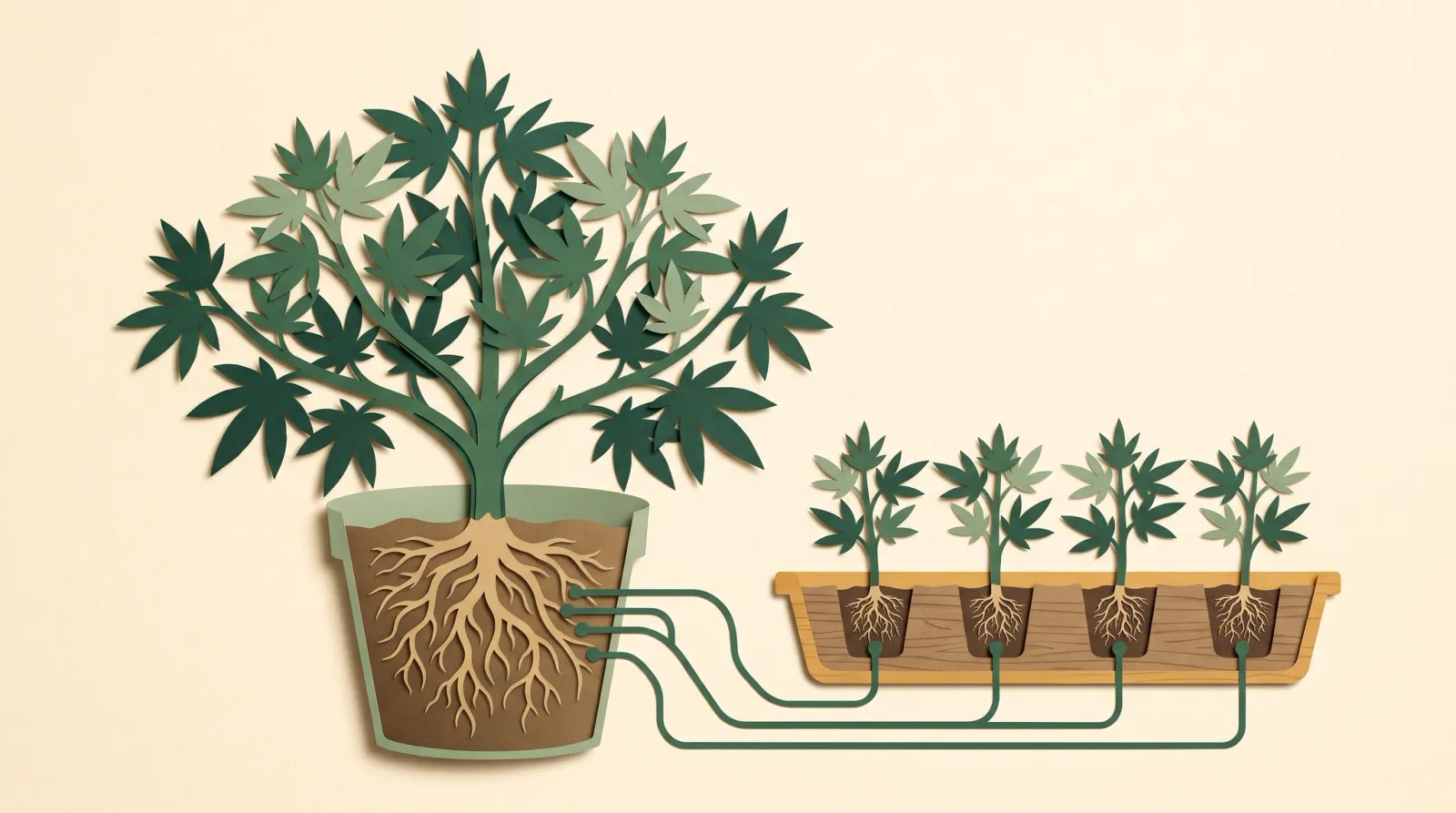
Keep a cannabis mother plant in vegetative growth under long days, give her plenty of light and balanced feeding, prune her so she branches, and retire her when her cuttings root poorly, her growth falls off, or a test finds hop latent viroid. No study sets a calendar lifespan for a mother. The “decade or more” figures you see online have no source behind them.
Here is the part most mother-plant guides skip. A healthy-looking mother is not proof of a clean mother. In a 2025 study of commercial stock plants, hop latent viroid turned up in mothers that showed no symptoms, and cuttings taken from infected mothers carried it at rates up to 100% within four weeks (Punja et al., 2025). Leaves gave inconsistent results; roots were the most reliable tissue to test.
So this lesson in High School covers two jobs: keeping her productive, and knowing when to let her go. For the cutting technique itself, see our guide on how to take and root the cuttings.
What is a cannabis mother plant?
A mother plant (growers also say “stock plant”) is a female plant kept in vegetative growth so you can take cuttings from her again and again. Each rooted cutting is a clone: a genetic copy of her. Commercial growers rely on this. An Ohio State University Extension factsheet notes that “most transplants are produced using stem cuttings excised from mother (female) stock plants” (Ohio State University Extension).
A mother never flowers while she does this job. She stays in the vegetative stage indefinitely, which is the stage before flowering on a normal seed-to-harvest timeline.
What does keeping one cost you?
Three things: floor space under a light, electricity for long days, and a standing place in your plant count. That last one is easy to forget. In New York, home growers may keep three immature and three mature plants per person, and the state regulator says “nothing prohibits a consumer from cloning their own plant to make additional plants, as long as your plant count does not exceed the plant limits” (NY Office of Cannabis Management FAQ). The same FAQ classes plants as immature “from germination through vegetation,” so a mother and her rooted clones count. Other states set their own limits. Check your state regulator before you start, and only grow where home cultivation is legal.
Which plant deserves to be a mother?
The one you have already grown, judged, and want again. That choice is phenotype selection, which we cover in choosing a keeper before she becomes a mother. The choice matters more than it seems. In a 2025 trial, clones from five different seed-grown mothers of the same cultivar differed in cannabinoid concentration, and the clone’s source was “strongly correlated” with that difference, whatever the nitrogen level (Dilena et al., 2025). Same strain name, different mothers, different results.
If you are deciding between keepers, notes on how each one actually worked for you help. The High IQ app can track that, strain by strain.
How much light does a mother plant need?
Long days, and more light than you might expect. Light does two jobs for a mother: it keeps her from flowering, and it powers the branching that becomes your cutting supply.
The research uses different schedules, and no trial has compared them for mothers:
| Study | Light schedule | What it tested | What it found |
|---|---|---|---|
| Campbell et al., 2019 | 24 hours a day, “as per industry practice” | Four lamp types on 144 mothers of two cultivars, for four weeks | Mothers under T5 fluorescent or metal halide made about 30% more growing tips than under metal halide plus far-red LED. Far red made plants about 19% taller with longer gaps between nodes. |
| Collado et al., 2024 | 18 hours a day | Total daily light, from low to high, on one cultivar in a greenhouse | Each step up in daily light added branches per plant. Branching had not levelled off at the highest light tested. |
Two practical points follow. First, an 18-hour or 24-hour day both kept plants vegetative in these trials, but neither study shows one beats the other for a mother. Second, more light means more branches, and more branches mean more cuttings. The highest level Collado tested is a ceiling of the experiment, not a target. For hardware, see our guide to choosing grow lights.
One more reason to keep her day unbroken: in Punja’s trials, hop latent viroid spread faster in plants on a 12-hour flowering schedule than on 24-hour light. That is a finding from one study, not a rule, but it is another reason to fix light leaks and timer faults.
How should you feed and pot a mother plant?
Feed for steady growth, not maximum growth. There is no published trial of mother-plant feeding rates, so be wary of any precise “mother formula.”
The closest evidence is a vegetative nitrogen trial on young plants of one cultivar. Growth peaked at a middle nitrogen level. The lowest level cut plant mass by about 75%, and the two highest levels restricted roots or stunted the plants (Saloner and Bernstein, 2020). That study ran for 32 days in small pots of perlite, so it is not a recipe for a plant you keep for months. What it does show is a penalty on both sides: starving her and overfeeding her both slow growth.
In practice: use a balanced vegetative feed, watch new leaves for pale colour (too little) or dark, clawed tips (too much), and adjust slowly. Our primer on how cannabis nutrients work explains the symptoms.
Pot size and repotting are the same story. Commercial trials used pots from 10 to 18.9 litres, but none tested pot size against mother health. Many growers move a mother into a larger pot as she grows, or trim her roots, because a root-bound plant slows down. That is grower practice, not a trial result. Keep the grow-room climate stable and use vapour pressure deficit as a guide; no study has set separate climate targets for mothers.
How do you prune a mother for more cuttings?
Prune so she makes many growing tips. Every tip is a potential cutting. In the Campbell trial, the number of tips on a mother directly limited how many cuttings she could give, and cultivar changed both her yield of cuttings and how fast they rooted.
Topping (cutting the main stem tip) and cutting back side shoots both push the plant to branch. Our guide to topping and training for more branches shows the cuts. Taking cuttings removes shoot tips too, so each cutting session doubles as a light pruning. No trial has tested a pruning schedule for mothers, so let regrowth guide you.
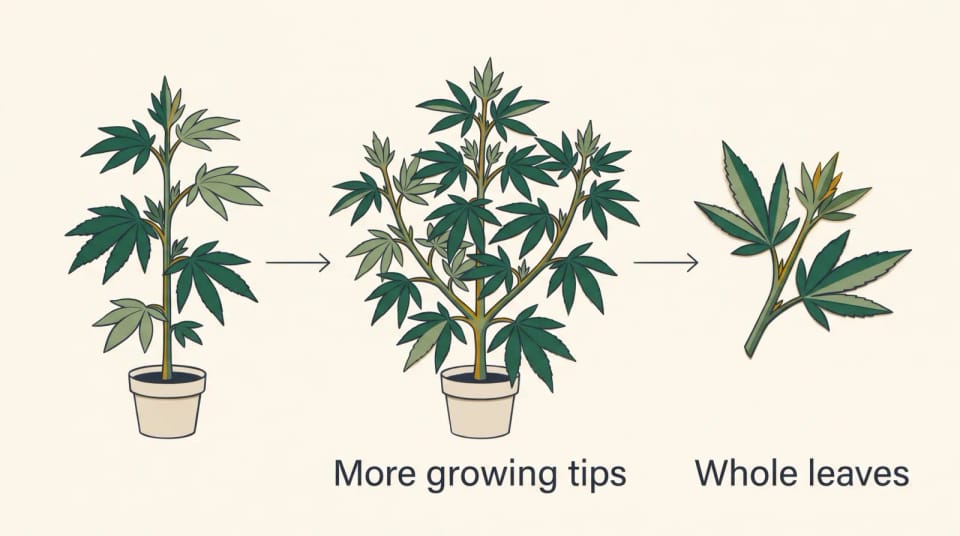
Topping turns one growing tip into many. Each cutting keeps its leaves whole; in one trial, trimming leaf tips lowered rooting.
Three findings help when you take the cuttings:
- Position barely matters. Cuttings from the top or the bottom of the stock plant rooted about equally, and the authors found position “had little effect on rooting success or quality” (Caplan et al., 2018).
- Keep the leaves whole. The same trial recommends at least three fully expanded, uncut leaves. Trimming the leaf tips dropped rooting from 71% to 53%.
- Wound the base. In Campbell’s cutting trial, lightly wounded stem bases were 162% more likely to root and rooted about a day and a half sooner.
Can a healthy-looking mother plant carry a disease?
Yes. Hop latent viroid is the main reason. A viroid is a tiny loop of infectious RNA, smaller than a virus. Reviewers describe it as a hidden threat because most infected cannabis plants show no symptoms, and it was first reported in cannabis in California in 2019 (Adkar-Purushothama et al., 2023). Another team found that infected plants “can often be asymptomatic for a period of growth and then develop symptoms” (Atallah et al., 2023).
For a mother, the Punja study is the one to read. Its findings, from licensed greenhouses and controlled trials (Punja et al., 2025):
- The viroid was found in stock plants and rooted cuttings with no symptoms.
- Cuttings from infected mothers tested positive at rates up to 100% within four weeks.
- Infected cuttings rooted worse than clean ones.
- Roots were the most consistent tissue to test. Leaves from the bottom, middle and top were not reliably positive, so one clean leaf test does not clear a mother.
- It spread through roots, shared recirculating water, and cutting wounds from contaminated tools.
- A 5 to 10% household bleach solution destroyed the viroid’s RNA in a lab test. UV light and heating to 70 to 90 °C for 30 minutes did not.
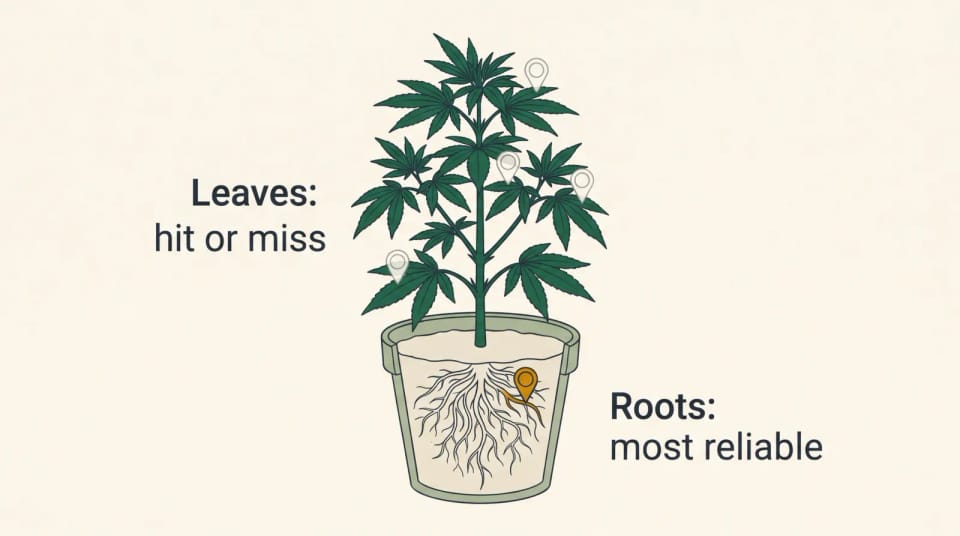
In a 2025 study, leaf samples missed hop latent viroid in some plants; roots were the most consistent tissue to test.
Three practical consequences for a home mother:
- Test before she becomes a mother, then on a schedule. The Punja authors recommend frequent testing of stock plants and clones and removing infected material. Testing services exist for commercial growers; ask what tissue they sample, and favour roots or several tissues.
- Disinfect blades between plants. Virginia Extension’s hemp guide says to “dip pruning tools in a commercial disinfectant before and between each use” and to discard or segregate “questionable plants” (Virginia Cooperative Extension).
- Seeds are not a clean restart. Seed from infected parents gave up to 100% infected seedlings in Punja’s work, and 58 to 80% in Atallah’s hemp tests. If a mother is positive, do not assume her seed line is clean.
Can an infected mother be cleaned up? Sometimes, in a lab. Meristem culture (growing a new plant from a tiny tip of tissue) gave viroid-negative plants in about 41% of attempts overall, ranging from none to all depending on genotype, and plants were followed for only six months. That is a rescue for a valuable genotype, not a home cure. Our explainer on hop latent viroid and how it spreads goes deeper.
Pests travel on cuttings too. The Ohio State factsheet warns that “stock cuttings may carry several types of pests and diseases.” A mother lives for months, which gives pests time to build. Check her regularly for spider mites and powdery mildew, because anything on her ends up on every clone.
How long can you keep a cannabis mother plant?
Nobody has measured it. We searched for a controlled study of mother age against cutting vigor, rooting or potency and found none. The online figures, from “a couple of years” to “a decade or more,” are anecdotes without a cited source.
What about the claim that clones “degrade” over time? The evidence is thin in both directions:
| Claim | What the evidence shows | Limit |
|---|---|---|
| Mutations build up inside one plant | Whole-genome sequencing of one plant found different mutations in its top, middle and bottom; the top carried the most unique variants (Adamek et al., 2022) | One plant, one cultivar. The study did not test clones, vigor or potency. The authors say decline is “anecdotally” reported. |
| Clones match their mother | Cannabinoid profiles of cuttings, tissue-culture plants and the mother were similar, with no significant differences (Chandra et al., 2010) | One variety, a short comparison, not repeated cycles over years. |
So drift is plausible, not demonstrated. A mother that seems to “lose it” may instead be root-bound, underfed, under pests, or carrying a viroid, all of which are testable. For a related question about cuts passed between growers, see what clone-only means.
When should you replace a mother plant?
Retire her on evidence, not on a birthday. These signs are practical judgement built from the research above, not trial thresholds:
- A positive viroid test. This is the clearest signal. Replace her from clean, tested stock and disinfect everything she touched.
- Cuttings that root worse than they used to. Infected cuttings rooted worse in Punja’s work, so a drop in rooting is worth a test before you blame age.
- Thin, weak regrowth after pruning that does not recover once you fix light, feeding and root space.
- Pests or mildew that keep coming back despite treatment.
Keep simple notes: the date of each cutting session, how many rooted, and how long it took. Without a record, “she is slowing down” is just a feeling. Before you retire her, root a few healthy cuttings so you have a replacement waiting, and test them first. If you have lost the mother and still want the genetics, cannabis revegetation and monster cropping are slower, less certain routes back.
Mother plant checklist
- Start from a plant worth copying. Pick a keeper you have grown and judged. Test her before she becomes a mother.
- Keep her in vegetative growth. Long days with no dark interruptions.
- Give her enough light. More light gave more branches, up to the highest level tested.
- Feed for steady growth, not maximum growth. Balanced vegetative feed; watch new leaves.
- Prune for more growing tips. Top and cut back so she stays short and bushy.
- Keep tools and water clean. Disinfect blades between plants, avoid shared recirculating water, isolate any plant you doubt.
- Test, record and retire. Test roots on a schedule, track rooting, and replace her when a test is positive or her cuttings decline.
Sources
- Punja ZK, et al. Transmission, spread, longevity and management of hop latent viroid. Plants (Basel), 2025.
- Atallah OO, et al. New insights into hop latent viroid detection, infectivity, host range, and transmission. Viruses, 2023.
- Adkar-Purushothama CR, et al. Hop latent viroid: a hidden threat to the cannabis industry. Viruses, 2023.
- Campbell LG, et al. Phenotypic plasticity influences the success of clonal propagation in industrial pharmaceutical Cannabis sativa. PLOS ONE, 2019.
- Collado CE, et al. Supplemental greenhouse lighting increased the water use efficiency, crop growth, and cutting production in Cannabis sativa. Frontiers in Plant Science, 2024.
- Caplan D, et al. Vegetative propagation of cannabis by stem cuttings. Canadian Journal of Plant Science, 2018.
- Adamek K, et al. Accumulation of somatic mutations leads to genetic mosaicism in cannabis. The Plant Genome, 2022.
- Chandra S, et al. Assessment of cannabinoids content in micropropagated plants of Cannabis sativa. Planta Medica, 2010.
- Dilena E, et al. Optimal nitrogen rates and clonal effects on cannabinoid yields of medicinal cannabis. Scientific Reports, 2025.
- Saloner A, Bernstein N. Response of medical cannabis to nitrogen supply under long photoperiod. Frontiers in Plant Science, 2020.
- Ohio State University Extension. Ever-evolving aspects of cannabis production. Factsheet ANR-99, 2021.
- Virginia Cooperative Extension. Integrated pest management of hemp in Virginia. ENTO-349NP, reviewed 2025.
- New York State Office of Cannabis Management. Medical and adult-use home cultivation of cannabis: FAQ. 2024.
Key takeaways
- A mother is a vegetative female kept for cuttings; she counts toward home-grow plant limits in at least New York.
- Light drives branching, and branches are your cutting supply. No trial shows 18 hours beats 24 hours for a mother.
- No study sets a mother’s lifespan. Retire her on a positive viroid test or measured decline.
- No symptoms does not mean no viroid. Test roots, disinfect blades, and do not treat her seeds as a clean restart.
FAQ
How long can you keep a cannabis mother plant?
No study has measured a mother plant’s useful lifespan. The year counts quoted online are uncited anecdotes. Keep her as long as she tests clean and her cuttings root well, and track both so you can see a real decline.
Should a mother plant get 24 hours of light?
Either 18 or 24 hours a day keeps a mother vegetative, and trials have used both. No study has compared the two for mother plants, so neither is proven better. What does matter is enough total light, since more light gave more branches in a greenhouse trial.
Do mother plants lose potency over time?
It has not been shown. One study found mutations building up inside a single plant, but it did not test clones or potency. An earlier comparison found cuttings matched their mother’s cannabinoid profile.
Can you flower a mother plant?
Yes, but flowering ends her role as a mother: a flowering plant no longer makes the vegetative shoots you cut from, and turning a flowered plant back to vegetative growth is slow and uncertain. Take and root cuttings first if you want to flower her and keep the genetics.
Does a mother plant count toward my home-grow limit?
In New York, yes: plants are immature from germination through vegetation, and clones count as long as you stay within the limits. Other states set their own rules. Check your state regulator before you keep a mother.



