Malawi Weed: What Is Actually Documented About Malawi Gold
A Malawi Gold seed line is not a lab result. Here is what the sources document about Malawi weed, chamba and African landrace cannabis, and what they do not.

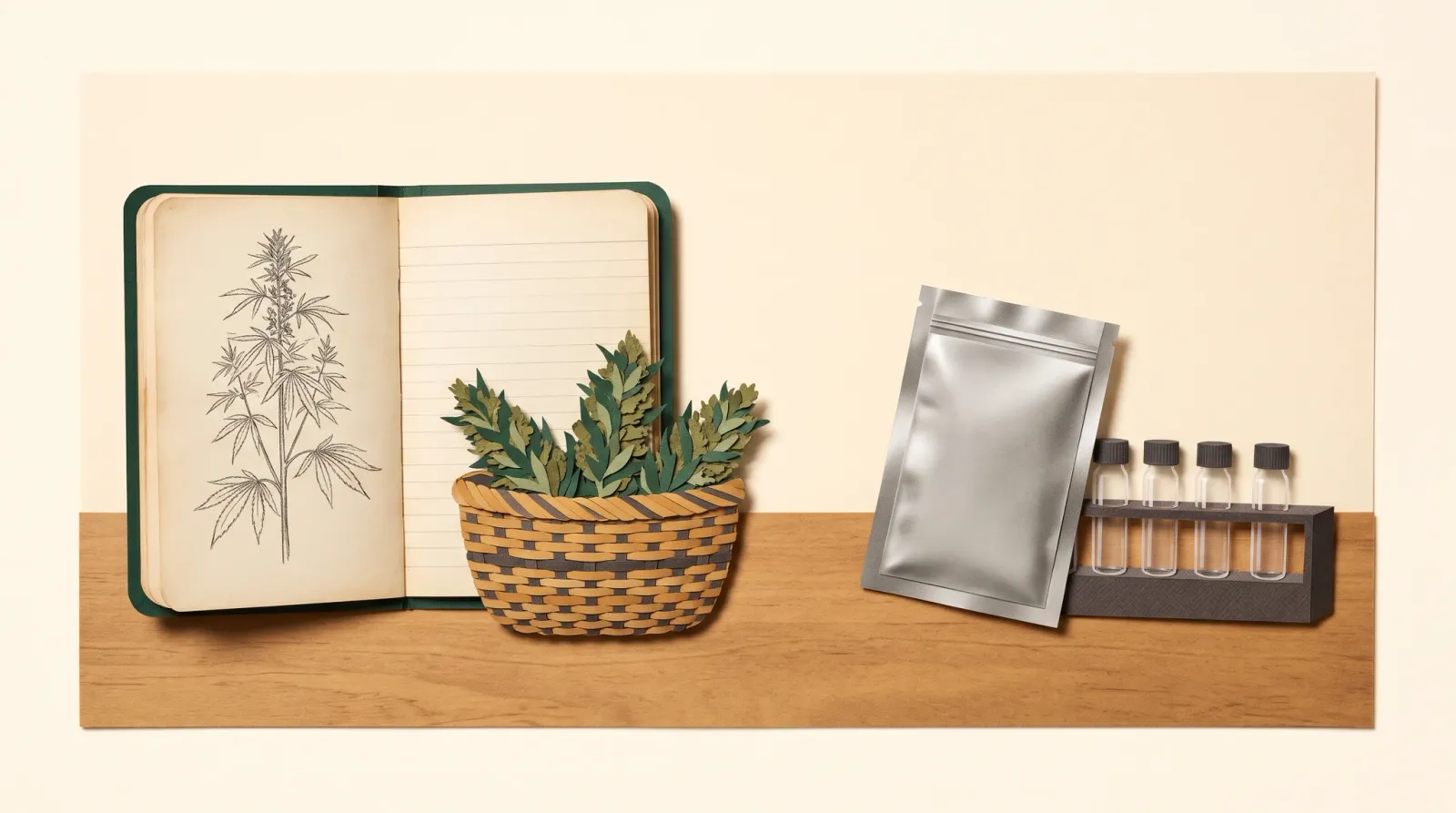
Malawi weed is chamba, a cannabis crop Malawian farmers have grown and cured for generations, and “Malawi Gold” is the name the rest of the world gave it, but no published study has measured its THC, its THCV or its DNA. The history is real. The famous strain card is not backed by a lab.
Search “malawi weed” and you get a confident profile: pure sativa, THC in the high teens or low twenties, rich in THCV. Here is the twist. We looked for the paper behind those numbers and did not find one. The one chemistry study people trace the THCV claim to did not test a single plant from Malawi. No African sample was among the 15 cannabis genomes held in the main public database in 2024. And the only academic paper titled “Malawi Gold” is an unfinished draft whose results section is still template filler.
This lesson in High School sorts what is documented from what is marketing, with a source beside each claim.
Sources checked October 29, 2026.
What is Malawi Gold, exactly?
Malawi Gold is a trade name for cannabis grown in Malawi, and for seed lines sold abroad that are said to descend from it. Locally, the plant is called chamba. A Malawi University of Science and Technology biologist writes that chamba “has been a part of the culture since ancient times,” and points to the phrase chamba cha makolo (chamba of the ancestors) as evidence of how old the tradition is (Bandawe, Malawi Medical Journal, 2022).
Researchers who interviewed farmers and traders in Lilongwe and Kasungu districts in 2018 write that Chichewa-speaking farmers produced several cultivars, Malawi Gold among them (Sowoya et al., Drugs and Alcohol Today, 2020). That is the authors’ description, not a botanical test. It tells you the name is in use. It does not tell you that every bag or seed packet called Malawi Gold is the same plant.
That matters because Malawi Gold is often called a landrace. If you are new to the word, start with what a landrace is: a local population shaped by farmers in one place over many seasons. Chamba fits that description historically. Whether a particular seed in a catalogue still carries that population is a separate question, and nobody has published the answer.
How did cannabis reach Malawi?
Probably by trade, but the route is a best guess, not a date. Sowoya and colleagues write that cannabis “was probably first introduced by traders along long-distance overland trading trails stretching to the Swahili coast,” with roots further back in the Indian subcontinent (Sowoya et al., 2020).
The bigger picture fits. A genome study of 110 cannabis samples concluded that the plant was first domesticated in East Asia, and that today’s hemp and drug types descend from a gene pool there (Ren et al., Science Advances, 2021). So cannabis is not native to Africa. People carried it there.
The geographer Chris Duvall puts its arrival on the continent at least 1,000 years ago, but notes that the archaeological evidence is thin and most written records date from the 19th century (Duvall, EchoGéo, 2019). For the wider story, see our lesson on the global history of cannabis.
Duvall also explains how a local type forms. African farmers mostly grew cannabis to smoke, and they saved seed from the flowers they liked smoking. Over generations, that choice shaped the crop (Duvall, 2019). That is the honest mechanism behind the word “landrace.” It is farmer selection, not a mystery.
What is the Malawi cob?
The Malawi cob is the traditional way of curing chamba: the flowers are pressed into a tight bundle and wrapped. It is the most visible piece of Malawi’s cannabis culture, and the sources do not agree on the wrapper.
Bandawe describes curing “by wrapping it tightly in banana leaf” (Bandawe, 2022). One UK heirloom-seed seller says the tops were wrapped in corn husks. Other pages say banana or maize leaves and give no source. Our honest summary: the cob is well attested, and the wrapper may have varied by place or time. We found no study that settles it.
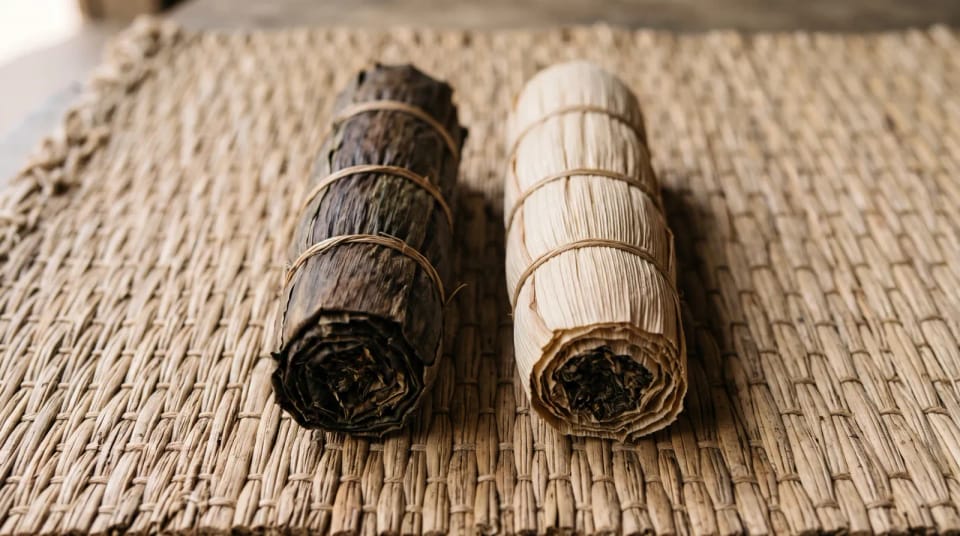
A Malawian biologist describes the cob as wrapped in banana leaf; one seed seller says corn husks. The bundle is well attested; the wrapper is not settled.
Is Malawi weed sativa or indica?
Nobody has tested it, and the labels themselves do not hold up well. The “pure sativa” tag on Malawi Gold pages comes from seed catalogues and strain databases, not from a genetic study of Malawian plants.
The science behind those labels is shaky to begin with. Genotyping of retail cannabis found that “marijuana strain names often do not reflect a meaningful genetic identity,” and reported sativa or indica ancestry matched the genetics only moderately (Sawler et al., PLOS ONE, 2015).
A later study found that samples labelled Sativa and Indica were genetically indistinct across the genome (Watts et al., Nature Plants, 2021). Our explainers on indica and sativa labels and on whether any strain is pure indica or pure sativa go deeper.
The botany adds a twist. In a 2004 chemotaxonomy study, Karl Hillig placed African drug plants in his “indica” group, not the sativa group (Hillig and Mahlberg, American Journal of Botany, 2004).
The authors of a 2025 genetic study instead argue for treating all cannabis as one species, Cannabis sativa. It placed West African landraces from Gambia and Ghana in an “Indoafrica” subgroup with southern India and Southeast Asia, and noted that earlier work had no wild-growing samples from Africa (Balant et al., Plants, People, Planet, 2025). Neither study names a Malawian sample.
So “pure sativa” is a seller’s label. It is not a finding.
Is Malawi Gold high in THCV?
That claim is repeated everywhere, and the closest primary study did not include a Malawian plant. THCV is a cannabinoid related to THC; our lesson on what THCV is covers the compound itself. This section is only about where the Malawi claim comes from.
Here is the trail. Hillig and Mahlberg measured cannabinoids in 96 plants of known origin. Every plant with a high ratio of THCV and its sister compound CBDV came from Asia or Africa, and the African ones came from Gambia, Lesotho, Nigeria, South Africa and Swaziland (Hillig and Mahlberg, 2004). Malawi is not on their list. They also measured apparent peak ratios, not calibrated amounts, and each sample was a handful of plants from one seed packet.
Duvall’s review cites that study for “a distinctive cannabis lineage with elevated levels of THCV” in southeastern Africa (Duvall, 2019). That is a fair reading of a regional pattern. It still rests on plants from other countries.
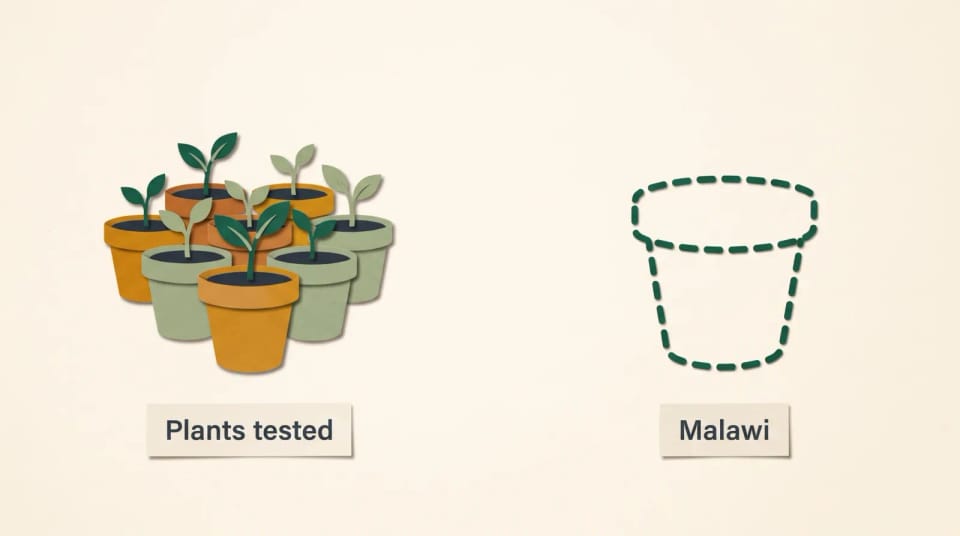
The 2004 study’s high-THCV African plants came from Gambia, Lesotho, Nigeria, South Africa and Swaziland. No Malawian plant was in the analysed set.
The rest of the trail is weaker. One UK heirloom-seed seller quotes an older catalogue that credits the Malawi high to “the presence of THCV,” with no test attached. The one academic manuscript titled “Malawi Gold” is a 2023 draft with no journal, no peer review and results sections that still read “Data Data Data.” Two of its authors list a licensed Malawian cannabis company as their affiliation. It shows a documentation gap. It is not evidence.
Why is so little documented about African landrace cannabis?
Because almost nobody has sampled it. A 2024 review of cannabis in southern Africa says there are “limited studies on the plant’s diversity” and “a lack of proper documentation of Cannabis varieties in southern Africa.” It counted 15 cannabis genome assemblies in the public NCBI database and noted that “none of these are representatives of African samples” (Ndlangamandla et al., Plants, 2024).
History explains part of it. Most colonial governments banned cannabis before the 1925 Geneva Opium Convention, Duvall writes (Duvall, 2019). In Malawi, the Noxious Weeds Act of 1936 and the Dangerous Drugs Act of 1956 governed the plant until 2020 (Bandawe, 2022). A crop that is illegal to grow is hard to collect, catalogue or study openly.
Meanwhile, the seed trade filled the gap with stories. One UK seller says its line descends from a landrace “collected in Malawi several decades ago,” sourced “via collector community” and kept inbred ever since. That may be true. It comes with no collection date, no collector and no genetic test, so it cannot be checked. This is the same problem behind strain names borrowed from places: a place name on a packet is a claim, not a pedigree. Our guide to tracing a strain’s family tree shows why lineage claims are hard to verify.
You can see how our own database lists Malawi Gold and Malawi. Treat those profiles as catalogue entries, not lab results. If you try a strain sold under the name, the High IQ app lets you track how it actually worked for you, which is better evidence about your experience than any catalogue blurb.
Is weed legal in Malawi?
Only for medical and industrial use, under licence, as of October 2026. Malawi’s Parliament passed the Cannabis Regulation Act on February 28, 2020 (Bandawe, 2022). The Act regulates cultivation, processing, sale and use “for medicinal, industrial or scientific purposes,” and defines industrial hemp as cannabis with no more than 1% THC (Cannabis Regulation Act, No. 6 of 2020). General adult-use consumption remains illegal, trade press reported in 2026 (Cannabiz Africa, 2026).
Here is the irony. A licence application must name “the approved cannabis variety or cultivar” and come with certified seed and a certificate of analysis (Cannabis Regulation Act, 2020). The Act never names Malawi Gold. But trade press reports that current Cannabis Regulatory Authority guidelines bar licensed growers from planting it (Cannabiz Africa, September 2026). A compliance consultancy reported the same in 2024, adding that the approved varieties were not local (Cannavigia, 2024). We could not open the regulator’s guidelines to confirm this, so read it as reported, not as settled law.
The licensing system itself has been uneven. In 2023 the BBC found that only one of four originally licensed companies still held a valid licence, and that cooperatives said they paid for seed and training they never received (BBC News, 2023). By September 2026, the regulator reported 55 licences issued that year, with more planned (Cannabiz Africa, 2026).
Laws change. Check current Malawian law before relying on any of this, and nothing here is advice to buy, carry or ship cannabis or seeds across a border.
What about traditional medical uses of chamba?
They are history, not evidence of a working remedy. Bandawe lists traditional uses for anthrax, dysentery, fevers, malaria and snakebite (Bandawe, 2022). Those are records of what people did, not results from trials. Talk to a clinician about any fever, persistent diarrhoea, suspected malaria or a snakebite; each needs prompt medical care, and cannabis is not a substitute.
Sources
-
Bandawe G. “Medical cannabis and cannabidiol: A new harvest for Malawi.” Malawi Medical Journal. 2022;34(2):138-142. doi.org/10.4314/mmj.v34i2.10
-
Sowoya L, Akamwaza C, Matola AM, Klein A. “Goodbye Nicky hello Goldie: exploring the opportunities for transitioning tobacco farmers into cannabis production in Malawi.” Drugs and Alcohol Today. 2020;20(3):295-303. doi.org/10.1108/dat-04-2020-0021
-
Duvall CS. “A brief agricultural history of cannabis in Africa, from prehistory to canna-colony.” EchoGéo. 2019;48. doi.org/10.4000/echogeo.17599
-
Ren G, Zhang X, Li Y, et al. “Large-scale whole-genome resequencing unravels the domestication history of Cannabis sativa.” Science Advances. 2021;7(29). doi.org/10.1126/sciadv.abg2286
-
Hillig KW, Mahlberg PG. “A chemotaxonomic analysis of cannabinoid variation in Cannabis (Cannabaceae).” American Journal of Botany. 2004;91(6):966-975. doi.org/10.3732/ajb.91.6.966
-
Balant M, Vitales D, Wang Y, et al. “Integrating target capture with whole genome sequencing of recent and natural history collections to explain the phylogeography of wild-growing and cultivated cannabis.” Plants, People, Planet. 2025. doi.org/10.1002/ppp3.70043
-
Ndlangamandla VV, Salawu-Rotimi A, Bushula-Njah VS, et al. “Finally Freed: Cannabis in South Africa: A Review Contextualised within Global History, Diversity, and Chemical Profiles.” Plants. 2024;13(19):2695. doi.org/10.3390/plants13192695
-
Sawler J, Stout JM, Gardner KM, et al. “The Genetic Structure of Marijuana and Hemp.” PLOS ONE. 2015;10(8):e0133292. doi.org/10.1371/journal.pone.0133292
-
Watts S, McElroy M, Migicovsky Z, et al. “Cannabis labelling is associated with genetic variation in terpene synthase genes.” Nature Plants. 2021;7(10):1330-1334. doi.org/10.1038/s41477-021-01003-y
-
Parliament of Malawi. Cannabis Regulation Act, No. 6 of 2020. Copy hosted by the Industrial Crops Association of Malawi
-
Gitonga C. “Malawi cannabis: Farmers’ high hopes fail to materialise.” BBC News. 22 March 2023. bbc.com
-
Makoni J. “Malawi has Issued 55 Cannabis Licenses This Year, Hopes to Double That by December.” Cannabiz Africa. 9 September 2026. cannabiz-africa.com
-
Cannavigia. “Cannabis Compliance in Malawi: Background Info, Fees and How-to Checklist.” 6 June 2024. cannavigia.com
-
Mpulamasaka N, et al. “Morphological Characteristics of the ‘Malawi Gold’ Bandawe Landrace Phenotype of Cannabis Sativa L.” Unpublished draft, 13 August 2023. PDF
Key takeaways
- Malawi weed is chamba, a long-standing local crop; “Malawi Gold” is its export and seed-trade name.
- The famous “pure sativa, high THCV” profile has no published lab or genetic test behind it.
- The key THCV study tested African plants from five other countries, not Malawi.
- No African sample was among the 15 cannabis genomes in the public database in 2024.
- Malawi licenses medical and industrial cannabis only, and trade press reports that Malawi Gold is not on the approved list.
FAQ
Is Malawi Gold a real landrace?
Malawian farmers have grown chamba for generations, and researchers describe Malawi Gold as one of their cultivars. What is unproven is whether any seed sold abroad today still carries that population. No published genetic test of a verified Malawian sample exists in the sources we checked.
Is Malawi sativa or indica?
No genetic study has tested it. “Pure sativa” is a label from seed catalogues. Studies of retail cannabis show these labels track genetics poorly, and one 2004 study actually grouped African drug plants under “indica.”
What does chamba mean?
Chamba is the local word for cannabis in Malawi. The phrase chamba cha makolo, chamba of the ancestors, is cited as a sign of how old the tradition is.
Is weed legal in Malawi?
Only medical and industrial cannabis, under a government licence, as of October 2026. Recreational use remains illegal. Laws can change, so check current rules before relying on this.
What African country has legal weed?
It depends on the purpose and the date. Malawi licenses medical and industrial cannabis. South Africa took a different path through its courts, explained in our guide to South Africa’s 2018 private-use ruling. Other countries differ, so check each one’s current law.





