Slow Cooker vs Sous Vide vs Instant Pot for Cannabis Infusion
Temperature control is what separates a good infusion from a wasted ounce. We put three appliances against the real decarb and degradation data.

Professor High
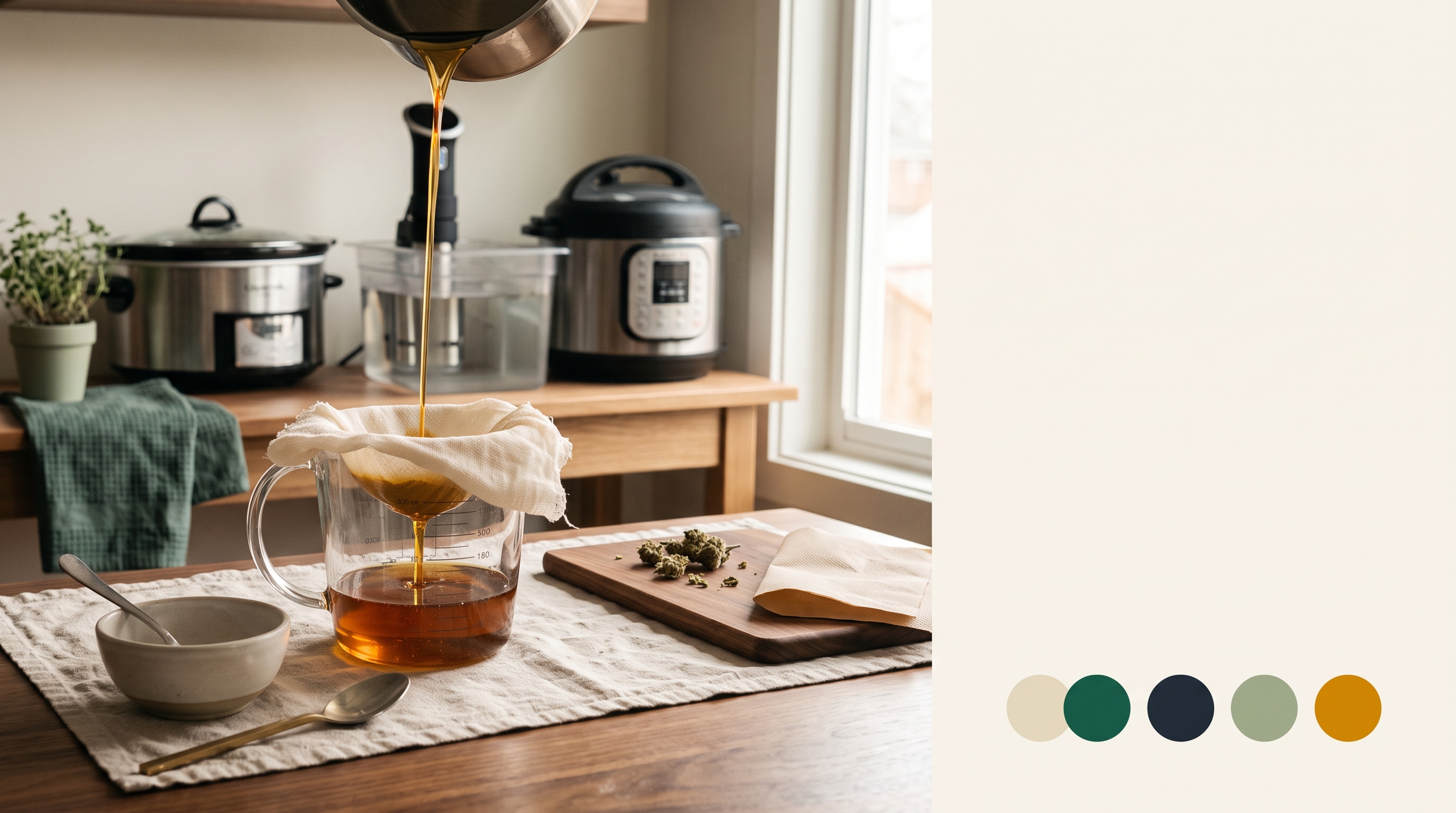
You made two batches of butter a month apart. Same jar of flower, same ratio, same recipe printed off the same website. One batch put your friends on the sofa for four hours. The other tasted like lawn clippings and did close to nothing.
Nothing about your ingredients changed. What changed was the temperature — how hot, for how long, and how tightly your appliance held the number it promised you.
That is the whole argument for caring which appliance you use. A slow cooker, an immersion circulator and an electric pressure cooker are not three flavours of the same tool. They control heat by three genuinely different mechanisms, and the gap between them shows up in your finished oil.
Before comparing them, though, we have to fix the temperatures themselves. A lot of the numbers circulating in infusion guides are wrong, and one of them is wrong in a way that has probably cost you terpenes.
The chemistry constraint: three temperatures that actually matter
Decarboxylation is a clock, not a switch
Raw cannabis is mostly THCA, not THC. THCA does not get you high. Heat knocks a carboxyl group off it and converts it to THC — that is decarboxylation, and it is the one step you genuinely cannot skip.
The best measurements we have come from Wang and colleagues, who heated cannabis in a vacuum oven at 80, 95, 110, 130 and 145°C and tracked the acids by mass spectrometry. THCA concentration dropped to effectively zero at 30 minutes at 110°C, 9 minutes at 130°C, and 6 minutes at 145°C. They fitted an activation energy of 88 kJ/mol.
Perrotin-Brunel and colleagues, working separately, reported a comparable activation barrier of about 85 kJ/mol and confirmed the reaction follows pseudo-first-order kinetics. Two independent groups landing within a few percent of each other is about as solid as this field gets.
The practical meaning of “pseudo-first-order with an 88 kJ/mol barrier” is this: near 110°C, every extra 10°C roughly doubles the rate. That scaling holds up well at the lower end and flattens at the top, where the reaction is finishing almost as fast as you can sample it.
So decarb is a trade between temperature and time. There is no magic setting. There is a curve, and you pick a point on it.
Degradation is not a cliff at 157°C
Here is the number you have seen a hundred times: THC’s boiling point is 157°C, so never let your infusion go above it or your THC turns into CBN.
That figure comes from vaporiser temperature charts, not from a degradation study. It is a convention for where cannabinoids start producing usable vapour, and it has been quietly promoted into a thermal safety limit it was never measured to be.
What the actual data show is different, and more useful. Urvashi, Han, Hong and colleagues ran hemp through pressurised liquid extraction across 80–160°C for 1 to 90 minutes. Neutral cannabinoid concentrations only started falling at 160°C after 30 minutes of exposure. They did see CBN accumulate at higher temperatures, and they described it plainly as “a well-known oxidation product of THC” — but noted it “could not totally account for the observed losses of THC.” Other side reactions were eating cannabinoids too.
The word doing the work there is oxidation. Turner and Elsohly mapped the THC-to-CBN decomposition pathway back in 1979, and it needs oxygen. Wang’s team gave us the clean control on this: heating in the dark, in a vacuum oven, at up to 145°C, produced no significant oxidation of THC to CBN. When they heated pure THCA at 110°C for 40 minutes, THC was the only decomposition product they saw.
Read those two results together and the rule you should actually be following becomes clear. CBN is mostly a function of oxygen exposure and time, not of crossing a magic temperature. An open pot at 95°C for eight hours can plausibly cost you more THC than a sealed vessel at 130°C for twenty minutes.
That single correction reshuffles the appliance rankings, as you will see.
Terpenes do not boil off — they evaporate, and an open pot vents them
The other piece of folklore is that terpenes “boil off” during infusion. Check the boiling points, all measured at standard atmospheric pressure:
| Terpene | Boiling point |
|---|---|
| α-Pinene | 156°C |
| Myrcene | 166–167°C |
| Limonene | 178°C |
| Linalool | 198°C |
| Caryophyllene | 256°C |
Every one of those sits above any sane infusion temperature. Nothing is boiling in your 90°C butter.
What happens instead is ordinary evaporation. Volatile compounds have measurable vapour pressure well below their boiling point, so they leave the liquid surface continuously. In a closed vessel the headspace saturates and the process stalls at equilibrium — the terpenes have nowhere to go. In an open vessel, rising steam carries that vapour away, the headspace never saturates, and the pot keeps stripping aroma for as long as you leave it on.
That is why your kitchen smells so strongly during a slow-cooker infusion. The smell is the product leaving. It is not a side effect; it is inventory walking out of the building.
Which means the appliance question reduces to two things: how tightly does it hold a temperature, and how well does it stay sealed.
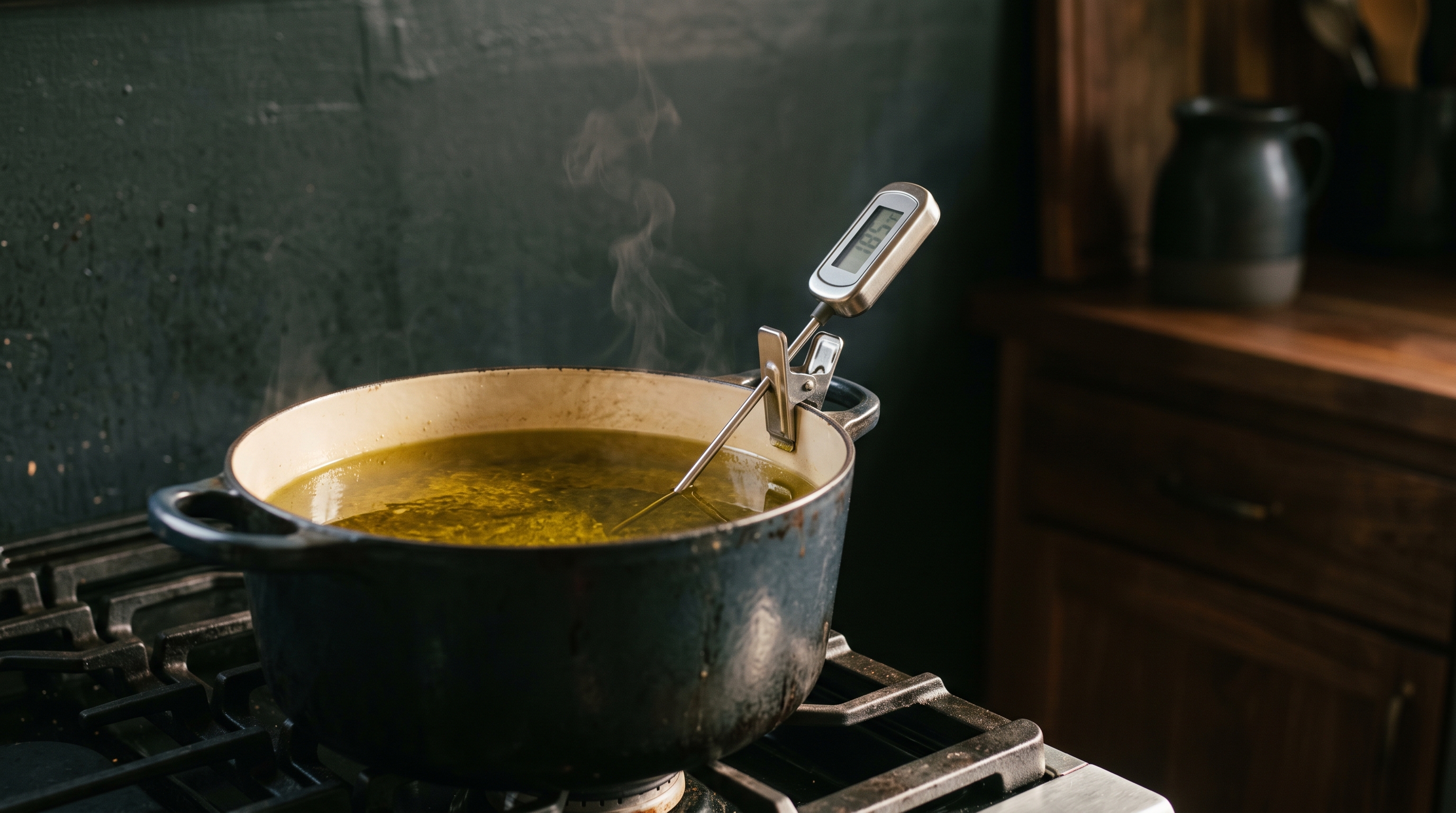
The slow cooker: cheap, forgiving, imprecise
A slow cooker holds temperature by the crudest method available — a thermostat that switches the element fully on, then fully off. Temperature does not sit at a setpoint; it saws up and down around one.
USDA guidance puts the working range of slow cookers at roughly 170–280°F (about 77–138°C), and independent testing shows real variation between models and even between batches in the same model. Your “low” is not your neighbour’s “low.”
There is one failure mode that matters more than the rest, and most guides miss it. If you are heating oil or butter directly in the crock, nothing caps the temperature at 100°C. Water-based food self-limits at the boil. Fat does not. On the high setting, with an element reaching for 280°F, oil in a lightly-filled crock can climb into the range where Urvashi’s group measured real cannabinoid loss — while you assume you are safely simmering.
The fix is simple and free: put your infusion in a sealed mason jar, and stand the jar in water. The water bath caps you at 100°C no matter what the element does, and the sealed jar keeps oxygen out and terpenes in. This is the single biggest upgrade available to a slow-cooker infusion, and it costs nothing.
Method: Decarb your flower in the oven first — 30 minutes at 110°C is well supported by the data above. Combine it with your chosen fat in a wide-mouth mason jar, seal it fingertip-tight, and stand it on a folded cloth in the crock. Add water to the shoulder of the jar. Low setting, 4 hours, lid on. Strain warm through cheesecloth.
Sous vide: the precision winner
An immersion circulator works on a completely different principle. It measures water temperature continuously, pumps the water to keep it uniform, and modulates the element to hold a setpoint rather than bouncing off it. Manufacturers typically claim accuracy to within 0.1°C. Even allowing generous scepticism about marketing specs, it is a different class of instrument from a bimetallic thermostat.
Three things follow, and they compound.
You get real control. Set 85°C and you get 85°C, for four hours, without checking. You can now actually run experiments — same flower, two bags, two temperatures — and trust that the variable you changed is the only variable that changed.
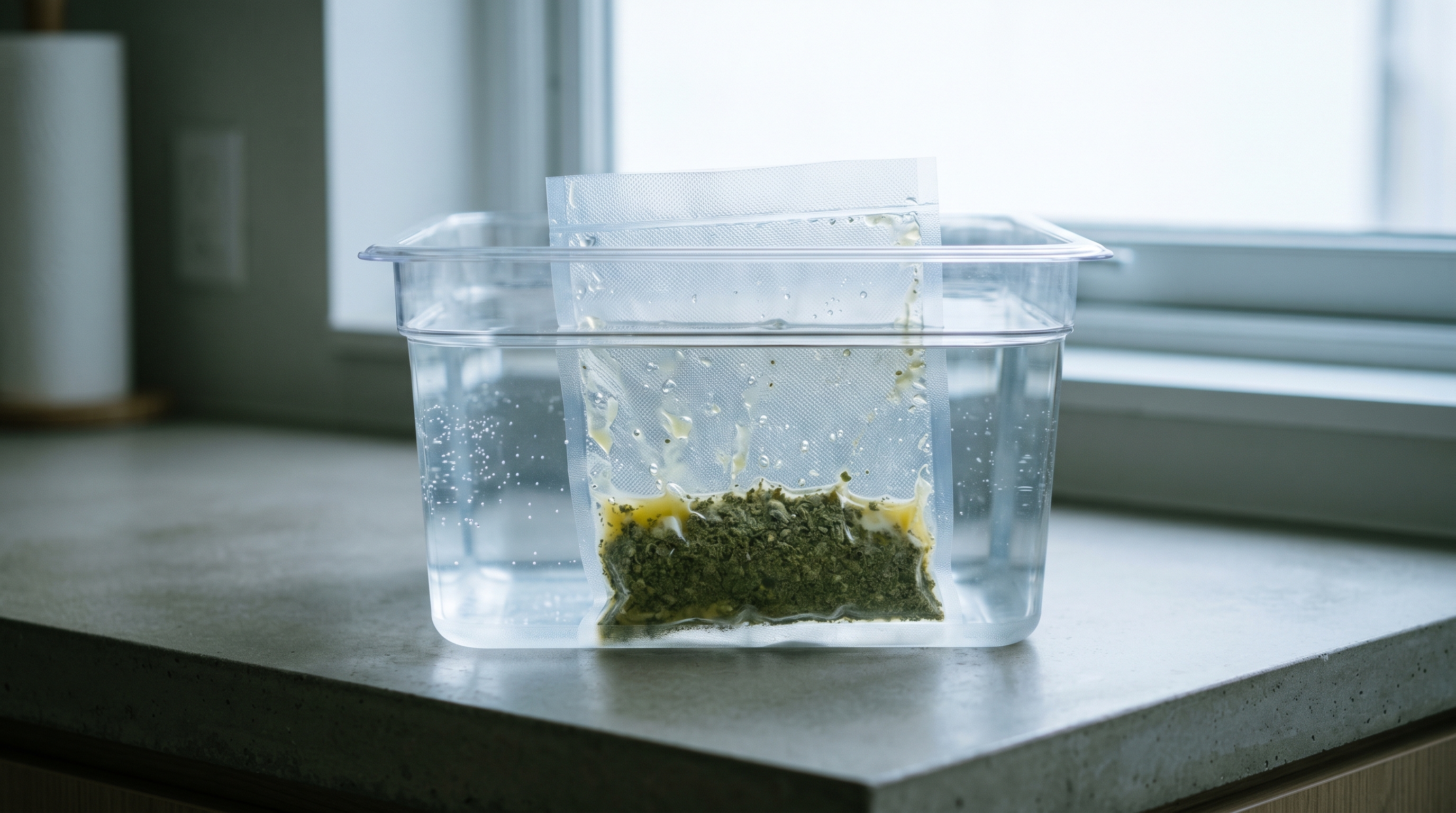
The bag is sealed. This is the underrated advantage, and after the oxidation finding above it may be the main one. A vacuum-sealed pouch is a closed system: terpene evaporation stalls at equilibrium, and there is very little oxygen present to drive THC toward CBN. You keep more of what you started with.
Your house does not smell. For a lot of people this is the deciding factor on its own, and it is a direct consequence of the same seal.
The cost is process friction. You need a vacuum sealer, or you need to use the water-displacement method with a zip bag, or you need mason jars — and jars partly give back the convenience you were buying. Hot fat in a thin bag is also genuinely unpleasant to handle. Let it cool before you lift it.
Method: Decarb first. Vacuum-seal decarbed flower with fat, pressing the bag flat so the plant material is not clumped. Circulator at 85°C for 4 hours. Cool the bag in the sink before opening, then strain.
A safety note worth taking seriously. Infused oils are low-acid, largely anaerobic environments, which is exactly the niche Clostridium botulinum exploits. University of Georgia Extension guidance for infused oils is unambiguous: non-acidified oils made with fresh ingredients should be refrigerated and discarded after four days, or frozen. Dried material is much lower risk than fresh, and decarbed cannabis is dry — but neither sous vide nor slow cooking is a spore-killing step at these temperatures. Refrigerate your finished oil, and read up on edible shelf life and storage before you make a big batch.
The Instant Pot: fast, sealed, and widely misunderstood
Pressure changes the maths, but not in the way most infusion guides claim.
An Instant Pot on high pressure runs at roughly 10.2–11.6 psi above atmospheric, which lifts water’s boiling point to about 115–117°C. That is not a marginal gain. It puts a water-based system directly into the efficient decarb band from Wang’s data, where THCA conversion takes tens of minutes rather than hours.
Urvashi’s team built their entire method on this logic — a closed system at elevated temperature and pressure, chosen specifically because short reaction times and water as the solvent “minimize loss due to degradation.” Their recommendation for CBD was thermo-chemical conversion at 130°C for 9 minutes. Fast and hot in a sealed vessel beat slow and warm in an open one.
Now the caveat that most articles get wrong. Pressure does nothing for oil. Fat has negligible vapour pressure; it was never going to boil, so raising the boiling point of a liquid it is not made of changes nothing about its temperature. If you put butter straight in the pot and seal the lid, the pressure benefit is essentially imaginary — what you have is a sealed vessel with a hot element and poor temperature feedback.
The pressure advantage is real only in a water-bath configuration: your fat and flower in a sealed mason jar, jar standing in water, lid on, pressure up. Now the water is the thermal medium, the pressure genuinely raises its temperature to ~115°C, and the jar gives you the sealed, low-oxygen environment.
On the “dedicated setting” question: no Instant Pot has a cannabis mode. Several models include a Sous Vide program, but coverage varies by model and on some of them the temperature is not freely adjustable. Check your manual before planning a method around it, and if you want a purpose-built machine with a real infusion cycle, that is a different product category — see our infusion machines buyer’s guide.
Method: Decarb first. Fat and flower in a sealed half-pint jar. One cup of water in the pot, trivet in, jar on top. High pressure, 30 minutes, then natural release — the slow cooldown is extra infusion time, not wasted time.
Head to head
| Slow cooker | Sous vide | Instant Pot | |
|---|---|---|---|
| Temperature precision | Poor — swings of 10–20°C are normal | Excellent — setpoint held within a fraction of a degree | Moderate — pressure fixes the ceiling, not the control |
| Sealed against oxygen | Only if you use a jar | Yes, by design | Yes, when using a jar |
| Odour in the kitchen | Significant | Almost none | Low |
| Active time | 10 minutes | 15 minutes | 10 minutes |
| Total time | 4–8 hours | 3–4 hours | 30 min plus release |
| Terpene retention | Lowest if lid-off; good in a sealed jar | Best | Good |
| Effort and cleanup | Lowest | Highest — sealing and bags | Low |
| Typical cost | $30–60 | $80–200 | $80–130 |
| Best for | Big forgiving batches | Repeatable, aromatic, controlled results | Speed, and small batches |
Two things in that table deserve calling out.
Total time is not the same as quality. The Instant Pot finishing in half an hour is not a compromise — given that degradation tracks oxygen and duration more than peak temperature, a short hot sealed run has a genuinely defensible case over an eight-hour open simmer.
The slow cooker’s weakness is fixable. Almost everything wrong with it comes from running fat open in the crock. Put it in a jar in water and it moves from worst-in-class to perfectly respectable, at a cost of zero dollars.
The verdict
Use sous vide if you care how it tastes. If your infusion is going into something where the cannabis flavour is part of the dish — infused olive oil, a vinaigrette, a finishing honey — the sealed bag preserves aromatics that an open pot vents into your extractor fan. It is also the only one of the three precise enough to let you iterate deliberately.
Use the Instant Pot if you want it done today. Jar-in-water on high pressure, thirty minutes, natural release. The closed system and the short duration are working in your favour, not against you. This is the best choice for small test batches.
Use the slow cooker if you are making a lot and want to walk away. Volume and forgiveness are real advantages. Just use the jar.
Use none of them for tinctures. Alcohol and sealed heated vessels are a bad combination. That method has its own rules.
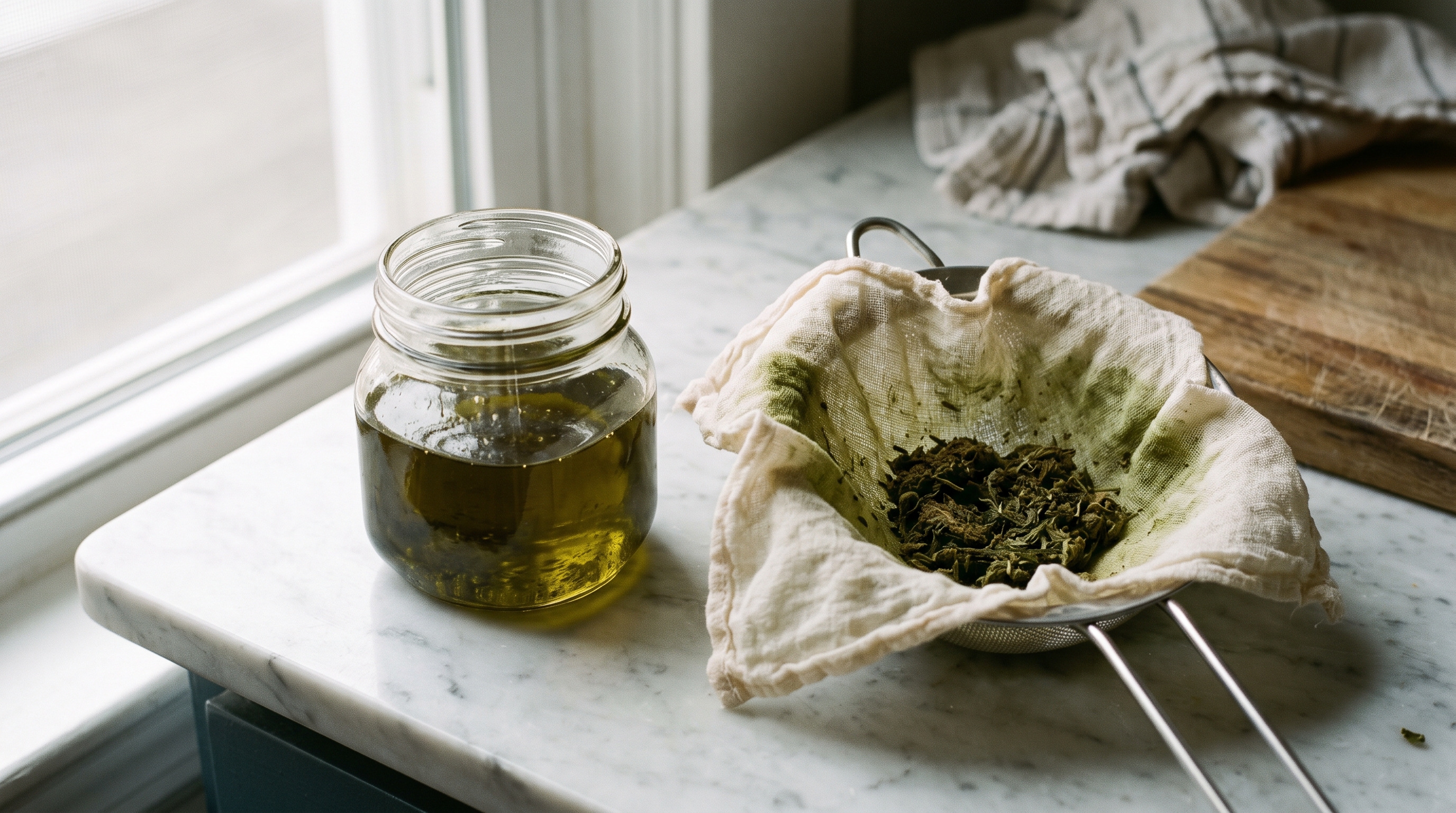
The variable that beats all three appliances
Here is the uncomfortable part. You can nail your temperature to a tenth of a degree and still not know how strong your butter is.
Appliance precision only controls the transfer step. It does nothing about the input. The flower going in has a cannabinoid content you probably know only as a number on a label, a terpene profile you almost certainly do not know, and a storage history that has been quietly oxidising it since harvest. Two jars labelled Blue Dream from different growers can differ enough in chemistry to swamp any difference between a slow cooker and a circulator.
That is the recurring theme across cannabis: names are marketing, chemistry is the thing. A Granddaddy Purple and a Northern Lights may both sit in the Relax High family and both point toward sleepy effects, but the myrcene and linalool actually in your jar decide what your butter does. A Durban Poison or Sour Diesel infusion lands somewhere else entirely — closer to Uplift High territory — and a balanced cultivar like Wedding Cake will surprise you in both directions depending on the batch.
So do the two things that actually pay off. First, run the dosing maths on every batch and, if you can, test the finished potency rather than guessing from a label. Second, write down what happened — which flower, which method, which temperature, and how it actually felt two hours later. That log is the only instrument that measures the variable none of these appliances touch: you. If you would rather not keep it in a notebook, the High IQ app is built to track exactly that.
Then start where you should always start with homemade edibles: low, and patient. Your appliance got more precise. Your tolerance did not.
FAQ
Do I still need to decarb separately if I’m infusing for four hours anyway? Yes. At 85°C, decarboxylation is slow — Wang’s group did not even see completion at 95°C within their 60-minute window. Long warm infusions convert some THCA, but not reliably all of it. Decarb hot and fast first, then infuse warm and long. They are two different jobs.
Is 157°C really safe to exceed? The 157°C figure is a vaporiser-chart convention, not a degradation threshold. The measured onset of neutral cannabinoid loss in Urvashi’s pressurised study was 160°C after 30 minutes. That said, there is no benefit to running an infusion that hot, and plenty of downside — stay in the 85–120°C band and the question does not arise.
Will a sealed jar explode in a pressure cooker? Not if you seal it fingertip-tight rather than fully tightening it, which lets pressure equalise. This is standard practice for pot-in-pot cooking. Do not fully torque the ring down.
Does a longer infusion always mean a stronger result? No. Transfer into fat is largely complete well before most recipes say stop, and additional hours mainly add oxidation and chlorophyll extraction. That is a large part of why some edibles taste so aggressively green.
Can I use the same method for coconut oil, butter and olive oil? Yes, the temperature logic is identical. What differs is the fat itself — saturation, water content and flavour all matter, and butter’s milk solids behave differently from coconut oil. Our guide to choosing a fat covers the trade-offs, and there is a vegan route if you need one.
How should I store the finished oil? Airtight, refrigerated, and away from light — the same oxidation chemistry that turns THC into CBN during cooking keeps working slowly in your fridge. If you are new to this, start here and read up on storing cannabis generally.
Sources
- Wang M, Wang Y-H, Avula B, Radwan MM, Wanas AS, van Antwerp J, Parcher JF, ElSohly MA, Khan IA. “Decarboxylation Study of Acidic Cannabinoids: A Novel Approach Using Ultra-High-Performance Supercritical Fluid Chromatography/Photodiode Array-Mass Spectrometry.” Cannabis and Cannabinoid Research, 2016. doi:10.1089/can.2016.0020
- Perrotin-Brunel H, Buijs W, van Spronsen J, van Roosmalen MJE, Peters CJ, Verpoorte R, Witkamp G-J. “Decarboxylation of Δ9-tetrahydrocannabinol: Kinetics and molecular modeling.” Journal of Molecular Structure, 2011. doi:10.1016/j.molstruc.2010.11.061
- Urvashi, Han J-H, Hong M, Kwon T-H, Druelinger M, Park S-H, Kinney CA, Olejar KJ. “Thermo-chemical conversion kinetics of cannabinoid acids in hemp (Cannabis sativa L.) using pressurized liquid extraction.” Journal of Cannabis Research, 2024. doi:10.1186/s42238-024-00243-x — PubMed 39080738
- Turner CE, Elsohly MA. “Constituents of Cannabis sativa L. XVI. A possible decomposition pathway of Δ9-tetrahydrocannabinol to cannabinol.” Journal of Heterocyclic Chemistry, 1979. doi:10.1002/jhet.5570160834
- Terpene boiling points: PubChem, citing the CRC Handbook of Chemistry and Physics and the Merck Index, all values at 760 mmHg.
- Slow cooker temperature range: USDA Food Safety and Inspection Service, “Slow Cookers and Food Safety.”
- Infused oil safety: University of Georgia Extension, “How to Safely Make Infused Oils.”
