Can THC Make You Hear Speech in Noise? What the Tests Found
THC increased speech reports in noise in one experiment, but another was null. See why false reports differ from sharper hearing or a diagnosis.

THC-containing cannabis increased the odds of repeated speech reports in noise in one controlled experiment, but another experiment found no clear effect. These were reports during clips containing no speech. That does not establish sharper hearing or diagnose why a particular person hears something. Mokrysz and colleagues
Here in High School, the useful question is simple: Did the sound contain speech, or did the listener report speech? A test can separate those things because researchers know what they played.
The opening illustration separates noise input from reported speech. Its textures and bubble are symbols, not sound measurements.
What did the cannabis experiments actually find?
Two experiments in one paper tested the same speech-in-noise task. Keep the outcome beside the exposure and limit:
| Experiment and endpoint | Exposure | Finding | Main limit |
|---|---|---|---|
| 17 adults: speech reports in noise-only clips | Vaporized cannabis: nominal 8 mg THC, then a 4 mg top-up; with or without CBD, versus placebo | No significant overall drug effect on speech illusion | Small selected sample; not evidence that all exposures are equivalent |
| 20 adult men and 20 adolescent boys: same task | Vaporized THC-rich cannabis, weight-adjusted to about 8 mg THC at 75 kg, versus placebo | More speech illusion after cannabis in the pooled analysis | Mixed ages, all male, current users; not a clinical-risk estimate |
Original accepted manuscript: methods, results and tables.
Those amounts describe the experiments, not a recommended dose or measured amount reaching the brain. The first study supplied a top-up; the second did not. Collapsing them into one identical exposure would lose an important detail.
The first study’s overall speech result was nonsignificant, with P = .348. The second study’s drug result was significant, with P = .009. Reading only the positive result makes the evidence seem more consistent than it was. Reading only the null result misses the other experiment. Mokrysz et al.
The paper reports funding for the first study from Drug Science, Channel 4 Television and the Beckley Foundation. The second had an MRC studentship supporting its first author. The authors declared no conflict of interest. Those disclosures belong alongside the methods and results. Study disclosures
What does “speech illusion” mean in this task?
It means reporting speech when the played clip contained only white noise. Participants wore headphones and heard short clips in random order. Some contained clear speech, some barely audible speech and some no speech at all.
They answered whether they heard speech with positive, negative or neutral content, nothing, or something uncertain. The researchers counted speech reports on the noise-only trials. Their scoring rule classified repeated reports as speech illusion. It was a research outcome, not a test that diagnosed a disorder. Task methods
The actual speech clips encouraged listeners to expect speech elsewhere in the task. That matters: this was a deliberately uncertain listening situation, not a recording of someone’s everyday fan experience. It also does not prove that expectation alone caused the difference after cannabis.
Our placebo and THC expectation lesson explains why instructions, ingredients and reported feelings need separate comparisons. This speech task did not independently manipulate each of those factors.
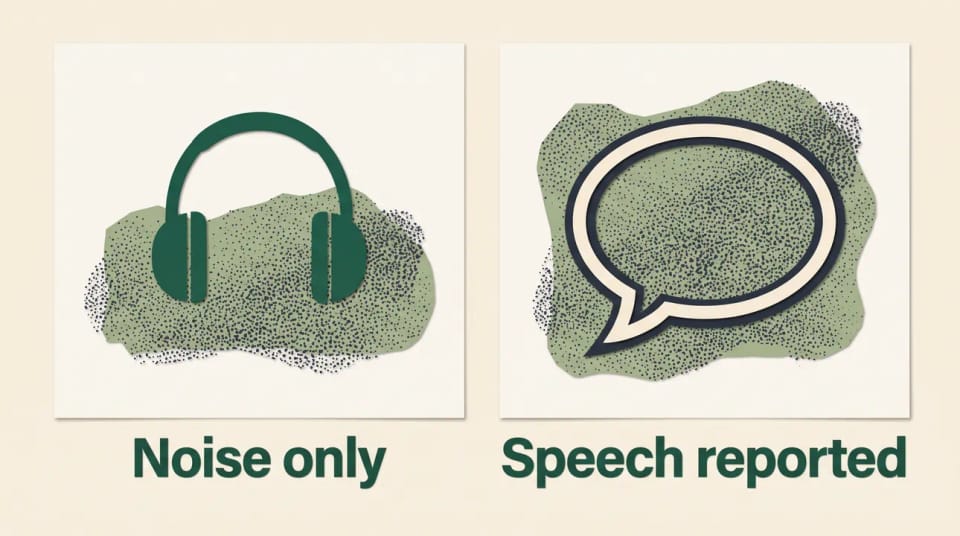
Noise-only input and a speech report are different things. This conceptual diagram shows the task distinction, not a result rate or a diagnostic test.
Is hearing speech in noise the same as better hearing?
No. Finding a real quiet voice and reporting a voice that was absent are different outcomes. Successful detection requires a signal that was actually there. More reports alone do not establish more accurate detection.
Our hearing-test evidence lesson asks about real sound thresholds and brain responses. This lesson asks about false speech reports. Neither test is a score for how enjoyable a song feels.
A similar distinction appears in our false-memory lesson: accepting an extra detail differs from correctly remembering more details. The analogy separates outcomes. It does not establish that memory errors and speech illusions have the same mechanism.
Did CBD prevent speech illusion?
The first experiment did not establish that benefit. Adding CBD to the tested cannabis did not significantly change speech illusion compared with cannabis containing negligible CBD. Both active conditions increased some self-rated psychotic-like symptoms, while the speech task’s overall drug effect remained null. Mokrysz et al.
Questionnaire changes and task changes did not line up neatly. The researchers also found no significant association between self-rated perceptual distortion and speech illusion in either experiment. A broad feeling of altered perception cannot stand in for this task result.
This was CBD administered with cannabis, not a treatment given afterward. It cannot establish a retail CBD remedy, or tell us what every dose and route would do.
Can this explain voices in a fan while high?
It offers a relevant research comparison, not a personal explanation. These experiments used controlled clips, selected current users and laboratory exposure. They did not test household fans or assess a reader’s hearing, sleep, medicines or health.
Both studies excluded people with relevant psychosis histories. The second included only males. Age differences in speech illusion were nonsignificant; that does not establish that younger people are protected. Small samples and noticeable intoxication also limit how far a blinded comparison can reach. Original study limitations
The same boundary applies to certainty. Our confidence and accuracy lesson distinguishes a strong judgment from a checked answer. These experiments cannot certify a particular perception as accurate or harmless.
When should hearing voices get medical attention?
Seek urgent medical assessment if you hear voices or sounds that others do not hear. NHS guidance lists multiple possible causes and recommends assessment. Do not use a noise task, a forum reply or the fact that you used cannabis to decide the cause. NHS guidance
Seek emergency help through your local emergency services for voices telling you to harm yourself or someone else, sudden confusion, or rapidly worsening hallucinations. There is no requirement to wait two days or until sober before seeking help. The NHS page gives UK contact routes; use the emergency service where you are.
Our detachment-versus-diagnosis lesson addresses a different experience. Its shared principle is useful here: describing a symptom supplies information for assessment, rather than making the diagnosis.
Key takeaways
- A speech report in a noise-only clip is a different outcome from detecting real speech.
- One cannabis experiment found an increase; the other had a null overall speech result.
- These task findings do not diagnose fan sounds, establish youth safety or validate CBD as a remedy.
FAQ
Does the study prove THC improves hearing?
No. Its key outcome counted speech reports when no speech was played. A higher count of false reports is not improved detection of actual sounds.
Does a speech illusion mean schizophrenia?
The task did not diagnose schizophrenia or follow participants to measure later diagnoses. It cannot diagnose you either. Hearing voices deserves medical assessment rather than a conclusion from a task score. NHS
Does switching from sativa to indica prevent it?
These experiments did not test that strategy. Neither a strain label nor a product classification establishes prevention. They offer no evidence for using a different cannabis product as a remedy.
Can I recreate the noise test to check myself?
It is not a home diagnostic test. Researchers used known recordings and a scoring rule for a specific comparison. A homemade version cannot decide why you hear something or whether you need care.
Sources
- Mokrysz C, Shaban NDC, Freeman TP, Lawn W, Pope RA, Hindocha C, Freeman A, Wall MB, Bloomfield MAP, Morgan CJA, Nutt DJ, Curran HV. Acute effects of cannabis on speech illusions and psychotic-like symptoms: two studies testing the moderating effects of cannabidiol and adolescence. Psychological Medicine 51(12):2134–2142 (2021; online 2020). Mokrysz et al., DOI; full accepted manuscript.
- NHS. Hallucinations and hearing voices. Reviewed July 28, 2025. Definitions and current care guidance.





