Does THC Disappear From a Filled Volcano Balloon?
THC can leave the airborne vapor inside a filled Volcano balloon and collect on its walls. Learn what the lab measured and why timing claims need limits.

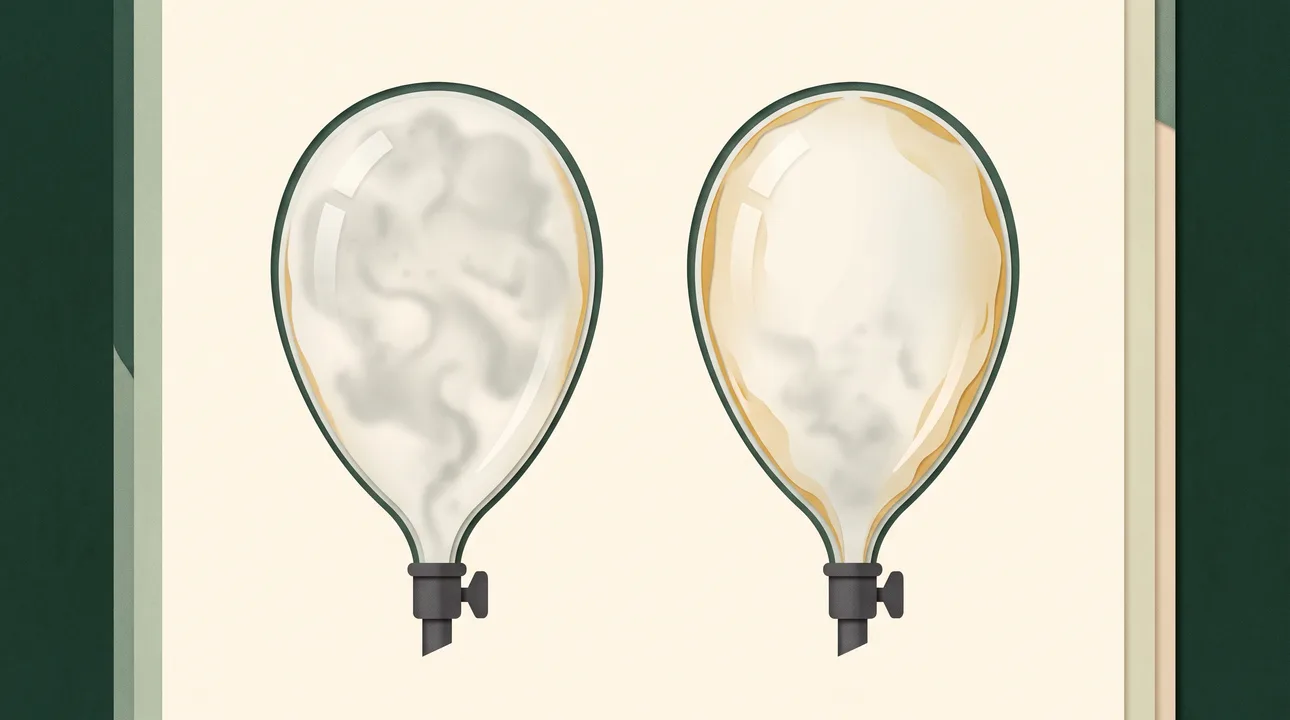
THC can leave the airborne vapor in a filled Volcano balloon and collect on its inner wall; that does not mean the THC has been chemically destroyed. A laboratory study measured this change over time. The useful lesson is about where the THC is, rather than a universal expiry time for every bag.
Here in High School, keep three things separate: the material loaded into a vaporizer, what reaches the balloon, and what remains airborne while the balloon waits. Calling all three “the dose” hides the question you are trying to answer.
What did the balloon experiment actually measure?
Hazekamp and colleagues’ 2006 study tested the original Volcano with purified THC on a liquid pad. The waiting-time experiment used 2 mg THC, roughly 8-liter balloons, a room near 22°C and 40–60% humidity. Each time condition was tested three times.
After five minutes, less than 2% of the loaded THC was recovered from the balloon’s inner surface in a separate wall-extraction experiment. After 180 minutes, the researchers reported almost no THC recoverable from the airborne-vapor extracts. The graph does not show an exact zero. The researchers attributed the decline to condensation.
Those findings answer different questions. The first measures material on the wall against the original load. The second measures what can still be collected from the air. Neither says that 98% of the original load was available to inhale at five minutes.
| Measurement | What its number refers to | What it cannot tell you alone |
|---|---|---|
| THC loaded into the chamber | Starting material | Amount reaching the balloon |
| THC collected from balloon air | Airborne fraction sampled | Amount absorbed by a person |
| THC extracted from the wall | Material deposited on the bag | Remaining airborne concentration |
The manufacturer supplied the study’s devices. That disclosure belongs beside the result and its narrow setup.
Is condensation the same as THC breaking down?
No. A change in location and a change in chemical identity are different claims. Think of the distinction as “on the balloon” versus “in the balloon’s air.” Material deposited on a surface is no longer part of the airborne fraction being sampled.
The bag can therefore remain inflated while the amount available in its airborne contents changes. A closed valve answers whether the balloon is open; it does not establish that its contents stay unchanged. This is why “the balloon still looks full” is a poor argument for a fixed delivered amount.
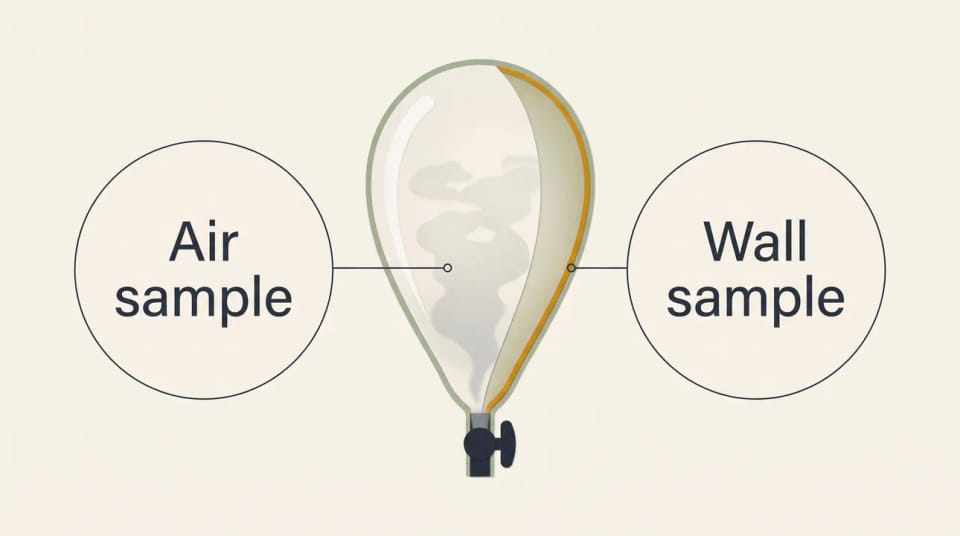
Air sampling and wall extraction answer different questions. This illustration shows locations, not measured amounts.
Our dry-herb temperature lesson covers the heating stage. This article covers a later stage: the filled balloon after vaporization. Raising a heater setting and changing the time a filled bag waits are different variables.
Can you calculate a universal THC half-life for a balloon?
Not from these findings. Two reported observations do not supply a decay rule for every device, bag and material. A half-life would need a defined measured quantity and a model that fits its change under stated conditions.
The distinction is practical when you read a claim such as “all bags lose half their potency after fifteen minutes.” Ask: half of the loaded THC, half of the airborne THC, or half of a person’s subjective effect? Ask what setup was tested. If those answers are missing, the percentage has no clear meaning.
The experiment does not establish an exact countdown for modern flower-filled balloons, other brands, or different rooms. It also does not turn the three-hour observation into a recommended waiting period.
Does newer vaporizer research settle the waiting-time question?
Lanz and colleagues’ 2016 laboratory comparison tested a Volcano Medic and other devices with plant material and cannabinoid standards. Researchers collected vapor, residue and material from device parts separately. They explicitly noted that cannabinoids deposited on the Volcano balloon were not measured.
That matters: a study of extraction efficiency is not automatically a study of a filled balloon waiting. An unmeasured fraction is not proof that nothing was deposited there. The comparison adds context to the accounting problem; it does not independently reproduce the 2006 time curve.
Our bioavailability lesson explains the next distinction: recovering THC from a device is different from showing how much enters someone’s circulation.
What does the manufacturer advise for a session?
Storz & Bickel’s current Volcano Classic manual says to fill only the approximate amount you intend to use within ten minutes. They also advise against completely filling the balloon to the point of overpressure.
Treat that as an operating instruction, not a laboratory promise of zero loss before minute ten or sudden failure afterward. It is not a reason to rush or inhale more than you intended. The useful adjustment is the amount prepared for a session, rather than a race to finish a large bag.
For device choices, see our vaporizer guide. For the distinction between flower devices and cartridges, use the dry-herb versus oil-vape comparison. A balloon result should not be carried across those formats without evidence.
High Families classifies products for browsing. A family name does not predict how quickly material will deposit inside a device.
Key takeaways
- Airborne THC, wall deposits and the original load are separate quantities.
- Condensation does not, by itself, demonstrate chemical destruction.
- The 2006 results come from a specific device and laboratory preparation.
- Follow your model’s operating instructions without turning them into a potency timer.
FAQ
Can I save a filled Volcano balloon until tomorrow?
The manufacturer’s guidance is to prepare the amount intended for the next ten minutes. A filled balloon is a session component, not a way to preserve a known airborne dose overnight.
Does a sealed valve prevent this loss?
A sealed valve and material collecting inside the bag address different things. Keeping the balloon closed does not establish that all THC remains airborne.
Does less visible vapor mean a precise percentage less THC?
No validated visual percentage is provided by these studies. Cloud appearance is not a calibrated cannabinoid measurement. Avoid turning a photograph or a fading cloud into a dose calculation.
Does this tell me how long my high will last?
No. The experiment concerns a device’s contents before inhalation. Your high’s duration is a different question. The elapsed time on a bag cannot answer it.
Sources
- Hazekamp A, Ruhaak R, Zuurman L, van Gerven J, Verpoorte R. (2006). Evaluation of a vaporizing device (Volcano®) for the pulmonary administration of tetrahydrocannabinol. Journal of Pharmaceutical Sciences. 95(6):1308–1317. DOI: 10.1002/jps.20574. PMID: 16637053.
- Lanz C, Mattsson J, Soydaner U, Brenneisen R. (2016). Medicinal Cannabis: In Vitro Validation of Vaporizers for the Smoke-Free Inhalation of Cannabis. PLOS ONE. 11(1):e0147286. DOI: 10.1371/journal.pone.0147286. PMID: 26784441.
- Storz & Bickel. Volcano Classic: Operation. Manufacturer support instructions, accessed October 11, 2026. Current instructions.
- Storz & Bickel. Volcano Classic: Instructions for Use. VAL-30-205, June 2025; section 5. Manufacturer manual.





