Orange Hairs on Weed: Ripe, Strong or Old? What the Evidence Says
Weed with orange hairs is normal. Pistil color is a rough ripeness clock, not a potency or freshness test. Here is what the one lab study found.

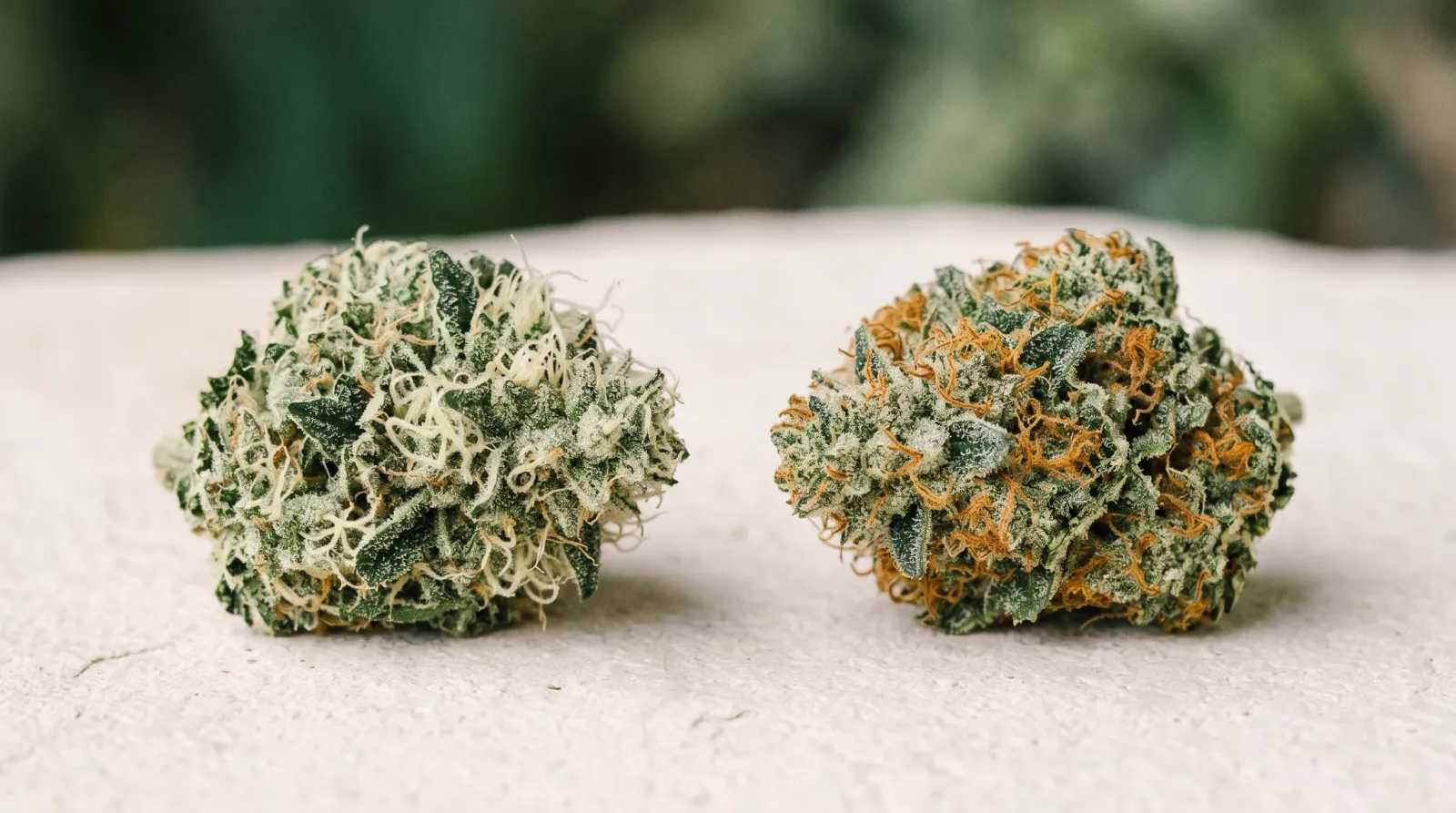
Orange hairs on weed show how far the flower ripened, not how strong or fresh it is. The hairs are the flower’s stigmas, and they darken from white toward orange, red or brown as the plant matures. The THC is made somewhere else: in the frosty resin glands on the small leaves around them.
That one fact settles most of the arguments. The only study that has set hair color against lab-measured cannabinoids tested 25 genotypes. In 22 of them, total cannabinoids peaked when the hairs were “mostly” or “fully” amber. In three, the peak came earlier, and in one it came while the hairs were still all white. Tran et al. 2025 The hairs are a clock, not a THC meter.
| Your question | What hair color can tell you | What it cannot tell you | What to check instead |
|---|---|---|---|
| Is it ripe? | A rough sign of how far the plant matured before harvest | The exact best day for a given plant | The resin heads, with a loupe |
| Is it strong? | Nothing reliable | How much THC is in this bud | The lab test on the label |
| Is it old? | Nothing; dried hairs are orange anyway | How long it sat on a shelf | Smell, moisture, package date and storage |
What are the orange hairs on weed?
They are stigmas, the part of the female flower that catches pollen. Growers usually call them pistils. In the botany papers, the visible hair is the stigma, and each female flower grows two of them. They push out from a small leafy cup called the bract, usually at uneven lengths. Spitzer-Rimon et al. 2019
The same study shows where the resin sits. Many glandular trichomes grow on the bract that wraps the ovary, and they appear before the stigmas lengthen. Spitzer-Rimon et al. 2019 Microscope work on high-THC plants also finds the large capitate trichomes on the bracts. Punja et al. 2023
That matters because the trichomes are the factories. Stalked glandular trichomes hold high levels of cannabinoids, and they strongly express the genes that build cannabinoids and terpenes. Livingston et al. 2020 For the full tour of those glands, see our guide to cannabis trichomes and their clear, cloudy and amber stages.
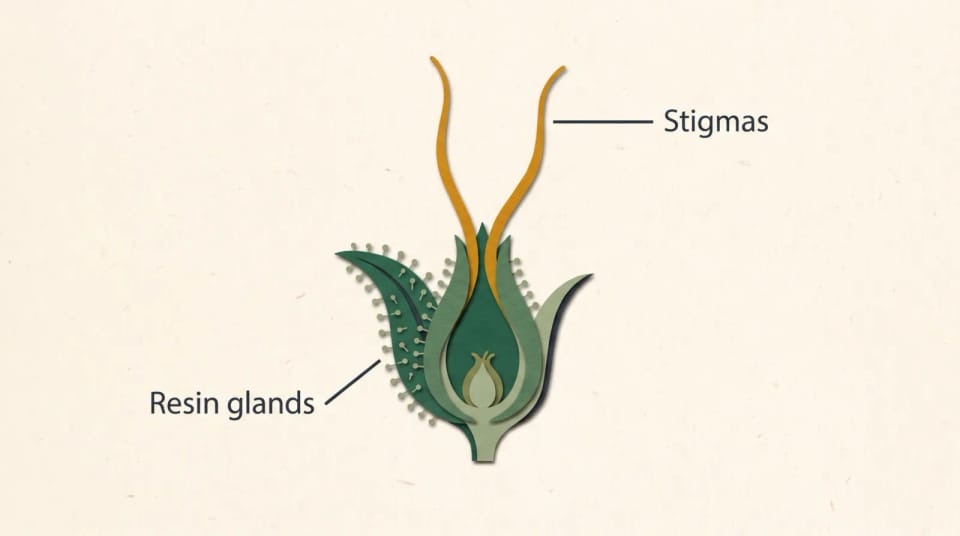
The hairs and the resin are different parts of the flower. Cannabinoids and terpenes are made in the resin glands on the bract, not in the stigmas.
Do orange hairs mean the weed is ripe?
Roughly, yes, at the level of the whole plant, with real exceptions. As cannabis flowers mature, the stigmas shift from whitish-yellow to reddish-brown. Two independent microscope studies describe that same change. Hesami et al. 2023, Punja et al. 2023
The 2025 Tran study is the first to test the folk rule with lab chemistry. The authors note that the popular link between stigma color and cannabinoid production “has not been explored scientifically” before. They grew 25 diverse genotypes and cut one flower cluster from each plant at four visual stages: fully white, some amber, mostly amber and fully amber. Then they measured 14 cannabinoids in each sample. Tran et al. 2025
Here is what they found:
- Concentration: 10 genotypes peaked at “mostly amber” and 12 at “fully amber”. Two peaked at “some amber” and one at “fully white”.
- Total yield: when they multiplied concentration by flower weight, 7 genotypes peaked at “mostly amber” and 18 at “fully amber”.
- Color itself: the hairs did not all turn the same shade. Depending on the genotype, they went from white to yellow, orange, amber, red or brown.
The authors conclude that the “mostly amber” rule of thumb “is still a useful approximation in most cases”, but that each genotype needs its own study. Tran et al. 2025 Keep the limits in view too. Each genotype was one plant with no replicates, grown in Australian tents, and each stage was a different flower cluster on that plant.
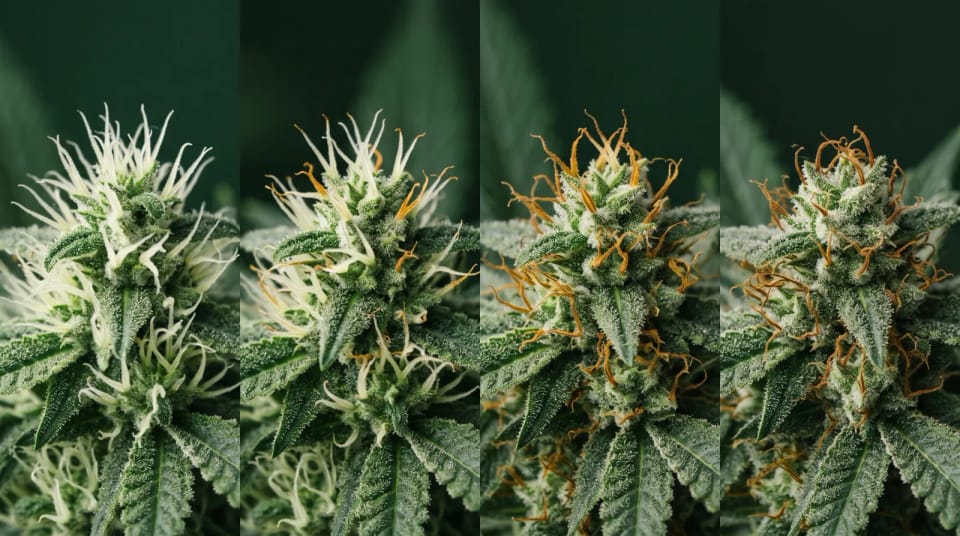
An illustration of the four visual stages used in the 2025 stigma study: fully white, some amber, mostly amber and fully amber. Most plants peaked late, but not all of them.
For growers, the better signal is the resin. Trichome heads move from clear to cloudy to amber as they age, and they develop at different times, so one bud carries glands at mixed stages. Punja et al. 2023 Our walk-through on reading trichomes with a loupe shows how to use that.
Do orange hairs mean stronger weed?
No. Hair color does not measure how much THC is in the bud you are holding. The cannabinoids are made in the resin glands, not in the hairs. Livingston et al. 2020
The Tran numbers make the point another way. Across the 100 samples, total cannabinoids ranged from 4.03 to 87.06 mg/g. Tran et al. 2025 Every genotype was sampled at every color stage. So the hair color told you where each plant was in its own ripening. It could not tell you which plant sat near the top of that range.
That study also measured plants at harvest, not cured flower from a shop. I found no study that tested hair color against potency in finished retail flower. If potency matters to you, read the lab result, and know that THC labels on flower have their own accuracy problems. Color myths travel in packs; the same logic applies to why some cannabis turns purple.
Do orange hairs mean old weed?
No study I found links hair color to how old flower is. Orange hairs on dried flower are the expected state, not a warning sign. In one microscope study, the stigmas “developed a deep tan-orange color” after harvest and drying. That observation comes from one dried bud in a figure, so treat it as a description, not a measurement. Punja et al. 2023 Our guide to drying and curing cannabis covers what happens in that step.
Freshness lives in chemistry you can smell, not in hair color. In a one-year storage study, terpenoid levels “decreased rapidly under all storage conditions”. Room temperature at 25 C caused the largest changes in cannabinoids, and whole flower kept at 4 C held up best. Milay et al. 2020 That study stored flower in the dark and did not record hair color. For the practical side, see how to store cannabis.
Does dark orange or brown mean the bud was pollinated?
Not on its own. In plants in general, pollination triggers color changes and early aging in the flower parts that received the pollen. O’Neill 1997 That is a review of plant biology broadly. I found no cannabis study that measured stigma color in pollinated against unpollinated flowers.
What the cannabis evidence does show is that pollination costs potency. In a study of two cultivars, fertilization “significantly decreased phytocannabinoids content” no matter which plant supplied the pollen. Lipson Feder et al. 2021 The authors tie this to “sinsemilla”, Spanish for “without seed”, the seedless flower growers aim for. The sign of pollination to look for is a seed, not a hair color. Our guide to feminized, autoflower and regular seeds explains why most growers keep male plants out.
What should you check instead of hair color?
Hair color answers none of the three questions well. These four checks answer them better.
- Look at the resin, not the hairs. A loupe or a phone macro lens shows the frosty glands on the small leaves. That is where the cannabinoids and terpenes are made. Livingston et al. 2020
- Smell it. Terpenes fall during storage, so a faint or flat aroma is a reason to ask how the flower was stored. Milay et al. 2020
- Read the label. Find the harvest or packaging date and the lab-tested cannabinoid numbers.
- Check for mold and seeds. Fuzzy, gray or web-like growth matters far more than hair color. Our guide to telling mold from trichomes shows the difference.
For a longer walk-through, here in High School we keep a buyer’s quality checklist covering color, smell, cure and trim. And the most useful test of a bud is how it worked for you; the High IQ app lets you track how a strain worked after each session, so your notes do the judging instead of the hair color.
If you cough, wheeze or feel unwell after smoking flower you think was moldy, stop using it and talk to a clinician.
Sources
-
Tran J, Dimech AM, Vassiliadis S, Elkins AC, Cogan NOI, Naim-Feil E, Rochfort SJ. “Determination of Optimal Harvest Time in Cannabis sativa L. Based upon Stigma Color Transition.” Plants (Basel). 2025;14(10):1532. DOI: 10.3390/plants14101532
-
Punja ZK, Sutton DB, Kim T. “Glandular trichome development, morphology, and maturation are influenced by plant age and genotype in high THC-containing cannabis (Cannabis sativa L.) inflorescences.” Journal of Cannabis Research. 2023;5:12. DOI: 10.1186/s42238-023-00178-9
-
Lipson Feder C, Cohen O, Shapira A, et al. “Fertilization Following Pollination Predominantly Decreases Phytocannabinoids Accumulation and Alters the Accumulation of Terpenoids in Cannabis Inflorescences.” Frontiers in Plant Science. 2021;12:753847. DOI: 10.3389/fpls.2021.753847
-
Spitzer-Rimon B, Duchin S, Bernstein N, Kamenetsky R. “Architecture and Florogenesis in Female Cannabis sativa Plants.” Frontiers in Plant Science. 2019;10:350. DOI: 10.3389/fpls.2019.00350
-
Livingston SJ, Quilichini TD, Booth JK, et al. “Cannabis glandular trichomes alter morphology and metabolite content during flower maturation.” The Plant Journal. 2020;101(1):37-56. DOI: 10.1111/tpj.14516
-
Hesami M, Pepe M, Jones AMP. “Morphological Characterization of Cannabis sativa L. Throughout Its Complete Life Cycle.” Plants (Basel). 2023;12(20):3646. DOI: 10.3390/plants12203646
-
Milay L, Berman P, Shapira A, Guberman O, Meiri D. “Metabolic Profiling of Cannabis Secondary Metabolites for Evaluation of Optimal Postharvest Storage Conditions.” Frontiers in Plant Science. 2020;11:583605. DOI: 10.3389/fpls.2020.583605
-
O’Neill SD. “Pollination Regulation of Flower Development.” Annual Review of Plant Physiology and Plant Molecular Biology. 1997;48:547-574. DOI: 10.1146/annurev.arplant.48.1.547
Key takeaways
- Orange hairs are stigmas darkening with age; they are normal on almost all cured flower.
- In the one lab study, 22 of 25 genotypes peaked late in hair color, but 3 did not.
- Hair color does not measure THC; the resin glands on the bracts make the cannabinoids.
- No study ties hair color to how old flower is; smell, storage and dates carry that.
- Check resin, smell, the lab label, mold and seeds before you judge a bud.
FAQ
Should weed have orange hairs?
Yes, cured flower almost always does. Stigmas darken as the plant matures, and one microscope study found they turn a deep tan-orange after harvest and drying. Orange hairs on a dried bud are the expected state, not a sign of a problem.
What do red hairs on weed mean?
Red is a shade, not a grade. In the 2025 stigma study, hairs ripened from white to yellow, orange, amber, red or brown depending on the genotype. A red-haired bud is not riper or stronger than an orange-haired one because of that color.
Do dark orange hairs mean PGR weed?
I found no study linking dark or orange hairs to plant growth regulator use, and none ruling it out. Hair color is not a test for how a plant was grown. A lab test and a seller’s records are the only real checks.
Are white hairs on weed bad?
On a living plant, fully white hairs usually mean it is early in ripening, though one genotype in the 2025 study peaked at that stage. On dried flower, lots of bright white hairs can hint at an early harvest. Treat it as a hint, then check the resin, smell and lab label.
Does more orange mean better weed?
No. More orange means the flower ripened further, which tracked a later cannabinoid peak in most but not all plants in the one study. It says nothing reliable about the THC in a given bud, its freshness or how it will feel for you.





