Can You Get a Tattoo High? What Artists, Laws and Pain Studies Say
Can you get a tattoo high? Studies show weed can make pain feel less unpleasant, not less intense, and artists and some state rules can turn you away.

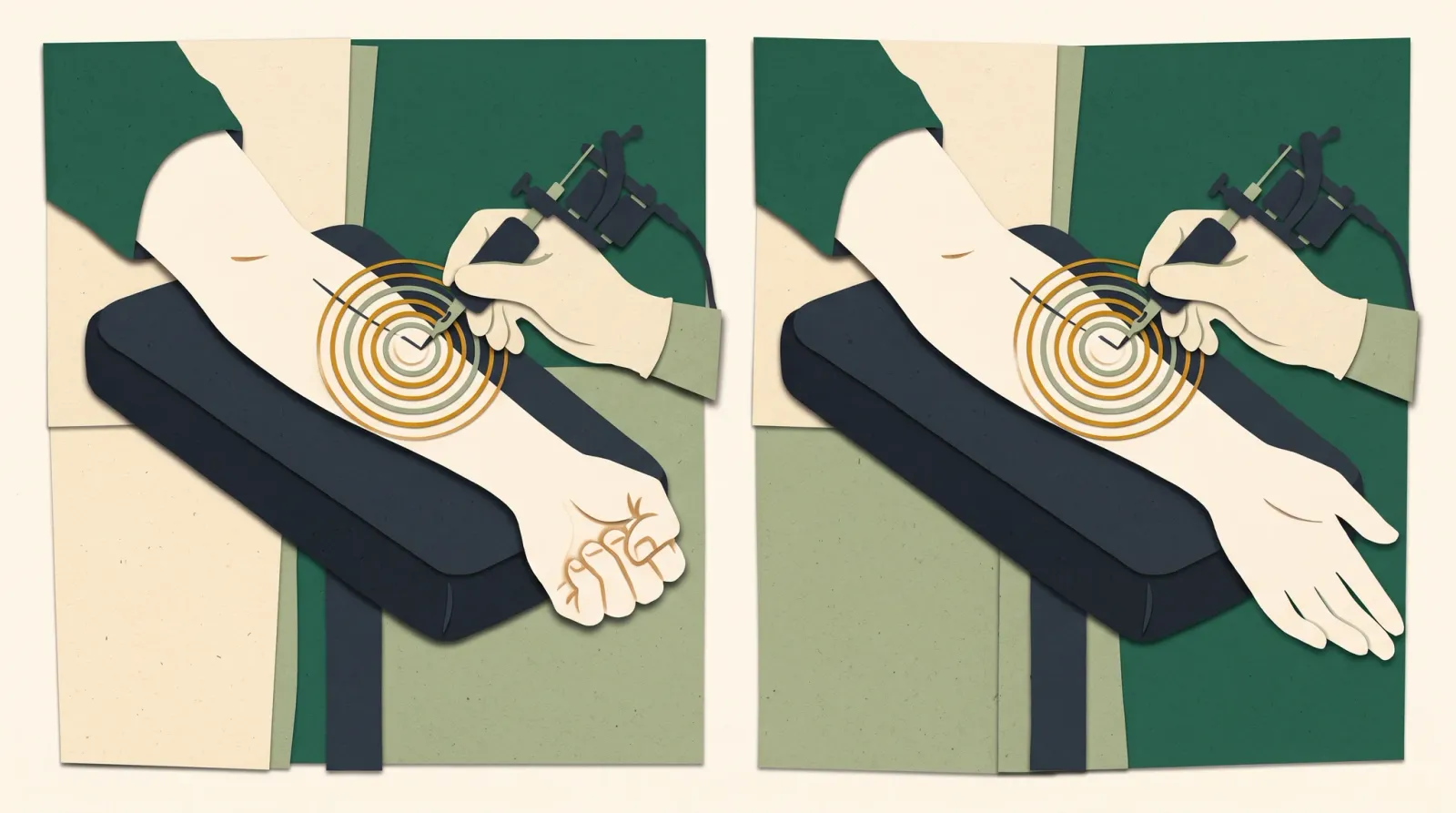
You can get a tattoo high only if the artist agrees, and many will not: rules in Texas, Michigan, Wisconsin and Tennessee tell artists not to tattoo a person under the influence of drugs. The pain evidence gives you a weak reason to try anyway. In lab experiments, cannabinoids made pain feel less unpleasant, but they did not reliably make it less intense.
Search this question and you get a forum argument. Some people swear by it. Others say it made them anxious and more sensitive. Shop pages and cannabis blogs contradict each other on bleeding, and none of them cite a study. Here is the part they skip: no human study of cannabis and tattoo pain, bleeding or healing turned up in our PubMed search. What does exist is a pain meta-analysis, a handful of controlled trials, and the written rulebook.
Sources and rules checked October 29, 2026. This article explains evidence and rules. It is not medical advice.
Does being high make a tattoo hurt less?
Probably not in the way people hope. A 2018 meta-analysis pooled 18 placebo-controlled studies with 442 healthy adults. Cannabinoids did not reliably lower pain intensity (Hedges g = 0.017, 95% CI -0.120 to 0.154). They did make ongoing pain feel less unpleasant (g = 0.288), and they slightly raised pain threshold and tolerance. De Vita et al., JAMA Psychiatry, 2018
In plain words: the needle may register just as strongly, but it may bother you a little less. We unpack that split in our lesson on pain that bothers you less without hurting less, including the brain-imaging study behind it. Lee et al., Pain, 2013
Three caveats matter for a tattoo chair:
- Every study used experimental pain. Volunteers faced heat, cold, pressure, capsaicin or electric stimuli. Nobody tested a tattoo needle.
- More was not better. In one smoked-cannabis trial with 15 volunteers, a medium dose lowered capsaicin pain at 45 minutes, and the high dose raised it. The low dose did nothing. Wallace et al., Anesthesiology, 2007
- Some trials found no relief at all. An oral cannabis extract gave 18 women no pain relief, and electrical pain thresholds dropped. Kraft et al., Anesthesiology, 2008 Intravenous THC made people feel high, with euphoria and a faster heart rate, but it did not change acute pain in five lab tests. Schindler et al., Psychopharmacology, 2020
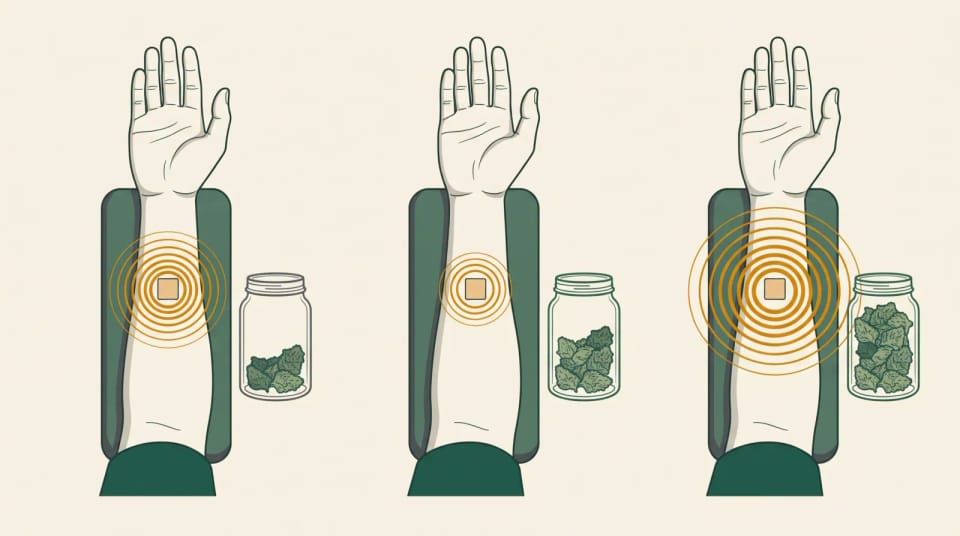
In one small trial, a medium dose eased capsaicin pain and the high dose raised it. It was lab pain in 15 volunteers, not a tattoo, and it is not a dosing guide.
That last result is worth remembering: high is not the same as numb. One study did find less pain sensitivity in daily smokers under controlled dosing, but those results do not carry over to occasional users. Cooper et al., Neuropsychopharmacology, 2013
A tattoo also has no anesthetic to interact with. A hospital tattoo-clinic review describes tattooing as “painful minor surgery performed without anesthesia.” Serup, Curr Probl Dermatol, 2017 Whether cannabis affects dental numbing is a separate question, covered in our guide to weed and dental numbing.
What actually makes a tattoo hurt more?
Time and stress, according to the people who sat through it. A survey of 1,092 tattooed adults linked more pain during tattooing to longer sessions and higher stress. Bleeding showed a borderline link (P = .052). Witkoś and Hartman-Petrycka, IJERPH, 2020 This was self-reported and backward-looking, so it shows an association, not a cause. The paper’s summary does not report cannabis use as a factor.
Stress is where dose matters. In a controlled trial, a lower oral THC dose reduced distress after a public-speaking stress test, while a higher dose made mood worse overall. Childs et al., Drug Alcohol Depend, 2017 That was a speech task, not a tattoo. Still, it matches what readers report: the same plant can calm one person and wind up another. Our cannabis and anxiety guide covers why.
Fainting is the other chair-side worry. Tattooing “can be associated with syncope,” the clinic review notes. Serup, 2017 Separately, THC raises heart rate and occasionally causes a marked drop in blood pressure on standing. Jones, J Clin Pharmacol, 2002 No study has measured whether those two facts add up in a tattoo chair. If you have ever felt dizzy or sick after too much THC, our explainer on greening out describes what is happening.
Does weed make you bleed more during a tattoo?
Nobody has measured it. That is the honest answer, and it is the one both sides of the internet argument skip.
Some lab work points at platelets. Cannabis joint extracts changed how human platelets behaved in a test tube, and the authors say their findings “require confirmation in vivo.” Laflamme et al., Platelets, 2026 Monkeys fed THC edibles daily showed reduced platelet function. Reitsma et al., Am J Physiol Cell Physiol, 2022 Neither study measured bleeding in a person.
The real bleeding concern is narrower. If you take warfarin or certain antiplatelet drugs, cannabis can interfere with how your body processes them. Greger et al., J Clin Pharmacol, 2020 That is a drug interaction in people on those medicines. It is not proof that weed alone makes a tattoo bleed. Our cannabis and blood thinners guide explains the interaction.
Healing has the same gap. We found no human study on cannabis and tattoo healing, scarring or ink retention. The FDA’s tattoo safety page focuses on infections from unhygienic practice or contaminated ink, and on reactions that can appear right away or years later. FDA, Think Before You Ink
| Question | What was studied | What it found | What it does not show |
|---|---|---|---|
| Will it hurt less? | Lab pain in healthy volunteers | Less unpleasant, not reliably less intense; mixed by dose | Anything about tattoo needles |
| Will I bleed more? | Platelets in test tubes and monkeys | Platelet changes | Bleeding in a person |
| Will it heal worse? | Nothing found | No data | Either outcome |
| Will the artist do it? | State rules and trade standards | Several bar it | A nationwide rule |
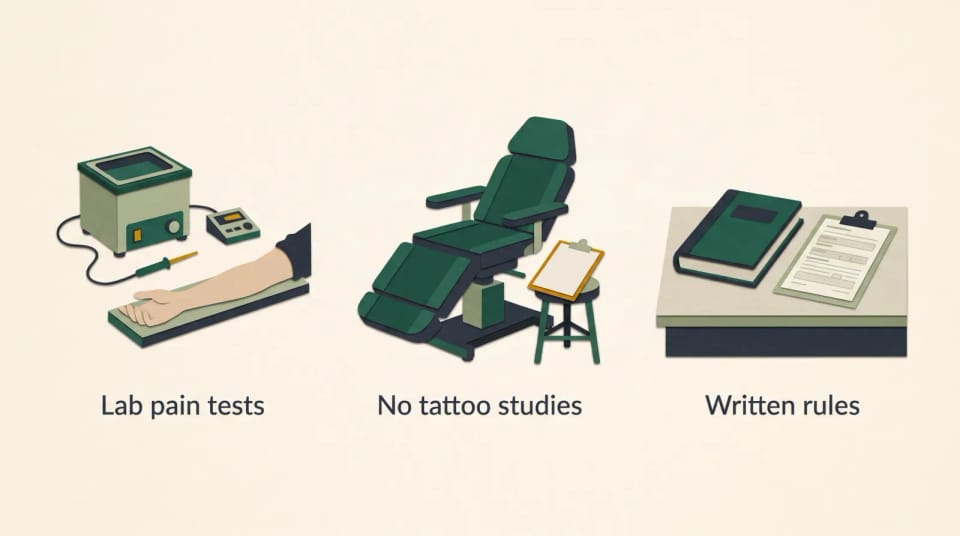
The pain answer comes from lab experiments, the bleeding and healing answers have no tattoo study behind them, and the permission answer comes from written rules.
Will a tattoo artist tattoo you if you are high?
In several states, the written rules tell them not to. Each rule uses different words, and the words matter:
- Texas: a tattooist may not tattoo “a person who the tattooist suspects is under the influence of alcohol or drugs.” Texas Health and Safety Code Sec. 146.012 The state’s studio checklist applies the same standard to body piercing. Texas DSHS
- Michigan: no one may tattoo, brand or pierce a person who “is under the influence of alcoholic liquor or a controlled substance.” MCL 333.13112
- Wisconsin: a tattooist or body piercer may not work on “a person who appears to be under the influence of alcohol or a mind-altering drug.” The same section requires signed, informed consent. Wis. Admin. Code SPS 221.10
- Tennessee: “No person shall tattoo another person who is under the influence of drugs or alcohol.” Tenn. Comp. R. & Regs. 1200-23-03-.02
Notice the standards: Texas turns on what the artist suspects, and Wisconsin on how you appear. The rules we read bind the artist, not the client. They also do not say whether state-legal adult-use cannabis counts as “drugs” or a “controlled substance,” so we will not guess. Other places write it differently. The District of Columbia, for example, restricts an impaired body artist and says nothing about the client. D.C. Code Sec. 47-2853.76e
So check your own state, and ask the shop. In a state with no client rule, the artist can still say no. It is their license and their work on your skin.
Can you give consent to a tattoo while high?
The piercing trade’s main standard says no. The Association of Professional Piercers states that “an inebriated or medicated person is not legally able to give informed consent,” and that an ethical piercer who notices a client is in an altered state “will refuse to perform the piercing.” APP Procedure Manual That is a professional body’s position, not a court ruling. We are not saying a signed waiver is void.
The manual also warns that a client who is not sober “may bleed more heavily, faint, and/or vomit,” may move suddenly, and may regret the decision later. The association states this without citing a study, so treat it as experience from the trade, not as evidence that cannabis thins blood.
The regret point has a little lab support. In one study of 10 adults, the highest smoked dose made people pick the risky option more often in a choice task. Lane et al., Neuropsychopharmacology, 2005 That is a small lab game, not a tattoo design. But a tattoo is permanent, and a decision you would still make sober is the one worth keeping.
Does the same apply to a piercing?
Mostly, yes. Michigan’s law, Wisconsin’s rule and the Texas studio checklist all name body piercing. Tennessee’s rule quoted above covers tattooing only. And the APP standard, written for piercers, is the clearest professional refusal policy we found. It also says APP does not set procedures for tattooing.
How can you prepare if you use cannabis?
Treat the appointment like any other professional booking. These steps keep you inside the rules and give the artist what they need:
- Ask the shop about its policy. Ask before the day whether it works on clients who have used cannabis. Do not light up in or outside the studio without asking; basic cannabis etiquette applies here too.
- Book a time you will be clear-headed. The artist can refuse you at the door. How long a high lasts depends on how you took it; our guide on how long a cannabis high lasts explains why edibles run longer than smoking.
- Tell the artist about relevant medicines. Mention blood thinners, antiplatelet drugs or a bleeding condition, just as you would tell a surgical team what you use.
- Write down the aftercare steps. Aftercare is a plan you carry out for weeks, and THC can make it easier to forget to carry out a plan.
Shops treat alcohol the same way, and every rule above names it. If you are tempted to calm your nerves with a drink instead, our guide to mixing cannabis and alcohol explains why the two together hit harder.
When to talk to a clinician
Talk to a doctor before a tattoo or piercing if you take blood thinners or antiplatelet drugs, have a bleeding or clotting disorder, have a heart condition, or have fainted during needles or procedures before. Get medical care for signs of infection after the session, such as spreading redness, swelling, pus or fever. Our checklist for talking to your doctor about cannabis helps you raise it without awkwardness.
Sources
- De Vita MJ, Moskal D, Maisto SA, Ansell EB. “Association of Cannabinoid Administration With Experimental Pain in Healthy Adults: A Systematic Review and Meta-analysis.” JAMA Psychiatry. 2018;75(11). DOI: 10.1001/jamapsychiatry.2018.2503
- Wallace M, Schulteis G, Atkinson JH, et al. “Dose-dependent effects of smoked cannabis on capsaicin-induced pain and hyperalgesia in healthy volunteers.” Anesthesiology. 2007;107(5):785-796. DOI: 10.1097/01.anes.0000286986.92475.b7
- Kraft B, Frickey NA, Kaufmann RM, et al. “Lack of analgesia by oral standardized cannabis extract on acute inflammatory pain and hyperalgesia in volunteers.” Anesthesiology. 2008;109(1):101-110. DOI: 10.1097/ALN.0b013e31817881e1
- Schindler EAD, Schnakenberg Martin AM, Sewell RA, et al. “In an exploratory randomized, double-blind, placebo-controlled, cross-over study, psychoactive doses of intravenous delta-9-tetrahydrocannabinol fail to produce antinociceptive effects in healthy human volunteers.” Psychopharmacology. 2020;237(10):3097-3107. DOI: 10.1007/s00213-020-05595-9
- Lee MC, Ploner M, Wiech K, et al. “Amygdala activity contributes to the dissociative effect of cannabis on pain perception.” Pain. 2013;154(1):124-134. DOI: 10.1016/j.pain.2012.09.017
- Cooper ZD, Comer SD, Haney M. “Comparison of the analgesic effects of dronabinol and smoked marijuana in daily marijuana smokers.” Neuropsychopharmacology. 2013;38(10). DOI: 10.1038/npp.2013.97
- Witkoś J, Hartman-Petrycka M. “Gender Differences in Subjective Pain Perception during and after Tattooing.” International Journal of Environmental Research and Public Health. 2020;17(24):9466. DOI: 10.3390/ijerph17249466
- Serup J. “Individual Risk and Prevention of Complications: Doctors’ Advice to Persons Wishing a New Tattoo.” Current Problems in Dermatology. 2017;52:18-29. DOI: 10.1159/000450775
- Jones RT. “Cardiovascular system effects of marijuana.” Journal of Clinical Pharmacology. 2002;42(S1):58S-63S. DOI: 10.1002/j.1552-4604.2002.tb06004.x
- Childs E, Lutz JA, de Wit H. “Dose-related effects of delta-9-THC on emotional responses to acute psychosocial stress.” Drug and Alcohol Dependence. 2017;177:136-144. DOI: 10.1016/j.drugalcdep.2017.03.030
- Lane SD, Cherek DR, Tcheremissine OV, et al. “Acute marijuana effects on human risk taking.” Neuropsychopharmacology. 2005;30(4):800-809. DOI: 10.1038/sj.npp.1300620
- Laflamme G, Hamzeh-Cognasse H, Cognasse F, Loubaki L. “Pilot study on cannabis-induced alterations in platelet function: implications for transfusion medicine.” Platelets. 2026;37(1):2644368. DOI: 10.1080/09537104.2026.2644368
- Reitsma SE, Lakshmanan HHS, Johnson J, et al. “Chronic edible dosing of Delta9-THC in nonhuman primates reduces systemic platelet activity and function.” American Journal of Physiology. Cell Physiology. 2022;322(3):C370-C381. DOI: 10.1152/ajpcell.00373.2021
- Greger J, Bates V, Mechtler L, Gengo F. “A Review of Cannabis and Interactions With Anticoagulant and Antiplatelet Agents.” Journal of Clinical Pharmacology. 2020;60(4):432-438. DOI: 10.1002/jcph.1557
- Texas Health and Safety Code, Chapter 146, Sec. 146.012. Texas Legislature
- Texas Department of State Health Services. “Licensing Requirements - Tattoo and Body Piercing Studios.” DSHS
- Michigan Public Health Code, MCL 333.13112. Michigan Legislature
- Wisconsin Administrative Code, ch. SPS 221 (SPS 221.10 and 221.12). Wisconsin Legislature
- Tennessee Department of Health, Rule 1200-23-03-.02. Tennessee Secretary of State
- District of Columbia Code Sec. 47-2853.76e. DC Council
- Association of Professional Piercers. Procedure Manual, “Drugs and Alcohol.” APP
- US Food and Drug Administration. “Think Before You Ink: Tattoo Safety.” FDA
Key takeaways
- In Texas, Michigan, Wisconsin and Tennessee, written rules tell artists not to tattoo someone under the influence of drugs.
- In lab experiments, cannabinoids made pain less unpleasant, not reliably less intense, and higher doses sometimes made it worse.
- No human study has tested cannabis and tattoo bleeding or healing; claims on both sides are unsourced.
- The real bleeding concern is for people on blood thinners or antiplatelet drugs.
- Ask the shop first, and arrive clear-headed.
FAQ
Can you smoke weed during a tattoo session?
Not if the artist says no, and many will. The state rules above apply to the person in the chair at any point, not only at check-in. Ask before a long session whether breaks are allowed and what you may do during them.
Is it bad to get a piercing after you drink?
Alcohol falls under the same rules. Michigan, Wisconsin, Texas and Tennessee all name alcohol alongside drugs, and the APP standard tells piercers to refuse any client in an altered state. Expect a professional piercer to reschedule you.
Is it a deal breaker if your tattoo artist smokes weed before work?
Rules cover artists too. Michigan’s law bars an impaired practitioner, Wisconsin bars a tattooist or piercer from working under the influence of a mind-altering drug, and the District of Columbia restricts impaired body artists. If your artist seems impaired, you can stop and leave.
Does weed thin your blood before a tattoo?
No study has shown that cannabis alone makes a tattoo bleed more. Platelet changes appear only in test tubes and monkeys. People on warfarin or antiplatelet drugs are a different case, because cannabis can interact with those medicines; talk to your prescriber.





