Hemp for Victory: Why the USDA Asked Farmers to Grow Hemp in WWII
Hemp for Victory began when Japan cut off Manila rope fiber. The US asked for 300,000 acres of hemp, farmers still registered, and about half got harvested.

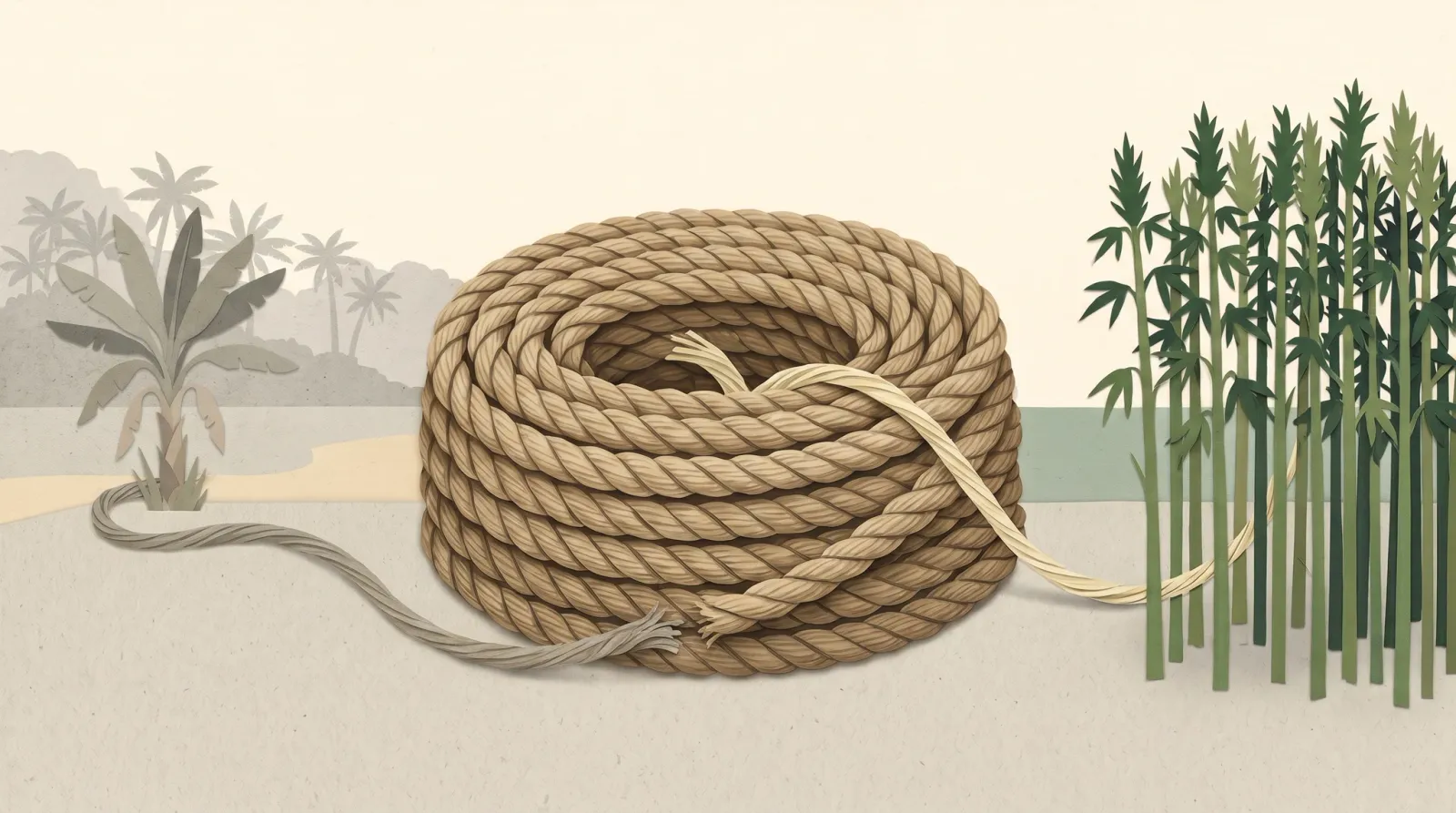
The US government urged farmers to grow hemp in World War II because Japan’s conquest of the Philippines cut off abacá, the “Manila hemp” fiber the Navy’s rope was made from. The Department of Agriculture contracted farmers, financed processing mills and made a short film, Hemp for Victory, to teach a crop few Americans still knew how to grow.
Here is the part most retellings skip. The film’s famous goal of 50,000 acres was for seed. The fiber ask for 1943 was 300,000 acres, and the USDA’s own table shows harvests of 14,500 fiber acres in 1942, 146,200 in 1943 and 53,400 in 1944. That is about half the ask at the peak. And the 1937 Marihuana Tax Act never went away: growers still registered, and the government paid their fee. USDA, Agricultural Statistics 1946, Table 391; Iowa State College, “Hemp: A War Crop for Iowa,” 1942
This lesson follows the paper trail: a 1942 magazine report, two state farm bulletins, the USDA acreage table, a 1945 Senate hearing and a 1946 conference report. For what came before, see the longer history of cannabis.
Why did the US government want farmers to grow hemp in World War II?
Because the rope fiber the US depended on came from territory Japan had taken. In March 1942, TIME reported that abacá came “90% of it from the Philippines” and that “abacá makes the rope for the world’s navies.” It added: “There has been little abacá since Manila fell.” TIME, “Jute, Hemp and Bedlam,” March 30, 1942
State farm advisers told growers the same thing. Iowa’s December 1942 bulletin said rope and cordage were needed “for the Army, Navy, Merchant Marine and essential civilian uses,” and that “the source of abaca, the hard fiber ordinarily used in making rope, has been cut off, and hemp is the best known substitute.” Iowa bulletin, 1942 Minnesota’s January 1943 pamphlet added that shipping shortages had “also limited imports of sisal and jute fiber.” University of Minnesota Extension pamphlet, January 1943
The problem was scale. US hemp had shrunk to a tiny crop. The USDA table shows 140 harvested fiber acres in 1933 and 2,070 in 1940. USDA Table 391 TIME said the Commodity Credit Corporation (CCC), the USDA agency running the program, hoped for 240 million pounds of homegrown hemp. It also said the CCC knew “of only ten people in all the U.S. who are fully versed in the sensitive art of harvesting hemp.” TIME, 1942
Why did the program start with seed, not fiber?
You cannot plant 300,000 acres without the seed to plant them. TIME described the plan in order: first persuade farmers “to plant 35,000 acres of hemp for 350,000 bushels of seed,” then sow that seed “across some 300,000 acres next year.” TIME, 1942 That two-step plan is why seed and fiber numbers get mixed up so often. Hemp seed had a different job then than it does on store shelves now; if you want the modern version, see hemp seed oil versus CBD oil.
What was the Hemp for Victory film?
It was a short 1942 government film that taught farmers how to grow, harvest and handle hemp for fiber. The National Archives holds it as identifier 1682. An Internet Archive record lists the producer as the USDA Office of Public Affairs and marks it public domain. Internet Archive record One digitized print runs about 14 minutes. Internet Archive copy
A published transcript of the narration says the film “is designed to tell farmers how to handle this ancient crop now little known outside Kentucky and Wisconsin.” The same transcript gives the numbers that cause confusion. Farmers “planted 36,000 acres of seed hemp” in 1942, and “the goal for 1943 is 50,000 acres of seed hemp.” Separately, “14,000 acres of fiber hemp were harvested.” Transcript of the narration We have checked these transcript lines against the documents, not against the film’s audio. The fiber figure fits the USDA table (14,500 acres). The seed figure is a planted count, so it runs above the USDA’s harvested hempseed count of 29,300 acres.
The film also told farmers: “For to grow hemp legally you must have a federal registration and tax stamp.” Hold onto that line. It matters in the legal section below.
How many acres of hemp did farmers actually grow?
At the 1943 peak, US farmers harvested 146,200 acres of fiber hemp, about half of the 300,000 acres requested. Every wartime acreage figure needs three labels: seed or fiber, planted or harvested, and whose count it is. Here are the main numbers with those labels.
| Year | What the number counts | Acres | Source |
|---|---|---|---|
| 1940 | Fiber, harvested, national | 2,070 | USDA Table 391 |
| 1942 | Fiber, harvested, national | 14,500 | USDA Table 391 |
| 1942 | Seed, harvested, national | 29,300 | USDA Table 391 |
| 1943 | Fiber, requested | 300,000 | Iowa bulletin; Minnesota pamphlet |
| 1943 | Seed, film’s goal | 50,000 | Film narration transcript |
| 1943 | Fiber, CCC program, planted / harvested | about 175,000 / about 136,000 | Senate hearing, 1945 |
| 1943 | Fiber, harvested, national | 146,200 | USDA Table 391 |
| 1944 | Fiber, harvested, national | 53,400 | USDA Table 391 |
| 1945 | Fiber, harvested, national (preliminary) | 6,900 | USDA Table 391 |
| 1946 | Fiber, harvested, national (preliminary) | 4,600 | USDA, Agricultural Statistics 1947 |
Two notes keep this table honest. First, the CCC figures come from testimony by S. H. McCrory, who ran the CCC Hemp Division, and cover its own program. The USDA total covers all growers. No source we opened reconciles the two. Second, the USDA volumes are scanned tables, so read the figures as the official series, rounded as printed.
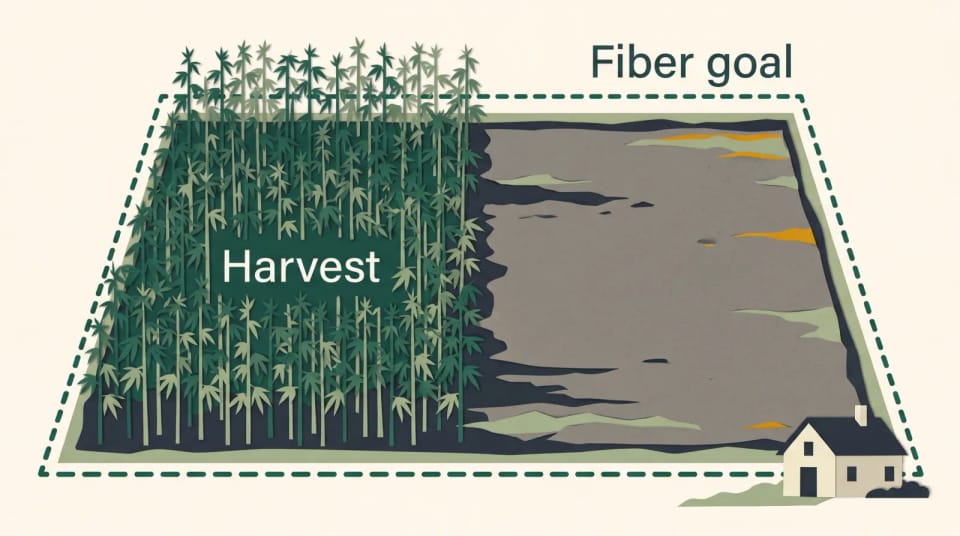
The ask versus the harvest. The government requested 300,000 acres of fiber hemp for 1943; the USDA recorded 146,200 harvested fiber acres that year.
Was hemp legal during World War II?
Yes, but only inside the 1937 Marihuana Tax Act, which stayed in force the whole war. The law did not ban hemp. It defined “marihuana” to exclude “the mature stalks of such plant” and fiber made from them. But it treated anyone who planted or cultivated the plant as a “producer” who had to register and pay a tax of “$1 per year, or fraction thereof.” Marihuana Tax Act, 50 Stat. 551 For how the rest of that law worked, read our lesson on the 1937 Marihuana Tax Act.
The wartime program used that registration instead of waiving it. Iowa’s bulletin told farmers that “all growers and processors of hemp, and all persons handling or transporting hemp seed,” had to register under the 1937 act. It added: “The Commodity Credit Corporation agrees to pay the registration tax for growers with whom contracts are made.” Iowa bulletin, 1942 Minnesota’s pamphlet said the CCC would “send in the signed contracts as applications for the licenses, pay the fees, and aid growers in making reports.” Minnesota pamphlet, 1943
So the common line that the government “suspended” the 1937 law for the war is wrong. The paperwork stayed. The government simply did it for its contract growers.
The 1937 law defined hemp by plant part: stalk and fiber outside the definition, leaves and flowers inside it. Today’s federal rules define hemp by THC concentration, which is a very different test. Compare today’s THC-percentage definition of hemp and how hemp is regulated today.
What did the wartime hemp actually do?
It built a short-lived processing industry and supplied fiber for rope. A statement entered at the 1945 Senate Finance Committee hearing said: “In World War II, 42 scutching mills were constructed in the States of Kentucky, Indiana, Illinois, Iowa, Minnesota” and Wisconsin, and “more than $12,000,000 was expended in the construction program.” Senate hearing, Hemp and Marihuana, May 24, 1945 A scutching mill separates the long fiber from the woody stalk. Iowa’s bulletin said its mills would be financed by the Defense Plants Corporation and run by War Hemp Industries, Incorporated, or another CCC agent. Iowa bulletin, 1942
The fiber went into rope as a blend. McCrory testified that, “by a WPB order,” rope makers had to use 15 percent American hemp in sisal rope three-quarters of an inch thick and larger. (WPB was the War Production Board.) Asked whether hemp had been part of the war effort, he said rope production rose “roughly 13 percent” in the first three quarters of 1944. He said War Production Board officials credited American hemp for that. Senate hearing, 1945
Read that last claim carefully. It is a program official repeating what another agency told him, in a hearing where mill owners wanted a law changed. It is real testimony. It is not proof that hemp “won the war.”
Why did hemp farming end after the war?
The emergency ended, the government mills closed, and no single cause explains the rest. At the 1945 hearing, George E. Farrell of the USDA said about $12 million had been spent on the mills. He said that after the 1944 crop they “will have completed their scutching operations and will be closed down.” Senate hearing, 1945
The same hearing shows a legal snag. Witnesses said the Treasury’s narcotics bureau had notified private mills in March 1945 that, beginning with the 1945 crop, no stalks could be “legally transported from the farm to the mills unless all leaves were removed.” Leaves counted as “marihuana” under the 1937 law, and leaves cling to retted stalks. McCrory said, “I do not believe that it is possible in the retting process to entirely eliminate the leaves.”
Congress responded. A February 1946 conference report explained that millers “may be liable for the payment of the transfer tax on marihuana” because “a small quantity of leaves still adhere to the stalks.” That tax was “$1 per ounce in certain cases and $100 per ounce in other cases.” The fix created a registration for millers so they could take in hemp without the transfer tax. House Conference Report No. 1672, February 27, 1946
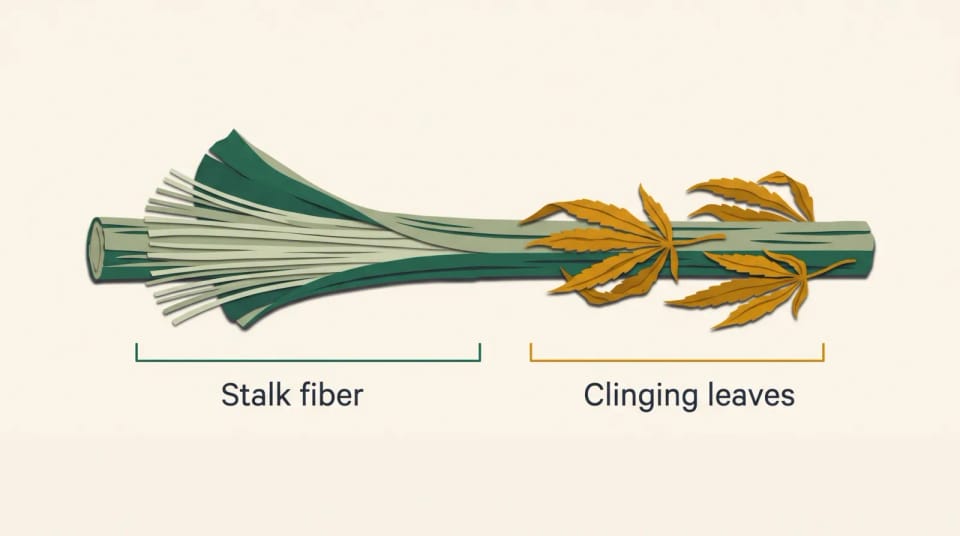
The 1937 law excluded mature stalks and fiber but covered leaves. Leaves that cling after retting made a miller’s purchase look like a taxable transfer, which Congress addressed in 1946.
Acreage kept falling. The USDA series drops from 6,900 harvested fiber acres in 1945 to 4,600 in 1946. The Congressional Research Service says that by 1948 production “had dropped back to 3 million pounds on 2,800 harvested acres, with no recorded production after the late 1950s.” CRS lists three causes for the decline: “competition from synthetic fibers, the Marihuana Tax Act, and increasing public anti-drug sentiment.” CRS Report RL32725, 2018 No source we opened shows which of those mattered most.
Notice the dates. Recorded US hemp production stopped by the late 1950s, more than a decade before the 1970 Controlled Substances Act. The 1970 law and the later war on drugs shaped what came next, but they did not end wartime hemp. The story has a present-day sequel too: the 2026 federal hemp THC change.
Which Hemp for Victory claims don’t hold up?
Several popular claims have no document behind them, and one is contradicted by the statute. Here in High School, a claim needs a source we can open. This is how the common ones check out.
| Claim you will see | What the documents show |
|---|---|
| The government suspended the 1937 law for the war | No. Growers registered; the CCC paid the fee (Iowa bulletin). |
| Farmers bought a “$5 tax stamp” | The statute set the producer tax at $1 per year (50 Stat. 551). |
| Farmers met the 300,000-acre goal | The national peak was 146,200 harvested fiber acres in 1943, about half (USDA Table 391). |
| The film’s “50,000 acres” was the hemp goal | That was the 1943 seed goal. The fiber ask was 300,000 acres. |
| Hemp farmers or their sons got draft deferments | We found no primary document that says so. |
| Farmers were required to watch the film | We found no document that says so. The narration describes it as designed to teach farmers. |
| The USDA later denied the film existed | We found no document that says so. The film is in the National Archives catalog. |
“No document found” is not proof that something never happened. It means the claim needs a source before anyone repeats it.
Key takeaways
- The US needed domestic hemp because Japan’s conquest of the Philippines cut off abacá rope fiber.
- The government asked for 300,000 acres of fiber hemp for 1943. The USDA counted 146,200 harvested fiber acres that year.
- The film’s 50,000-acre goal was for seed, the first step toward a fiber crop.
- The 1937 Marihuana Tax Act stayed in force. Growers registered, and the CCC paid their fee.
- Forty-two government-built mills processed the crop and then closed after the 1944 harvest.
- Recorded US hemp production ended by the late 1950s, before the 1970 Controlled Substances Act.
FAQ
Was Hemp for Victory a real government film?
Yes. Hemp for Victory is a 1942 USDA film, and the National Archives holds it as identifier 1682. It is in the public domain. You can watch digitized copies through the Internet Archive.
Did the government waive the Marihuana Tax Act for hemp farmers?
No. State farm bulletins from 1942 and 1943 told growers they had to register under the 1937 law. The Commodity Credit Corporation submitted their contracts as license applications and paid the registration fee. Congress amended the law in 1946 so registered millers could buy stalks with clinging leaves without the transfer tax.
Did hemp farmers get a draft deferment in World War II?
We found no primary document that says hemp farmers or their families received draft deferments for growing hemp. The claim appears online without a source. Until someone produces a record, treat it as unconfirmed.
How many acres of hemp were grown in the US during WWII?
The USDA counted 146,200 harvested fiber acres at the 1943 peak and 53,400 in 1944. In 1942, it counted 14,500 fiber acres and 29,300 seed acres. The government’s 1943 fiber request was 300,000 acres, so the peak harvest reached about half.
Why did hemp farming stop after the war?
The wartime demand ended and the government mills closed after the 1944 crop. CRS names synthetic fibers, the Marihuana Tax Act and anti-drug sentiment as causes of the decline. Recorded production ended by the late 1950s, years before the 1970 Controlled Substances Act.





