Phytol and Sabinene: Two Minor Terpenes With Major Potential
Phytol and sabinene are minor cannabis terpenes with intriguing preclinical research on calm, inflammation, and the entourage effect. The honest science.

When people talk cannabis terpenes, they reach for the headliners: myrcene, limonene, caryophyllene, linalool. Those compounds get the magazine covers. They show up in big numbers and have stacks of studies behind them. But a cannabis flower is a chemical orchestra. The quiet players in the back row still shape the sound.
Today I want to introduce two of those background musicians: phytol and sabinene. Neither will dominate a lab report. Both are routinely overlooked. And both have a small but genuinely interesting body of research. I will walk you through what the science says, where the evidence is thin, and why these two molecules matter — even if your dispensary has never named them.
Why minor terpenes matter at all
First, a quick reframe. “Minor” does not mean “irrelevant.” A terpene present at 0.05% by weight can still matter. These molecules are potent, and many cross the blood-brain barrier easily. As I explain in The Science of Terpene Synergy, the full terpene profile is often more interesting than any single big-number compound.
That is the premise behind the entourage effect — the idea that cannabinoids and terpenes work together, shaping each other’s effects. If the theory holds (and the evidence is still genuinely mixed), then trace compounds are exactly what make two “same THC” flowers feel different. That is also why I keep saying that THC percentage is a terrible way to choose cannabis and that your dispensary labels are mostly wrong. The interesting chemistry lives in the details.
So let us get into the details.
Phytol: the chlorophyll leftover with a calming reputation
Where it comes from
Phytol is unusual among cannabis terpenes. Most terpenes are made directly by the plant’s enzymes. Phytol is different. It is largely a decomposition product of chlorophyll — the green pigment that powers photosynthesis. Roughly a third of the chlorophyll molecule is phytol by structure. As chlorophyll breaks down during drying and curing, free phytol is released [Russo, 2011].
That origin story has two consequences worth knowing:
- It is technically a diterpene. While myrcene and limonene are small monoterpenes (10 carbons), phytol is a larger, acyclic diterpene alcohol with the formula C₂₀H₄₀O. It is heavier and far less volatile.
- Its level depends on processing, not just genetics. Because phytol comes from chlorophyll breakdown, how the flower is dried and cured influences how much ends up in the final product. Interestingly, older literature notes the drying process was partly intended to oxidize chlorophyll into phytol to improve smoke-ability [Russo, 2011].
Aroma-wise, phytol is subtle: a mild, grassy, faintly floral, green-tea-like scent. It rarely jumps out at you. It is more of a balancing, rounding presence in a profile — a supporting note rather than a soloist. If you want the broader picture of how aroma maps to chemistry, see the science of cannabis aromas.
The mechanism: GABA and the relaxation pathway
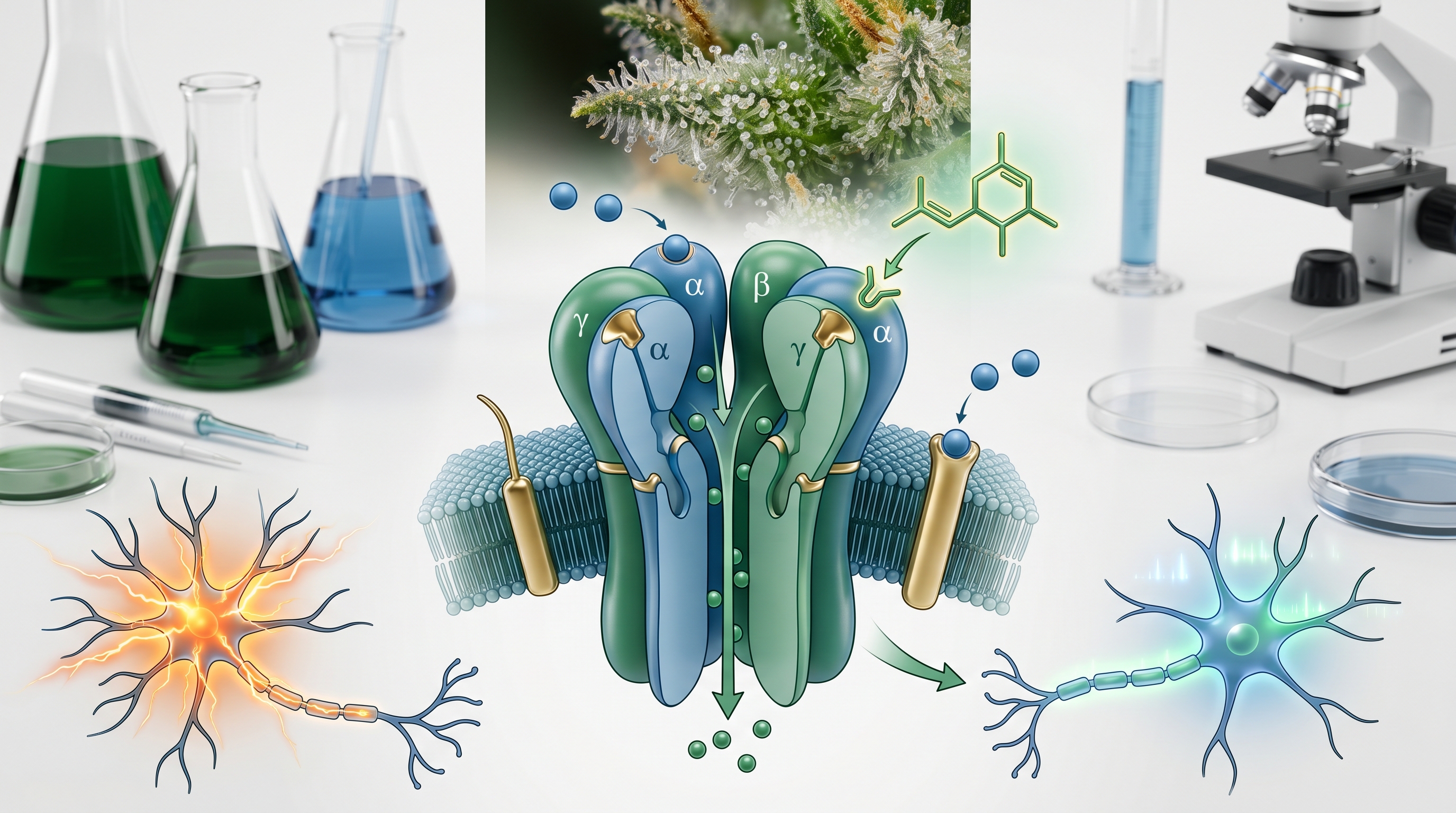
Here is where phytol gets interesting. Research suggests phytol may interact with the GABAergic system — GABA being the brain’s primary inhibitory (“calm down”) neurotransmitter.
Two related mechanisms have been proposed in preclinical work:
- Boosting GABA levels. One study [Bang, 2002] reported that phytol increases GABA by blocking SSADH, an enzyme that breaks GABA down. Less breakdown means more GABA available.
- Acting like a GABA-A modulator. In rodent studies, phytol produced sedative and anxiety-reducing behavior, and at least one report found these effects were blocked by flumazenil — the same antagonist that blocks benzodiazepines at the GABA-A receptor’s benzodiazepine site. That overlap is suggestive of a shared mechanism.
A frequently cited study [Costa, 2014] found that phytol produced anxiolytic-like effects in mice. The authors pointed to GABAergic transmission as the likely pathway. Other rodent work has reported sedative effects, increased sleep time, and anticonvulsant activity. This is the science behind phytol’s reputation as a relaxing, sleep-friendly compound — and it loosely connects phytol to the kind of profile I describe in the Relax High family, alongside heavyweights like myrcene.
Phytol is also busy elsewhere. In cell studies, it activates metabolic receptors like retinoid X receptors (RXR) and the fatty-acid receptor GPR40. It has even shown anticancer activity in lung cell lines in vitro [Chacon, 2022]. These are early-stage findings, but they show phytol does more than smell grassy.
The honest safety note
I am not going to hand-wave this one. Phytol has a real, if narrow, safety conversation attached. In 2020, a Canadian cannabis company pulled phytol-containing vape products over concerns about using it as an inhalation additive. There is also a rare condition called Refsum disease. People with it cannot properly process phytanic acid, a metabolite the body makes from free phytol. Those patients are told to limit phytol intake.
For the average person eating leafy greens or smoking cured flower, trace amounts of natural phytol are not the worry here. The open question is about concentrated phytol added to inhaled products. There, the long-term safety science is genuinely incomplete. As always, this is general education, not medical advice. If you have a specific condition, talk to a clinician.
Sabinene: the spicy little ring with antimicrobial muscle
Where it comes from
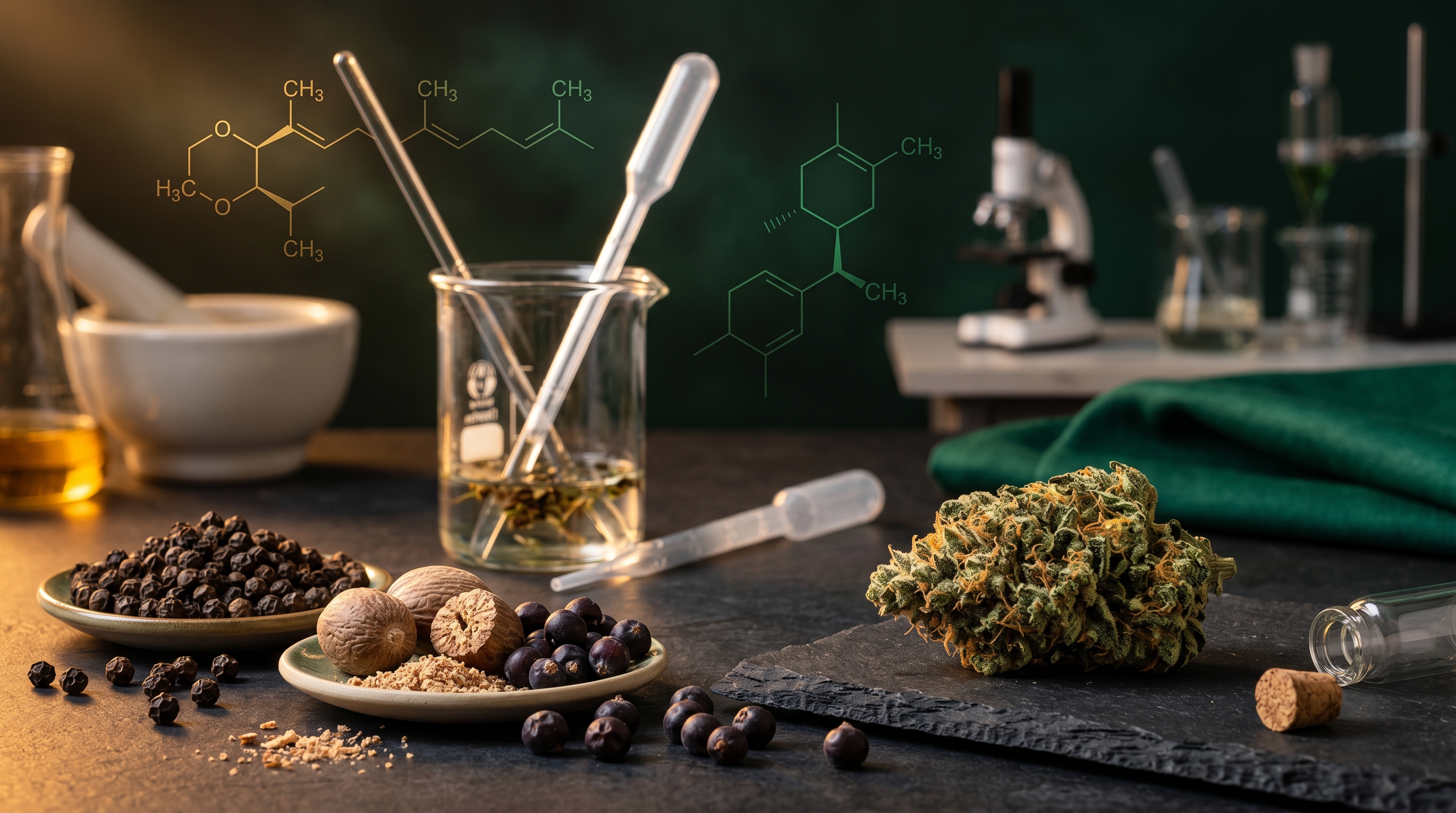
Sabinene is a completely different beast. It is a bicyclic monoterpene — a small 10-carbon molecule (C₁₀H₁₆) built around a distinctive double-ring structure. That makes it a chemical cousin of the pinenes [Srividya, 2024]. You will find it far more abundantly outside cannabis than inside it. It is a major component of black pepper, nutmeg, juniper berries, carrot seed, and Norway spruce essential oils. In cannabis it is a true minor terpene, usually present in small amounts when present at all.
Aroma: warm, woody, spicy, and pine-like with citrus undertones. If you have ever cracked fresh black pepper or grated nutmeg, you have smelled sabinene at work. In a cannabis profile it leans toward the spicy, peppery end — territory it shares with caryophyllene.
The research: anti-inflammatory, antifungal, antioxidant
Sabinene’s research file is dominated by three themes, almost all of it preclinical (cell or animal studies):
- Anti-inflammatory. One study [Valente, 2013] examined an essential oil that was roughly 29% sabinene. It reported robust anti-inflammatory activity, driven in part by blocking nitric oxide production in stimulated immune cells — a core inflammatory pathway. This fits the broader pattern I cover in cannabis and inflammation.
- Antifungal and antimicrobial. Multiple studies show sabinene-rich oils inhibiting fungi and bacteria. Sabinene hydrate (a related oxygenated form) showed minimum inhibitory concentrations as low as ~0.03 mg/mL against Bacillus subtilis and Staphylococcus aureus in one 2024 study, with Gram-positive bacteria more susceptible than Gram-negative.
- Antioxidant. Sabinene shows concentration-dependent free-radical scavenging in DPPH assays and protects cells against lipid peroxidation in stressed-cell models.
Newer rodent work has even explored neuroprotective angles — reducing neuroinflammatory markers like TNF-α and IL-6, and showing benefit in models of seizure and oxidative stress. Promising? Yes. Proven in humans? No.
A reality check on sabinene and anxiety
Here is a humbling data point. In a 2018 systems study [Kamal, 2018], researchers surveyed patients on which strains worked best for anxiety, then chemically profiled the favorites. The result: sabinene hydrate showed a statistically significant negative correlation with anxiolytic activity (correlation coefficient −0.843, p<0.05). In other words, among the minor terpenes examined, more sabinene hydrate tracked with less perceived anxiety relief.
I bring this up deliberately. It would be easy to write a glowing list of “sabinene benefits,” but good science means reporting the inconvenient findings too. Sabinene is not a relaxation terpene the way phytol or linalool appear to be — its strengths cluster around inflammation, microbes, and antioxidant defense, not calm. If anxiety is your goal, you are better served reading Best Cannabis Strains for Stress Relief or my complete guide to cannabis and anxiety, and leaning on terpenes like linalool, limonene, or nerolidol.
How phytol and sabinene fit the entourage effect
So what do these two trace compounds actually contribute to a real cannabis experience? Honestly, we do not fully know — and anyone who tells you otherwise is selling something. But here is the reasonable, evidence-informed framework.
The entourage concept does not require two compounds to hit the same receptor. As a 2022 secondary-terpene review [Chacon, 2022] emphasizes, synergy can be pharmacodynamic (compounds acting at different targets toward a shared outcome) or pharmacokinetic (one compound changing how another is absorbed).
Through that lens:
- Phytol plausibly adds to the relaxing, body-heavy side of an experience. It nudges the GABA system in the same general direction as myrcene and linalool. If several mild GABA-friendly compounds stack, the combined nudge could matter more than any one alone. That is the synergy argument in miniature. This is exactly the kind of low-key compound that helps explain why the same strain hits you differently each time depending on cure and freshness.
- Sabinene more likely contributes on the anti-inflammatory and antimicrobial axis — a supporting role for the physical-comfort, Relief High side of things, alongside caryophyllene rather than the calming terpenes.
The takeaway is not “seek out phytol strains” or “avoid sabinene.” It is that the full profile is a system, and these minor players are part of why a reductionist indica-vs-sativa label tells you almost nothing useful. For the bigger argument, see why a strain name is not your ideal high and my terpenes guide for the full cast of characters. You can also explore strains by compound on the phytol and sabinene terpene pages.
The limitations (read this part)
I am going to be blunt, because this is a science article and you deserve honesty:
- Almost everything here is preclinical. Most phytol and sabinene findings come from cell cultures and rodents, often at doses far higher than you would ever get from cannabis. As one reviewer dryly noted, the terpene doses that produced sedation in animals would be “near impossible to achieve through consumption of cannabis.”
- Human data is essentially absent for both compounds in a cannabis context. We have strong human evidence for very few terpenes — and even the famous ones, like the limonene-and-anxiety work, are still early.
- Concentrations in cannabis are low and variable, and rarely reported on standard labels — which is part of why lab testing standards are failing consumers.
- Phytol’s inhalation safety is genuinely unsettled. Treat added phytol in vape products with caution until better data exists.
None of this means phytol and sabinene are useless. It means the responsible position is “intriguing and worth tracking,” not “miracle compound.” The honest scientist’s favorite phrase applies: more research is needed.
What this means for you
The practical move is not to chase a single trace terpene. It is to pay attention to your own responses and notice that aroma, cure, and full chemistry — not just THC percentage — shape how you feel. The best way to learn what actually works for your body is to track it systematically. That is the entire reason we built High IQ: so the patterns that matter to you stop being invisible.
Minor terpenes like phytol and sabinene are a reminder that cannabis is far more sophisticated than the indica/sativa shorthand suggests. The quiet players in the back row are still part of the music.
Key takeaways
- Phytol is a diterpene formed when chlorophyll breaks down. Its level depends on drying and curing, not just genetics. Preclinical research links it to the GABA system and a calming, sleep-friendly profile.
- Sabinene is a spicy, bicyclic monoterpene found in black pepper, nutmeg, and juniper. Its research strengths are anti-inflammatory, antifungal, and antioxidant — not anxiety relief.
- Almost all of this evidence is preclinical. Cell and animal studies are promising, but human cannabis data is essentially absent for both compounds.
- Phytol’s inhalation safety is unsettled. Be cautious with concentrated phytol added to vape products.
- The real lesson is the system. The full terpene profile shapes your experience far more than a strain name or THC number. Track your own responses to learn what works for you.
Frequently asked questions
Is phytol psychoactive? No. Phytol is not intoxicating on its own. Its interest lies in possible GABAergic, calming effects observed in preclinical studies — not in producing a “high.”
Which cannabis strains are high in phytol? Because phytol comes from chlorophyll breakdown, its level depends heavily on drying and curing rather than genetics alone. Some sources associate it with cultivars like OG Kush, Harlequin, and Cannatonic, but trace amounts appear across virtually all green plant material.
Is sabinene safe? In food and fragrance contexts, sabinene has a long history of use and low acute toxicity in studies (one rodent study reported a developmental no-observed-adverse-effect level of 250 mg/kg/day). It is a mild skin irritant at high concentrations. As with any inhaled compound, the cannabis-specific safety data is limited.
Does sabinene help with anxiety? The evidence does not support that. One systems study actually found sabinene hydrate negatively correlated with anxiety relief. Sabinene’s research strengths are anti-inflammatory, antifungal, and antioxidant — not calming. For anxiety, look to linalool, limonene, or nerolidol.
What does phytol smell like? Mild and grassy, with faint floral and green-tea notes. It is a subtle, balancing aroma rather than a dominant one.
Are these terpenes unique to cannabis? No. Phytol is found in green tea and leafy greens (it is a chlorophyll component). Sabinene is abundant in black pepper, nutmeg, juniper, and carrot seed. Both are widespread in the plant world.
Sources
- Russo EB. Taming THC: potential cannabis synergy and phytocannabinoid-terpenoid entourage effects. British Journal of Pharmacology. 2011;163(7):1344-1364. doi:10.1111/j.1476-5381.2011.01238.x
- Chacon FT, Raup-Konsavage WM, Vrana KE, Kellogg JJ. Secondary Terpenes in Cannabis sativa L.: Synthesis and Synergy. Biomedicines. 2022;10(12):3142. doi:10.3390/biomedicines10123142
- Costa JP, de Oliveira GAL, de Almeida AAC, et al. Anxiolytic-like effects of phytol: Possible involvement of GABAergic transmission. Brain Research. 2014;1547:34-42. doi:10.1016/j.brainres.2013.12.003
- Kamal BS, Kamal F, Lantela DE. Cannabis and the Anxiety of Fragmentation—A Systems Approach for Finding an Anxiolytic Cannabis Chemotype. Frontiers in Neuroscience. 2018;12:730. doi:10.3389/fnins.2018.00730
- Valente J, Zuzarte M, Gonçalves MJ, et al. Antifungal, antioxidant and anti-inflammatory activities of Oenanthe crocata L. essential oil. Food and Chemical Toxicology. 2013;62:349-354. doi:10.1016/j.fct.2013.08.083
- Srividya N, et al. Structure and Function of Sabinene Synthase, a Monoterpene Cyclase That Generates a Highly Strained [3.1.0] Bicyclic Product. Journal of the American Chemical Society / PubMed PMID:39527408. doi:10.1021/jacs.4c10520
This article is educational and not medical advice. Cannabis affects everyone differently — consult a qualified healthcare professional about your specific situation.


