Can Weed Make You Hallucinate? What Dose and Studies Show
Weed often changes how things look and sound, but true hallucinations are rare and cluster at high THC doses. See what the studies show and when to get checked.

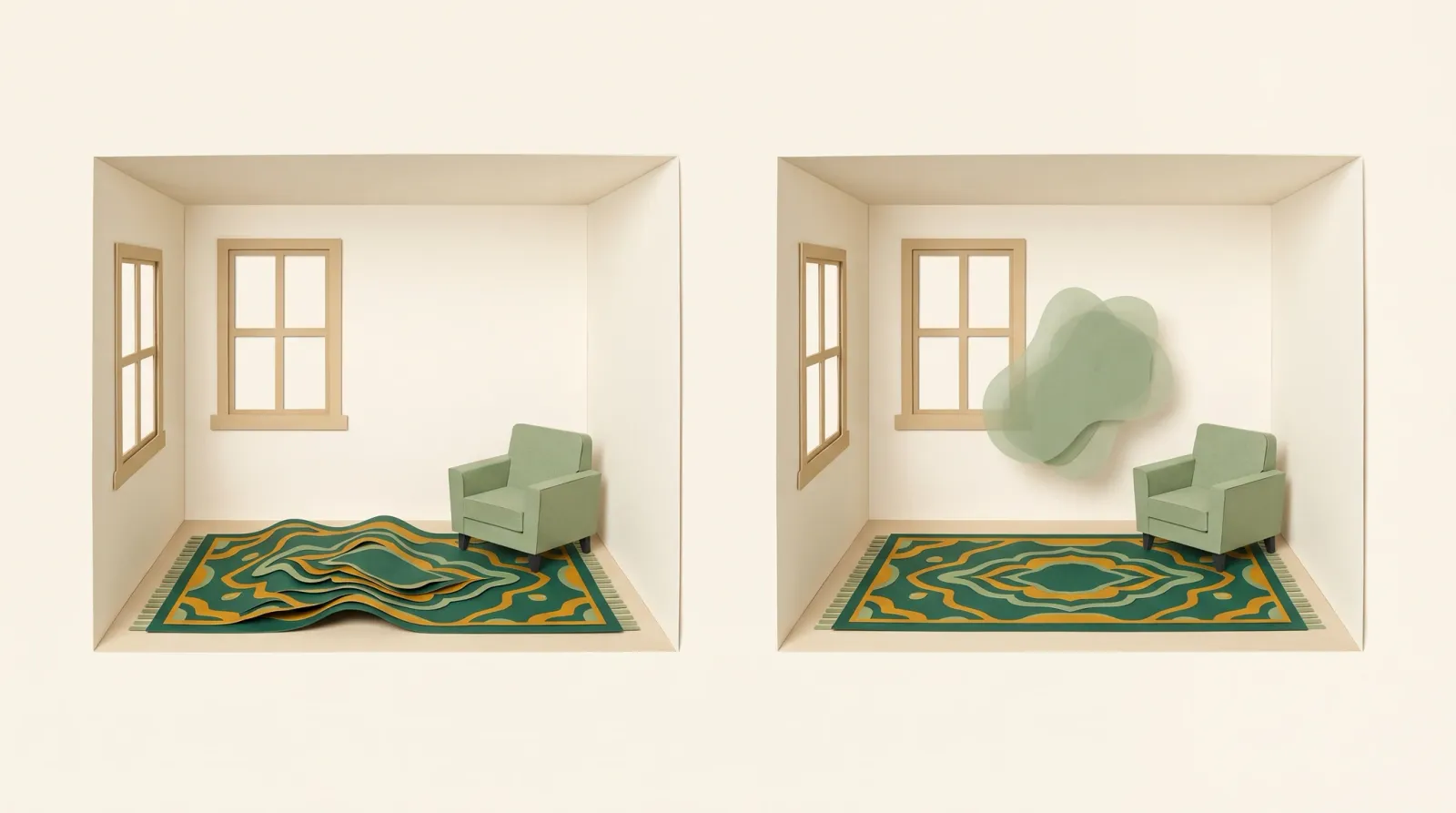
Weed often changes how things look and sound, but true hallucinations are rare, cluster at high THC doses and in sensitive people, and need a medical check when they persist, return after the high ends, or come with voices or unusual beliefs. The US Drug Enforcement Administration’s fact sheet lists “enhanced sensory perception” as a common effect and says “illusions, delusions, and hallucinations are rare except at high doses.” DEA drug fact sheet
Here is the detail worth sending to a friend. In a controlled lab study, one healthy volunteer took the same 25 mg of THC twice. Smoked, he reported no hallucinations. Vaporized, he heard voices he could not make out and saw patterns moving on the carpet and chairs. His blood THC 10 minutes after vaping was 16 ng/mL, against 1 ng/mL after smoking. The effects peaked at about 20 minutes and had almost gone by 4 hours. Barrett et al., 2018
That is one person, so it tells you nothing about how often this happens. It does show something useful: how fast and how high THC peaks can matter more than the number on the package.
Is it a hallucination or just weed changing what you see?
Most of what people describe after smoking is altered perception, not hallucination. The difference is whether something real is there.
The NHS defines hallucinations as hearing, seeing, smelling, tasting or feeling things “that appear to be real but only exist in your mind.” NHS: hallucinations and hearing voices
| Altered perception | True hallucination | |
|---|---|---|
| What happens | Something real looks, sounds or feels different | You perceive something that has no source |
| Examples | Brighter colors, music that feels richer, a pattern that seems to shift | A voice with no speaker, an object nobody else can see |
| How common on weed | Listed as a common effect by the DEA | “Rare except at high doses” (DEA) |
| What it usually means | An ordinary part of being high | A sign of too much THC, or a reason for a medical check if it lingers |
A carpet pattern that ripples is a real carpet seen differently. In the Barrett case, the volunteer’s experience sat on that border: real voices in the room felt louder and stranger, and real furniture seemed to move. Vision changes such as blur and halos are a separate topic again; see blurry vision and halos after cannabis. So is the sense that you or the world feels unreal, covered in feeling unreal while high.
Does everyone hallucinate on weed?
No. The same dose can do very different things to different people.
In one controlled study, 21 healthy men with little cannabis experience took 10 mg of THC by mouth. Eleven became briefly psychotic on a standard symptom scale, which includes hallucinations. Ten did not. Atakan et al., 2013
A larger pooled analysis gives the same picture. Researchers combined 10 placebo-controlled studies: 239 healthy volunteers and 400 intravenous THC doses. Among 114 people who got two or more doses, 36% showed no clinically significant response at any dose. About 21% responded at every dose. About 24% responded only at the higher doses. Ganesh et al., 2020
The same analysis found frequent users had a weaker response. Tolerance seems to blunt this effect.
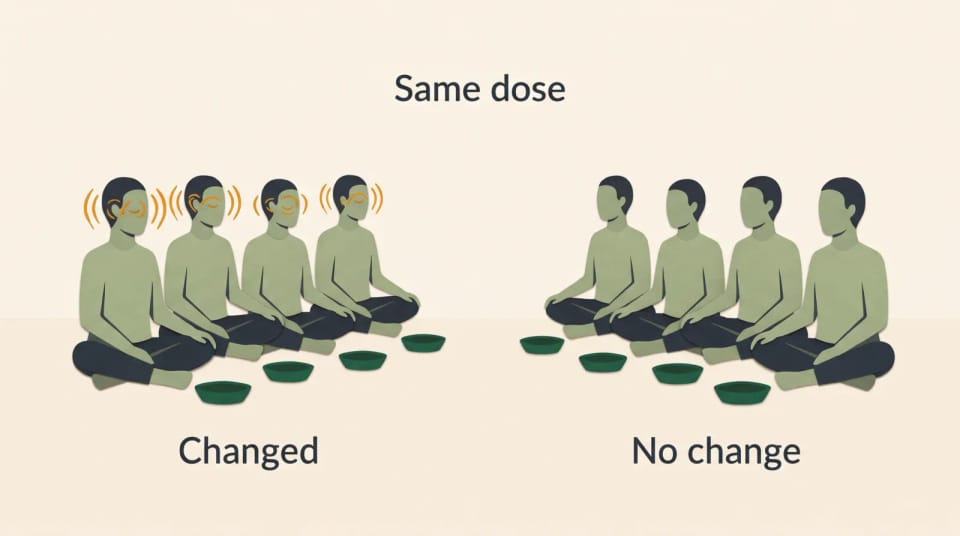
In a controlled study, about half of healthy men given the same 10 mg oral THC dose became briefly psychotic on a symptom scale and half did not. A study can show the split; it cannot tell you in advance which group you are in.
How much THC does it take to hallucinate?
There is no single threshold. The odds rise with dose, strength and inexperience.
The US National Institute on Drug Abuse says hallucinations and panic are “more common when a person takes a large amount, the cannabis product is strong (has a high level of THC), or the person has little experience with using cannabis.” NIDA
In the pooled lab data, the response rose with dose. The authors put their dose range at roughly one-quarter of a joint’s THC up to a full joint. Those doses went straight into a vein, though, so they peaked faster and higher than a normal smoke. A hallucination rating on the scale also did not always mean a vivid hallucination. Ganesh et al., 2020
A meta-analysis of 15 THC studies in healthy people found THC clearly raised scores for positive symptoms, the group that includes hallucinations and delusions. It found no consistent evidence that CBD reduced THC’s effects. Hindley et al., 2020
Strength on a label is a weak guide to your own response. Our lesson on why THC percentage is a poor guide explains why. The vaping case above makes the same point: the peak matters, and the peak depends on how you take it.
If you want to see your own pattern, the High IQ app lets you log how a strain and dose actually worked for you. Over time that record beats any label.
Can edibles make you hallucinate?
They can, at high enough doses, but no controlled study found here compared edibles with smoking for hallucinations.
What is clear is timing. The CDC says edibles can take up to 2 hours to act, which makes it easy to take more before the first dose hits. CDC cannabis FAQ That is the classic route to too much THC. Our guide on what to expect at each edible dose walks through the tiers.
A 2026 pilot study gave four healthy adults 25 mg of THC by mouth in a quiet, supported session. Their experience was similar to that of 25 mg of psilocybin, and two participants mistook a THC capsule for a classic hallucinogen. Barrett et al., 2026 That was four people with pure THC in a special setting, so treat it only as proof that a high oral dose can feel hallucinogen-like for some people.
Is seeing patterns with your eyes closed when high a hallucination?
Nobody knows for sure, because no controlled study of THC and closed-eye visuals turned up in our research.
What is known is that the visual system makes images without any drug. In one study, 10 of 13 sober adults who wore a blindfold for four days reported visual hallucinations, from bright spots to faces. They knew the images were not real. Merabet et al., 2004 Another study found that simply closing the eyes made the visual cortex more excitable. de Graaf et al., 2017
Neither study involved cannabis. Together they show that eyes-closed shapes and colors are not unique to being high. They do not prove that closed-eye visuals on weed are harmless. If you see things with your eyes open that are not there, the NHS advice to get medical help applies.
Is it normal to hear voices when high?
Hearing real sounds differently is common. Hearing a voice with no source is less common than seeing things, and it is a reason to get checked if it happens more than once.
The best population numbers come from the UK Biobank. More than 109,000 adults reported whether they had ever used cannabis and whether they had ever had certain unusual experiences in their lives. These are lifetime reports, not reports from during a high. Wainberg et al., 2021
| Ever reported | Never used cannabis | Ever used | Used daily |
|---|---|---|---|
| Visual hallucinations | 2.8% | 4.6% | 6.1% |
| Auditory hallucinations | 1.3% | 2.7% | 3.6% |
Three things stand out. Rates rise with use. Visual reports are about twice as common as auditory ones. And non-users report both, so these experiences are not caused only by cannabis. The authors say the link may also reflect reverse causation or other shared factors.
One common case is hearing speech in steady noise, like a fan. Our lesson on hearing speech in noise while high covers the lab tests on that.
Does hallucinating on weed mean you have psychosis?
Not by itself. One episode during a high is different from a psychotic disorder, but it is not meaningless either.
In the lab, these effects usually fade within hours. In one intravenous THC study, raters scored hallucination-type behavior at a minimal level or higher in 62% of volunteers shortly after the dose and in 6% about 2.5 hours later. Colizzi et al., 2019 NIDA adds that a temporary psychotic episode during intoxication “may be linked with developing a psychotic disorder later in life.” NIDA
The bigger numbers apply to a narrower group: people who were diagnosed with cannabis-induced psychosis, usually in hospital. Estimates of how many later receive a schizophrenia or bipolar diagnosis vary widely:
- About 20% later received a schizophrenia-spectrum diagnosis, in a 2026 meta-analysis of 13 studies. Javed et al., 2026
- 34% transitioned to schizophrenia, in a 2020 meta-analysis (six cannabis studies). Murrie et al., 2020
- 47.4% converted to schizophrenia or bipolar disorder, in Danish national registers. Starzer et al., 2018
None of these figures describes someone who saw the rug move once at a party. They do explain why repeated or lasting hallucinations deserve a proper assessment. Genes matter too: in the UK Biobank, the link between cannabis and hallucinations was stronger in people with higher genetic risk for schizophrenia. Read more on who faces higher risk with THC.
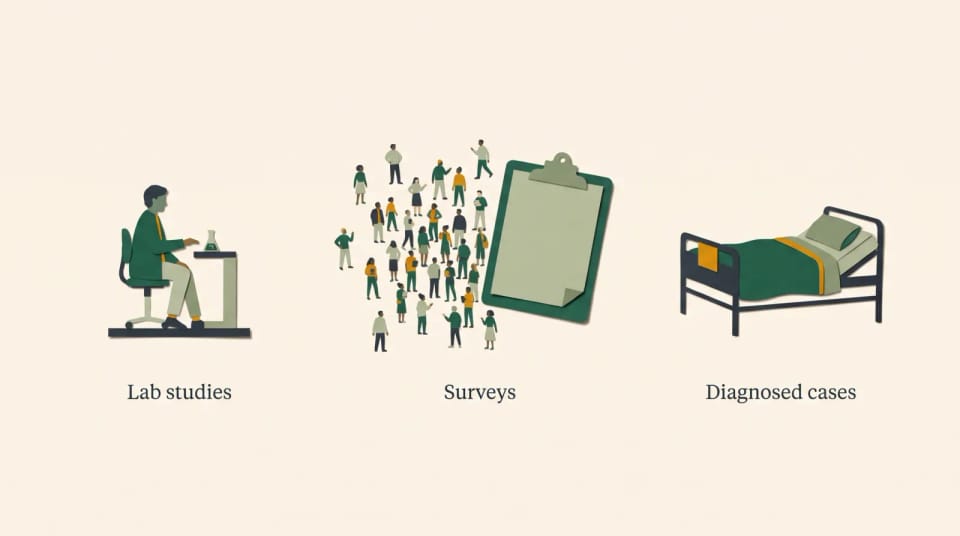
Lab studies dose healthy volunteers, surveys ask people about their whole lives, and diagnosis studies follow patients treated for psychosis. Each number answers a different question.
When should you talk to a clinician?
Get medical help if hallucinations last after the high wears off, keep coming back, or come with beliefs that others find strange. The NHS says to get medical help for hallucinations. It says to call 999 or go to A&E for voices telling you to harm yourself or someone else, hallucinations that are quickly getting worse, sudden confusion, or speech that is not making sense. NHS
In the US, the CDC lists “delusions or hallucinations” among the signs of using too much cannabis. Call Poison Control at 1-800-222-1222, or 911 in an emergency. CDC If you or someone you know is struggling or thinking about suicide, NIMH points to the 988 Suicide and Crisis Lifeline: call or text 988. NIMH
Case reports describe heavy users whose visual changes lasted for up to several months after they stopped. Lerner et al., 2011 That was eight patients with no comparison group, so no one knows how common it is. Lasting visual changes are still a reason to see a clinician.
For the wider list of warning signs, see signs of too much cannabis. When you simply feel too high and none of the warning signs above apply, see what helps when you feel too high. If the fear is about being watched or judged rather than seeing things, our guide to cannabis paranoia and when it needs help is the closer match.
Sources
-
Barrett FS, Schlienz NJ, Lembeck N, Waqas M, Vandrey R. “‘Hallucinations’ Following Acute Cannabis Dosing: A Case Report and Comparison to Other Hallucinogenic Drugs.” Cannabis and Cannabinoid Research. 2018;3:85-93. DOI: 10.1089/can.2017.0052
-
Ganesh S, Cortes-Briones J, Ranganathan M, Radhakrishnan R, Skosnik PD, D’Souza DC. “Psychosis-Relevant Effects of Intravenous Delta-9-Tetrahydrocannabinol: A Mega Analysis of Individual Participant-Data from Human Laboratory Studies.” International Journal of Neuropsychopharmacology. 2020;23:559-570. DOI: 10.1093/ijnp/pyaa031
-
Hindley G, Beck K, Borgan F, et al. “Psychiatric symptoms caused by cannabis constituents: a systematic review and meta-analysis.” The Lancet Psychiatry. 2020;7:344-353. DOI: 10.1016/S2215-0366(20)30074-2
-
Atakan Z, Bhattacharyya S, Allen P, et al. “Cannabis affects people differently: inter-subject variation in the psychotogenic effects of Δ9-tetrahydrocannabinol.” Psychological Medicine. 2013;43:1255-1267. DOI: 10.1017/S0033291712001924
-
Colizzi M, Weltens N, McGuire P, Van Oudenhove L, Bhattacharyya S. “Descriptive Psychopathology of the Acute Effects of Intravenous Delta-9-Tetrahydrocannabinol Administration in Humans.” Brain Sciences. 2019;9(4):93. DOI: 10.3390/brainsci9040093
-
Wainberg M, Jacobs GR, di Forti M, Tripathy SJ. “Cannabis, schizophrenia genetic risk, and psychotic experiences: a cross-sectional study of 109,308 participants from the UK Biobank.” Translational Psychiatry. 2021;11:211. DOI: 10.1038/s41398-021-01330-w
-
Murrie B, Lappin J, Large M, Sara G. “Transition of Substance-Induced, Brief, and Atypical Psychoses to Schizophrenia: A Systematic Review and Meta-analysis.” Schizophrenia Bulletin. 2020;46:505-516. DOI: 10.1093/schbul/sbz102
-
Starzer MSK, Nordentoft M, Hjorthøj C. “Rates and Predictors of Conversion to Schizophrenia or Bipolar Disorder Following Substance-Induced Psychosis.” American Journal of Psychiatry. 2018;175:343-350. DOI: 10.1176/appi.ajp.2017.17020223
-
Javed MS, El-Khoury R, Taha AA, Reagu SM. “Prevalence of schizophrenia spectrum and bipolar disorder among patients with cannabis induced psychosis: a systematic review and meta-analysis.” BMC Psychiatry. 2026;26:186. DOI: 10.1186/s12888-025-07382-2
-
Barrett FS, Wolinsky D, Daily Z, Ciancio J, Arthur K, Vandrey R. “Pilot study comparing the effects of high dose THC to high dose psilocybin and placebo in the set and setting of a classic psychedelic therapy session.” Psychopharmacology. 2026. DOI: 10.1007/s00213-026-07138-0
-
Lerner AG, Goodman C, Rudinski D, Bleich A. “Benign and time-limited visual disturbances (flashbacks) in recent abstinent high-potency heavy cannabis smokers: a case series study.” Israel Journal of Psychiatry and Related Sciences. 2011;48:25-29. PMID: 21572239
-
Merabet LB, Maguire D, Warde A, Alterescu K, Stickgold R, Pascual-Leone A. “Visual hallucinations during prolonged blindfolding in sighted subjects.” Journal of Neuro-Ophthalmology. 2004;24:109-113. DOI: 10.1097/00041327-200406000-00003
-
de Graaf TA, Duecker F, Stankevich Y, Ten Oever S, Sack AT. “Seeing in the dark: Phosphene thresholds with eyes open versus closed in the absence of visual inputs.” Brain Stimulation. 2017;10:828-835. DOI: 10.1016/j.brs.2017.04.127
-
US Drug Enforcement Administration. “Drug Fact Sheet: Marijuana/Cannabis.” PDF
-
National Institute on Drug Abuse. “Cannabis (Marijuana).” Research topic page
-
US Centers for Disease Control and Prevention. “Cannabis Frequently Asked Questions.” 2025. CDC FAQ
-
NHS. “Hallucinations and hearing voices.” Reviewed 28 July 2025. NHS page
-
National Institute of Mental Health. “Understanding Psychosis.” NIMH page
Key takeaways
- Brighter colors and shifting patterns are common. A true hallucination, something with no source, is rare.
- Risk rises with dose, product strength and inexperience, and falls with tolerance.
- The same dose can change one person’s perception and leave another’s untouched.
- No controlled study of closed-eye visuals on THC was found.
- Hallucinations that persist, repeat or come with voices or strange beliefs need a medical check.
FAQ
Does everyone hallucinate on weed?
No. In a pooled lab analysis, 36% of volunteers given two or more THC doses showed no significant response at any dose. Frequent users responded less. Even at the same dose, some people notice changes and others notice none.
Can edibles make you hallucinate?
Yes, at high doses, though no study found here compared edibles with smoking for hallucinations. The main risk is timing: edibles can take up to 2 hours to act, so people take more too soon. A 2026 pilot found 25 mg of oral THC felt hallucinogen-like to some participants.
Is it normal to hear voices when high?
Hearing real sounds differently is common. Hearing a voice with no source is not typical, and it was about half as common as visual hallucinations in UK Biobank lifetime reports. If it happens more than once or lasts past the high, talk to a clinician.
Does CBD stop THC hallucinations?
There is no reliable evidence that it does. A meta-analysis found no consistent sign that CBD reduces THC’s psychotic-like effects; only one of four studies found a reduction. Do not count on a high-CBD product as a safety net.
Can weed cause hallucinations after the high wears off?
Case reports describe lasting visual changes in a few heavy users after they stopped, but no one knows how common this is. Hallucinations that continue after the high ends are a reason to get a medical assessment, not to wait it out.





