Cannabis-Infused Basil Pesto: A No-Heat Recipe Done Right
Make cannabis-infused basil pesto with decarbed infused olive oil, no heat needed. Per-tablespoon dosing math, terpene synergy, storage, and FAQ.

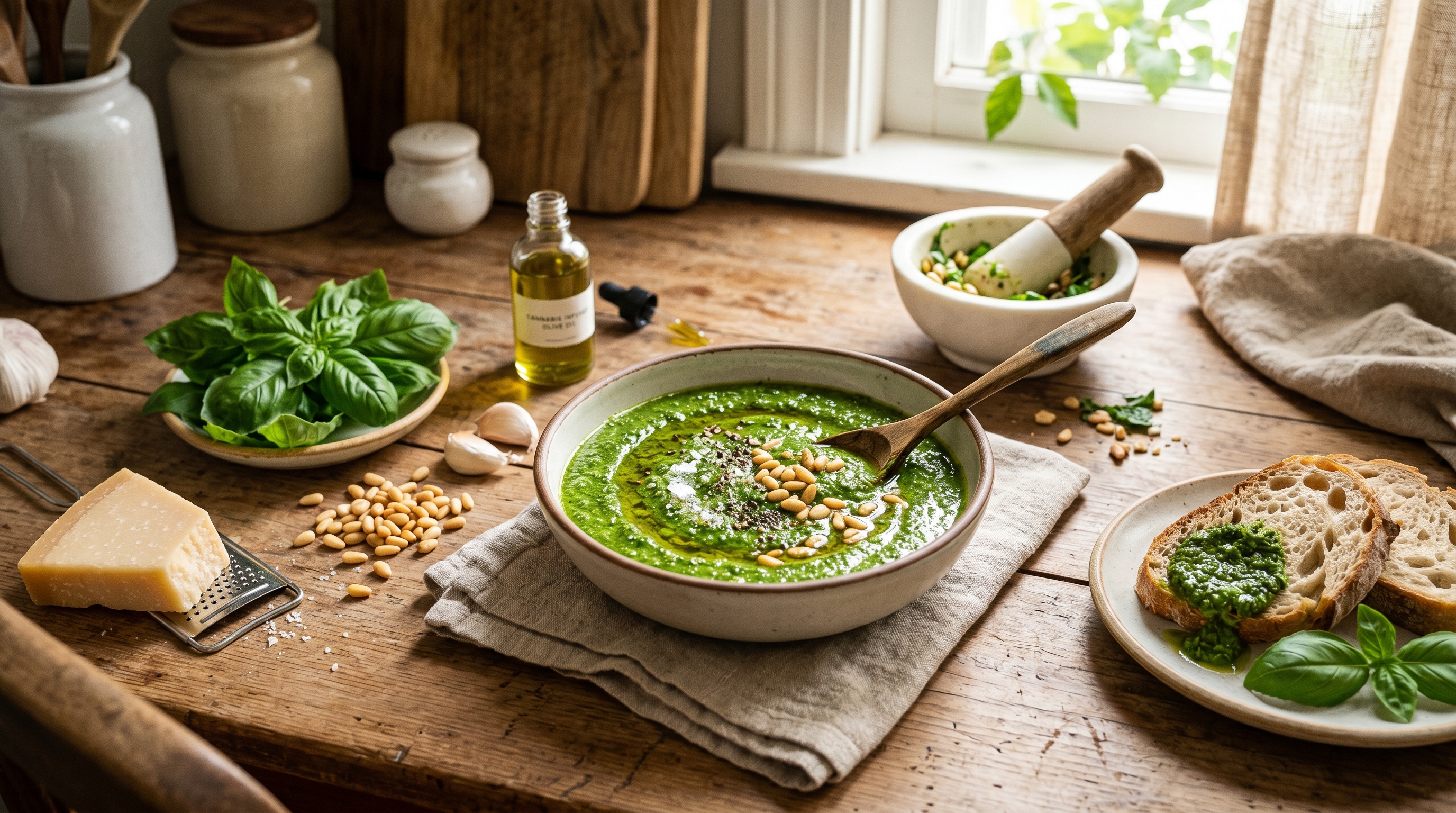
Pesto is the perfect first sauce for a home cannabis cook, and not by accident. It is built on fat. It is loud with flavor. And it is never cooked. Those three traits line up well with how cannabinoids behave in food. Ever wonder why your infused brownie tasted like a lawn clipping while a store gummy tasted like candy? The pesto answer is going to make you happy. A good basil pesto hides the weed and respects the dose at the same time.
I am Professor High. In this guide I will walk you through a classic Genovese-style pesto with one upgrade — a measured dose of decarbed cannabis-infused olive oil. We will keep it cold. We will keep the math honest. And we will keep your evening pleasant. Edibles are powerful, and the effects arrive slowly. The one mistake that really stings is taking a second helping before the first one shows up. So we will dose per tablespoon, label everything, and start low.
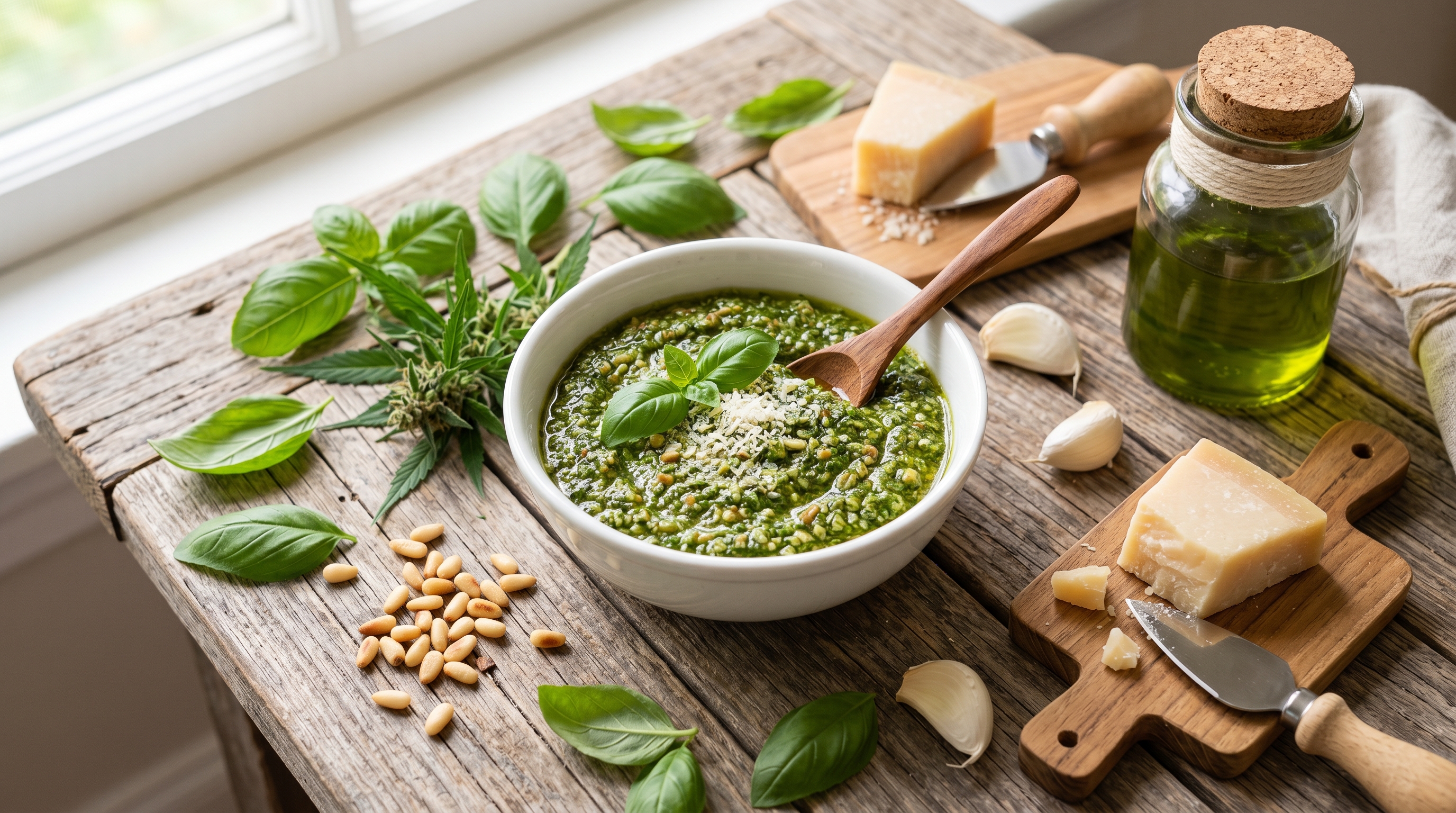
Why Pesto Is Built for Cannabis
THC and CBD are lipophilic — literally “fat-loving.” They dissolve readily into oils and fats and barely at all into water. That single chemical fact is why every serious infusion uses butter, oil, or another fat rather than water, and it is why pesto is such a natural fit. Pesto is essentially a fat delivery system wearing a green disguise.
Look at the ingredient list. Olive oil is the backbone. Pine nuts are roughly half fat by weight. Parmesan brings more fat still. When you eat that fat alongside activated cannabinoids, your small intestine forms tiny structures called mixed micelles — think of them as microscopic delivery trucks — that ferry the cannabinoids into your lymphatic system and bloodstream. Research on edible bioavailability suggests that taking cannabinoids with dietary fat may meaningfully increase how much reaches your system compared to a fat-free format, partly by routing them around first-pass liver metabolism [Zgair, 2016]. A broader review of lipid carriers in edibles reaches a similar conclusion [McClements, 2020]. Pesto hands your body that fat on a silver spoon.
One honest caveat: not all fats are equal carriers. Saturated fats like coconut oil and butter pack cannabinoids more densely, while olive oil — about 14% saturated — is a slightly less efficient carrier per spoonful. That is a feature here, not a bug. We are not trying to max out potency; we are making a flavorful sauce you can dose precisely. If you want the chemistry behind picking a fat, the right-fat guide covers it, and the broader cannabis cooking 101 primer is a great companion read.
The No-Heat Rule
Here is the part most recipes get wrong. Pesto is a cold sauce, and it should stay that way. We are not simmering anything. The cannabinoids are already activated in the infused oil (more on that in a second), so there is zero reason to apply more heat. Keeping pesto cold does two things at once: it protects the bright, grassy flavor of fresh basil, and it preserves the lighter aromatic terpenes that start to evaporate when things get hot. You did the heating earlier, during infusion and decarboxylation. The sauce itself stays raw.
This is also why pesto is more forgiving than baked edibles. With a brownie, oven temperature and bake time can quietly nudge your dose around. With pesto, what you mix is what you get. If you have struggled with the weedy taste in homemade edibles, the cold, flavor-dense approach here is your friend.
Decarb First, Always
Your infused olive oil only works if the cannabis was decarboxylated before infusing. Raw cannabis is full of THCA and CBDA — the acidic precursors — which will not get you high no matter how much pesto you eat. Heat converts THCA into THC. That conversion is the entire point of decarboxylation, and skipping it is the single most common reason a first edible “does nothing.”
The clean workflow is: decarb your flower, infuse it into olive oil low and slow, then use that finished oil cold in the pesto. If you have not made infused oil before, follow a proper method — the same principles in our cannabutter foundation guide and tincture guide apply directly to oil. Whatever you do, know the milligrams of THC per cup of your finished oil. Without that number, the dosing math below is guesswork, and guessing is how people green out.
The Terpene Bonus: Basil and Cannabis Share a Language
Here is the part that makes a cannabis chef grin. Basil and cannabis overlap in their aromatic chemistry. Basil is notably rich in linalool, the same lavender-soft terpene found in many calming cannabis cultivars, and it also carries ocimene, a sweet, herbal terpene that shows up in brighter, more energetic strains. Some basil varieties even contribute a touch of pinene and caryophyllene.
Why does that matter? Cannabis researchers describe a proposed entourage effect, in which terpenes may shape and modulate the experience cannabinoids produce [Russo, 2011]. The evidence is genuinely mixed — some lab studies show terpenes nudging cannabinoid activity, others find no interaction at all — so I will hedge honestly here: pairing basil’s terpenes with a cannabis profile may complement the overall sensory experience, but you should not expect a dramatic, guaranteed shift in effects. What is not in doubt is the flavor: when your infused oil’s aroma rhymes with the basil, the finished pesto tastes more cohesive and less “off.” For the deeper science, see our breakdown of terpene synergy.
If you want to lean into this, choose your infused oil’s strain by its High Family. A linalool-forward, mellow profile suits an evening pasta night; an ocimene-leaning brighter profile pairs nicely with a lunchtime pesto if your tolerance and schedule allow it.
Ingredients and Equipment
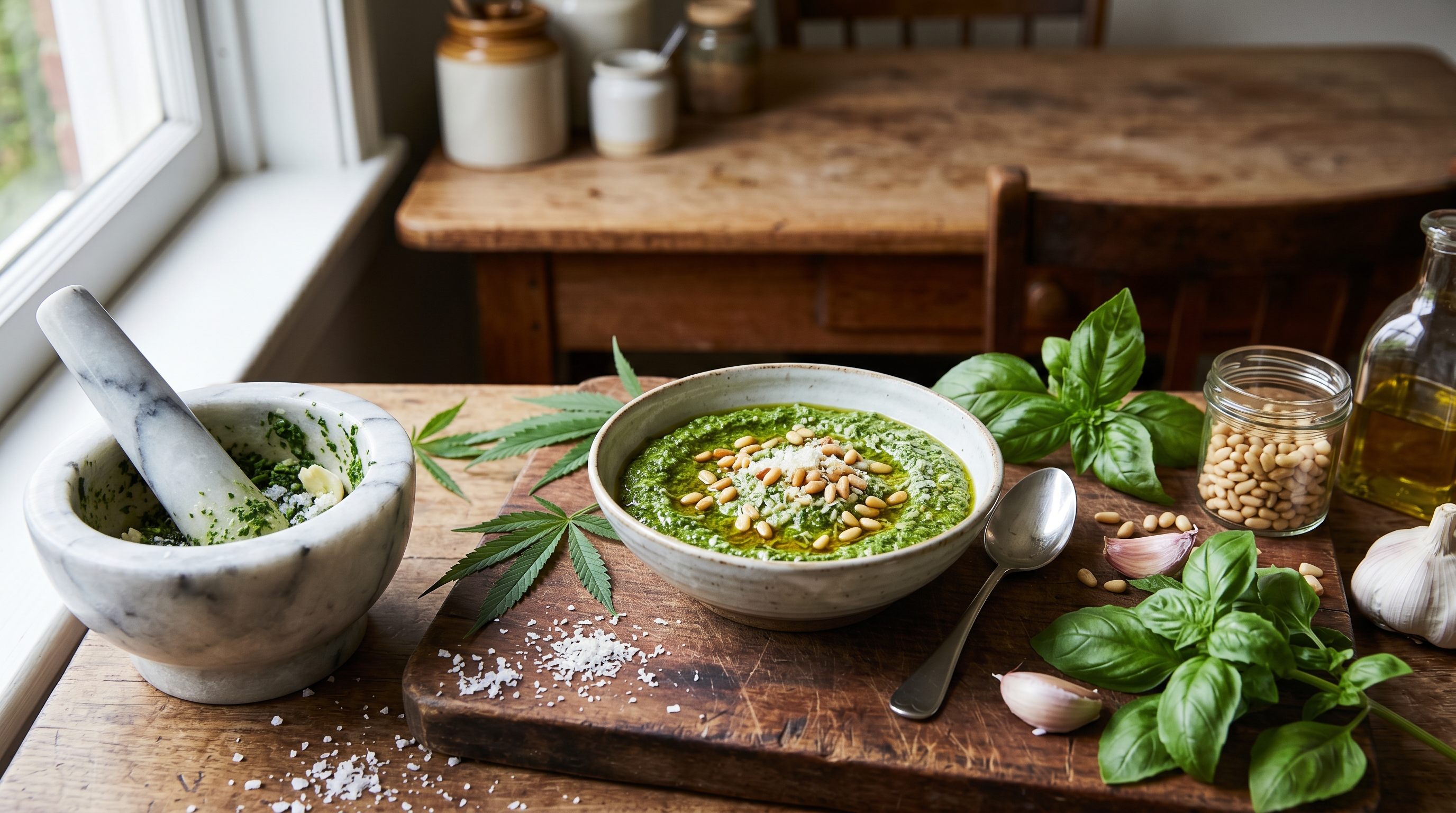
This makes roughly 1 cup of pesto, which we will divide into 8 servings of 2 tablespoons each. We will use a small, fixed amount of infused oil so the dose stays modest and predictable.
Ingredients
- 2 cups fresh basil leaves, packed (stems removed)
- 1/3 cup toasted pine nuts (walnuts work too)
- 1/2 cup freshly grated Parmesan
- 2 cloves garlic
- 1 tablespoon lemon juice (optional; helps keep the green bright)
- 1/4 teaspoon kosher salt, plus more to taste
- Freshly ground black pepper
- 2 tablespoons cannabis-infused olive oil (decarbed; potency known)
- 4 tablespoons regular extra-virgin olive oil
Equipment
- Food processor or blender (a mortar and pestle works if you are feeling traditional)
- Measuring spoons (precision matters for dosing)
- Airtight storage container and a clear label
A quick note on the oil split: I am using 2 tablespoons of infused oil and 4 tablespoons of plain oil. That ratio lets you control the dose with the infused portion while still getting enough total fat for texture and bioavailability. You can shift the ratio, but if you do, redo the math.
Step-by-Step Method
- Toast the pine nuts. In a dry skillet over medium heat, toast the pine nuts for 2–3 minutes until just golden and fragrant. Watch them — they scorch fast. Let them cool completely. This is the only heat in the recipe, and it never touches the cannabis.
- Pulse the dry-ish ingredients. Add cooled pine nuts, Parmesan, and garlic to the food processor. Pulse in short bursts until crumbly.
- Add the basil and seasoning. Add basil leaves, lemon juice, salt, and a few grinds of pepper. Pulse until you have a coarse green paste, scraping down the sides as needed.
- Stream in the plain oil. With the processor running, slowly drizzle in the 4 tablespoons of regular olive oil until the pesto is smooth and emulsified.
- Fold in the infused oil last, off the heat. This is the key move. Turn the processor to low and stream in your 2 tablespoons of infused olive oil, or simply stir it in by hand at the end. Adding it last and cold means no potency is lost and the dose stays evenly distributed. Blend just until incorporated — do not over-process, which warms the mixture.
- Taste and adjust — carefully. Taste for salt and acid only if you are comfortable consuming a tiny amount, and remember that even a lick counts toward your dose. If you would rather not, season before the infused oil goes in.
That is it. No simmering, no baking, no waiting two hours at the stove — the only waiting you do is after you eat.
Per-Tablespoon Dosing Math
This is the section that keeps your night fun, so do not skip it. Edible dosing is just division, but you have to start from a real number. For a deeper walkthrough, our edible dosing math for home cooks post is the definitive reference; here is the short version for this exact recipe.
Step 1 — Total THC in the batch. Use only the infused oil’s potency, since the plain oil contributes zero THC.
Say your infused olive oil tests at 100 mg THC per cup. One cup = 16 tablespoons, so each tablespoon carries about 6.25 mg THC. You are adding 2 tablespoons, so the whole batch holds roughly:
2 tbsp × 6.25 mg = 12.5 mg THC total in the pesto.
Step 2 — THC per serving. The batch is 8 servings of 2 tablespoons each:
12.5 mg ÷ 8 servings = about 1.5 mg THC per 2-tablespoon serving.
That is a gentle, beginner-friendly dose — right in the microdose-to-low range. If your oil is stronger, the number climbs fast. With oil at 200 mg/cup, that same batch jumps to ~25 mg total, or about 3 mg per serving. With a potent 400 mg/cup oil, you are looking at ~50 mg total and 6+ mg per serving — getting into territory where one generous scoop on pasta is a real dose.
The rules I will not bend:
- Always know your oil’s mg-per-cup. If you do not, treat the batch as unknown and dangerous, and consider testing potency at home.
- Start low and go slow. Eat one measured serving, then wait. Edibles route through your liver, where THC becomes 11-hydroxy-THC — a metabolite that is often stronger and longer-lasting than inhaled THC.
- Respect the 2-hour rule. Onset can take 30 minutes to 2 hours. Do not redose because “nothing is happening.” This is the classic trap, and the fix is patience. Our guide on when to increase your dose — and when absolutely not to is worth a read.
- Eat consistent portions. Spoon out a measured 2 tablespoons rather than free-handing it over a bowl of pasta. The portion is the dose.
If you are brand new to all of this, the beginner’s dosing chart will help you pick a target before you cook.
What to Do With Infused Pesto
Pesto is gloriously versatile, which is exactly why it is such a useful thing to keep on hand. Because the dose lives in the sauce, you can portion it onto almost anything:
- Pasta — the classic. Toss 2 tablespoons through warm (not scalding) cooked pasta off the heat. For a fully infused dinner, pair it with our marinara pasta sauce recipe on alternating nights.
- Bread and toast — spread on warm crusty bread or fold into a grilled cheese after cooking.
- Vegetables — drizzle over roasted or steamed veggies once they are off the burner.
- Dips and dressings — stir a spoonful into yogurt or sour cream for a crudité dip, the same trick that makes our infused ranch dressing and guacamole work.
- Eggs, grain bowls, soups — swirl in at the very end, never during cooking.
The golden rule across all of these: add the pesto after the heat is off. Hot pasta water and a sizzling pan are fine to mix into, but prolonged direct heat is unnecessary and works against you. For inspiration on plating infused food beautifully, see how top chefs are elevating edibles.
Storage: Fridge and Freezer
Fresh basil pesto is perishable, and the cannabis does not change that. Treat it like any fresh herb sauce, with two small additions: label the dose, and keep it away from anyone who should not have it.
Refrigerator (up to ~1 week): Transfer to an airtight container and press a thin layer of plain olive oil or plastic wrap directly onto the surface to limit browning. Basil oxidizes and darkens with air exposure — that lemon juice from step 3 helps too. Label it clearly with the date and mg THC per serving so future-you is not guessing.
Freezer (up to ~3 months): Pesto freezes beautifully, and it solves your dosing problem at the same time. Spoon it into an ice cube tray in measured portions — if each cavity holds 2 tablespoons, each cube is one labeled serving. Freeze, pop out, and store the cubes in a labeled freezer bag. Thaw a cube or two as needed. This portion-and-freeze method is the single best habit for any infused sauce. For the broader storage science, our guide on keeping cannabis fresh and potent and the edibles shelf-life guide go deeper.
A word on safety that bears repeating: infused food looks exactly like regular food. Store it on a separate, clearly marked shelf, out of reach of children, guests, and pets. The label is not optional.
Frequently Asked Questions
Can I just add ground decarbed flower instead of infused oil? You can, and some recipes do, but you sacrifice control and add grit and a stronger weed flavor. Pre-made infused oil gives you a known potency and a smoother sauce. If you go the flower route, you still must decarboxylate first.
Why olive oil instead of coconut oil or butter? Olive oil is the traditional pesto fat and tastes right. It is a slightly less efficient cannabinoid carrier than saturated fats, but for a low-dose, flavor-forward sauce that is fine. You can blend in a little melted coconut oil if you want more carrying capacity, though it will firm up when chilled.
Will heating the pasta destroy the THC? Briefly tossing pesto through warm pasta off the heat is fine — THC is stable well above normal eating temperatures. The reason we avoid cooking is flavor and terpene preservation, not fear of destroying the dose. Prolonged high heat is what you want to skip.
How long until I feel it? Anywhere from 30 minutes to 2 hours, because edibles pass through digestion and the liver. This is why the 2-hour rule exists. Eat one serving, set a timer, and be patient.
I took too much. Now what? Do not panic — uncomfortable, but not dangerous. Find a calm space, hydrate, and ride it out. Our guide on why too much cannabis makes you sick covers what is happening and how to get comfortable.
Does the basil actually change my high? Honestly, probably not dramatically. The shared terpenes between basil and cannabis make the flavor more harmonious, and the proposed entourage effect suggests terpenes may shape the experience — but the human evidence is limited and mixed. Enjoy it for the taste; treat any effect on the high as a maybe, not a guarantee.
Key Takeaways
Infused pesto is a rare edible. It is both beginner-friendly and genuinely delicious. It works with cannabis chemistry instead of against it. Fat carries the cannabinoids. No heat means the flavor stays bright. And the terpene profile rhymes with the plant itself. Get your infused oil’s potency right. Divide carefully. Label everything, and freeze the rest in measured cubes. Start low, wait, and let the pasta do its job. That is the whole game.
Sources
- McClements, D.J. (2020). “Enhancing Efficacy, Performance, and Reliability of Cannabis Edibles: Insights from Lipid Bioavailability Studies.” Annual Review of Food Science and Technology. https://www.annualreviews.org/content/journals/10.1146/annurev-food-032519-051834
- Zgair, A. et al. “Dietary fats and pharmaceutical lipid excipients increase systemic exposure to orally administered cannabis and cannabis-based medicines.” PMC5009397. https://pmc.ncbi.nlm.nih.gov/articles/PMC5009397/
- “Opportunities and challenges in developing orally administered cannabis edibles.” Current Opinion in Food Science. https://www.sciencedirect.com/science/article/abs/pii/S221479931830064X
- LaVigne, J.E. et al. (2021). “Cannabis sativa terpenes are cannabimimetic and selectively enhance cannabinoid activity.” Scientific Reports. https://www.nature.com/articles/s41598-021-87740-8
- Russo, E.B. (2011). “Taming THC: potential cannabis synergy and phytocannabinoid-terpenoid entourage effects.” British Journal of Pharmacology. https://bpspubs.onlinelibrary.wiley.com/doi/10.1111/j.1476-5381.2011.01238.x
- Sommano, S.R. et al. “The Cannabis Terpenes.” Molecules / PMC8489319. https://pmc.ncbi.nlm.nih.gov/articles/PMC8489319
Educational content only. Cannabis affects everyone differently; consult a healthcare provider about your situation and follow your local laws.


