Cannabis Ranch Dressing: Infused Crowd-Pleaser Recipe
Make creamy cannabis ranch with infused oil, nail the per-tablespoon dosing math, and label it right so a shared dressing never blindsides a guest.

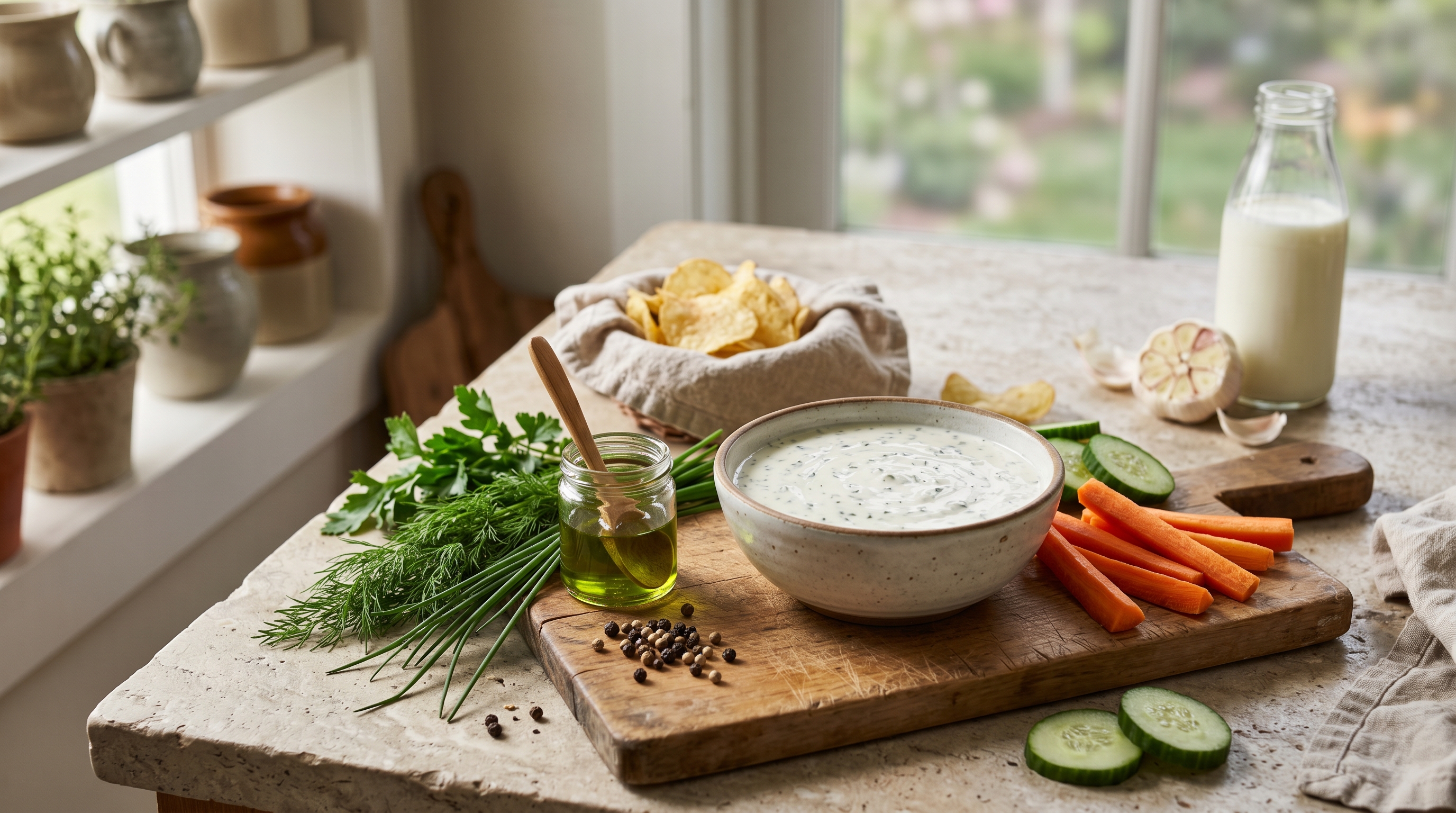
Ranch is the dressing America can’t quit. It goes on salads, sure — but also wings, pizza crusts, carrot sticks, fries, and basically anything that holds still long enough. That universal-dip status is why it makes such a great cannabis carrier. It is also why it demands a little respect. A bottle of “house ranch” on a party table looks completely innocent. Make it infused without doing the math, and you’ve built the most common edible mistake there is: a tasty food that nobody knows is dosed.
Good news — ranch is genuinely one of the easier dressings to dose well. Its buttermilk, mayonnaise, and oil base is loaded with fat, and as you’ll see, fat is not just flavor here. It’s the carrier that actually carries cannabinoids into your bloodstream. Better still, ranch is a cold, no-cook recipe, which means no oven, no scorched potency, and no guessing what the heat did to your dose.
The trick is that a poured or dipped dressing hands control of the dose to whoever’s holding the spoon. So we’re going to make a great ranch, work the per-tablespoon arithmetic together, and then cover the labeling and storage rules that keep a shared bottle from becoming a problem. Let’s get into it.
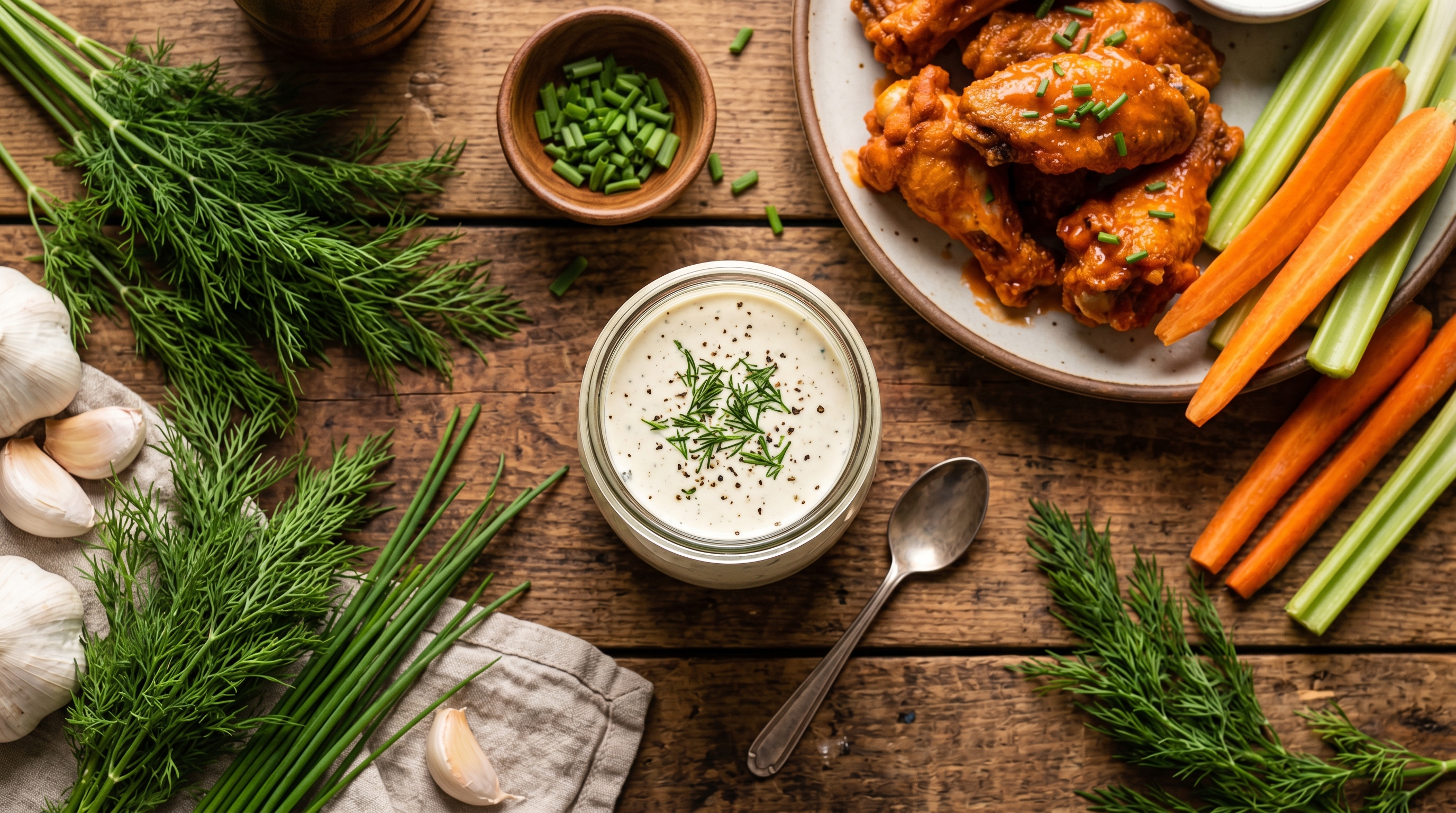
Why Ranch Is a Near-Perfect Cannabinoid Carrier
Here’s the science that makes ranch more than a stoner gimmick. THC and CBD are lipophilic — fat-loving and water-hating. They dissolve into oils and fats, not into watery liquids. That’s why you infuse oil or butter rather than, say, a vinegar, and it’s also why the fat in a recipe directly affects how much of a dose you actually absorb.
Ranch is built on three fatty pillars: buttermilk, mayonnaise (which is mostly oil), and your infused oil itself. That fat does real work in your gut. When you eat cannabinoids with dietary fat, enzymes break the fat down. They package it into tiny carriers called mixed micelles and chylomicrons. Those carriers shuttle the cannabinoids into your blood. A good share of that traffic even routes through the lymphatic system, which partly sidesteps the liver’s aggressive first-pass metabolism.
How big is the effect? In a controlled rat study, co-administering cannabis with dietary lipids increased systemic exposure to THC by about 2.5-fold and CBD by roughly 3-fold compared to a fat-free formulation, with about a third of each cannabinoid solubilized into absorbable micelles [Cherniakov, 2016]. Human work points the same way: a randomized crossover study found a high-fat meal substantially raised plasma CBD versus an energy-matched high-carb meal, and a separate trial saw peak CBD concentrations climb many-fold under fed, high-fat conditions [Williams, 2025]. Research consistently suggests that taking cannabinoids with fat may improve and stabilize absorption — though individual results still vary, and none of this is medical advice.
The practical takeaway cuts two ways. The fat in ranch may make it an efficient delivery vehicle, which is great. It also means the same milligram count may feel stronger with a creamy dip than swallowed dry. That is one reason cannabis hits differently on an empty stomach. So respect that and dose low. Want the full breakdown of how absorption routes compare? Our guide to consumption methods ranked by bioavailability goes deeper. And because the effect is partly about the terpenes you bring along, an oil infused with a citrusy limonene-rich strain may ride differently than a sedating myrcene-heavy one.
What You’ll Need
This recipe makes about 1¾ cups of dressing — roughly 14 tablespoons, which we’ll treat as 14 servings of one tablespoon each. We’ll dose it as a party-friendly, low-and-slow batch.
Ingredients:
- 1 cup buttermilk (or ½ cup milk plus ½ cup plain full-fat Greek yogurt)
- ½ cup mayonnaise
- 2 tablespoons sour cream (optional, for extra body)
- 1 to 3 teaspoons cannabis-infused oil (your potency lever — see the math below)
- 1 tablespoon fresh dill, chopped (or 1 teaspoon dried)
- 1 tablespoon fresh chives, finely minced
- 1 tablespoon fresh parsley, chopped
- 1 clove garlic, finely grated (or ½ teaspoon garlic powder)
- ½ teaspoon onion powder
- 1 teaspoon white wine vinegar or lemon juice
- ½ teaspoon salt, plus more to taste
- ¼ teaspoon ground black pepper
Equipment:
- A whisk and a mixing bowl, or a lidded mason jar
- A clean measuring spoon dedicated to the infused oil (precision matters here)
- A dedicated, clearly marked serving spoon or pour bottle
- An airtight jar for storage and a label
A quick word on the infused oil. You can buy a lab-tested infused oil with a known milligrams-per-teaspoon figure, which makes the math trustworthy, or make your own. If you make your own, the two things that decide your potency are decarboxylation and infusion. Skip or botch the decarboxylation step and your ranch will do nothing; nail it, and you have an active ingredient. A neutral oil keeps the flavor clean, but choosing the right fat for your infusion shapes both taste and extraction. For the full infused-oil and cannabutter walkthrough, see our cannabutter foundation guide and cannabis cooking 101.
Step-by-Step: From Oil to Bottle
This is a no-cook recipe, which is the whole point. Heat is the enemy of a measured dose here — your cannabinoids are already activated in the oil, so you just need to distribute them evenly and cold.
Step 1: Confirm Your Oil’s Potency
Before anything touches the bowl, know your milligrams. If you bought infused oil, read the label for mg of THC per teaspoon. If you made it, run the dosing math in the next section first. You can’t dose a dressing you haven’t measured.
Give the oil a thorough stir or shake. Cannabinoids settle, and an unstirred bottle can hand one scoop a tiny dose and the next a wallop.
Step 2: Build the Creamy Base
In your bowl or jar, combine the buttermilk, mayonnaise, and sour cream. Whisk (or seal and shake) until it’s smooth and uniform. A fully blended base is the foundation for an even dose — lumps and pockets are where potency hides unevenly.
Step 3: Whisk In the Infused Oil First
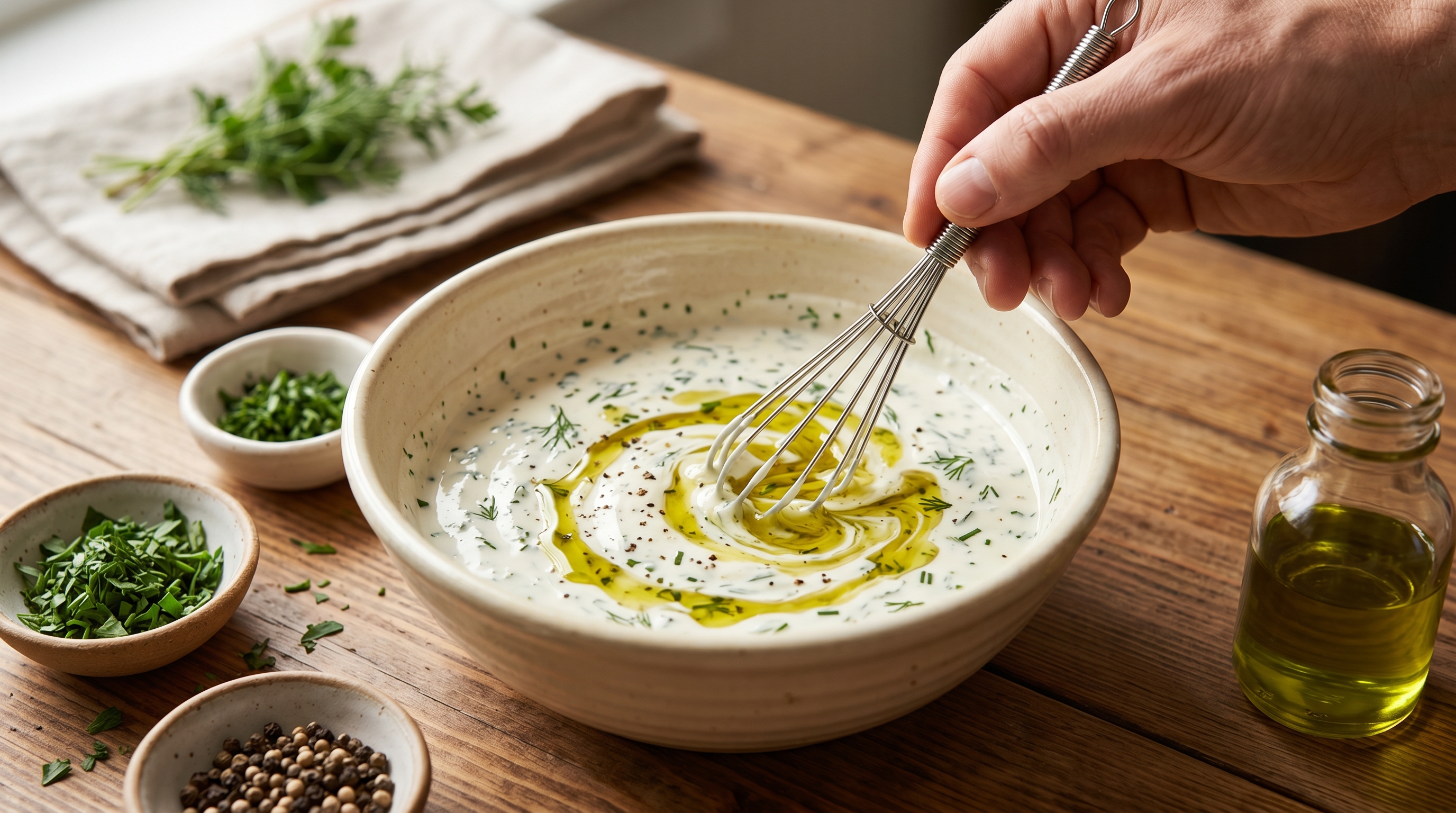
Add your measured infused oil to the creamy base before the herbs and seasonings go in, and whisk it hard for a full minute — or shake the sealed jar vigorously. This is the most important step in the entire recipe. Even distribution is what makes the dose-per-tablespoon math real. Stir the oil in last and under-mix, and a few servings could carry several times the intended dose while others carry almost none.
Because oil and a buttermilk base want to separate, emulsification matters. Whisking steadily while you drizzle, or shaking a tightly sealed jar, helps the oil break into fine droplets that stay suspended. The mayonnaise actually helps here — it’s already an emulsion and pulls the infused oil into the mix.
Step 4: Fold In Herbs and Seasoning
Add the dill, chives, parsley, garlic, onion powder, vinegar or lemon juice, salt, and pepper. Whisk or shake again until evenly combined. Ranch’s bold, savory profile — garlic, onion, tangy buttermilk, fresh herbs — does double duty here, masking any faint herbal note from the oil so it just tastes like really good ranch. If you’re sensitive to the weedy taste that can sneak into edibles, this seasoning is your friend.
Step 5: Chill, Then Taste
Refrigerate the dressing at least 30 minutes so the flavors marry and it thickens slightly. Then taste on a plain cucumber slice or lettuce leaf and adjust salt or acid. Give the jar a gentle shake before serving — but don’t skip the dosing section first.
The Dosing Math (Read This Twice)
This is where an infused dressing earns its reputation as a tricky edible to share. A gummy is pre-portioned; a bottle of ranch is a free-for-all that someone pours by feel. So your job is to control the total dose in the batch and then publish a clear per-tablespoon number.
The master formula for homemade infused oil:
Grams of cannabis × THC% (as a decimal) × 1000 × extraction efficiency = total mg THC
Then:
Total mg THC ÷ number of servings = mg per serving
A couple of factors keep this honest. The first is the decarboxylation conversion: raw THCA loses roughly 12% of its mass converting to active THC, which is why many calculators apply a 0.88 factor. The second is extraction efficiency — not all the THC makes it into your oil. Real-world infusion typically lands around 70 to 90% efficiency depending on method (stovetop oil roughly 75 to 85%, sous vide higher). When in doubt, assume lower efficiency; it produces a more conservative, weaker estimate, which is the safe direction to err.
A worked example. Say you infused 2 grams of 18% THC flower into a small batch of oil at an assumed 75% efficiency:
- 2 × 0.18 × 1000 × 0.75 = 270 mg total THC in your infused oil
- If your full bottle is, say, 6 teaspoons, that’s 45 mg per teaspoon
Now suppose your ranch uses just 2 teaspoons of that oil across 14 one-tablespoon servings:
- 45 mg × 2 = 90 mg in the batch
- 90 mg ÷ 14 = about 6.4 mg THC per tablespoon
That’s a sensible party number — a low-to-moderate single serving. Standard guidance puts beginners around 2.5 to 5 mg, occasional users around 5 to 15 mg, and regular users higher. If you bought a labeled oil instead, skip straight to the second formula using the printed mg-per-teaspoon. For more on dialing in numbers, lean on our edible dosing math for home cooks and the beginner dosing chart.
Your potency lever: use less infused oil for a milder batch, more for a stronger one. For a true microdose dressing, 1 teaspoon of the oil above across 14 servings lands around 3.2 mg per tablespoon. Keep in mind that the buttermilk-and-mayo fat may make a given dose feel stronger than the same milligrams in a fat-free format — another reason to start low. New to all this? Our edible dosing for beginners guide and the first-time users guide are required reading. And if you want to verify your estimate against reality, testing homemade edible potency at home is worth the effort.
Labeling a Shared Dressing — Non-Negotiable
Homemade edibles look exactly like regular food, and infused ranch looks identical to the bottle in everyone’s fridge door. That’s the whole hazard. For a shared dressing, do all of the following:
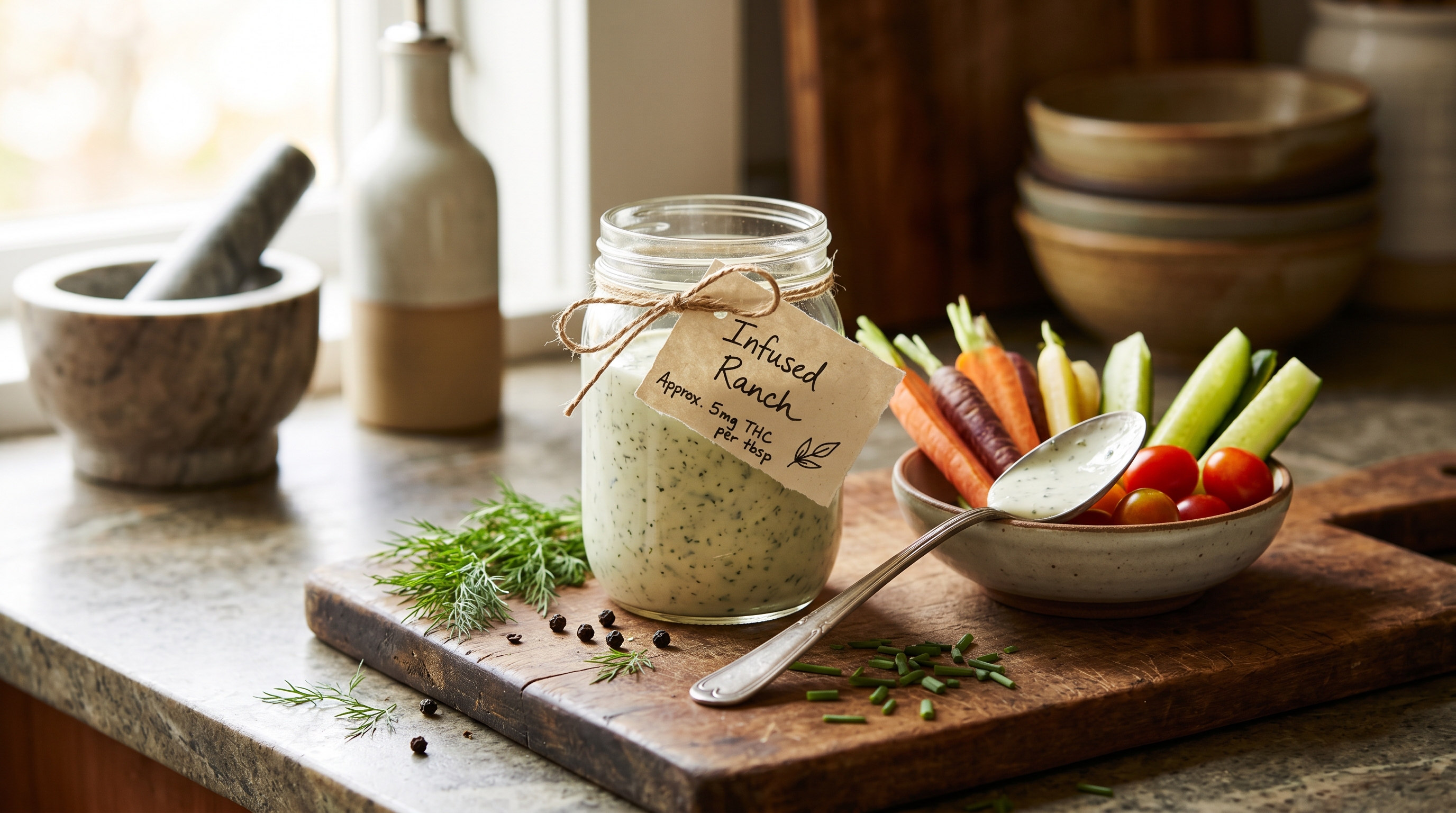
- Put a clearly written label on the jar: “INFUSED — approx. 6 mg THC per tablespoon. Start with one. Wait 2 hours.”
- Use one dedicated serving spoon or pour bottle sized so “one spoon equals one serving” is literally true. A free-pour over a salad is where doses run away.
- Tell every guest, out loud, before anyone dips or drizzles. Informed and consenting is the entire rule. Never set out infused food where someone could eat it unknowingly.
- Always provide a non-infused ranch too, so hungry guests have a safe option and aren’t tempted to keep drowning their wings in the medicated one.
If you’re hosting, our cannabis tasting party guide and cannabis etiquette rules cover the social side. And please keep infused dressing away from children and pets — cannabis and pets do not mix, and a curious dog at a barbecue is a real risk.
Keeping It Fresh: Storage and Shelf Life
Ranch is a dairy product, so storage is non-negotiable. This is fridge food, full stop.
- Refrigerate immediately in an airtight jar, and keep it cold between rounds. Don’t let an infused dressing sit out on a warm table for hours — both for food safety and because room-temperature dip invites mindless over-pouring.
- Plan for about one week. A buttermilk-and-mayo dressing keeps roughly 5 to 7 days refrigerated. If you used fresh garlic and herbs, lean toward the shorter end — fresh aromatics shorten shelf life.
- For a slightly longer life, make the base with dried herbs and garlic powder instead of fresh, and it’ll hold closer to the full week.
- Shake before every use. Separation is normal in a homemade dressing, and re-mixing isn’t just about texture — it redistributes the cannabinoids so your per-tablespoon dose stays consistent from the first pour to the last.
- Never freeze it. Buttermilk and mayo break and turn grainy when thawed, and uneven thawing can pool the oil.
For keeping your raw flower and infused oil potent before they ever hit the bowl, our cannabis storage guide has you covered. Want another shareable infused dish that uses the same dosing principles? Try our cannabis-infused guacamole or pasta sauce marinara.
What to Do With It
This is the fun part — ranch goes on nearly everything, which makes portion control the only real discipline:
- Salads. The classic. One measured tablespoon dresses a side salad nicely without turning into a guessing game.
- Veggie and wing dip. Carrots, celery, peppers, and buffalo wings love ranch. Pour your measured serving into a small personal dish rather than letting people dunk from the communal jar — that keeps doses honest.
- A finishing drizzle. Tacos, baked potatoes, grain bowls, and pizza crusts all take a measured drizzle well. The pairing with a caryophyllene-rich, peppery strain oil is especially nice over savory food.
- A CBD-forward version. Swap in a CBD-dominant infused oil for a mellow, non-euphoric dressing that still gets the fat-carrier benefit.
Whatever you put it on, the rule holds: measure the serving, then wait. The fat means it may hit harder than you expect.
A Note on Serving Responsibly
The whole reason this article exists is that a poured or dipped dressing removes the eater’s control over their dose. So host like the adult in the room. Keep the per-serving number genuinely low for a crowd — 5 mg or under per tablespoon is a friendly default — because you can’t predict everyone’s tolerance, and the dairy-and-oil fat may amplify effects. Tell people onset can take up to two hours and that re-pouring “because nothing happened yet” is how people green out.
Don’t pair infused ranch with alcohol; mixing cannabis and alcohol amplifies both unpredictably. If a guest does overshoot, our guide on how to sober up from being too high walks through the calm-it-down basics — hydration, a low-stimulation spot, and time. Edibles aren’t dangerous when treated with respect; they get people in trouble when treated like ordinary food. None of this is medical advice, and people who are pregnant, on medications, or managing a health condition should talk to a clinician first.
Frequently Asked Questions
Do I need to decarb my cannabis for this recipe? Not at the dressing stage — this is a no-cook dish. But the cannabis must already be activated in the oil. Use pre-decarbed flower in your infusion or a pre-made infused oil. If you skip decarboxylation entirely, your ranch will have little to no effect.
Why does my infused ranch feel stronger than the same dose in a gummy? Likely the fat. Buttermilk, mayo, and oil are lipid-rich, and research suggests dietary fat can meaningfully increase cannabinoid absorption. The same milligram count may simply land harder with a creamy food than on an empty stomach. Start low.
Can I make a CBD-only version? Yes. Swap in a CBD-infused oil for a non-euphoric, mellow dressing. The same dosing math and labeling rules apply — CBD is also fat-soluble and benefits from the dairy-and-oil carrier.
How long does it keep, and can I freeze it? About 5 to 7 days in the fridge in a sealed jar — shorter if you used fresh garlic and herbs. Don’t freeze it; buttermilk and mayo separate and turn grainy when thawed, which also messes with even dosing.
How long do the effects last? Edible effects typically peak around 2 to 4 hours and can linger for 6 or more, far longer than smoking. That long tail is exactly why you wait the full two hours before considering more. See our guide on how long a cannabis high lasts.
What if my batch turns out too strong? Whisk in more plain buttermilk and mayonnaise to dilute the per-tablespoon dose across more total volume, then recalculate and relabel. It’s always easier to dilute down than to undo an overdose.
Key Takeaways
Cannabis ranch is the rare edible where the food and the science actually line up: the buttermilk-mayo-oil base is a genuine fat carrier that may improve how your body absorbs cannabinoids, and a cold whisk skips the heat that complicates dosing. Make the oil right, do the math, and keep the per-tablespoon dose low and clearly labeled — that’s the whole game.
The hardest part isn’t the recipe. It’s remembering that a poured dressing strips eaters of control over their own dose, which puts the responsibility squarely on you, the host. Measure it, label it, tell people, refrigerate it, and provide a non-infused option. Do that, and you’ve got a crowd-pleasing dressing nobody regrets the next morning.
Want to actually learn from each batch instead of guessing? The High IQ app lets you log what you made, the dose, and how it felt — so your next jar is dialed in, not a do-over. Track what works, and let the data do the remembering.
Sources
- Cherniakov I, et al. “Dietary fats and pharmaceutical lipid excipients increase systemic exposure to orally administered cannabis and cannabis-based medicines.” European Journal of Pharmaceutical Sciences / PMC. PMC5009397
- Zgair A, et al. “Oral administration of cannabis with lipids leads to high levels of cannabinoids in the intestinal lymphatic system and prominent immunomodulation.” Scientific Reports, 2017. Nature
- McClements DJ. “Enhancing Efficacy, Performance, and Reliability of Cannabis Edibles: Insights from Lipid Bioavailability Studies.” Annual Review of Food Science and Technology, 2020. Annual Reviews
- “A high-fat meal significantly impacts the bioavailability and biphasic absorption of cannabidiol (CBD).” Scientific Reports, 2025. Nature
- “A prior high-fat meal increases plasma cannabidiol concentrations compared to an isoenergetic high-carbohydrate meal.” Proceedings of the Nutrition Society, 2025. Cambridge Core
- “Calculating THC Dosage in Edibles: The Complete Math Guide.” MunchMakers, 2026. MunchMakers


