CBD, THC and Your Prescriptions: The 2026 CYP450 Review
A 2026 systematic review maps which liver enzymes CBD and THC actually touch — CYP3A4, CYP2C9, CYP2C19 — and what that means for your prescriptions.

Professor High

You already know cannabis “can interact with medications.” Everyone says it. Almost nobody tells you which enzymes, in which direction, or why a 25 mg CBD gummy and a 600 mg CBD prescription are not remotely the same question.
That vagueness leaves you with two bad options: assume there is no risk, or assume there is a catastrophic one. Neither helps you talk to the person who writes your prescriptions.
A systematic review published in 2026 in the European Journal of Drug Metabolism and Pharmacokinetics — dos Santos and colleagues — went looking for the enzyme-level detail. Here is what they found, what they explicitly could not establish, and how to turn that into a real conversation.
This is education, not medical advice. Nothing here is a reason to change, reduce, skip or stop a prescribed medication. If something below worries you, that is a reason to call your prescriber or pharmacist — not a reason to self-adjust.
What CYP450 Enzymes Actually Do
Your liver is a chemical processing plant, and the cytochrome P450 family is its main production line. These enzymes take fat-soluble compounds — drugs, hormones, plant chemicals — and modify them so your body can clear them.
The scale is what people underestimate. The dos Santos review opens by noting that CYP450 isoforms handle the metabolism of roughly 80% of therapeutic drugs. Not 80% of exotic drugs — 80% of the pharmacy: statins, blood thinners, antidepressants, antipsychotics, anticonvulsants, immunosuppressants, some chemotherapies, many painkillers.
“Isoform” is the word that matters. CYP450 is not one enzyme; it is a family, each member with its own preferred substrates. CYP3A4 is the workhorse. CYP2C9, CYP2C19 and CYP2D6 each own a slice of the pharmacy. Which isoform a drug depends on determines whether an interaction is even possible.
So the useful question is never “does cannabis interact with drugs?” It is: which isoform does my medication depend on, and does a cannabinoid do anything to that specific isoform?
Why the direction matters more than the fact
Two things can happen at an enzyme, and they have opposite consequences.
Inhibition slows the enzyme down. Your medication clears more slowly, so more of it stays in your bloodstream for longer — effectively a higher dose than the label says, without you changing anything.
Induction speeds the enzyme up. Your medication clears faster, so less of it is around to work — effectively a lower dose than the label says.
Inhibition tends to look like side effects. Induction tends to look like the drug quietly not working. The second is easier to miss and, for something like an anticonvulsant or an immunosuppressant, is not a minor problem.
What the 2026 Review Found
dos Santos and colleagues followed PRISMA methodology and searched PubMed, SciELO, ScienceDirect and Scopus for studies published between January 2019 and March 2025, looking at how phytocannabinoids modulate hepatic CYP450 isoforms in vitro, in vivo, or ex vivo.
Here is the honest headline: four studies met their eligibility criteria. Four.
That is not a reason to dismiss the review — it is the reason to read it carefully. A tightly screened review tells you what the field has actually established, and by omission how much of what circulates online is extrapolation rather than measurement.
The isoform-by-isoform picture
| Isoform | What the review reported | Practical reading |
|---|---|---|
| CYP3A4 | Inhibited by phytocannabinoids, CBD in particular | The broadest exposure, because CYP3A4 metabolises the largest share of drugs |
| CYP2C9 | Inhibited | Relevant to a specific and clinically sensitive set of drugs |
| CYP2C19 | Inhibited — but one included study indicated activity could also be induced under certain conditions | The messiest of the four; direction is not settled |
| CYP2D6 | Minimal or no modulation | The reassuring finding, and the one nobody repeats |
The review’s overall conclusion was that phytocannabinoids influence key CYP450 enzymes predominantly through inhibition, and that CBD was consistently identified as a potent inhibitor of the CYP enzymes responsible for drug metabolism.
Three things in that table deserve more attention than they get.
CYP2D6 came out largely untouched. That is a real finding, and the kind of nuance that gets flattened out of consumer coverage. “These isoforms, not that one” is both more accurate and more useful than “cannabis affects your liver enzymes.”
CYP2C19 may go both ways. One included study indicated induction under certain conditions, against a general backdrop of inhibition. When a review reports conflicting directions on the same enzyme, the correct response is “unresolved,” not “pick the scarier one.”
CBD is the recurring name, not THC. The review’s summary language centres on cannabidiol. THC is a phytocannabinoid and was within scope, but the consistent inhibitor signal across the included studies was CBD. Our THC vs CBD explainer covers the receptor-level story underneath this one.
What the review cannot tell you
The included studies were in vitro, in vivo, or ex vivo — cell systems, animal models, tissue preparations. That design tells you a molecule can inhibit an enzyme. It does not tell you by how much, at what human dose, or whether your specific prescription meaningfully shifts.
The authors were explicit about this: their conclusion calls for additional clinical and mechanistic studies to assess safety and pharmacokinetic implications in patients using cannabis-based therapies. That is a research field describing a gap, not one issuing a warning.
Mechanism established, magnitude not. Treat anyone who gives you a precise percentage for how much your medication levels will shift with real suspicion.
Why Dose Changes the Question Entirely
The single most common error in cannabis interaction advice is treating “CBD” as one thing.
Consider the range in front of a consumer. A wellness gummy might contain 10–25 mg of CBD. A tincture or capsule might deliver 50 mg. Prescription CBD used in epilepsy is dosed per kilogram of body weight and lands vastly higher — the CBD epilepsy story is where much of the clinical interaction literature came from, precisely because those doses are large enough for effects to be measurable.
Enzyme inhibition is concentration-dependent, so the low end and the high end of that range are not the same proposition. The review establishes that CBD is a potent inhibitor in the systems studied; it does not establish that every consumer dose produces a clinically meaningful shift.
This cuts both ways. “Low dose, therefore no concern” is also an assumption, not a finding — nobody has mapped the dose-response curve for you personally, which is exactly why the answer is disclosure rather than arithmetic. Format matters too: full-spectrum, broad-spectrum and isolate products carry different amounts of CBD, and a CBD isolate versus CBG isolate decision changes what is in the bottle.
Route Matters: The First-Pass Problem
Where a cannabinoid goes first determines how much liver it meets, and in what concentration.
Anything you swallow is absorbed from the gut and delivered straight to the liver through the portal vein before it reaches the rest of your body. That is first-pass metabolism, and it is why edibles behave so differently from inhaled cannabis. Inhaled cannabinoids skip that step initially, entering through the lungs; they still reach the liver, but not as a concentrated first bolus. Our bioavailability ranking, the sublingual versus edible onset comparison and the full pharmacokinetics guide cover how much this changes the numbers.
The reasonable inference — and this is mechanistic reasoning, not a finding from the review — is that oral routes present the liver with the highest concentrations and are therefore the most plausible setting for an enzyme interaction. Nano-emulsified and fast-acting formats change absorption speed, which changes peak concentration, which is the variable that matters for competitive inhibition.
Do not read that as permission. “Inhaled is probably lower risk” is not “inhaled is safe with my medication.”
Why Grapefruit Is the Right Analogy
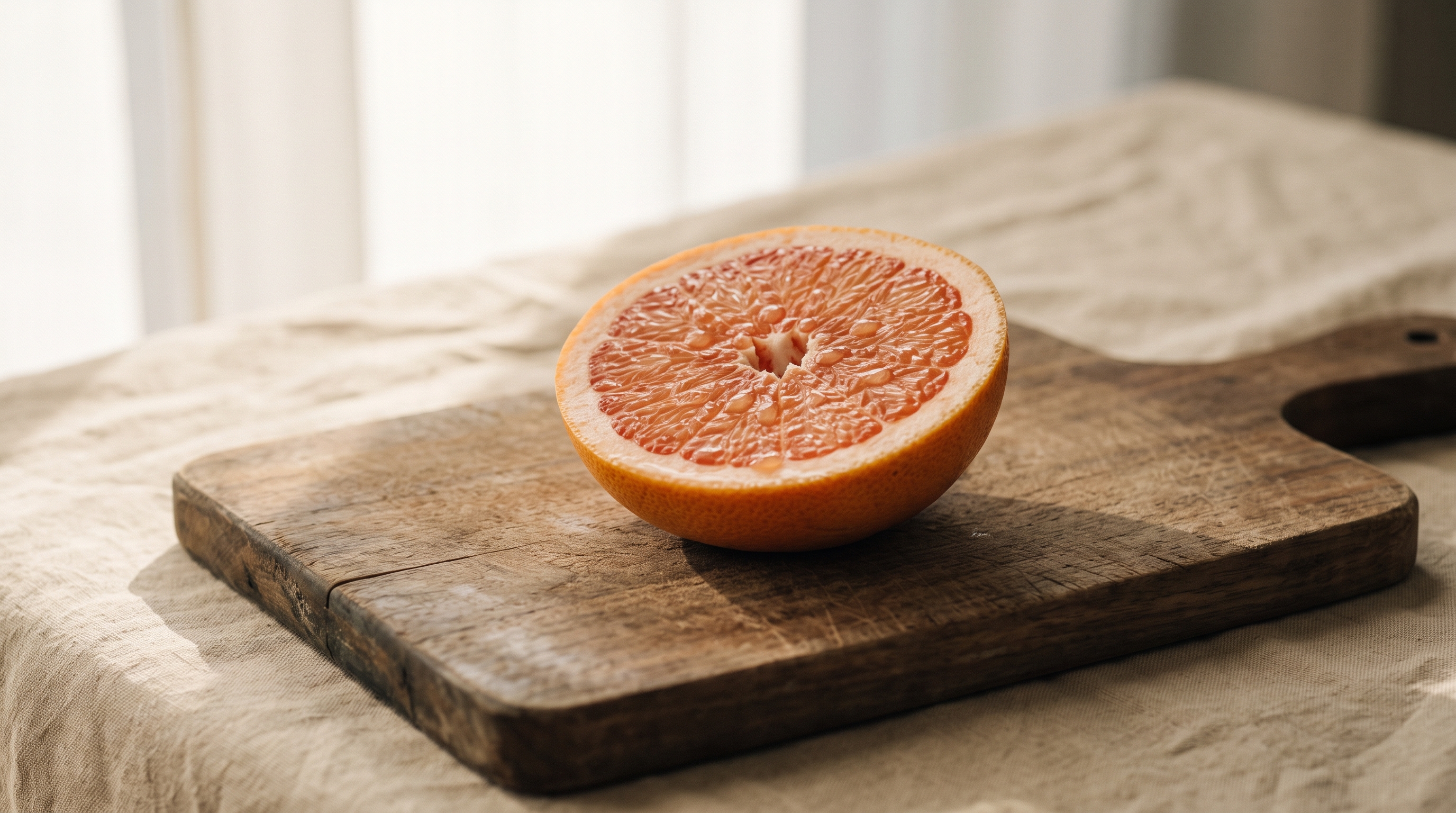
If you have ever picked up a prescription with a sticker telling you to avoid grapefruit, you have already met enzyme inhibition — you just were not told the mechanism. Grapefruit contains compounds that inhibit CYP3A4. Slow that enzyme and a drug depending on it clears more slowly, so blood levels climb higher than the dose intended. The warning is not because grapefruit is toxic; it is because grapefruit changes how much of the drug you effectively receive.
The analogy earns its place because it makes the mechanism intuitive without making it frightening — nobody thinks grapefruit is dangerous, only dangerous in combination, and only with specific drugs. It also sets the right expectation about specificity: the sticker appears on some bottles and not others, because it depends on which enzyme the drug uses.
Where the analogy stops: grapefruit’s CYP3A4 effect is heavily concentrated in the intestinal wall, and has been studied in humans for decades. The cannabinoid picture is at an earlier stage — which is exactly what a four-study systematic review published in 2026 is telling you.
Where This Matters Most
Because CYP3A4, CYP2C9 and CYP2C19 are the isoforms flagged in the review, the medication classes that lean on those enzymes are the ones worth raising explicitly with a prescriber.
- Anticoagulants. Warfarin depends heavily on CYP2C9 and has a narrow therapeutic window — small changes in blood level have real clinical consequences. It has its own deep dive: cannabis and blood thinners.
- Anticonvulsants. Several run through CYP2C9 and CYP2C19, and here an unnoticed drop in effectiveness is as serious as a rise.
- Immunosuppressants. Heavily CYP3A4-dependent, narrow windows, monitored by blood level for exactly this reason.
- Statins. Several are CYP3A4 substrates.
- Some antidepressants and antipsychotics. Split across isoforms, including CYP2C19 — the one with unsettled direction.
- Some chemotherapy and supportive-care agents. People reach for cannabis for cancer-related symptoms specifically, which makes this conversation more likely, not less.
Two contexts raise the stakes further. Older adults typically take more medications at once, and our guide for seniors covers why polypharmacy compounds every interaction question. And if you have surgery coming up, what to tell your care team is a conversation to have before the day, not on it.
None of this is a list of things to stop. It is a list of things to mention.
The Part That Actually Protects You
Everything above narrows to one behaviour: tell your prescriber and your pharmacist that you use cannabis, and be specific. Vague disclosure produces vague advice. Bring:
- The product type and route. Flower, vape, edible, tincture, capsule, topical — and whether it is inhaled, swallowed, held under the tongue, or applied to skin.
- The actual milligrams. Both THC and CBD, per serving. Read the package; do not estimate.
- The frequency. Nightly is a different exposure profile from twice a month.
- How long you have been doing it. If you started cannabis before a recent blood test, that test already reflects it.
Pharmacists are the underused resource here. They have the interaction databases open, they know which isoform each of your medications runs through, and checking is a normal part of the job. It costs you one question.
And the thing to avoid, firmly: do not adjust a prescription yourself. Not the dose, not the timing, not skipping. If the interaction is real, the fix is a monitored adjustment by the person who prescribed it. If it is not, you have taken a risk for nothing.

What the Label Does Not Tell You
An interaction conversation depends on knowing what you actually took. But a strain name is not a chemical specification. Two products sold under the same name can differ substantially in cannabinoid content, and the accompanying chemistry — limonene, myrcene, caryophyllene and the rest of the terpene profile — varies too. Browsing by effect or by High Family gets you closer to the chemistry than a name does, but the milligram figures on the package remain the only numbers a pharmacist can work with.
CBD-forward cultivars like ACDC, Harlequin, Charlotte’s Web, Cannatonic and Ringo’s Gift are where this matters most, because people choose them specifically for higher CBD — the cannabinoid the review names most often. A balanced or high-CBD product is not automatically the “gentler” choice from an enzyme perspective. A THC-dominant cultivar like Blue Dream poses a different chemical question, and finding your own THC-to-CBD ratio now has a pharmacological dimension as well as an experiential one.
Your own metabolism is the last variable. Genetics shape how you process cannabis, and CYP enzyme variants differ meaningfully between people — the MTHFR and metabolism piece covers how far individual biochemistry can sit from the population average. Two people, same product, same prescription, different outcome.
Which is our argument in one sentence: the label is a starting point, and your own response is the data that matters. If you want a record you can hand to a prescriber — product, dose, route, date, how you felt — that is what the High IQ app is for.
Key Takeaways
- CYP450 enzymes metabolise roughly 80% of therapeutic drugs, so which isoform your medication uses determines whether an interaction is even possible.
- dos Santos and colleagues found phytocannabinoids — CBD in particular — inhibit CYP3A4, CYP2C9 and CYP2C19, with CYP2D6 showing minimal or no modulation. One study indicated CYP2C19 could also be induced, so that direction is unsettled.
- Only four studies met eligibility, all in vitro, in vivo or ex vivo. Mechanism is established; clinical magnitude is not.
- Disclosure with specifics is the action item — never a self-managed change to a prescribed medication.
Frequently Asked Questions
Does this mean I should stop taking CBD if I’m on medication?
No. Nothing here supports stopping anything on your own — and that includes your prescription. It supports telling your prescriber and pharmacist exactly what you take, in milligrams, so they can check your medications against the isoforms involved. They may say it is fine. They may want a blood level checked. That decision belongs to them.
Is smoking or vaping safer than edibles for interactions?
Mechanistically, inhaled cannabinoids avoid the concentrated first pass through the liver that swallowed products go through, which makes oral routes the more plausible interaction setting. But that is reasoning from pharmacokinetics, not a finding of the review, and inhaled cannabinoids still reach the liver. It is a variable worth mentioning to your prescriber, not a workaround. See our consumption methods comparison for the numbers.
Is THC safe then, since the review focused on CBD?
That is the wrong conclusion. THC was within scope; CBD is simply the molecule that produced the consistent inhibitor signal in the studies that qualified. “Less evidence of a strong effect” is not “evidence of no effect,” particularly from a review of four studies that explicitly called for more clinical work.
What about CBD topicals and creams?
The review examined hepatic enzymes, and topicals are designed to act locally with limited systemic absorption — which makes a liver-enzyme interaction less likely in principle. Still worth mentioning to your pharmacist, because absorption varies by formulation and by how much you use.
How long does the effect last after I stop?
No honest source can give you a confident number, and the review does not answer it. Inhibition generally eases as the inhibiting compound clears, but the timeline depends on the compound, the dose and the enzyme. Our drug testing guide covers cannabinoid clearance, but clearance and enzyme recovery are not the same clock. If timing matters for a procedure or a blood test, ask your care team.
My doctor dismissed the question. What now?
Ask a pharmacist. They check this routinely and will tell you which isoform each of your medications depends on. If a real concern surfaces, you go back to the prescriber with something specific rather than a general worry.
Sources
- dos Santos MC, et al. The Influence of CBD and THC on Hepatic Enzymes of the Human Cytochrome P450 Complex Family: A Systematic Literature Review. European Journal of Drug Metabolism and Pharmacokinetics, 2026. DOI: 10.1007/s13318-025-00978-9 · PubMed 41417208
This article is educational and is not medical advice. It is not a substitute for consultation with a qualified healthcare professional. Do not start, stop, or change the dose of any prescribed medication based on anything you read here.
