Did George Washington Grow Weed? What His Hemp Diaries Say
Did George Washington grow weed? He grew hemp for rope, canvas and nets, and no record we opened shows he grew it to get high. Here is the diary evidence.

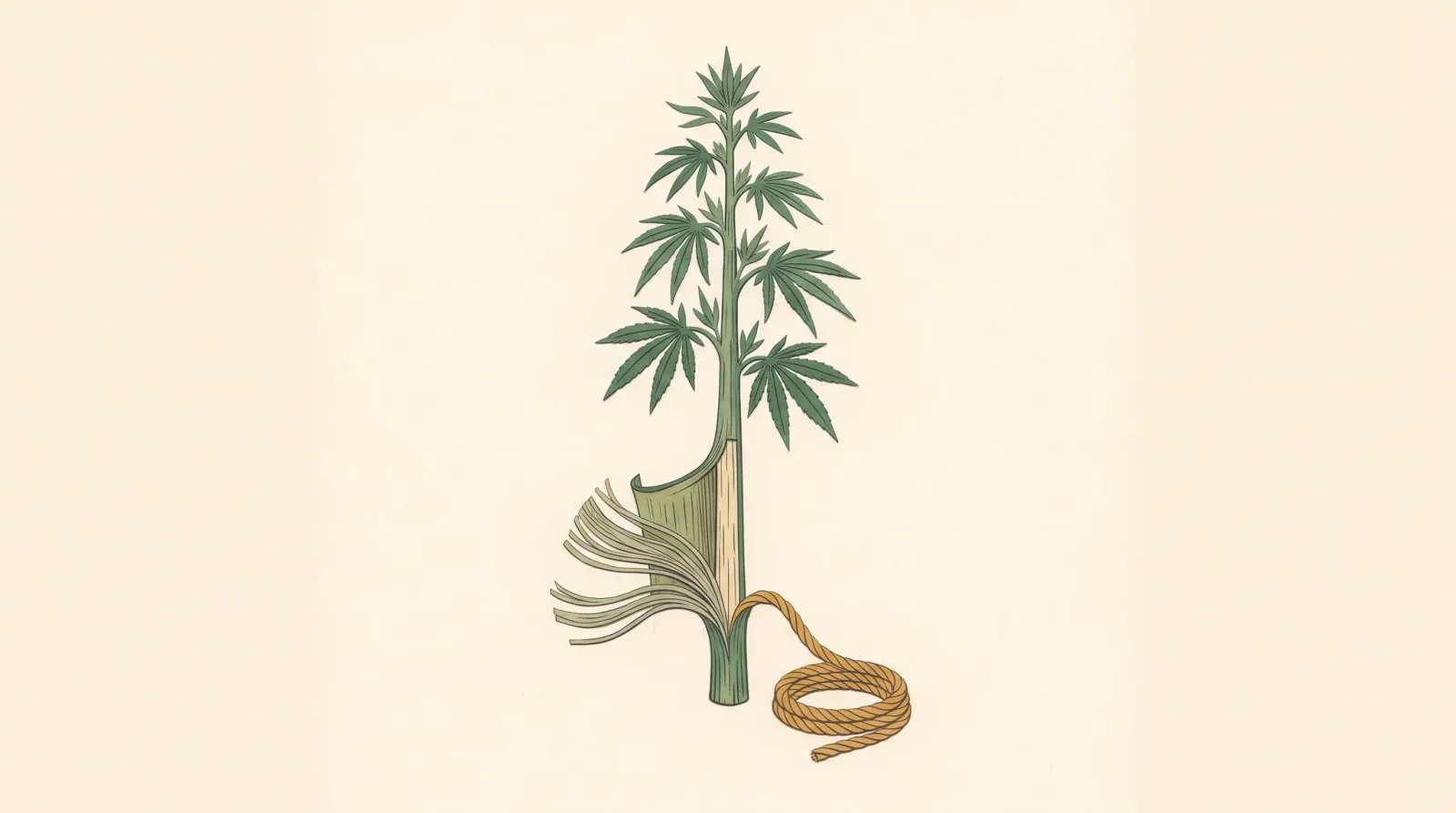
George Washington grew hemp as a fiber crop on all five Mount Vernon farms, and no document we opened shows he grew it, or used it, to get high. His own estate’s historians say he used it for rope, thread for sacking, canvas and mending the seine nets of his Potomac fishery. Mount Vernon: George Washington Grew Hemp
The “Washington grew weed” claim usually rests on one diary line. On 7 August 1765 he wrote: “Began to seperate the Male from the Female hemp at Do.—rather too late.” Diary, 7 August 1765 Two days later he wrote: “Abt. 6 Oclock put some Hemp in the Rivr. to Rot.” Diary, 9 August 1765 Rotting stems in water is called retting. It is how fiber is loosened for rope. That second line rarely gets quoted.
Here in High School, we read the actual diary pages and letters, not the meme. This lesson walks through each line people cite, what the scholarly editors say about it, and the one question the record leaves open. For the bigger picture, start with the longer history of cannabis, from ancient texts to modern science.
Primary documents checked October 29, 2026.
What the record says versus what the myth says
| The claim you see | What the documents show |
|---|---|
| “Washington grew weed.” | He grew hemp, a fiber crop, and wrote about pulling and retting it. Diary, 9 August 1765 |
| “Separating males from females proves he wanted buds.” | The editors of his Papers annotate that line as a note on “a highly profitable fiber crop”. Washington gives no reason. Diary, 7 August 1765 |
| “He said: make the most of the Indian hemp seed and sow it everywhere.” | That wording is a misquote. The real sentence is “The Hemp may be sown any where.” Mount Vernon: Spurious Quotations |
| “He smoked hemp in his pipe.” | No document we opened links Washington to smoking hemp. |
| “His hemp had no THC.” | Nobody tested it. That claim is as unsupported as the opposite one. |
Why did George Washington grow hemp?
He tried it as a cash crop to replace tobacco. In September 1765 he wrote to his London merchants, Robert Cary & Company. He asked “the general price one might expect for good Hemp in your Port watered & prepared according to Act of Parliament”. He wanted to “form some Idea of the profits resulting from the growth”. Letter to Robert Cary & Company, 20 September 1765
The same letter shows his tobacco was selling badly. He said he had made “an Essay” (a trial) in hemp and flax and “suffer[ed] pretty considerably” from drought and his own inexperience. So the first season lost money.
The editors of his Papers add that Virginia paid a bounty on water-rotted hemp. Diary, 7 August 1765, editors’ note Mount Vernon says he weighed hemp against tobacco in the 1760s and chose wheat as his main crop. Hemp stayed on as a working crop for the estate’s own rope, cloth and nets. Mount Vernon: George Washington Grew Hemp
He was not unusual. At Monticello, Thomas Jefferson’s home, hemp joined flax and cotton as a crop “primarily used for making clothing”. Enslaved laborers grew it there and at Poplar Forest. Monticello: Hemp On these Virginia plantations, the hands doing the pulling and retting were enslaved people, and that belongs in the story.
What does “separate the male from the female hemp” mean?
Hemp plants are either male or female, and the two sexes mature at different times, which matters for fiber. A 1913 US Department of Agriculture review of fiber hemp puts it plainly: “Hemp is dioecious.” Pollen flowers and seed flowers grow on separate plants. The male plants “die after the pollen is shed”, while the females stay green for about two months, until their seeds ripen. Dewey, “Hemp”, USDA Yearbook 1913
That timing gap is the fiber grower’s problem. The same review says to cut hemp “when the staminate plants are in full flower and the pollen is flying”. Cut too early and the fiber is weak. Leave it too long and the fiber turns “coarse, harsh, and less pliable”, and the stalks will not ret properly. A modern review from Wageningen University agrees: male and female plants “do not flower and age simultaneously”. Peak stem and fiber yield comes “at full (male) flowering”. Salentijn et al., Frontiers in Plant Science, 2019
If you want a refresher on plant sex and seeds, see how cannabis plant sex and seeds work.
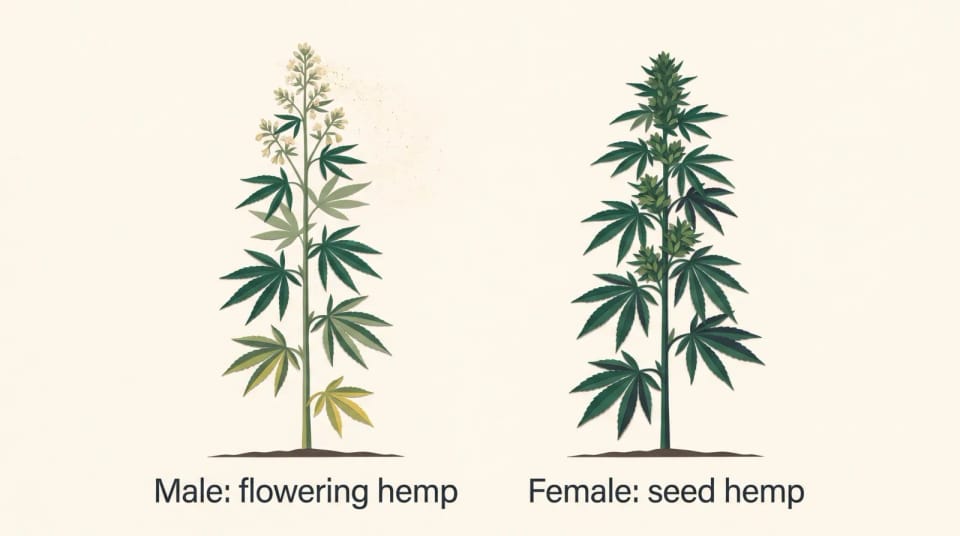
Fiber growers watched the male plants. Their flowering marked the harvest window, and they died back weeks before the females finished seed.
So what was Washington doing on 7 August 1765? He does not say. The Papers editors gloss the line as “Cannabis sativa, a highly profitable fiber crop”. They also quote a later gardening manual saying male plants were handled apart because they are “coarser, and the stalks larger”. Diary, 7 August 1765, editors’ note That manual dates from 1806, after Washington died, so it shows later practice, not his stated reason.
The surrounding entries fit a farmer working to a calendar. The day after the retting note, he wrote that he “Seperated my Ewes & Rams but I beleive it was full late”. Diary, 10 August 1765 Two “too late” notes in four days, one for hemp and one for sheep, read like timing worries, not a secret harvest.
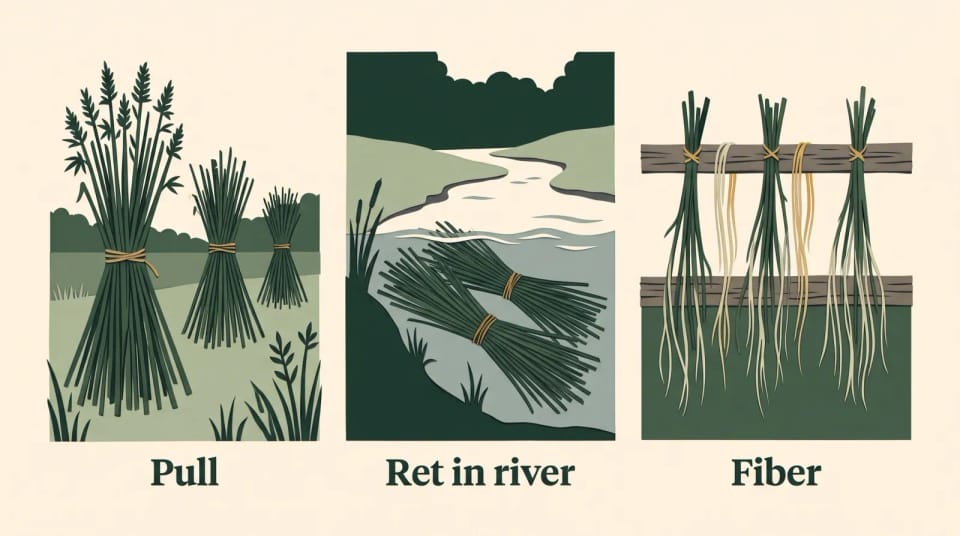
Pulling, retting in water and loosening fiber are the stages of making rope fiber. Washington’s diary records the first two. The fiber panel shows general practice, not a diary entry.
What was “blossom hemp” in Washington’s diary?
Most likely the male plants, though Washington never defines the term. On 29 August 1766 he wrote: “Began to pull Hemp at the Mill and at Muddy hole—too late for the blossom Hemp by three Weeks or a Month.” Diary, August 1766 We found no editors’ note on this entry.
The 1913 USDA review offers a clue. It says male plants “are often called the flowering hemp, since the pistillate flowers are rarely observed”. Dewey, “Hemp”, USDA Yearbook 1913 Put that beside the fiber timing above, and “too late for the blossom Hemp” reads as “I missed the window for the male plants”. Treat that as our inference from later agricultural writing, not as Washington’s own definition. Either way, the line is about pulling stalks on schedule.
What was Washington’s “East India hemp”?
It was a seed experiment he never explained, and it is the one genuinely open question. In January 1794 he told his farm manager he had given the gardener “a few Seed of East India hemp to raise from”. He asked them to “make the most of it at the proper Season for Sowing.” Letter to Howell Lewis or William Pearce, 6 January 1794 In March 1795 he asked that the saved seed be “carefully sown agin, for the purpose of getting into a full stock of seed.” Letter to William Pearce, 15 March 1795
The strongest line comes in May 1796. He asked what had happened to the saved seed. All of it should have been sown again, “that not only a stock of seed sufficient for my own purposes might have been raised, but to have dissiminated the seed to others; as it is more valuable than the common Hemp.” Letter to William Pearce, 29 May 1796
“More valuable” and “my own purposes” are the phrases people point to. Here is the honest read:
- Washington never says why it was more valuable or what his purposes were. The Papers editors do not say either. They note only that he wanted to build up seed through repeated sowings.
- The letters talk about seed stock and sharing seed with other farmers. Nothing in them mentions smoking, medicine or effects.
- An easy fiber explanation does not fully fit either. In the 1913 review, Indian-type hemp grown by the USDA was “of no value for fiber” compared with Kentucky hemp. Dewey, “Hemp”, USDA Yearbook 1913 That was a twentieth-century trial from Calcutta seed, though. It cannot tell us what Washington’s plants were.
So the record supports “unexplained”, not “proof of weed” and not “proof of better rope”. Pages that call this India hemp “jute” are also wrong: the same USDA review says jute is “not at all related” to hemp. Resin preparations such as charas have their own long history in South Asia; see the history of charas and hash for that thread.
Is “make the most of the Indian hemp seed and sow it everywhere” a real quote?
No. It is a misquote that turns a farm aside into a slogan. Mount Vernon lists it among spurious Washington quotations. Mount Vernon: Spurious Quotations
The real source is a letter of 24 February 1794 to William Pearce. Most of it covers bank notes, posts and rails, a mill race, a stud horse and lost sheep. Hemp comes up once, after a paragraph on where to sow sainfoin, a forage crop: “I am very glad to hear that the Gardener has saved so much of the St foin seed, & that of the India Hemp. Make the most you can of both, by sowing them again in drills.” The paragraph ends: “The Hemp may be sown any where.” Letter to William Pearce, 24 February 1794
“May be sown any where” means the crop is not fussy about ground. “Sow it everywhere” is an instruction to spread it far and wide. Those are different sentences.
Could Washington’s hemp have gotten anyone high?
Nobody knows, because nobody tested it. No chemical analysis of any plant Washington grew turned up in our search. We did not search herbarium or museum collections, so that is not proof none exists.
You will see confident claims both ways. Some say his hemp was “under 0.3% THC” and could not affect anyone. But 0.3% is a modern legal line, written into federal law as a percentage of THC by dry weight. 7 U.S.C. § 1639o No such test existed in 1765. Applying it to plants nobody measured is a guess dressed as a fact. Our guides explain how the federal hemp THC limit is counted and the November 2026 hemp law change.
Other pages sort it into “sativa for rope, indica for smoking”. Those labels do not reliably predict chemistry, as our lesson on why indica and sativa labels do not predict a high explains.
What we can say: the plant he grew was managed, harvested and processed as a fiber crop, by the methods fiber growers used. Whether a given eighteenth-century field could have produced intoxicating flower is a separate question the record does not answer.
How did hemp go from Washington’s farms to a banned plant?
The plant’s legal story changed long after the founding era. The 1937 Marihuana Tax Act taxed and restricted cannabis. The 1970 Controlled Substances Act placed it in Schedule I, which is why hemp later had to be legalized again.
Mount Vernon itself shows the turn. Its staff began planting industrial hemp again in 2018, in research plots with the University of Virginia. NPR, 23 August 2018 For today’s rules, see how hemp and cannabis are regulated today, and for the seed’s food role, what hemp seed oil is and is not.
Key takeaways
- Washington grew hemp on all five Mount Vernon farms for rope, sacking thread, canvas and fishing nets.
- The famous male-and-female line sits two days before a retting note. His Papers’ editors read it as a fiber-crop note; Washington gives no reason.
- “Blossom hemp” most likely meant male plants, based on later agricultural writing, not his own definition.
- “Sow it everywhere” is a misquote. He wrote “The Hemp may be sown any where.”
- His “East India hemp” was “more valuable than the common Hemp” for reasons he never stated. That is the honest open question.
- No document we opened shows he smoked or used hemp for effects, and no one has tested what he grew.
- For more claims checked against evidence, see other cannabis myths, fact-checked.
FAQ
Did George Washington smoke marijuana?
No document we opened shows that he did. His diaries and letters describe hemp as a farm crop: pulled, retted in the river and turned into fiber. Online claims that he smoked hemp in a pipe do not cite a diary page or letter.
Did George Washington grow hemp or cannabis?
Both words describe the same species, Cannabis sativa, which is how his Papers’ editors identify his crop. What matters is the use. Washington grew and processed it as fiber hemp for rope, cloth and nets.
Did Washington say “make the most of the Indian hemp seed and sow it everywhere”?
No. His real words, in a February 1794 letter, were “Make the most you can of both” about sainfoin and India hemp seed, then “The Hemp may be sown any where.” Mount Vernon lists the popular version as a spurious quotation.
Did Thomas Jefferson grow hemp too?
Yes. Monticello records hemp, with flax and cotton, as a crop used mainly for making clothing. Enslaved laborers grew it at Monticello and at Jefferson’s Poplar Forest plantation.
Why would a farmer separate male and female hemp plants?
Male plants flower and die back weeks before females ripen their seed. Fiber growers timed the harvest to male flowering, because cutting later gives coarse fiber that is hard to ret. A grower who also wanted seed had to leave the females standing longer.





