Does Grapefruit Make You Higher? What the Enzyme Evidence Says
Does grapefruit make you higher? No human study has tested it. Grapefruit blocks a gut enzyme that clears swallowed THC, so only edibles are plausible.

No human study has tested whether grapefruit makes a cannabis high stronger. Grapefruit blocks CYP3A4, a gut enzyme that helps clear swallowed THC, so a stronger edible is plausible but unmeasured. Smoked or vaped THC skips the gut route the fruit acts on, and the documented risk is to prescription drugs, not to your high.
Here is the detail worth sending to the friend who swears by a glass of juice. The US prescribing information for dronabinol, a synthetic THC capsule, tells prescribers to watch for more side effects when it is taken with CYP3A4 blockers, and it names grapefruit juice in that list. FDA, MARINOL prescribing information, 2017 The only measured number comes from a drug far stronger than juice. In 36 healthy men, the antifungal ketoconazole raised total exposure to THC about 1.8-fold and to its metabolite 11-OH-THC about 3.6-fold after a THC and CBD mouth spray. Stott et al., SpringerPlus 2013 Nobody has run that experiment with grapefruit.
So the claim has a real mechanism and a warning label behind it. What it lacks is a test.
Why do people think grapefruit makes you higher?
The idea comes from pharmacy, not folklore. Grapefruit is famous for changing how much of some medicines reaches the blood. The US Food and Drug Administration requires warnings about grapefruit juice on some prescription and over-the-counter drugs. FDA consumer update
THC is cleared partly by the same enzyme family. People connect the two facts and conclude that grapefruit must “boost” cannabis. The connection is reasonable. The conclusion skips three questions: which route the THC takes, how strong the fruit’s effect is on THC specifically, and whether anyone has measured it.
It is the same shape as the mango myth, which we took apart earlier here in High School: a true chemical fact, stretched into a promise about how high you will feel.
What does grapefruit actually block?
Grapefruit switches off an enzyme in the wall of your small intestine, not in your liver. A 2013 review in the Canadian Medical Association Journal explains the mechanism. Chemicals in grapefruit called furanocoumarins are processed by intestinal CYP3A4 into reactive forms that bind to the enzyme and destroy it. The enzyme stays inactive until your body makes new enzyme. Bailey, Dresser and Arnold, CMAJ 2013
That review lists the facts that matter most for this question:
- It works on swallowed drugs. The drugs affected are taken by mouth. When the same drugs are given into a vein, grapefruit does not change their blood levels.
- One serving is enough. One whole grapefruit or about 200 mL of juice can cause a clinically relevant effect for affected drugs.
- Only some drugs are affected. They share three traits: taken by mouth, only partly absorbed into the blood on their own, and broken down by CYP3A4.
- People differ a lot. How strongly someone reacts varies markedly from person to person.
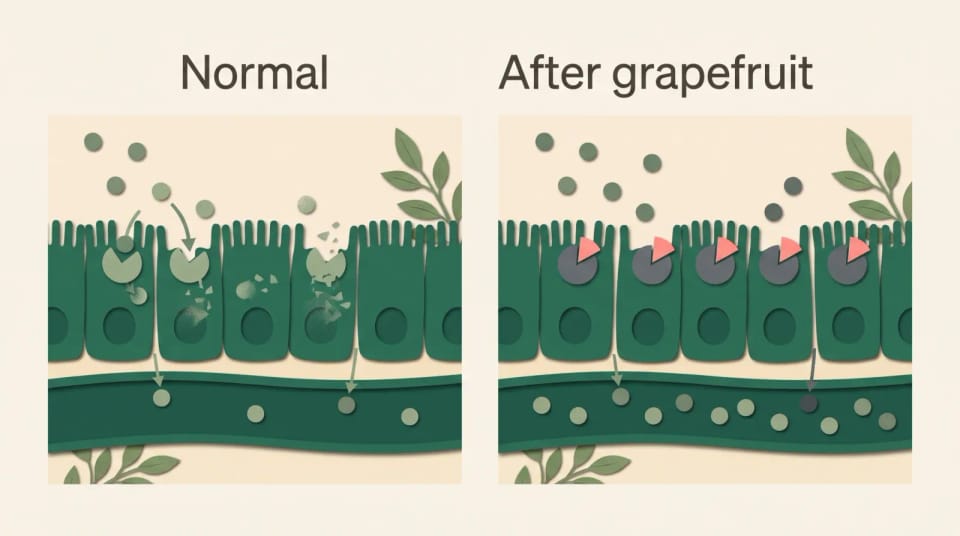
Grapefruit compounds bind to and disable CYP3A4 in the intestinal wall until the body makes new enzyme, so more of an affected swallowed drug reaches the blood. This is the mechanism for medicines; it has not been measured with THC.
The FDA puts it in consumer terms: grapefruit juice can block intestinal CYP3A4, so more of a drug gets into the blood. The size of the effect depends on the person, the drug and the amount of juice. Seville oranges, pomelos and tangelos might act the same way. FDA consumer update
Does CYP3A4 matter for THC?
Yes, but it shares the job. Lab work with human liver tissue found that CYP2C9 does most of the work of turning THC into 11-OH-THC, while CYP3A4 handles other breakdown steps. Watanabe et al., Life Sciences 2007 The dronabinol label names CYP2C9 and CYP3A4 as the main enzymes that metabolize THC. FDA, MARINOL prescribing information, 2017
A 2023 clinical review in a German medical journal states the division of labor simply: CYP2C9 activates THC into 11-OH-THC, and CYP3A4 inactivates both THC and 11-OH-THC. It classes grapefruit juice as a strong CYP3A4 inhibitor. It concludes that such inhibitors can raise blood levels, especially of 11-OH-THC, in patients starting or changing a prescription cannabinoid. Herdegen and Cascorbi, Dtsch Arztebl Int 2023
Two limits keep that from becoming a party trick. First, the review covers prescription oral cannabinoid drugs and says it does not discuss recreational use. Second, it notes that THC absorption by mouth already varies so much within the same person that real-world changes are hard to judge. Our guide to how your body absorbs and clears THC explains what research suggests about where THC goes after you take it.
Has anyone tested grapefruit with cannabis?
Not that we could find. On October 29, 2026, we searched PubMed for grapefruit together with cannabis, marijuana, cannabinoids, CBD, dronabinol and THC. None of the records was a human study of grapefruit and a cannabinoid, and none measured how high anyone felt. PubMed is not every database, so this is “we found no human study”, not proof that none exists.
The closest human evidence is the ketoconazole study. Here is what it did and did not show. Stott et al., SpringerPlus 2013
- Design. An open-label crossover trial in 36 healthy men, split into three groups of 12. Each took four sprays of a THC and CBD mouth spray, alone and with one 400 mg dose of ketoconazole, a strong CYP3A blocker.
- Result. Total exposure rose about 1.8-fold for THC, 1.9-fold for CBD and 3.6-fold for 11-OH-THC. Peak 11-OH-THC levels roughly tripled.
- Side effects. More euphoric mood, sleepiness, taste changes and headache were reported with ketoconazole. The authors said the higher exposure might explain the extra effects on the nervous system.
- Limits. The sponsor was the spray’s maker, and the authors were its employees. The volunteers were healthy men only. Ketoconazole blocks the enzyme in both the gut and the liver, so it is a much bigger hammer than a glass of juice.
One more detail is telling. The trial banned grapefruit for 10 days before dosing and throughout the study. Researchers treat grapefruit as something that could disturb cannabinoid levels. That is a reason for caution, not a measurement of the effect.
An independent systematic review reached the same place: the ketoconazole study “further supports CYP3A4 as a significant metabolic pathway for THC and CBD”, but specific human interaction data are lacking. Stout and Cimino, Drug Metab Rev 2014
Does it matter if you smoke instead of eat?
Yes. The grapefruit mechanism needs the drug to pass through the gut wall, so it is an edible question first. That is an inference from how the mechanism works, not a measured result.
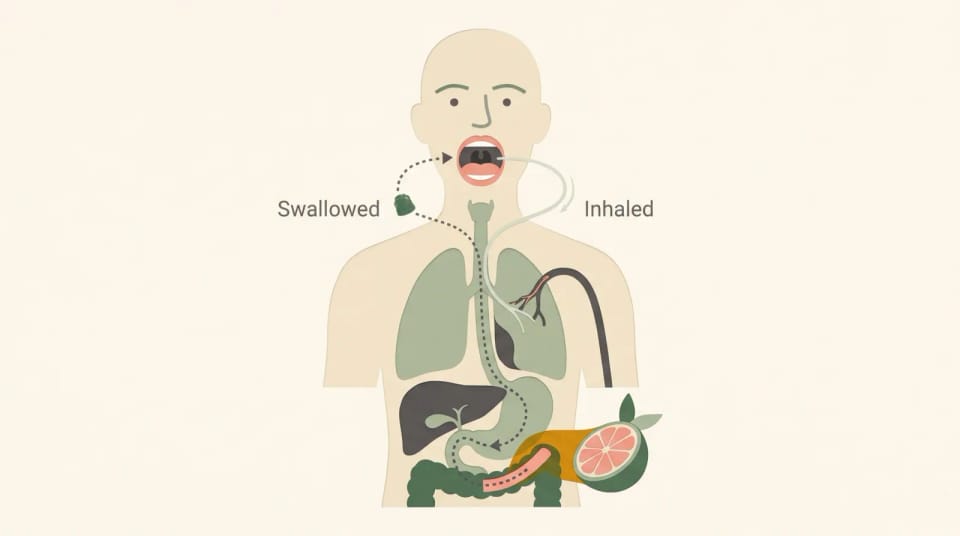
Grapefruit acts on enzyme in the intestinal wall. Inhaled THC reaches the blood through the lungs, so the gut mechanism does not apply the same way. No study has measured either route with grapefruit.
When you eat cannabis, THC is absorbed through the gut and then passes the liver before it reaches the rest of your body. The 2023 review puts oral THC bioavailability at about 6 to 7% and says blood levels after swallowing are 10 to 20 times lower than after inhaling. Herdegen and Cascorbi, Dtsch Arztebl Int 2023 That heavy first-pass breakdown is exactly the kind of setup where blocking a gut enzyme could matter. Our guide to bioavailability by method compares the routes.
When you smoke or vape, THC enters the blood from the lungs. It does not take the gut route on its way in. The CMAJ review reports that grapefruit does not change drugs given straight into a vein, which is the closest tested parallel to a route that skips the gut. Bailey, Dresser and Arnold, CMAJ 2013
| Question | Swallowed (edibles, capsules) | Inhaled (smoke, vapour) |
|---|---|---|
| Passes through the gut wall on the way in? | Yes | No |
| Does the grapefruit mechanism plausibly apply? | Yes, by mechanism | Not the same way, by mechanism |
| Human study with grapefruit? | None found | None found |
| Closest human evidence | Ketoconazole with a mouth spray (not grapefruit) | None found |
| Practical stake | Edibles already vary a lot; an extra factor adds uncertainty | The fruit is unlikely to be the main variable |
If edibles are your route, the useful habits are the same with or without grapefruit: start low and wait before taking more. The food factor with real data is fat, not citrus, and eating before cannabis covers it. If you want to see your own pattern, the High IQ app lets you log how a strain or edible worked each time, so you compare sessions instead of guessing.
What is the real risk with grapefruit and cannabis?
Prescriptions. The grapefruit warning exists because some medicines become stronger or longer-lasting when the gut enzyme is switched off. FDA names statins as one example of an affected drug group. For a few drugs the effect runs the other way, and grapefruit lowers how much gets absorbed. FDA consumer update
Cannabis adds its own layer. In a lab assay, CBD blocked CYP3A4 strongly, while THC was much weaker. Yamaori et al., Life Sciences 2011 That is a test-tube result, not a measured effect in people, but it explains why CBD products often come with a “grapefruit warning”. That warning is about CBD and your medicines, not about getting higher. For the full picture of enzymes and prescriptions, see cannabis and medication interactions.
This is education, not medical advice. Do not start, stop or retime a medicine, or change how much grapefruit you eat for a medical reason, based on this article. If you take a prescription and use cannabis or CBD, ask your pharmacist whether either one interacts with your medicine and with grapefruit.
When to talk to a clinician: contact a doctor or pharmacist if you take a medicine with a grapefruit warning and use cannabis or CBD, or if you notice unusual sleepiness, dizziness, a racing heart, confusion or fainting after combining them. If someone has chest pain, trouble breathing or cannot stay awake, call emergency services.
Sources
-
Bailey DG, Dresser G, Arnold JMO. “Grapefruit-medication interactions: forbidden fruit or avoidable consequences?” CMAJ. 2013;185(4):309-316. doi.org/10.1503/cmaj.120951, PubMed 23184849
-
US Food and Drug Administration. “Grapefruit Juice and Some Drugs Don’t Mix.” Consumer update, last modified July 1, 2021. fda.gov
-
US Food and Drug Administration. MARINOL (dronabinol) capsules prescribing information, revised August 2017. accessdata.fda.gov
-
Stott C, White L, Wright S, Wilbraham D, Guy G. “A Phase I, open-label, randomized, crossover study in three parallel groups to evaluate the effect of Rifampicin, Ketoconazole, and Omeprazole on the pharmacokinetics of THC/CBD oromucosal spray in healthy volunteers.” SpringerPlus. 2013;2:236. doi.org/10.1186/2193-1801-2-236, PubMed 23750331
-
Watanabe K, Yamaori S, Funahashi T, Kimura T, Yamamoto I. “Cytochrome P450 enzymes involved in the metabolism of tetrahydrocannabinols and cannabinol by human hepatic microsomes.” Life Sciences. 2007;80:1415-1419. doi.org/10.1016/j.lfs.2006.12.032, PubMed 17303175
-
Herdegen T, Cascorbi I. “Drug Interactions of Tetrahydrocannabinol and Cannabidiol in Cannabinoid Drugs: Recommendations for Clinical Practice.” Deutsches Arzteblatt International. 2023;120(49):833-840. doi.org/10.3238/arztebl.m2023.0223, PubMed 37874128
-
Yamaori S, Ebisawa J, Okushima Y, Yamamoto I, Watanabe K. “Potent inhibition of human cytochrome P450 3A isoforms by cannabidiol: role of phenolic hydroxyl groups in the resorcinol moiety.” Life Sciences. 2011;88:730-736. doi.org/10.1016/j.lfs.2011.02.017, PubMed 21356216
-
Stout SM, Cimino NM. “Exogenous cannabinoids as substrates, inhibitors, and inducers of human drug metabolizing enzymes: a systematic review.” Drug Metabolism Reviews. 2014;46(1):86-95. doi.org/10.3109/03602532.2013.849268, PubMed 24160757
Key takeaways
- No human study we found has tested grapefruit with cannabis, and none measured the high.
- Grapefruit destroys CYP3A4 in the gut wall, and it affects swallowed drugs, not drugs given into a vein.
- THC is broken down by CYP2C9 and CYP3A4, so a stronger edible is plausible but unmeasured.
- The ketoconazole numbers (about 1.8-fold THC, 3.6-fold 11-OH-THC) come from a strong drug, not from juice.
- Smoked or vaped THC does not take the gut route grapefruit acts on.
- The documented grapefruit risk is to prescription medicines. Ask a pharmacist if you take any.
FAQ
Does grapefruit juice make edibles stronger?
It might, but no one has measured it. Grapefruit blocks the gut enzyme CYP3A4, and that enzyme helps break down swallowed THC, so the mechanism points in that direction. The only human numbers come from ketoconazole, a much stronger blocker. Edible effects already vary a lot between people, as why edibles feel different between people explains.
Will grapefruit juice stop my gummies from working?
No evidence we found says it does. The documented grapefruit effect on CYP3A4-processed drugs is to raise blood levels, not lower them. FDA notes a few drugs where grapefruit lowers absorption through a different route, but THC is not among the examples it names.
Does a strain called Grapefruit, or its limonene, do the same thing?
No evidence supports that. A strain such as Grapefruit is named for its aroma, and the grapefruit enzyme effect comes from furanocoumarins in the fruit. In a lab assay, d-limonene, the common citrus terpene, did not block CYP3A enzymes. For what limonene is known for, see limonene, the citrus terpene, the main terpene in our Uplift High family.
Does grapefruit change CBD?
No human grapefruit and CBD study turned up in our search. In the ketoconazole trial, total CBD exposure rose about 1.9-fold when CYP3A was blocked, so CBD is also processed partly by this enzyme. CBD itself also blocks CYP3A4 in lab tests, which is why CBD labels carry grapefruit-style warnings about medicines.
How long does the grapefruit effect last?
For the blood pressure drug felodipine, a glass of juice taken within 4 hours gave the maximum effect, 10 hours before gave about half, and 24 hours before gave about a quarter. That timing comes from felodipine, not THC. It reflects how long the gut takes to replace the destroyed enzyme, and that varies by person, as how metabolism genes vary explores.





