Can You Smoke Weed When Sick? What the Cold and Flu Evidence Covers
Can you smoke weed when sick? No human study has tested it. See what mouse, cell and medicine-label evidence says about smoke, vapes, edibles and sharing.

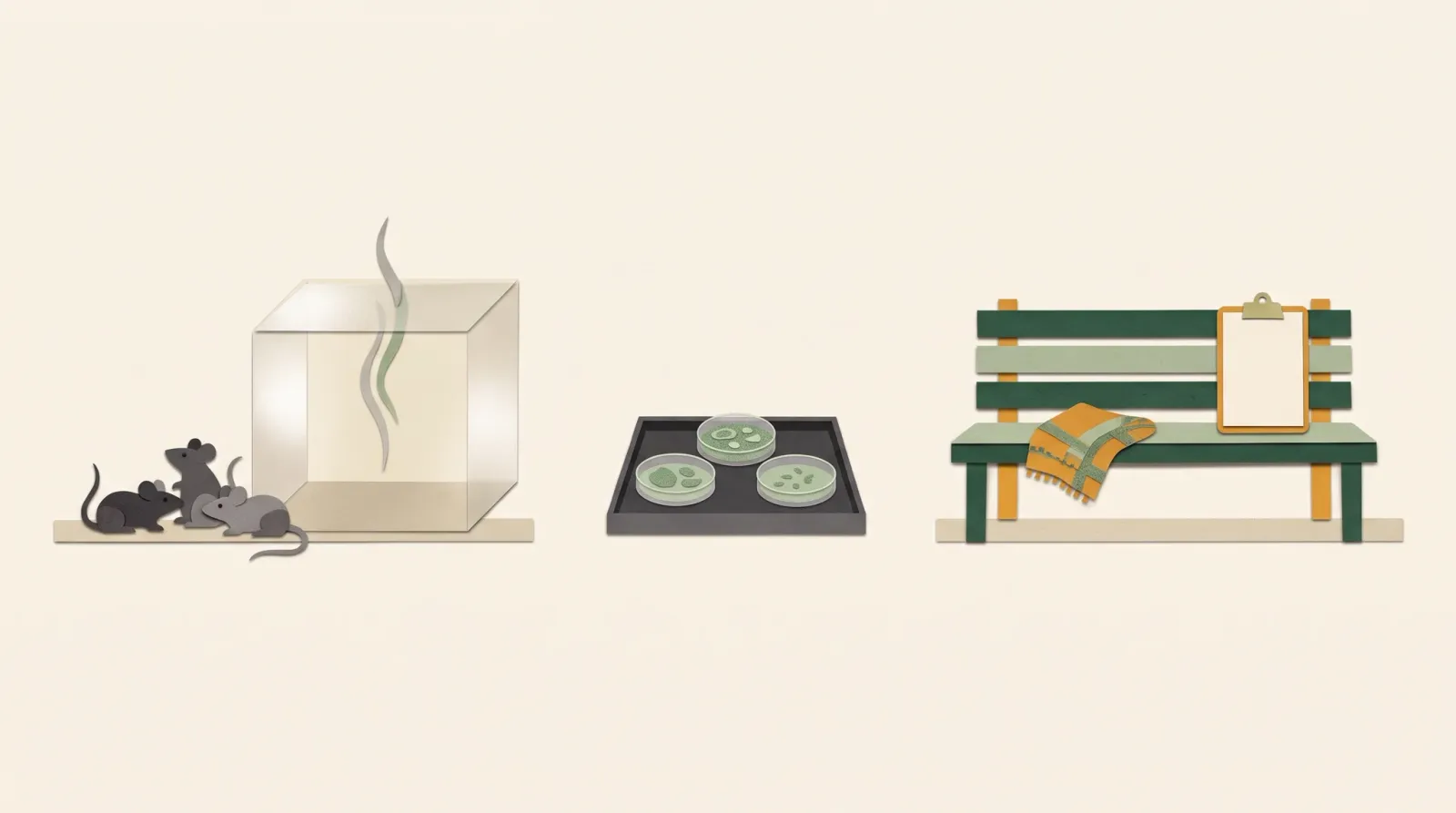
No human study has tested smoking weed during a cold or the flu, so the honest answer is that the evidence points toward pausing inhaled cannabis while you are sick. Smoke adds irritation to airways that are already inflamed. The one infection experiment, in mice, found more flu virus and fewer immune cells in the lungs. Cold medicine labels and shared joints bring risks of their own.
That first fact is the one worth sending to a friend: the closest thing to a test is a mouse study. Smoke-exposed mice carried more flu virus in their lungs than unexposed mice, but the rise was small and appeared only in females. Nobody has run the human version. So “weed weakens your immune system” and “weed is fine when you are sick” both claim more than the research shows.
Here in High School, we sort the evidence by what it can and cannot tell you. This lesson covers colds and flu in otherwise healthy adults. It is not medical advice, and it does not cover COVID-19, asthma or chronic lung disease.
Sources opened and checked October 29, 2026.
Has anyone tested smoking weed while sick?
Not in people, as far as our searches found. We searched PubMed through a research-paper index and the open web through October 29, 2026. We found no human trial or cohort that gave cannabis to people with a cold or flu and measured how long they stayed sick. That is not proof that no study exists. It does mean any confident answer you read is built on indirect evidence.
The indirect evidence comes in four kinds. Each one answers a different question.
| Kind of evidence | What it found | What it cannot tell you |
|---|---|---|
| Mouse infection experiment | Mice given heavy cannabis smoke, then flu, had more lung virus (females only) and fewer lung immune cells (Milad et al., ERJ Open Research) | Whether one session makes a person’s cold last longer |
| Human cells in a dish | Lung immune cells (alveolar macrophages) from habitual cannabis smokers killed bacteria less well in the lab (Baldwin et al.; Shay et al.) | Whether those smokers catch more colds or flu |
| Health records and surveys | Mixed: one small 1990s study found slightly more outpatient visits for respiratory illness among daily smokers (Polen et al.); a larger Ontario cohort found no rise in respiratory emergency visits (Vozoris et al.) | Cause and effect, or anything about an active infection |
| People with a cold or flu who use cannabis | No study found | Everything this article’s title asks |
A 2024 review of cannabis and lung health puts it plainly. Immune effects, whether more infection risk or some protection against overreaction, have been “suggested in animal models and in vitro without conclusive extrapolation to humans” (Bando et al., Seminars in Respiratory and Critical Care Medicine). For the difference between symptoms, lung function and disease, see what lung-health research actually measures.
Does weed make a cold last longer?
There is no human evidence either way. The claim usually traces back to the 2023 mouse study, so it helps to know exactly what that study did.
Researchers at McMaster University exposed mice to whole-body smoke from six cannabis cigarettes for an hour, twice a day, across ten days. They infected the mice with influenza A on day 5. By day 11, smoke-exposed mice had fewer immune cells in their lungs, including macrophages and dendritic cells. Lung virus rose in females, a change the authors called “modest but significant.” Males showed no change in lung virus. Both sexes lost more weight in the first days of infection. Each group had five mice (Milad et al., 2023).
That is a real signal, and it is worth taking seriously. It is also a heavy, repeated dose in a small animal, measured once. The authors themselves call for human data. “In mice, heavy smoke meant more flu virus in females” is accurate. “Weed makes your cold last longer” is not shown.
The human cell studies point the same way but stop short too. Macrophages from habitual cannabis smokers were worse at engulfing and killing bacteria and made fewer signalling proteins in the lab (Baldwin et al., 1997). Those were bacteria, not cold viruses, and the donors were long-term smokers, not people with a fresh cold. For the bigger picture of CB2 receptors and immune cells, see how cannabinoids interact with the immune system.
Can smoking weed make a cold or sore throat worse?
Smoke is the part we have the most evidence on, and it is the main reason to pause. The CDC says smoking cannabis “can also lead to a greater risk of bronchitis, cough, and mucus production,” and that these symptoms usually improve when people stop (CDC, Cannabis and Lung Health). A review by long-time cannabis lung researchers found that chronic cough, sputum, wheeze and airway inflammation are about as common in cannabis smokers as in tobacco smokers (Tashkin and Roth, 2019).
Recent work fills in the airway picture. In a 2026 Canadian study, habitual cannabis smokers reported worse respiratory symptoms than never-smokers, and their airway cells showed higher activity of a mucus-making gene (Leung et al., European Respiratory Journal). That study measured healthy smokers, not people with infections. We cannot say a cold amplifies the effect. We can say smoke and a cold work on the same tissue: your throat and airways.
A cough during a cold also blurs a useful signal. If you are not sure whether you are coughing from the hit or from the bug, our guide to why weed makes you cough explains the normal cannabis cough. A cough that lingers, worsens or returns after improving is a different matter (see the clinician section below).
What about water? A bong cools smoke, but cooling is not cleaning. Smoke still reaches the throat. Our explainers on whether a bong filters smoke and on bong water temperature cover why a smoother hit is not a gentler one.
Is vaping or an edible better than smoking when sick?
Each route changes what reaches your airway, and none has been tested during an infection. Here is a symptom-by-route view of what the evidence does and does not cover.
| Route | What reaches the throat and lungs | What the evidence shows | What it does not show |
|---|---|---|---|
| Joint, pipe or bong | Hot combustion smoke | Linked with cough, mucus and bronchitis symptoms (CDC); in one young-adult cohort, smoking only was tied to about three times the odds of new respiratory symptoms (Sun et al., 2026) | Any effect on how long a cold lasts |
| Dry herb or oil vape | Aerosol without combustion | Fewer combustion toxicants, but both smoking and vaping are linked with “altered immune responses in lung,” and THC vaping is linked to vaping lung injury (Chaiton et al., 2026); vaping only had no detected link to new symptoms, with a very wide margin of error (Sun et al., 2026) | That vaping is safe or gentle on a sore throat |
| Edible or drink | Nothing inhaled | Avoids the airway by design | That edibles are safe while sick; no study covers it |
| Tincture | Nothing inhaled if swallowed | Not covered by the sources here | Anything about illness |
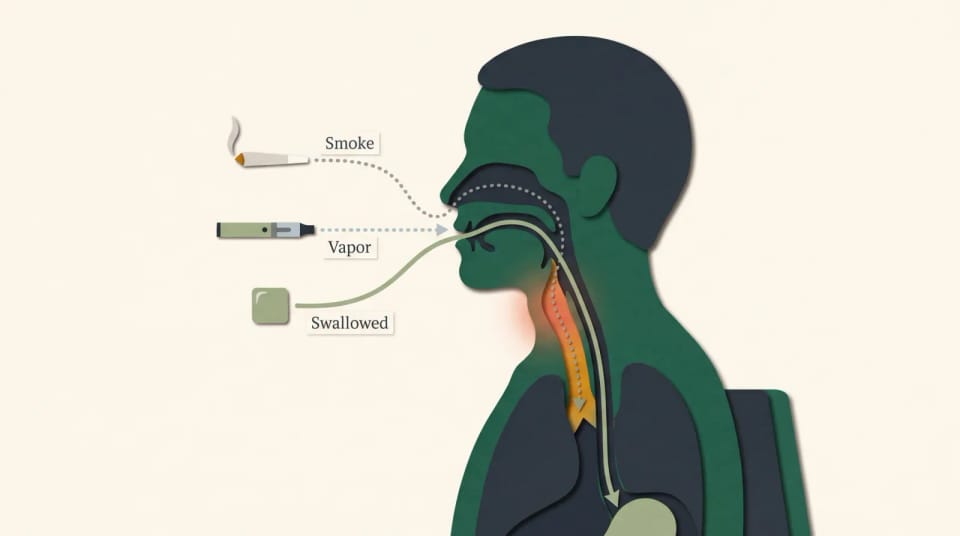
Smoke and vapor both travel down the airway; an edible skips it. Skipping the airway is not the same as being tested and safe during an illness.
Vaping is a trade, not a fix. The 2024 lung-health review notes that vaping may cut some toxin exposure but carries other risks, including more intense drug exposure (Bando et al.). For the full chemistry, see vaping versus smoking.
Edibles bring a different problem: timing. They take far longer to kick in and last far longer than a hit, which matters when you are already tired, dizzy or taking medicine. Our guide to how long a high lasts with smoking versus edibles explains the gap. If a cold has wrecked your appetite, remember that cannabis on an empty stomach can hit differently too.
Can you spread a cold by sharing a joint or bong?
A shared mouthpiece can carry germs from one mouth to the next. Our searches found no study that measured cold or flu spread through a joint, though, so nobody can tell you how often it happens.
The closest documented case involved tuberculosis. In a 2003 Queensland outbreak, 29 of 45 contacts (64%) who had shared a water pipe with an infected person showed a significant skin-test reaction. Sharing the pipe was linked to infection, but the statistical margin crossed “no effect,” and close household contact was the stronger risk (Munckhof et al.). TB is not a cold. The case shows only that a shared pipe can be a route for a respiratory germ.
Researchers who studied cannabis sharing during the COVID-19 pandemic treated shared joints and pipes as a plausible risk, and found that the share of inhalers who did no sharing at all doubled during the pandemic (12.4% before, 24.9% during). That paper describes behavior; it is not a transmission study (Assaf et al., “Puff, Puff, Don’t Pass,” Harm Reduction Journal).
The practical point comes from ordinary illness guidance, not cannabis research. The CDC advises staying home and away from others while sick, and resuming normal activities once symptoms have improved overall and you have had no fever (without fever-reducing medicine) for at least 24 hours (CDC, Preventing Spread of Respiratory Viruses). A smoke circle is a group activity, and a shared room has its own issues, covered in our piece on secondhand cannabis smoke.
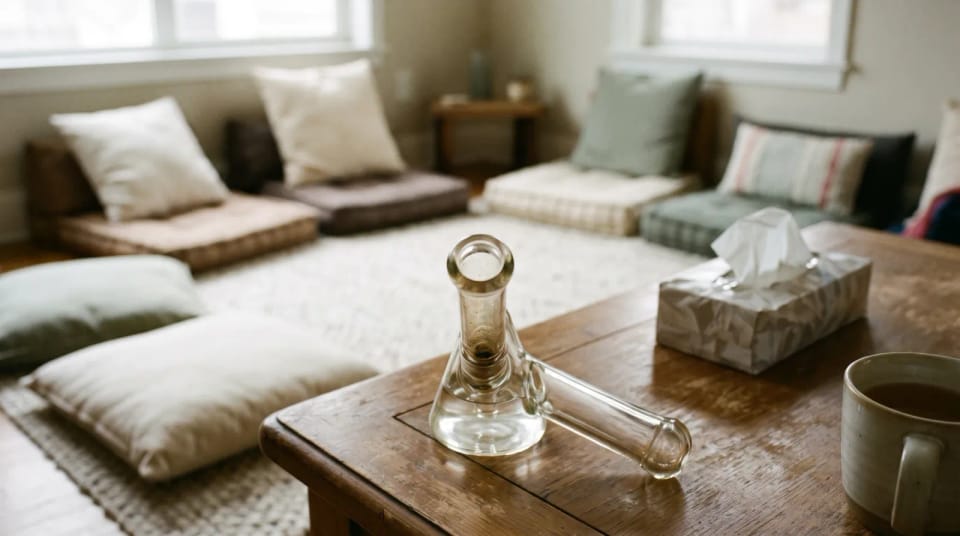
One pipe in a circle touches every mouth in it. No study has measured cold or flu spread this way; the precaution follows from how these viruses travel.
Can you mix weed and cold medicine?
Read the label on the exact product in your hand. We looked at one store-brand nighttime cold and flu liquid containing acetaminophen, dextromethorphan and doxylamine. Its Drug Facts label does not mention cannabis by name. It does say (DailyMed label):
- “marked drowsiness may occur”
- “alcohol, sedatives, and tranquilizers may increase drowsiness”
- “Ask a doctor or pharmacist before use if you are taking sedatives or tranquilizers”
- “Ask a doctor before use if you have … a breathing problem or chronic cough that lasts or as occurs with smoking”
- “be careful when driving a motor vehicle or operating machinery”
That last line about cough “as occurs with smoking” is worth noticing. The label already flags a smoker’s cough as a reason to check with a doctor first.
Cannabis brings its own impairment. The CDC says cannabis can slow reaction time and decision-making, impair coordination and distort perception, and that using multiple substances at the same time can increase impairment (CDC, Cannabis and Driving). We did not open a primary study that tests THC with any specific cold medicine, so we will not claim a measured interaction. Ask a pharmacist about your product and your use. For the general picture, see cannabis and medication interactions, and never drive on a sedating medicine plus cannabis; cannabis and driving covers the wait.
When should you talk to a clinician instead?
Some people should treat a flu as a health question first and a cannabis question not at all. The CDC lists groups at higher risk of flu complications. These include adults 65 and older, children younger than 2, and people with asthma, chronic lung disease, heart disease, diabetes or a weakened immune system. Pregnant people, and people up to two weeks after pregnancy, are on the list too (CDC, People at Increased Risk). If you are in one of these groups, ask your clinician or pharmacist before adding anything, cannabis included.
The CDC also lists emergency warning signs of flu in adults (CDC, Signs and Symptoms of Flu). Seek medical care right away for:
- Difficulty breathing or shortness of breath
- Persistent pain or pressure in the chest or abdomen
- Persistent dizziness, confusion or inability to wake up
- Seizures
- Not urinating
- Severe muscle pain
- Severe weakness or unsteadiness
- Fever or cough that improve but then return or worsen
- Worsening of a chronic medical condition
Confusion and dizziness deserve a special note. They can also come from too much THC, and the two can be hard to tell apart in the moment. Our explainer on greening out describes a THC reaction, but when in doubt during an illness, treat it as a medical sign.
Key takeaways
- No human study has tested cannabis use during a cold or flu; the nearest experiment used mice.
- In mice, heavy cannabis smoke meant fewer lung immune cells and more flu virus in females only.
- Smoke is the best-documented problem: it is linked with cough, mucus and airway irritation.
- Vapes skip combustion but still send aerosol to the lungs; edibles skip the airway but are untested in illness.
- Do not share a joint, pipe or bong while you are contagious.
- Read your cold medicine label, and ask a pharmacist before combining it with cannabis.
FAQ
Can you smoke weed with a cold?
No study has tested it in people, so nobody can give you a measured answer. What is known is that smoke irritates the throat and airways, the same tissue a cold inflames. Pausing inhaled cannabis until you recover is the choice that fits the evidence.
Can weed cure a cold or the flu?
No source we found supports cannabis as a cold or flu remedy, and none shows it speeds recovery. The only infection experiment, in mice, pointed the other way, with more lung virus in female mice exposed to smoke. Treat claims of a cannabis cold remedy as unsupported.
Does weed weaken your immune system?
Lab studies show that lung immune cells from habitual smokers work less well against bacteria, and a mouse study found fewer lung immune cells after heavy smoke. Reviews say these effects have not been shown to translate to people getting sick more often. “Weakens your immune system” overstates what has been measured.
Is it OK to smoke weed with bronchitis?
The CDC links smoking cannabis with bronchitis, cough and mucus, so smoke works against already irritated airways. Bronchitis can also signal something that needs care. Ask a clinician, especially if you have asthma or a chronic lung condition.
Can you spread a cold by sharing a joint?
A shared mouthpiece can pass saliva and germs from person to person, though no study has measured cold or flu spread this way. A tuberculosis cluster has been tied to a shared water pipe. If you are sick, keep your own gear and stay out of the circle until you are no longer contagious.
Sources
- Milad N, Fantauzzi MF, McGrath JJC, et al. (2023). Cannabis smoke suppresses antiviral immune responses to influenza A in mice. ERJ Open Research, 9(6), 00219-2023. https://doi.org/10.1183/23120541.00219-2023
- Baldwin GC, Tashkin DP, Buckley DM, et al. (1997). Marijuana and cocaine impair alveolar macrophage function and cytokine production. American Journal of Respiratory and Critical Care Medicine. https://doi.org/10.1164/ajrccm.156.5.9704146
- Shay AH, Choi R, Whittaker K, et al. (2003). Impairment of antimicrobial activity and nitric oxide production in alveolar macrophages from smokers of marijuana and cocaine. Journal of Infectious Diseases. https://doi.org/10.1086/368370
- Tashkin DP, Roth MD (2019). Pulmonary effects of inhaled cannabis smoke. American Journal of Drug and Alcohol Abuse. https://doi.org/10.1080/00952990.2019.1627366
- Bando JM, Tashkin DP, Barjaktarevic IZ (2024). Impact of marijuana use on lung health. Seminars in Respiratory and Critical Care Medicine. https://doi.org/10.1055/s-0044-1785679
- Chaiton M, Kundu A, Nathwani AA (2026). Health impacts of cannabis: focus on smoking vs. vaping effects on the respiratory and cardiovascular systems. Current Opinion in Pulmonary Medicine. https://doi.org/10.1097/MCP.0000000000001239
- Sun R, Benowitz NL, Hammond D, et al. (2026). Cannabis vaping, smoking, and dual use and the onset of respiratory symptoms among U.S. young adults. American Journal of Preventive Medicine. https://doi.org/10.1016/j.amepre.2026.108421
- Leung C, Gilchrist CL, Wang CJ, et al. (2026). Clinical, physiological, imaging and molecular responses to cannabis smoking: the CANUCK study. European Respiratory Journal, 67(1), 2501659. https://doi.org/10.1183/13993003.01659-2025
- Assaf RD, Javanbakht M, Gorbach PM, et al. (2023). Puff, puff, don’t pass: harm reduction for cannabis use during a viral respiratory pandemic. Harm Reduction Journal, 20, 23. https://doi.org/10.1186/s12954-023-00751-8
- Munckhof WJ, Konstantinos A, Wamsley M, et al. (2003). A cluster of tuberculosis associated with use of a marijuana water pipe. International Journal of Tuberculosis and Lung Disease, 7(9), 860-865. https://pubmed.ncbi.nlm.nih.gov/12971670/
- Polen MR, Sidney S, Tekawa IS, Sadler M (1993). Health care use by frequent marijuana smokers who do not smoke tobacco. Western Journal of Medicine. https://pubmed.ncbi.nlm.nih.gov/8337854/
- Vozoris NT, Zhu J, Ryan CM, Chow CW (2022). Cannabis use and risks of respiratory and all-cause morbidity and mortality: a population-based, data-linkage, cohort study. BMJ Open Respiratory Research. https://doi.org/10.1136/bmjresp-2022-001216
- Centers for Disease Control and Prevention. Cannabis and Lung Health; Cannabis and Driving; People at Increased Risk for Flu Complications; Signs and Symptoms of Flu; Preventing Spread of Respiratory Viruses When You’re Sick. https://www.cdc.gov/cannabis/health-effects/lung-health.html
- DailyMed, National Library of Medicine. Nighttime Cold and Flu liquid, Drug Facts label (acetaminophen, dextromethorphan HBr, doxylamine succinate). https://dailymed.nlm.nih.gov/dailymed/drugInfo.cfm?setid=41f4bf6d-f83c-92e4-e063-6394a90aebab





