

What Does Zeroing a Vape Mean? Where the Cloud Actually Goes
Zeroing a vape means exhaling no visible cloud. A missing cloud hides the exhale, not the dose. See where the aerosol goes and what no study has measured.

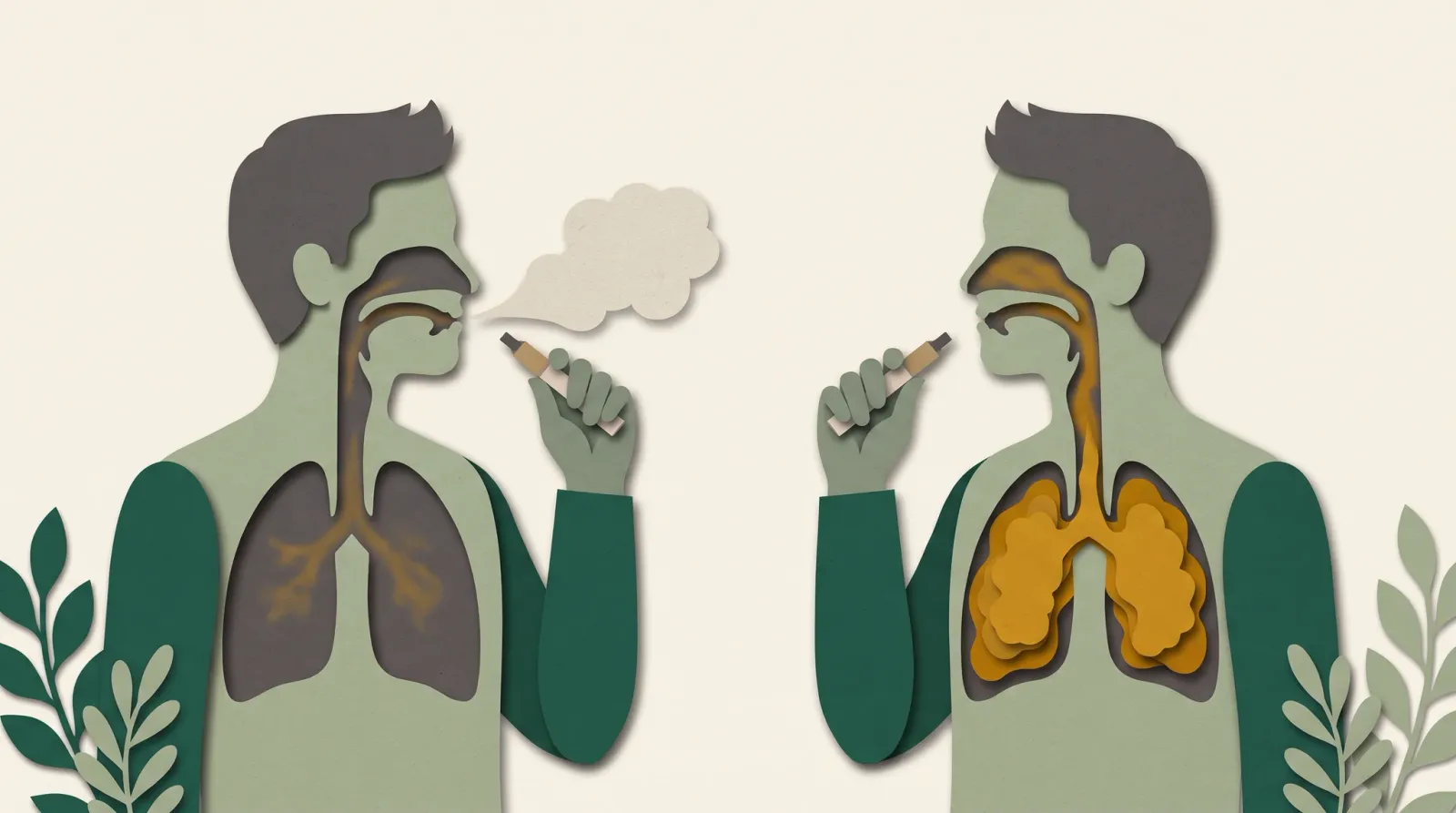
Zeroing a vape means taking a hit and exhaling little or no visible cloud, usually by drawing the aerosol deep into the lungs and holding it for a moment. The missing cloud tells you where the aerosol went, not that the hit was lighter. Most of it stayed inside you, or the little that came out evaporated before anyone saw it. No study has measured zeroing with a cannabis vape.
Here is the specific worth remembering: zeroing hides the exhale, not the dose. In a 10-person lab study, people the researchers called “lung inhalers” breathed out almost none of the nicotine and flavor chemicals they took in, with retention near 100 percent (Khachatoorian et al., 2022). In a 13-person research-ward study, experienced users retained 93.8 percent of the nicotine they inhaled (St Helen et al., 2016). A no-cloud exhale is what a high-retention hit looks like.
Two honest limits come with those numbers. Both studies used nicotine e-liquid, and nobody in either study was asked to zero. They breathed the way they normally do. Here in High School, we treat them as the closest evidence we have, not as a cannabis measurement.
Sources opened and checked October 29, 2026.
What does it mean to zero a vape?
“Zeroing” is slang for an exhale with no visible cloud. In interviews with 11 high school students who vaped nicotine, participants described zeroing as holding the vapor in the lungs until they could breathe out without a cloud. They said they used it to make vaping less obvious around adults (Dubé et al., 2023).
You will also see two related words:
| Term | What people mean by it |
|---|---|
| Zeroing | Exhaling little or no visible cloud after a hit |
| Ghosting | Letting a cloud out of the mouth, then pulling it back in |
| Stealth vaping | An umbrella term for any way of making vaping less visible |
A note on a mix-up: some people use “zeroing” to mean running a cartridge until it is empty. That is a different problem. If you meant dry, burnt hits from an empty or starved coil, see our guide to dry hits and burnt cartridges.
How do people zero a vape?
The idea is simple: inhale deeper and exhale later, so less aerosol comes back out. That is all this article will say about technique. We do not give steps, hold times or power settings for hiding vaping. The term grew up among teenagers avoiding detection, and High School is written for adults who want to understand what happens in the body.
What matters more is the physics behind the trick. How you breathe changes what comes back out far more than most people assume.
Where does the cloud go when you zero a vape?
A cloud that never appears has three possible explanations. They are not the same thing, and the cloud alone cannot tell you which one happened.
- It deposited inside you. Droplets that reach the deep lung settle on airway surfaces. Nicotine, flavor chemicals, propylene glycol and glycerin then largely stay in the body rather than coming back out (Hua et al., 2023).
- It came out and evaporated. In a chamber study, exhaled e-cigarette particles were liquid droplets that evaporated almost immediately. Particle counts at the bystander position returned to background within seconds, unlike cigarette smoke (Martuzevicius et al., 2019). Several authors of that study worked for tobacco companies, and it measured particle numbers, not gases or toxicants.
- It was never inhaled deeply in the first place. A small puff held in the mouth makes a small cloud. That is a smaller hit, not a zeroed one.
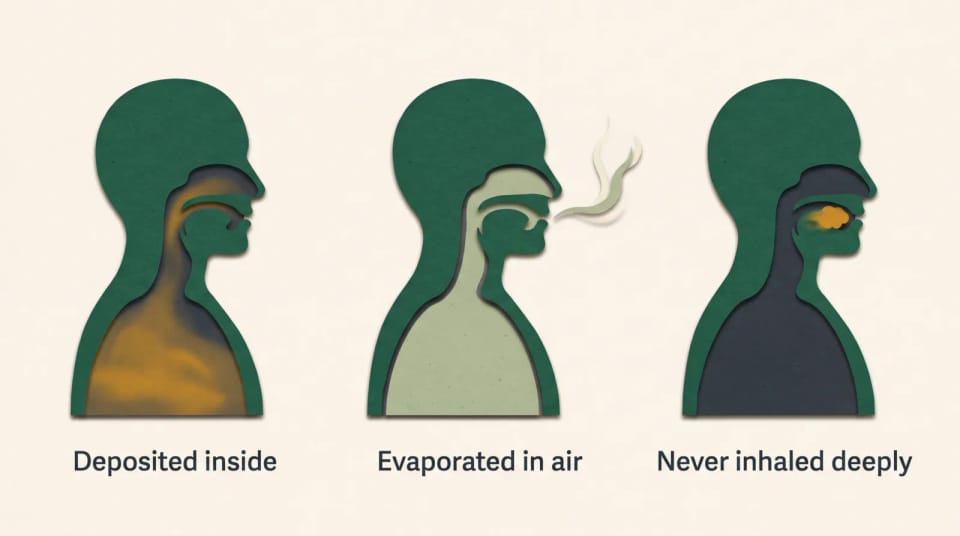
A missing cloud has three possible causes. Only the first means the aerosol stayed in the body, and the cloud itself cannot tell you which one happened.
The evaporation point is the one most people miss. A cloud that is “gone” is not proof that everything was retained, and it is not proof that the air is clean either. A chamber study of simulated cannabis vaping aerosol found that particle levels were still 21 to 57 percent of their peak after 60 minutes (Tang et al., 2025). That study used aerosol made by a machine, not people exhaling, so it does not directly contradict the e-cigarette chamber study. It does show that cannabis aerosol can behave differently. For the bystander side of this question, see what bystanders breathe from cannabis smoke and vapor.
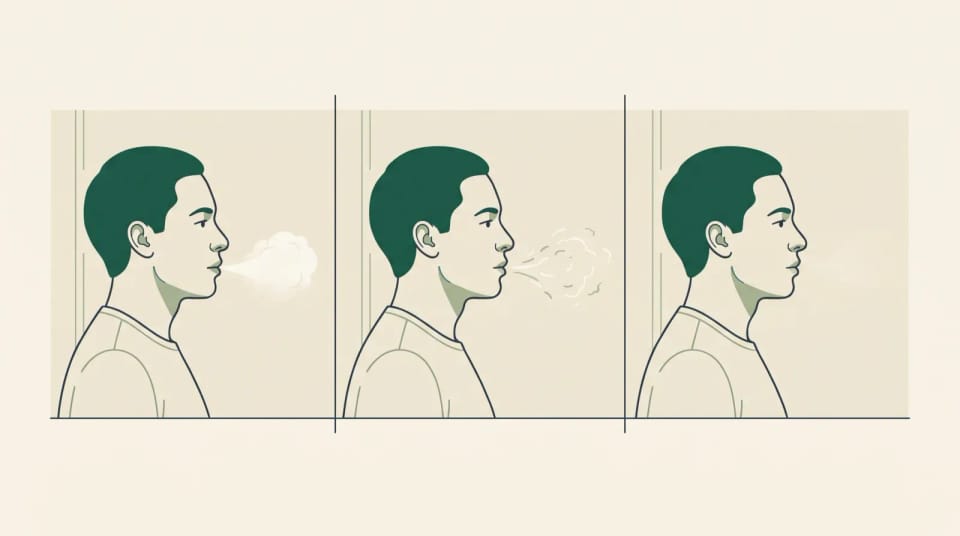
Exhaled e-cigarette droplets evaporate quickly, so a cloud can disappear after it leaves the mouth. Seeing nothing does not mean the air is clean or that the hit stayed inside.
Does a regular exhale let most of the hit back out?
It depends on how you inhale, and the numbers swing widely. A bench study from government occupational-health researchers ran a popular pod device through a machine and then modeled what a person would breathe. It estimated that 52 to 72 percent of the inhaled aerosol could be exhaled again for a plain puff with no breath hold (Ranpara et al., 2021). An earlier model predicted total lung deposition of 15 to 45 percent depending on the breathing pattern (Sosnowski and Kramek-Romanowska, 2016).
Now set those beside the human measurements:
| What was studied | Kind of evidence | What it found |
|---|---|---|
| Pod device, plain puff, no hold | Machine plus computer model | About half to nearly three quarters could come back out |
| 10 young adults vaping freely | Small human lab study | “Lung inhalers” retained near 100 percent; “mouth inhalers” exhaled a measurable fraction |
| 11 experienced pod users, 20 minutes | Small human lab study | About 90 to 100 percent retention deduced for nicotine, menthol, propylene glycol and glycerin |
| 13 experienced users, own devices | Research-ward study | 93.8 percent of inhaled nicotine retained |
Sources: Ranpara et al., Khachatoorian et al., Hua et al., St Helen et al.
Do not average these rows. One is a model and the others are small samples of nicotine users. The useful lesson is the gap between them: the way a person breathes changes what comes back out more than the device does. A review of e-cigarette deposition reached the same conclusion. It found that the breathing pattern is the main lever and that direct measurements inside the body remain scarce (Bennett et al., 2022).
Does holding your breath really keep more in?
For small particles in general, yes. In 10 volunteers breathing fine particles of a similar size range to vape droplets, the fraction that stayed in the lungs was 0.74 after a 20-second breath hold, versus 0.62 with no hold (Invernizzi et al., 2006). Older bolus experiments found the same direction for particles under 2 micrometers (Scheuch and Stahlhofen, 1992).
Neither study used vape aerosol, and neither used cannabis. They describe how lungs treat small particles, which is the mechanism behind zeroing. They are not a measurement of zeroing itself.
Does zeroing get you higher?
Nobody has tested it with a vape, so the honest answer is “unknown.” Keep three questions apart:
- Mechanism. A deeper inhale and a longer hold raise deposition of small particles in general.
- Absorption. People who breathe e-cigarette aerosol deeply retain nearly all of the nicotine in it. No study has measured the same thing for THC from a cartridge.
- Demonstrated effect. For smoked cannabis, the breath-hold studies disagree. A longer hold raised blood THC in some studies, but one found no change in how high people felt (Azorlosa et al., 1995), while another found higher “high” ratings after a long hold (Block et al., 1998).
We cover that smoke evidence in detail in what breath-hold studies found for smoked cannabis. Smoke and vapor are different aerosols, so those results do not transfer cleanly. And since the size of a hit varies from puff to puff anyway, see why puff counts do not measure THC dose.
If you want to see whether the way you inhale changes how a cartridge works for you, a simple log helps more than guesswork. The High IQ app lets you track how a strain or product worked each time, so you can compare sessions instead of relying on memory.
Is zeroing a vape bad for your lungs?
No study has measured harm from zeroing, with cannabis or with nicotine. That cuts both ways: there is no evidence that it damages the lungs, and no evidence that it is safe.
What the evidence does say is narrower. Zeroing does not change what is in the aerosol. The CDC notes that e-cigarette aerosol, including what users exhale, can contain harmful and potentially harmful substances (CDC). Cannabis cartridges add their own questions, such as metals found in cannabis vape aerosol and what cartridge emission studies can and cannot say. A hidden exhale means more of whatever the aerosol contains stays in you.
One small human study adds a signal worth knowing. Among experienced pod users, those who retained more aerosol mass reported more symptoms (Hua et al., 2023). That is a correlation in 11 men using one nicotine product, not proof that retention causes symptoms.
Power settings change the cloud too, but not as a simple dial. See why volts do not set the temperature. For the wider picture, read what research shows about cannabis and lung health.
When to talk to a clinician
Talk to a doctor or another clinician if you have chest pain, shortness of breath, a cough that does not go away, wheezing, or fainting after vaping. Seek emergency care for severe trouble breathing. If a big hit leaves you briefly lightheaded, our explainer on why weed can make you dizzy covers the common causes, but it is not a diagnosis.
Key takeaways
- Zeroing means exhaling little or no visible cloud after a vape hit.
- A missing cloud hides the exhale, not the dose. In small nicotine studies, deep inhalers retained about 90 to 100 percent.
- A vanished cloud can mean the aerosol stayed in you, evaporated in the air, or was never inhaled deeply.
- Breath holds raise small-particle deposition in general. No study has measured zeroing with cannabis.
- There is no evidence that zeroing is harmful or safe. It does not change what the aerosol contains.
FAQ
Is zeroing a vape bad for you compared with regular vaping?
No study has compared the two directly. The retention studies suggest that a deep, no-cloud hit keeps more of the aerosol in the body than a shallow puff. Whatever the aerosol contains, more of it stays in. That is a reason for caution, not a measured harm.
What is the difference between zeroing and ghosting?
Zeroing means exhaling with no visible cloud. Ghosting means letting a cloud out of the mouth and then pulling it back in. Both are forms of stealth vaping, and neither has been studied for cannabis.
Does zeroing make the cloud disappear or just hide it?
Mostly it means less aerosol comes back out, because more of it deposited in the lungs. Any droplets that do come out can evaporate within seconds, so they are hard to see. Evaporated droplets are not the same as clean air.
Does zeroing waste less THC?
Probably more of what you inhale stays in the body, based on nicotine studies of deep inhalers. No study has measured THC retention from a cannabis cartridge with a breath hold. Whether that changes how high you feel is not known for vapor.
Sources
- Dubé CE et al. Adolescents Who Vape Nicotine and Their Experiences Vaping: A Qualitative Study. Substance Abuse: Research and Treatment, 2023.
- Martuzevicius D et al. Characterization of the Spatial and Temporal Dispersion Differences Between Exhaled E-Cigarette Mist and Cigarette Smoke. Nicotine & Tobacco Research, 2019.
- Ranpara A et al. Effect of Puffing Behavior on Particle Size Distributions and Respiratory Depositions From Pod-Style Electronic Cigarette, or Vaping, Products. Frontiers in Public Health, 2021.
- Sosnowski TR, Kramek-Romanowska K. Predicted Deposition of E-Cigarette Aerosol in the Human Lungs. Journal of Aerosol Medicine and Pulmonary Drug Delivery, 2016.
- Bennett WD et al. Respiratory Tract Deposition of E-Cigarette Particles. Comprehensive Physiology, 2022.
- Khachatoorian C et al. Tracing the Movement of Electronic Cigarette Flavor Chemicals and Nicotine from Refill Fluids to Aerosol, Lungs, Exhale, and the Environment. Chemosphere, 2022.
- Hua M et al. Exposure, Retention, Exhalation, Symptoms, and Environmental Accumulation of Chemicals During JUUL Vaping. Chemical Research in Toxicology, 2023.
- St Helen G et al. Nicotine delivery, retention and pharmacokinetics from various electronic cigarettes. Addiction, 2016.
- Invernizzi G et al. Real-time measurement of particulate matter deposition in the lung. Biomarkers, 2006.
- Scheuch G, Stahlhofen W. Deposition and dispersion of aerosols in the airways of the human respiratory tract: the effect of particle size. Experimental Lung Research, 1992.
- Tang X et al. Secondhand Exposure to Simulated Cannabis Vaping Aerosols. Environmental Science & Technology, 2025.
- Azorlosa JL et al. Marijuana smoking: effects of varying puff volume and breathhold duration. Journal of Pharmacology and Experimental Therapeutics, 1995.
- Block RI et al. Sedative, stimulant, and other subjective effects of marijuana: relationships to smoking techniques. Pharmacology Biochemistry and Behavior, 1998.
- Centers for Disease Control and Prevention. About Secondhand Smoke.





