Are Amanita Gummies Legal? What FDA and Lab Tests Say Is Inside
Amanita is not a controlled drug, but FDA calls it an unapproved food additive. Lab tests of smoke-shop amanita gummies found psilocin, hidden THC or neither.

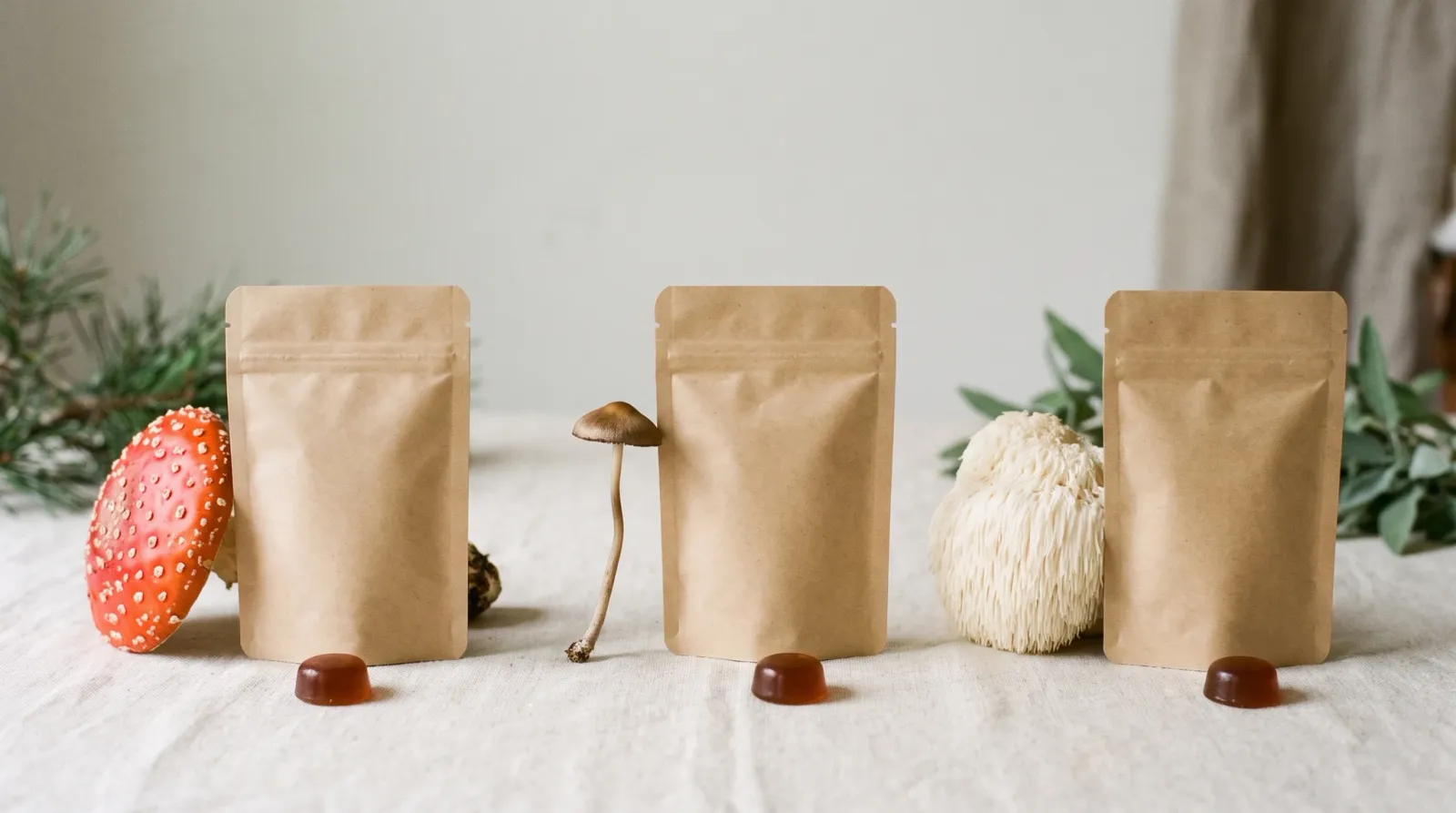
Amanita gummies sit in a legal gap: Amanita muscaria is not a federally controlled drug, but FDA says it is an unapproved food additive, so a food made with it is adulterated under federal law. That is not the same as “legal.” And independent lab tests of smoke-shop “amanita” gummies have found psilocin (a Schedule I drug), undisclosed THC, or no amanita compounds at all. FDA letter to industry, December 18, 2024
Here is the part worth sending to a friend. Three different substances get sold in near-identical gummies, and the law handles each one differently. Psilocybin is Schedule I. Amanita muscaria is not scheduled, but FDA calls it an unapproved food additive. Lion’s mane and reishi are ordinary supplement ingredients. In one lab study, the label did not predict what was inside: of 8 gummies bought from smoke and vape shops in Portland, Oregon, 7 contained psilocin, and the 2 labeled as amanita held no detectable muscimol or ibotenic acid. Correia et al., Clinical Toxicology, 2025
That is 8 gummies from one city, so treat it as a warning sign, not a census of every brand.
Last checked: October 29, 2026. State law, FDA’s review of supplements and the federal hemp rules can change, so check again before you rely on any of this.
Is amanita muscaria the same as magic mushrooms?
No. They are different mushrooms with different active compounds.
- Amanita muscaria (fly agaric) is the red mushroom with white spots. Its main compounds are muscimol and ibotenic acid. Muscimol acts on GABA-A receptors, the brain’s main “slow down” signaling system, according to the discussion in a 2026 CDC outbreak report.
- Psilocybin mushrooms (“magic mushrooms”) are mostly Psilocybe species. The body converts psilocybin to psilocin. For what psilocybin does and how it interacts with cannabis, see our guide to psilocybin mushrooms and cannabis and the overview of how cannabis and psychedelic compounds overlap in the brain.
- “Functional” mushrooms such as lion’s mane, reishi, cordyceps, maitake and turkey tail are sold as wellness supplements. A CDC field report describes these species as “not psychogenic.” Michienzi et al., MMWR, 2024
| Amanita muscaria | Psilocybin mushrooms | Functional mushrooms | |
|---|---|---|---|
| Main active compounds | Muscimol, ibotenic acid, muscarine | Psilocybin, psilocin | Not psychoactive species |
| Federal drug schedule | Not in Schedule I | Schedule I | Not scheduled |
| FDA food status | Unapproved food additive; food with it is adulterated | Controlled drug, not a lawful food ingredient | Sold as dietary supplements under DSHEA |
| FDA premarket approval | None | None | None |
| What lab tests found in retail gummies | Some “amanita” gummies held psilocin or lacked amanita markers | Psilocin also turned up in gummies labeled “psilocybin-free” | One tested gummy showed none of the screened drugs |
| Link to cannabis | None botanical; THC listed or found in some products | None botanical | Some blends add hemp extract |
The federal schedule entries come from 21 CFR 1308.11, which lists psilocybin and psilocyn in Schedule I and has no entry for muscimol, ibotenic acid or Amanita.
Are amanita gummies legal under federal law?
Not cleanly. Two federal rulebooks apply, and they give different answers.
Drug law. Amanita compounds are not listed in Schedule I. Possessing them is not a federal drug crime the way possessing psilocybin is.
Food law. On December 18, 2024, FDA concluded that Amanita muscaria, its extracts, and muscimol, ibotenic acid and muscarine are not authorized for use in conventional food. FDA calls them unapproved food additives, which makes any food containing them adulterated and subject to enforcement. FDA based that on a review of more than 600 publications, adverse event reports and poison center data. FDA letter to industry
The agency’s consumer notice is blunt: “We also recommend that people avoid eating foods with these ingredients.” FDA constituent update
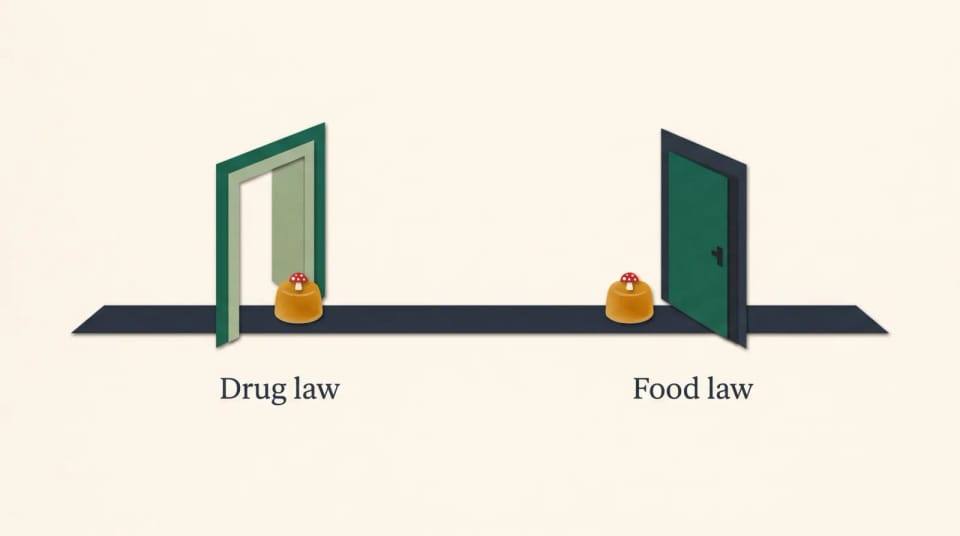
Amanita compounds are not in Schedule I, so federal drug law lets the gummy through. FDA food law blocks it: it calls amanita an unapproved food additive. State law can add a third gate.
So “not a controlled substance” and “legal to sell as a gummy” are two different statements. Brand blogs that say amanita is “legal in 49 states” usually mean only the first one.
Does calling it a dietary supplement change anything?
It does not create a safe harbor. A gummy’s legal category depends on how it is made and labeled, and FDA said in 2024 that it was still “evaluating” amanita in dietary supplements. FDA constituent update
FDA has acted since then. In a September 2025 warning letter, the agency said products declaring Amanita muscaria as a dietary ingredient were adulterated, because the firm lacked adequate information to show the ingredient carries no significant or unreasonable risk. The same letter treated an amanita chocolate as adulterated food. A warning letter is an agency position about one company, not a court ruling or a final rule.
Functional mushrooms sit in ordinary supplement territory. Under DSHEA, supplements need no FDA approval before sale; the company is responsible for safety and labeling, and FDA can act after a product reaches the market. FDA dietary supplements overview “Sold as a supplement” means “not approved,” not “proven to work.” This research found no human trial of functional mushroom gummies, so we make no health claims for them here.
Are mushroom gummies legal in my state?
It depends on the state, and no primary source we found surveys all fifty. Retail pages that list “banned states” disagree with each other, so do not trust any single list, including ours.
Louisiana is the state we verified. Its statute lists Amanita muscaria and Amanita pantherina as “hallucinogenic plants,” alongside Psilocybe. Making or distributing a preparation meant for human consumption that contains one carries 2 to 10 years in prison and a fine of up to $20,000; possession carries up to 5 years and up to $5,000. The statute exempts products labeled as dietary supplements and made in compliance with listed federal food law sections, which does not settle the federal question above. La. R.S. 40:989.1
Other states and cities act through food-adulteration rules, age limits or local licensing, and that picture moves. For your state, check the attorney general’s or health department’s website.
Psilocybin is a separate story. Oregon, for example, has its own psilocybin laws (the Portland study cites Measures 109 and 110). State-regulated psilocybin systems are not permission for gas-station gummies, and psilocybin stays Schedule I federally.
What is actually inside smoke-shop mushroom gummies?
Small lab studies keep finding the same thing: the label is a claim, not a result.
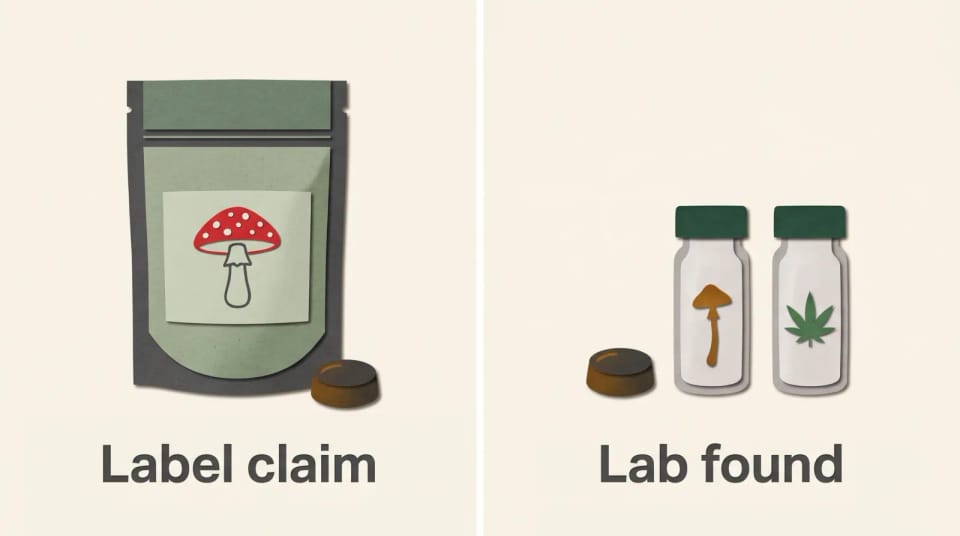
In small lab studies, some gummies sold as amanita held psilocin or THC instead. The studies were small and not random, so this shows a risk, not every product.
Here is what three studies reported:
| Study | What was tested | What turned up |
|---|---|---|
| Portland, Oregon (Correia 2025) | 8 gummies from 7 smoke or vape shops | 7 held psilocin. The 2 sold as amanita had no ibotenic acid or muscimol. One labeled psilocybin-free contained psilocybin. One “nootropic” held undisclosed delta-9 THC. |
| Consumer products (Katragunta 2025) | 27 products, including 14 gummies | 11 gummies claimed amanita extract; muscimol and muscarine were detected without ibotenic acid. One gummy labeled “no psilocybin” held psilocin and psilocybin. Five products lacked all target compounds. |
| Charlottesville, Virginia (Michienzi 2024) | 6 packages from 5 brands, bought at gas stations and smoke shops | 4 of 6 held unlabeled psilocybin or psilocin. Others held undisclosed caffeine, ephedrine, mitragynine (the main kratom compound) or DMT. |
Two caveats keep this honest. The Virginia screen could not detect muscimol, ibotenic acid or muscarine at all, so it says nothing about whether real amanita was present. And all three samples are small and were not chosen at random; some products in the same studies matched their labels.
Inconsistency shows up even within a single product line. In a CDC and FDA investigation of mushroom chocolates, FDA tested 54 samples and found muscimol, psilocin, kavalactones, acetylpsilocin and pregabalin across them. Different samples of the same flavor held different substances. Rumph et al., MMWR, 2026
Cannabis edibles have a milder version of the same problem: see how often edible labels miss.
Are mushroom gummies related to cannabis?
Not botanically and not chemically. Amanita, psilocybin mushrooms and cannabis are unrelated organisms acting on different receptor systems. The link is practical, in three places.
- The same shelf. Mushroom gummies are sold in the same smoke shops, vape shops and gas stations that sell hemp THC products. Those hemp products follow their own rulebook, which is about to change: see the federal hemp THC changes taking effect on November 12 and December 11, 2026 and why hemp and dispensary cannabis follow different rules.
- THC inside the gummy. The Portland study found undisclosed delta-9 THC in one of eight gummies. An audit of the 13 most-trafficked online amanita retailers found that 12 sold gummies and that “some” amanita products also contained THCP and delta-9 THC. The audit did not say how many. LoParco et al., Substance Use and Misuse, 2026
- Look-alike effects. The Virginia clinicians wrote that “mushroom gummy intoxication might appear similar to cannabis intoxication.” That matters in an emergency room, where staff may assume THC.
Sharing a shelf with hemp THC does not put a mushroom gummy under cannabis law. A gummy that contains THC carries both sets of problems at once.
Can amanita gummies make you sick?
Yes, and poison centers have the records. FDA’s letter cites “hundreds of calls” to poison centers in a single year, with symptoms including central nervous system depression, seizures, heart effects, hallucinations, breathing problems and “even death.” FDA also notes that boiling the mushroom may not fully remove its toxins. FDA letter to industry
The most serious recent cluster involved mushroom chocolates, not gummies. CDC counted 180 cases in 34 states in 2024. Among cases with outcome data, 43.7% were hospitalized and 2 people died. Those percentages describe people already sick enough to be counted, not the odds for anyone who eats a mushroom product. After one brand’s recall, recalled products were still on some smoke and vape shop shelves on July 16, 2024. Rumph et al., MMWR, 2026
In Virginia, the four adult patients had fast heart rate, confusion, anxiety or sleepiness and nausea; all went home within 12 hours. A 3-year-old who ate a gummy spent a day in the hospital. Michienzi et al., MMWR, 2024 Child-resistant storage matters as much here as with an edible a child eats by mistake.
The marketing claims have little behind them. A 2026 review notes that amanita is promoted for stress, mood, sleep and pain “despite limited clinical evidence and established toxicity risks,” and that no standard surveillance system tracks it. Ordak, Frontiers in Pharmacology, 2026
When to call Poison Help or a clinician
If someone feels unwell after a mushroom gummy, or a child eats one, call Poison Help at 1-800-222-1222 in the US. Call 911 for trouble breathing, a seizure, or someone who will not wake up. Keep the package so staff can see the label, and tell them it may contain substances not listed on it. This article does not tell you how to treat symptoms; that is the poison center’s job. Afterward, you can report a bad reaction to FDA through MedWatch.
How do you check what a mushroom gummy label claims?
A careful read cannot make an adulterated product lawful or safe. It can show you how little the label promises.
- Find the species name. Look for the Latin name: Amanita muscaria, a Psilocybe species, or Hericium erinaceus for lion’s mane. “Nootropic” or “mushroom blend” tells you nothing.
- Read psilocybin wording with suspicion. Two of the studies above found psilocybin or psilocin in gummies labeled free of it.
- Look for cannabinoids. Check the ingredients for delta-9 THC, THCP or hemp extract.
- Match a lab report to the batch and read its target list. If a lab report exists, match it to the batch in your hand, then check which compounds it tested. The skills in how to read a certificate of analysis carry over. A test cannot report what it did not look for.
Key takeaways
- Amanita muscaria is not a scheduled drug, but FDA calls it an unapproved food additive, and food made with it is adulterated.
- Psilocybin and psilocin are Schedule I; functional mushrooms are unapproved supplements, not psychedelics.
- Louisiana names amanita in a criminal statute; other states vary, so check yours.
- Small lab studies found psilocin, undisclosed THC or missing amanita compounds in gummies sold as amanita.
- If someone feels unwell, call Poison Help at 1-800-222-1222.
FAQ
Are amanita gummies FDA approved?
No. FDA has said Amanita muscaria and its compounds are not authorized for use in conventional food, and it has sent a warning letter about supplements declaring amanita as an ingredient. No mushroom gummy, amanita or functional, has FDA approval.
Are functional mushroom gummies like lion’s mane legal?
Generally, yes. Lion’s mane, reishi and similar species are sold as dietary supplements, which need no FDA approval before sale. Legal to sell does not mean proven to work, and some blends add hemp extract, which brings hemp rules into play.
Will amanita or mushroom gummies show up on a drug test?
Standard urine drug screens do not usually detect these mushroom compounds, according to the Virginia clinicians. A gummy that contains THC can still trigger a THC test, so read up on what a THC test looks for. Because labels miss, you cannot be sure what a gummy contains.
Is amanita related to cannabis?
No. Amanita and cannabis are unrelated organisms that act on different receptor systems. The overlap is the shop shelf and THC that some products list or contain.
Sources
- FDA Human Foods Program. “Letter to Industry on the Use of Amanita Muscaria or its Constituents in Food.” December 18, 2024. fda.gov
- FDA. “FDA Alerts Industry and Consumers about the Use of Amanita Muscaria or its Constituents in Food.” December 18, 2024. fda.gov
- FDA. Warning letter, MARCS-CMS 711990. September 11, 2025. fda.gov
- Michienzi A, Hamlin J, Farah R, Bazydlo L. “Notes from the Field: Schedule I Substances Identified in Nootropic Gummies Containing Amanita muscaria or Other Mushrooms, Charlottesville, Virginia, 2023-2024.” MMWR. 2024;73(28):628-630. DOI: 10.15585/mmwr.mm7328a3
- Rumph JT, Winquist A, Troeschel AN, et al. “Severe Illness Associated with Eating Mushroom-Containing Chocolate Products, United States, January-October 2024.” MMWR. 2026;75(13):179-184. DOI: 10.15585/mmwr.mm7513a2
- Correia MS, Gonzaga MJ, Temple C, Gerona RR. “Quantitative analysis of recreational psychoactive mushroom gummies in Portland, Oregon.” Clinical Toxicology. 2025. DOI: 10.1080/15563650.2025.2450240. PubMed
- Katragunta K, Avula B, Chittiboyina AG, Lata H, Khan IA. “Quantitative LC-QToF-MS Analysis of Mycochemicals in Amanita muscaria, Psilocybe spp. (Agaricomycetes), and Consumer Products.” International Journal of Medicinal Mushrooms. 2025. DOI: 10.1615/IntJMedMushrooms.2024056373. PubMed
- LoParco CR, Tillett KK, Rossheim ME, Okey SA, Berg CJ. “Amanita Muscaria Mushrooms: An Online Retail Assessment of Branded Retailers, 2025.” Substance Use and Misuse. 2026. DOI: 10.1080/10826084.2026.2734264. PubMed
- Ordak M. “Amanita muscaria in the evolving novel psychoactive substances landscape: toxicological risks and clinical implications, a narrative review.” Frontiers in Pharmacology. 2026;17:1838212. DOI: 10.3389/fphar.2026.1838212. PubMed
- Louisiana Revised Statutes 40:989.1. legis.la.gov
- 21 CFR 1308.11, Schedule I. eCFR
- FDA. “Dietary Supplements.” fda.gov





