Ash Catchers and Bubblers: Do They Really Change the Hit?
An ash catcher keeps ash out of your bong and a bubbler adds water, but no cannabis study shows either one filters smoke. Here is what each part changes.

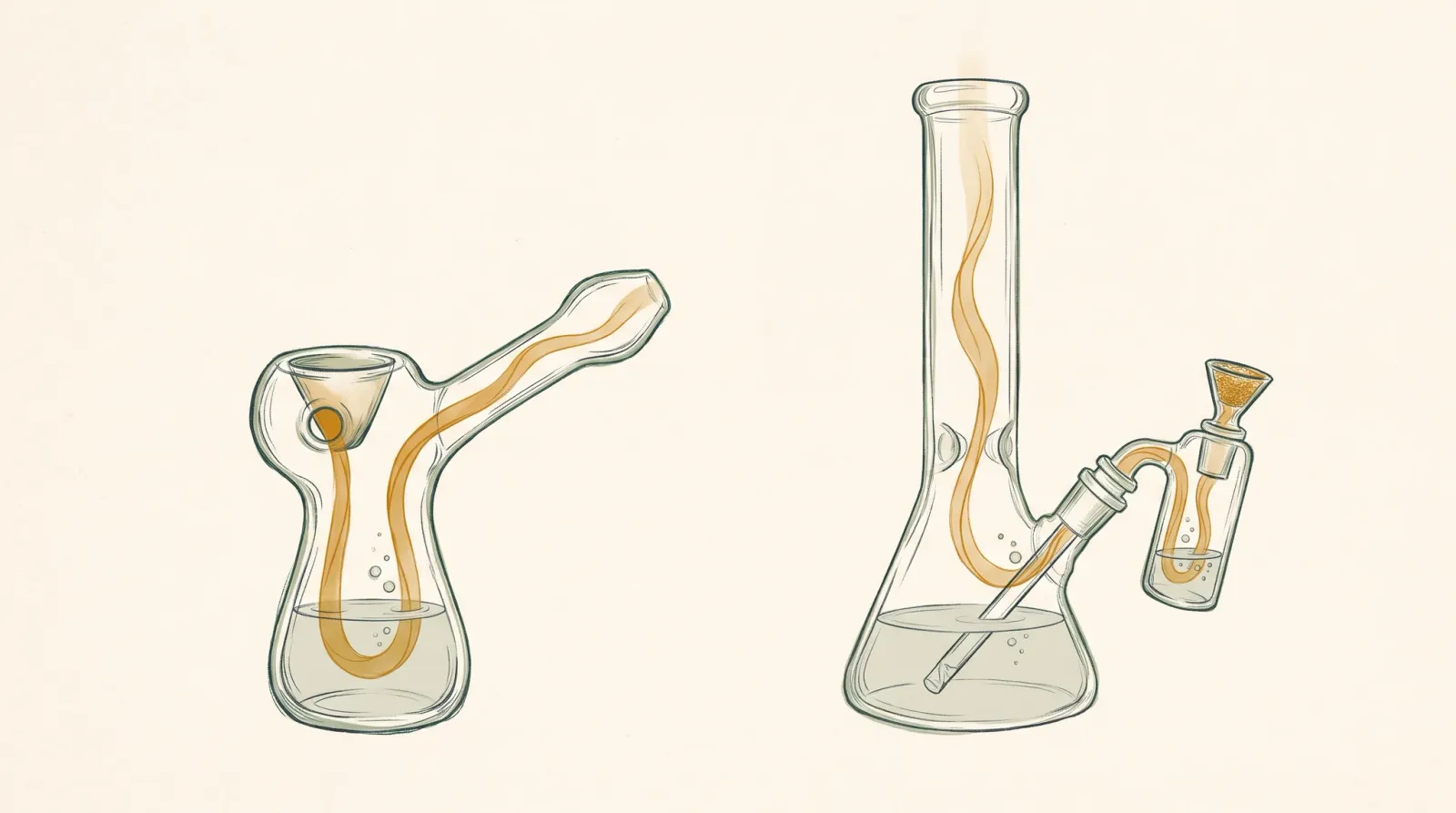
Ash catchers and bubblers change how a hit feels, through airflow, cooling and where ash and resin end up, but no cannabis study we found has measured either one filtering smoke. The best controlled data come from tobacco hookah research, and they point the same way: extra water stages change the feel more than the chemistry.
Here is the detail worth sending to the friend who swears by his percolator. In the only randomised human crossover trial of a bubble diffuser we found, 34 hookah smokers used the same pipe with and without one. With the diffuser, exhaled carbon monoxide was 56.5 ppm against 51.7 ppm without it. Plasma nicotine was 13.7 against 12.2 ng/mL, and exhaled benzene was 8.4 against 8.5 ppm. None of those differences was statistically significant. Smokers did report about twice the relief of craving with the diffuser. The authors concluded that the maker’s claim of greater filtration was “unsubstantiated” (Brinkman et al., Tobacco Control, 2020). That was tobacco in a hookah, not cannabis in a bong. Still, it is the closest thing to a direct test that exists.
This lesson in High School covers the hardware. For the base question of whether bong water filters smoke at all, start there.
What is an ash catcher, and what is a bubbler?
An ash catcher is a small attachment that sits between the bowl and the bong’s joint. Smoke passes through it before it reaches the main chamber. Loose ash and some sticky residue land in the catcher instead of the bong. It is a removable pre-chamber you can rinse on its own.
A bubbler is a different device altogether. It is a small handheld water pipe, usually with a fixed bowl, one compact water chamber and a short mouthpiece. Think of it as a pocket-size cousin of the bong. You do not usually add an ash catcher to a bubbler; most have no removable joint to fit one.
A percolator (perc) is a piece of glass inside a bong or catcher that splits smoke into many smaller bubbles. Tree, honeycomb, showerhead and inline percs are just different shapes for that job. Our history of the bong, from straight tube to percolator has a glossary of the parts and where they came from.
Ash catcher vs bubbler: what is the difference?
They answer different questions. An ash catcher is an upgrade to a bong. A bubbler is a choice of pipe.
| Ash catcher | Bubbler | |
|---|---|---|
| What it is | An attachment for a bong’s bowl joint | A complete small water pipe |
| Water | Dry type: none. Wet type: a small amount, often with a perc | One small chamber |
| Main job | Keep ash and some residue out of the main piece | Add a water stage to a pipe-size session |
| How the hit feels | Wet type adds a second water stage and more pull resistance | Gentler than a dry pipe, smaller than a bong |
| Cleaning | One more piece to rinse, but the main bong stays cleaner | Fixed bowl and narrow glass can be awkward to clean |
| Measured filtration of cannabis smoke | None found | None found |
That last row is the honest bit most product pages skip. Neither device has a cannabis study behind a filtration claim.
Dry vs wet ash catcher: which one do I need?
Pick by what bothers you, airflow or cleaning. A dry ash catcher has no water. It holds a screen, disc or simple chamber that catches falling ash. It adds little pull resistance and empties in seconds.
A wet ash catcher holds a little water and usually a perc. Smoke bubbles through it before it bubbles through the bong. You get a second water stage, which most people describe as cooler and smoother. You also get more drag, more weight on the bowl joint and one more container of dirty water to change.
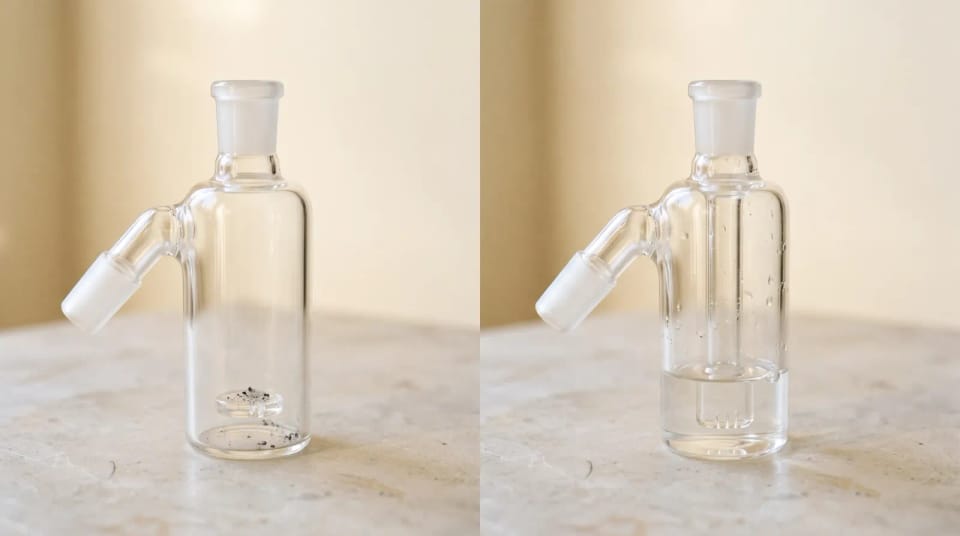
A dry catcher is an empty pre-chamber that catches ash. A wet catcher adds a second water stage, which changes the pull as well as the feel.
If you mostly want a cleaner bong, a dry catcher does that job with less fuss. If you want the hit to feel cooler, cold water and ice change temperature more directly; see our guide to cold water and ice catches, which explains why cooling is not the same as cleaning.
Does a percolator or ash catcher actually filter smoke?
Not in any measurement we found. We searched for a study of an ash catcher, dry or wet, on cannabis smoke and found none. We also found no cannabis study of percolator type. That is an absence in our searches, not proof that no study exists anywhere.
What does exist is research on water itself, mostly from tobacco hookahs. It shows water removes some things and leaves most others.
- In a machine-smoked hookah, the water bubbler did not reduce carbon monoxide, nitric oxide, polycyclic aromatic hydrocarbons (PAHs) or dry particulate matter. It did cut nicotine and carbonyl compounds by about half (El Hourani et al., Chemical Research in Toxicology, 2020).
- An earlier hookah study found that removing the water raised nicotine several-fold but had little effect on nicotine-free dry particulate (Shihadeh, Food and Chemical Toxicology, 2003).
- Real-time measurements of hookah smoke found particle number and size were similar with and without water, and very little gas-phase filtering (Perraud et al., Aerosol Science and Technology, 2019).
The pattern is consistent. Water dissolves some water-soluble compounds. It does little to the gases and fine particles that make up most of the smoke.
The cannabis-specific evidence is older and thinner. A 1996 smoking-machine report tested three water pipes, including a motorised mixer built to maximise water contact. All three delivered more tar for each unit of cannabinoid than an unfiltered joint, and the mixer did worst (Gieringer, MAPS Bulletin, 1996). The likely reason: cannabinoids are sticky and get trapped along with the tar. That report was not peer reviewed, used low-potency research cannabis and tested no percolator or catcher. A 1993 literature review predicted that pipes with gas-dispersion frits “would likely be most effective” (Cozzi, MAPS Bulletin, 1993). That was a prediction, and nobody we found has tested it.
The newest work is a 2025 preprint that ran cannabis smoke from a joint and from a plain bong through GC-MS, one sample each. No compound in its detection range was completely removed by the bong water (Kiatchaipipat et al., bioRxiv preprint, 2025). It is not peer reviewed, and its bong had no perc or catcher.
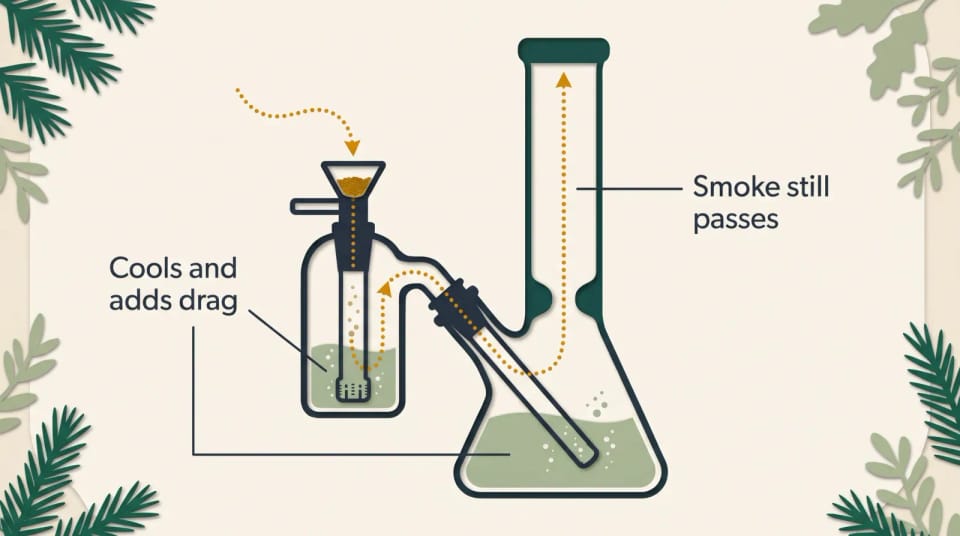
A wet catcher adds a second water stage. That changes temperature and pull. The research on water found it removes some water-soluble compounds, not most of the smoke.
What did the bubble diffuser trial actually find?
It found a change in feel and behaviour, not in exposure. The 2020 trial gave 34 experienced hookah smokers three sessions in random order: a plain research waterpipe, the same pipe with electric heating, and the same pipe with a plastic mesh bubble diffuser on the stem (Brinkman et al., 2020).
With the diffuser:
- Puff number, puff volume, exhaled carbon monoxide, exhaled benzene, plasma nicotine and heart rate did not change significantly.
- Average puff flow rose from 10.1 to 11.5 litres per minute. People pulled a little harder.
- Smokers reported roughly twice the relief of urges and craving.
The heating arm showed something else worth knowing. When a component changed how the pipe delivered smoke, smokers made up for it, taking about twice the total puff volume. Researchers call that compensation. A smoother-feeling device can lead to bigger or longer pulls, which is part of why smoother is not the same as cleaner. Our lesson on hit size and hold time covers that side of it.
Keep the limits in view. This was tobacco shisha, a plastic diffuser on a hookah stem and a small convenience sample. It is not a glass percolator, and it is not cannabis.
Do ash catchers add drag?
Wet ones usually do; dry ones add little. Pulling smoke through water means overcoming the pressure of the water above the bubble outlet, and static fluid pressure grows with depth (HyperPhysics, Georgia State University). A wet catcher adds a second column of water, so you need a stronger pull to start the bubbles. Finer percs and deeper water add to it.
We found no published draw-resistance numbers for cannabis glass, so we will not give you one. If a bong already feels hard to pull, a wet catcher will likely make that worse. Lowering the water, or swapping to a dry catcher, usually eases the pull. For water level and pull speed, see how to use a bong, step by step.
Is an ash catcher worth it for keeping a bong clean?
That is the job it plausibly does best, by design. Ash and some residue land in a small removable piece instead of the main chamber. Rinsing a catcher is quicker than scrubbing a whole bong. Nobody has measured how much it catches, so ignore any percentage you see on a product page.
The trade-off is one more piece to clean. A wet catcher left dirty turns into its own small, smelly bong. Our guide on how to clean a bong, catcher and percolator covers the routine.
Bubbler or bong: which one should you pick?
Pick by session size, space and how much glass you want to care for. A bubbler suits small, portable sessions where a dry pipe feels too harsh to you. A bong with an ash catcher suits a fixed spot at home and people who want to tune airflow and cleaning.
If you are weighing a bubbler against a dry pipe, our guide to dry pipes for small sessions compares the simple options. For material, glass, silicone and wood pipes each trade durability against taste and cleaning. Dab rigs use percs too, but that is a different device with a different job; see percolators on dab rigs.
If you switch pieces, the High IQ app lets you log how the same strain felt in each, so your comparison rests on notes rather than memory.
Does a smoother hit mean a safer one?
No. Cooler smoke can feel easier on the throat, but feel is not exposure. No study we found shows an ash catcher, bubbler or percolator lowers the harm of cannabis smoke. If lowering smoke exposure is your goal, the evidence points somewhere else: see vaping vs smoking cannabis and what the research shows about cannabis and lung health.
When to talk to a clinician: if smoking leaves you with a cough that will not settle, wheezing, chest tightness, shortness of breath or coughing up blood, talk to a doctor. New glass will not fix a symptom, and a smoother pipe can hide one.
Key takeaways
- An ash catcher is a bong attachment; a bubbler is a small complete water pipe.
- Dry catchers mostly keep ash out. Wet catchers add a second water stage, more cooling feel and more drag.
- We found no cannabis study measuring filtration by an ash catcher, percolator or bubbler.
- Tobacco hookah research shows water removes some water-soluble compounds, not most gases or particles.
- The one controlled diffuser trial found no change in exposure, a harder pull and more craving relief.
- Smoother is not safer. Talk to a clinician about lasting breathing symptoms.
FAQ
What is the difference between a bong and a bubbler?
A bubbler is a smaller handheld water pipe, usually with a fixed bowl and one compact chamber. A bong is larger, with a removable bowl or downstem and room for add-ons such as an ash catcher. Both pass smoke through water. Neither has a cannabis study showing it filters better than the other.
Does a bubbler filter smoke as well as a bong?
No study we found compares the two for cannabis. Tobacco hookah research suggests water removes some water-soluble compounds and little of the gas and fine particles, whatever the size of the pipe. A bong’s larger chamber mostly changes volume and cooling, not proven filtration.
Do ash catchers make hits smoother or harsher?
A wet ash catcher usually makes a hit feel smoother because it adds a second water stage, though it also adds drag. A dry catcher changes the feel very little. Neither has been shown to change what is in the smoke.
Does a percolator actually filter smoke?
There is no cannabis measurement of a percolator that we found. The closest test, a tobacco hookah trial of a bubble diffuser, found no change in carbon monoxide, benzene or nicotine exposure. Percs change bubble size and feel; filtering is a claim, not a result.
Can you put an ash catcher on a bubbler?
Usually not. Most bubblers have a fixed bowl with no joint to attach a catcher. Ash catchers are made for bongs with a removable bowl and a standard joint size.
Sources
- Brinkman MC, et al. Evidence of compensation among waterpipe smokers using harm reduction components. Tobacco Control, 2020. doi:10.1136/tobaccocontrol-2018-054502
- El Hourani M, et al. Does the bubbler scrub key toxicants from waterpipe tobacco smoke? Chemical Research in Toxicology, 2020. doi:10.1021/acs.chemrestox.9b00521
- Shihadeh A. Investigation of mainstream smoke aerosol of the argileh water pipe. Food and Chemical Toxicology, 2003. doi:10.1016/S0278-6915(02)00220-X
- Perraud V, et al. Chemical characterization of nanoparticles and volatiles present in mainstream hookah smoke. Aerosol Science and Technology, 2019. doi:10.1080/02786826.2019.1628342
- Kiatchaipipat S, et al. Qualifying the effectiveness of cannabis smoke filtration via bong water using GC-MS. bioRxiv preprint, 2025. doi:10.1101/2025.09.01.673549
- Gieringer D. Marijuana water pipe and vaporizer study. MAPS Bulletin, 1996 (not peer reviewed).
- Cozzi NV. Effects of water filtration on marijuana smoke. MAPS Bulletin, 1993 (literature review).
- Nave R. Static fluid pressure. HyperPhysics, Georgia State University.





