How to Use a Bong: Water Level, Pull Speed and a Small First Hit
To use a bong, cover the downstem slits with water, test with an empty pull, draw slowly and clear a small hit. Here is which steps have evidence.

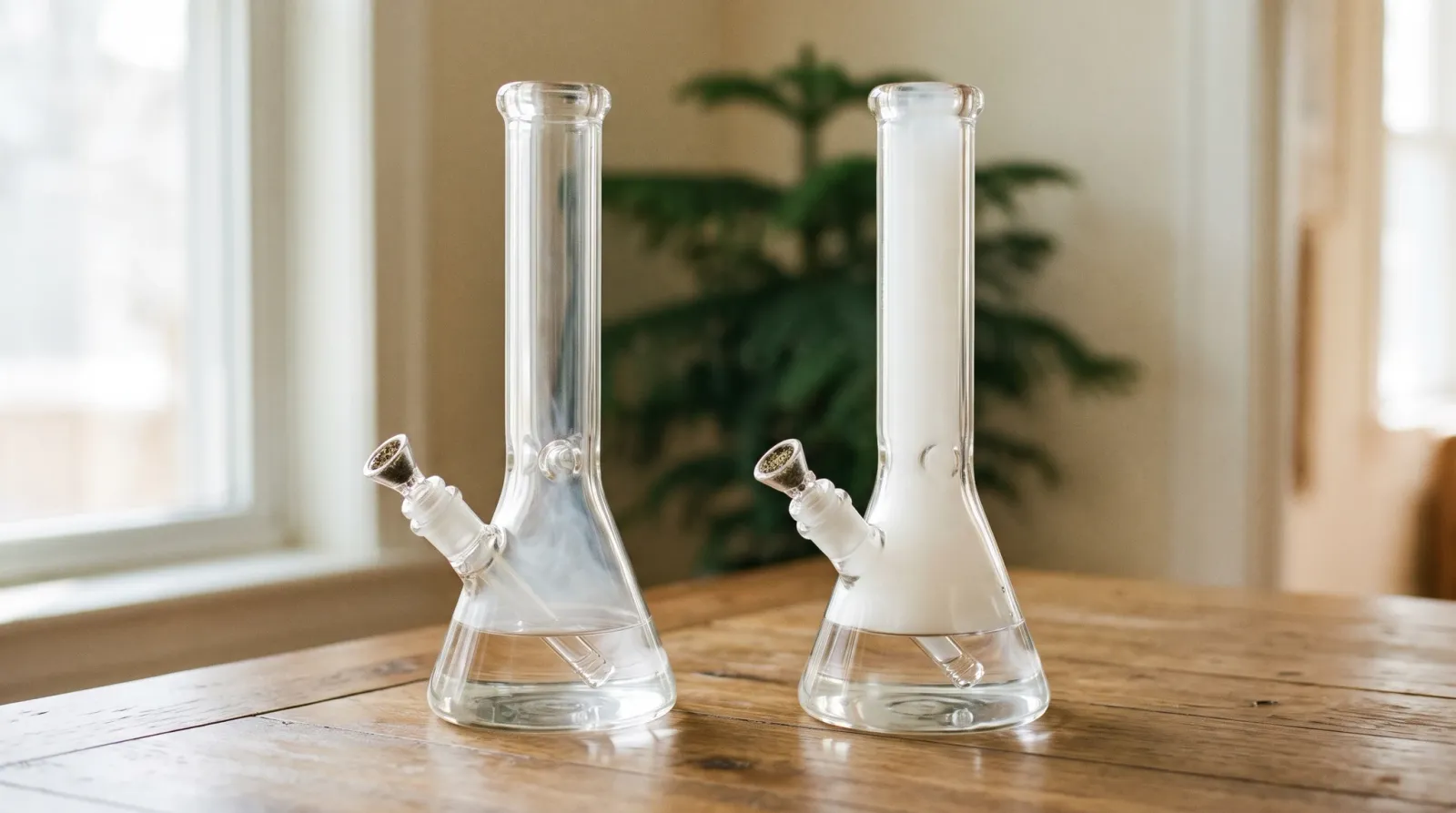
To use a bong, cover the downstem slits with water, check it with an empty test pull, light one edge of the bowl while you draw slowly, stop at a small hit, lift the bowl to clear the chamber and breathe out without holding it. Then wait before the next one. Most guides give you those steps. Few tell you which of them anyone has measured.
Here is the short version. The water level and the “one-third of the chamber” rule are craft habits; nobody has tested them. The one thing controlled studies have tested is how much smoke goes in. In one lab study, larger puffs of cannabis smoke (30, 60 and 90 ml) raised blood THC, carbon monoxide and the rated high in dose-related steps, while holding the breath for 10 or 20 seconds raised blood THC but not the rated high (Azorlosa and colleagues, 1995). So the size of your hit is the main dial you control.
That study used cigarettes and a machine-paced puff, not a bong, and it had seven regular users per experiment. It still gives the clearest answer to the question beginners care about: a smaller pull is a smaller dose.
This guide is for adults where cannabis is legal. Paraphernalia and use rules differ by place. Public health guidance puts not smoking first: Canada’s Lower-Risk Cannabis Use Guidelines call smoking likely the most hazardous way to use cannabis and recommend non-smoking methods. If you smoke anyway, the steps below aim at less smoke, not more.
What are the parts of a bong?
A bong is a water pipe: smoke from the bowl travels down a tube, bubbles through water and rises into a chamber you breathe from. If you want the backstory, here in High School we cover the history of the bong separately.
| Part | What it does |
|---|---|
| Bowl (or slide) | Holds the ground flower. On many pieces it lifts out to clear the chamber. |
| Downstem | The tube that carries smoke from the bowl down into the water. Its tip has a hole or slits. |
| Water | Cools the smoke as it bubbles through. It also adds resistance to your draw. |
| Chamber (tube) | The space above the water where smoke collects. |
| Carb | A small hole on some pieces. Covered while you draw, uncovered to clear. Many bongs have none. |
| Mouthpiece | The open top. Your lips go inside the rim to make a seal. |
How do you use a bong, step by step?
Start with a clean piece and a packed bowl. Packing is its own skill; our guide on how to pack a bowl so it burns evenly covers grind, fill and the dry pull, so we will not repeat it here.
- Fill the water just over the downstem slits. Pour fresh water in through the mouthpiece until the openings at the tip of the downstem sit just under the surface.
- Take an empty test pull. With no flower in the bowl, draw gently. You want steady bubbling with little effort and no water reaching your lips. If it splashes or feels heavy, pour some out.
- Pack and seat the bowl. Load a small, loosely packed bowl and press it firmly into the downstem so air enters only through the bowl.
- Seal your lips and start a slow draw. Put your lips inside the mouthpiece rim, not around the outside. Begin a slow, steady breath in.
- Light one edge, then stop lighting. Hold the flame just above one edge of the bowl while you draw. Pull the flame away once that edge glows.
- Stop at a small hit. On a first hit, let the chamber fill only partway, then stop drawing.
- Clear the chamber. Lift the bowl out of the downstem, or take your finger off the carb, and finish the breath.
- Exhale without holding. Breathe out normally.
- Wait before another hit. Set the piece down. Effects take time to build, and our guide on how long to wait between hits explains why first effects are not full effects.
- Dump the water after the session. Pour it out, rinse, and start with fresh water next time.
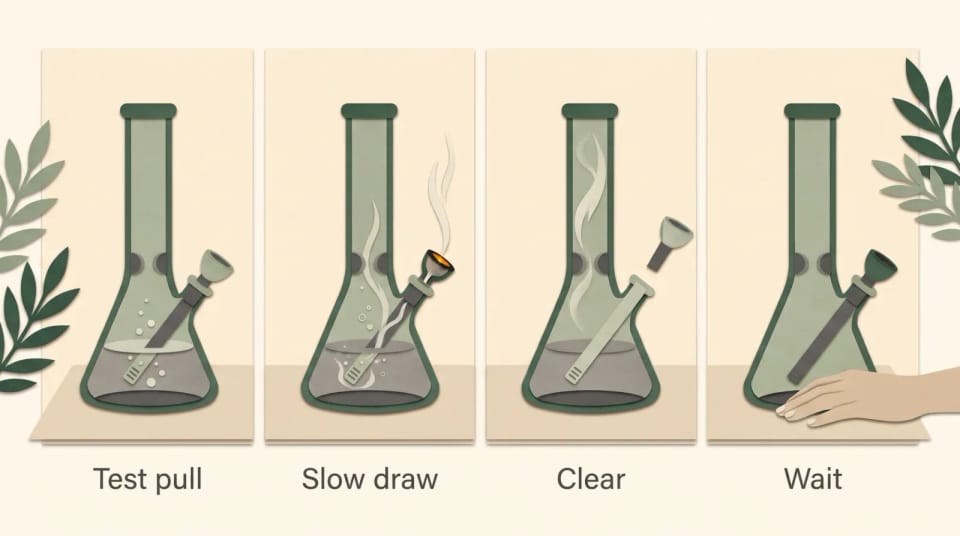
The four moments that matter: test the water empty, draw slowly, clear a small hit, then put the piece down and wait.
How much water should you put in a bong?
Put in just enough water to cover the downstem openings, then let an empty test pull decide. Guides give depths from about half an inch to two inches over the downstem. None of those numbers comes from a measurement. We searched for a study of cannabis bong water depth and draw resistance, splashing or coughing, and found none.
The physics is simple, though. The pressure needed to push air under a column of water rises with its depth (HyperPhysics, static fluid pressure). Our arithmetic from that formula: each extra centimetre of water over the slits adds about 98 pascals your lungs must overcome before a single bubble forms. More water means a heavier draw and more chance of water reaching your mouth. Too little water means the slits sit above the surface and the smoke skips the water.
That is why the empty test pull works better than a ruler. You are testing your own piece, your own downstem and your own lungs.
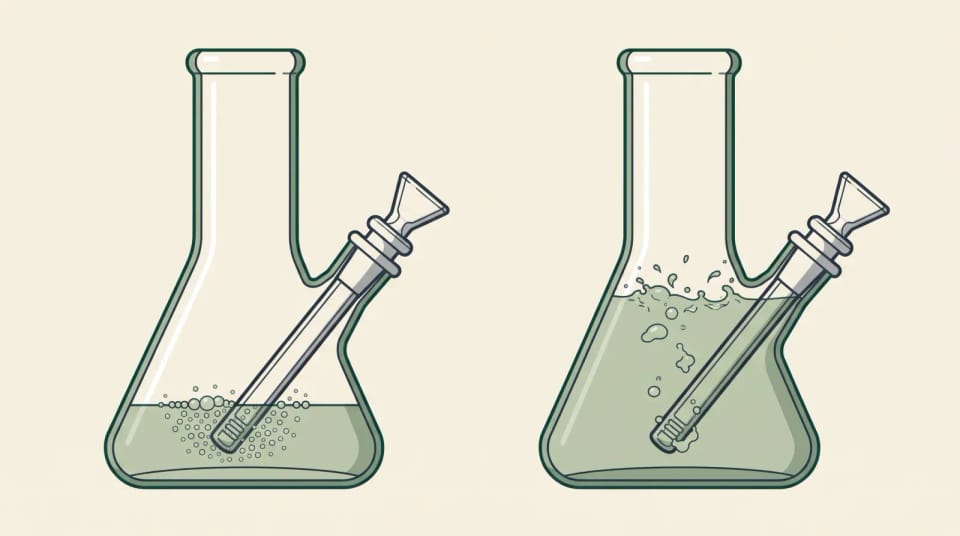
Depth adds resistance. Water that just covers the slits still bubbles every bit of smoke through it, with an easier draw.
Water temperature is a separate argument. Our piece on what bong water temperature actually changes found no controlled human trial comparing hot, cold and ice water, so pick whatever you prefer and do not expect it to change your lungs.
How big should your first bong hit be?
Small: stop well before the chamber is full, because the amount of smoke you inhale is what sets the dose. The common advice of “a quarter to a third of the chamber” is a sensible habit, not a tested number. No study ties a fraction of a bong chamber to a dose. Chambers vary in size, flower varies in potency and people vary in tolerance.
What the research does show:
- Smoke volume moves dose. In the Azorlosa study, bigger puffs raised blood THC and rated effects in steps (Azorlosa and colleagues, 1995). Another lab study held the total amount burned fixed and found puff size alone made no significant difference (Tashkin and colleagues, 1991). Read together, the total smoke you take in is the thing that matters.
- Hit size really varies. In a survey of 1,824 adults, the median amount of flower per hit rose from about 0.042 g for a self-described small hit to 0.093 g for a large one, roughly double (Habib and colleagues, 2025). Those are self-reports, not weighed amounts.
- People rate one bong hit as a bigger unit. In a survey of 1,368 adults, respondents rated one bong hit as equal to two puffs on a joint, pipe or vaporizer at the low-dose level (St Pierre and colleagues, 2025). That is a rating by lower-tolerance users, not a blood measurement, and it does not prove a bong is stronger.
Pull speed matters for the same reason. A slow, steady draw lets you watch the chamber fill and stop on time. A hard, fast pull fills it before you can react. For a starting point on THC amounts, see a beginner’s THC dosing chart. If you are new to cannabis entirely, start with a first-time cannabis user’s guide.
If you want to learn your own number, the High IQ app lets you log a session and how a strain worked, so “two small hits of this one was plenty” becomes a note instead of a guess.
How do you clear a bong, and what if there is no carb?
Clearing means letting fresh air rush in behind the smoke so you can breathe in what is left in the chamber. On most modern glass, you lift the bowl or slide out of the downstem while you keep drawing. On a piece with a carb, you take your finger off the hole instead. If your bong has neither a removable bowl nor a carb, you simply keep inhaling; the bowl itself is the air path.
There is no controlled study of slide versus carb clearing, or of how long smoke can sit in a chamber. If you take a bigger hit than you meant to, you do not have to clear it all. Take your mouth away and let the rest drift out, away from other people.
Should you hold a bong hit in?
No, not for a stronger high: the controlled evidence is mixed, and health guidance says not to. In the Azorlosa study, holding for 10 or 20 seconds raised blood THC but did not raise the rated high (Azorlosa and colleagues, 1995). Other studies found longer holds raised carbon monoxide intake (Zacny and Chait, 1991) and tar retention (Tashkin and colleagues, 1991). Those studies used cannabis cigarettes, not bongs.
Health Canada’s summary of the lower-risk guidelines says that if cannabis is smoked, people should avoid harmful practices such as inhaling deeply or breath-holding (Health Canada; Fischer and colleagues, 2017). Our article on what the breath-holding studies found compares each study side by side.
You will also see the claim that “95 percent of THC is absorbed in the first few seconds.” We could not find that figure in the study it is usually pinned to. Neither “it is instant” nor “holding does nothing” is established.
Does bong water filter the smoke?
Bong water cools smoke and catches some compounds, but it does not clean smoke. In a 1996 smoking-machine test, the best of three water pipes delivered about 30 percent more tar per unit of cannabinoids than an unfiltered joint (Gieringer, MAPS Bulletin). That report was not peer reviewed and was funded by advocacy groups, though its finding runs against bong marketing. A peer-reviewed study of tobacco water pipes found the water did not reduce carbon monoxide, nitric oxide, polycyclic aromatic hydrocarbons or particulate matter (El Hourani and colleagues, 2020). Neither tested a modern glass cannabis bong.
So the water is about comfort, not safety. For the full comparison, see whether bong water filters smoke. If lower lung exposure is your goal, our vaping versus smoking cannabis guide covers the alternative.
How often should you change bong water?
Use fresh water every session and dump it when you are done. There is no cannabis-specific study of how often to change it. There is one published case: doctors linked a young man’s severe lung infection to Pseudomonas bacteria that matched the bacteria cultured from his bong water (Kumar and colleagues, 2017). It is a single case with other risk factors, so it gives no risk figure. It does make stale water an easy thing to skip.
For deeper cleaning, see our guide to cleaning a bong with isopropyl alcohol and salt.
Ventilation matters for the people around you too. Measurements during home bong sessions found fine particulate matter building up in the room, and the authors concluded bong smoking is not safe for bystanders (Nguyen and Hammond, 2022). Our guide to secondhand cannabis smoke has more.
Which bong steps have evidence and which are habit?
| Step | What backs it | Label |
|---|---|---|
| Water just over the slits | Physics: deeper water adds resistance | Mechanism |
| Empty test pull | Follows from the physics; not studied | Convention |
| Slow draw, stop at a small hit | Smoke volume raised blood THC and effects | Tested (cigarettes) |
| “A third of the chamber” | No study | Convention |
| Clear with slide or carb | No study | Convention |
| Do not hold it in | No rated gain; more CO in some studies; health guidance | Mixed evidence plus guidance |
| Fresh water every session | One case report | Precaution |
| Wait before the next hit | Effects take time to build | Guidance |
When should you stop or talk to a clinician?
Stop if you cough hard, feel dizzy or start to feel unwell, and do not push through to finish a bowl. Coughing is an irritation reflex, not a sign of good weed; our guide on why weed makes you cough and when to stop explains the warning signs.
Talk to a clinician if a cough keeps coming back, lasts for weeks, or comes with fever, wheezing or blood. Get emergency help for severe trouble breathing, chest pain or blue or grey lips. If you have asthma or another lung condition, discuss inhaled cannabis with your clinician before you try a bong.
Key takeaways
- Cover the downstem slits with water and let an empty test pull, not a ruler, set the level.
- Hit size is the main dial you control. Draw slowly so you can stop on a small first hit.
- Clear by lifting the bowl or releasing the carb, then breathe out without holding.
- Bong water cools smoke. It does not make smoke clean or safe.
- Use fresh water every session, wait between hits and stop if you cough hard.
FAQ
Why do I cough so much when I use a bong?
Smoke irritates your airway, and a big, fast pull delivers a lot of it at once. Taking smaller hits and drawing slowly reduces how much smoke reaches your throat in one go. Coughing does not mean the weed is strong. If coughing keeps returning or you have trouble breathing, stop and seek medical advice.
Can you use a bong without water?
You can draw through a dry bong, but it then works like a large dry pipe, with hot smoke and nothing to cool it. The evidence that water reduces harm is weak, so the main difference you will notice is a hotter, harsher draw. Add enough water to cover the downstem slits and the draw feels smoother.
Is a bong hit stronger than a joint?
A bong hit can be a bigger serving of smoke than a single puff on a joint, and people rate it that way in surveys. No controlled study among the ones we found shows the same amount of flower is stronger through a bong. What changes is how easy it is to take a large hit at once, so start smaller than you would with a joint.
What do you do with leftover smoke in the chamber?
If you took more than you wanted, you do not have to inhale it. Take your mouth away and let it drift out, away from other people. Nobody has studied whether smoke that sits in the chamber for a while gets harsher, so treat “stale smoke” as folklore.
How often should you clean a bong?
Change the water after every session and give the glass a full clean when residue builds up. There is no tested schedule, but a single case report linked contaminated bong water to a serious lung infection. A clean piece also draws more easily and tastes better.
Sources
- Azorlosa JL, Greenwald MK, Stitzer ML. Marijuana smoking: effects of varying puff volume and breathhold duration. Journal of Pharmacology and Experimental Therapeutics, 1995.
- Tashkin DP, and colleagues. Effects of varying marijuana smoking profile on deposition of tar and absorption of CO and delta-9-THC. Pharmacology Biochemistry and Behavior, 1991.
- Zacny JP, Chait LD. Response to marijuana as a function of potency and breathhold duration. Psychopharmacology, 1991.
- Fischer B, and colleagues. Lower-Risk Cannabis Use Guidelines: a comprehensive update of evidence and recommendations. American Journal of Public Health, 2017.
- Health Canada. Lower-risk cannabis use guidelines. Government of Canada, 2019.
- Gieringer D. Marijuana water pipe and vaporizer study. MAPS Bulletin, 1996 (not peer reviewed).
- El Hourani M, and colleagues. Does the bubbler scrub key toxicants from waterpipe tobacco smoke? Chemical Research in Toxicology, 2020.
- Kumar AN, and colleagues. Marijuana “bong” pseudomonas lung infection: a detrimental recreational experience. Respirology Case Reports, 2017.
- Nguyen PK, Hammond SK. Fine particulate matter exposure from secondhand cannabis bong smoking. JAMA Network Open, 2022.
- St Pierre M, and colleagues. The Index of Cannabis Equivalence (ICE): a user-centered approach to standardization of cannabis dose-response. Journal of Psychoactive Drugs, 2025.
- Habib MI, and colleagues. Estimating cannabis consumption in milligrams of THC from self-reported hit size. Cannabis, 2025.
- Nave R. Static fluid pressure. HyperPhysics, Georgia State University.





