Do All Animals Have an Endocannabinoid System? Not Insects, and Not Every Receptor
Every vertebrate studied has cannabinoid receptors, but insects have none. See which animals have which parts of the endocannabinoid system, and how old it is.

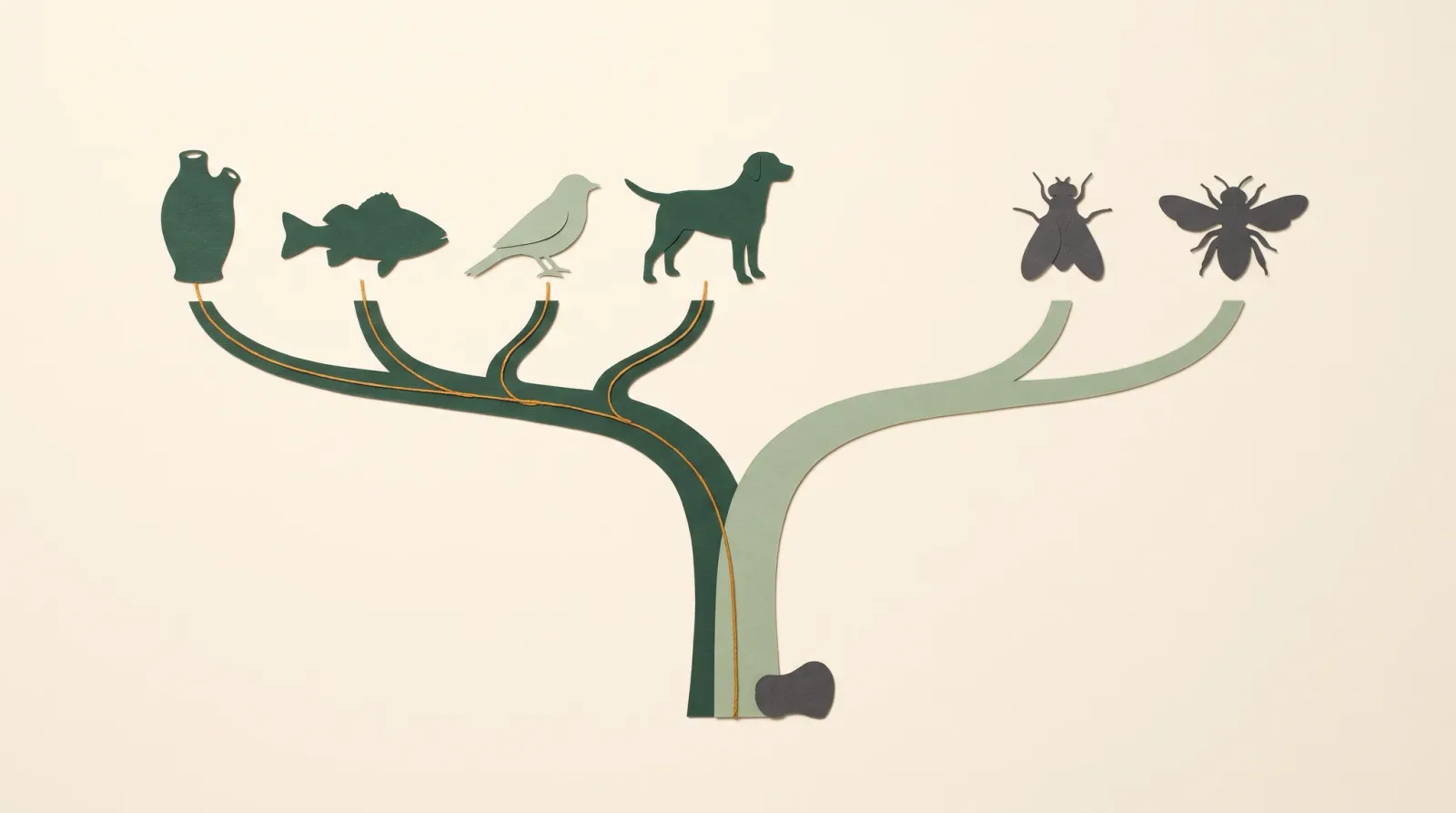
No, not all animals have a full endocannabinoid system: every vertebrate studied so far carries cannabinoid receptors, but insects have none, and many other invertebrates make the signalling molecules without the classic receptors. The receptor family, CB1 and CB2, turns up in genome searches only in chordates: animals with backbones plus two small sea-floor relatives, sea squirts and lancelets. Elphick, 2012
So the line you see repeated, “all animals have an ECS”, needs one correction. A fruit fly has no cannabinoid receptor. A sea squirt has one. Your dog has both CB1 and CB2. The rest of this lesson sorts out who has which part, how old the receptors are, and why dogs react so strongly to THC.
Research checked October 29, 2026.
What counts as an endocannabinoid system?
The system has three parts, and they do not travel together. If you want the human version first, here is how the endocannabinoid system works in people.
- Receptors. CB1 and CB2 receptors are the docking sites. THC acts mainly at CB1.
- Signalling molecules. The body makes two main ones, anandamide and 2-AG.
- Enzymes. These build the molecules on demand and break them down after use.
The key fact is that these parts have different histories. A genome comparison across 12 organisms found that some parts are limited to mammals, some to vertebrates, some to chordates, and one breakdown enzyme, FAAH, has relatives in all eukaryotes. McPartland et al., 2006 An earlier review suggested the ability to make these molecules may be ancient, while using them to pass signals between cells may have arisen separately in different lineages. Elphick and Egertova, 2005
So “does this animal have an ECS?” is really three questions. The answer can be yes for the molecules and no for the receptors.
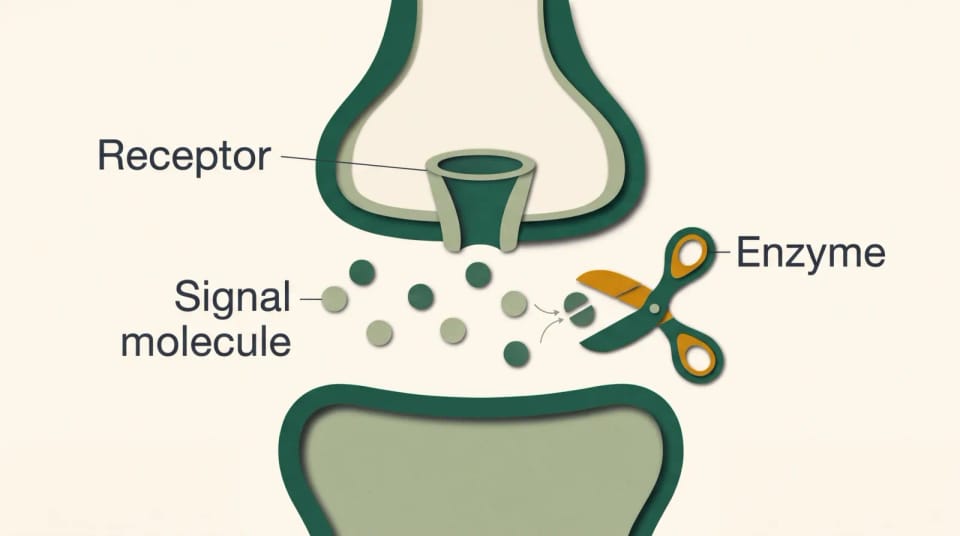
Three parts, three histories. The signal molecules and enzymes are far more widespread across animals than the CB1 and CB2 receptors.
Which animals have cannabinoid receptors?
Every vertebrate group that has been checked has CB1 and CB2 type receptor genes. The 2012 review lists them in a frog (Xenopus), the chicken, zebrafish and pufferfish, alongside mammals. Fish add a twist: zebrafish carry one CB1 gene and two CB2 genes, while the pufferfish Fugu has two CB1 genes and one CB2. Elphick, 2012
Outside the vertebrates, the receptor appears in only two places. The sea squirt Ciona intestinalis has one, called CiCBR, and it sits outside both the CB1 and CB2 branches of the family tree. Elphick, Satou and Satoh, 2003 The lancelet Branchiostoma floridae has another, BfCBR, with 23% identity to human CB1 and CB2. Elphick, 2007
The sea squirt is the best evidence that this is a working system and not just a gene. Its receptor sits along nerve fibres, the same place CB1 sits in mammals. Egertova and Elphick, 2007 It makes both anandamide and 2-AG and has a FAAH-like enzyme. A synthetic cannabinoid slowed the reopening of its siphon, and mammalian receptor blockers reduced that effect. Matias, McPartland and Di Marzo, 2005
Here is the scorecard. “Genome” means a receptor gene was found or searched for. “Binding” means a lab assay found a site that grabs cannabinoid drugs, without identifying the gene behind it.
| Animal group | CB1/CB2-type receptor | Anandamide or 2-AG | Main evidence |
|---|---|---|---|
| Mammals, including people and dogs | Yes, CB1 and CB2 | Yes | Genome, binding, behaviour |
| Birds and amphibians | Yes, CB1 and CB2 genes | Not covered here | Genome |
| Bony fish | Yes, with extra copies | Not covered here | Genome |
| Sharks and lampreys | CB1-type gene seen; no CB2 gene found | Not covered here | Early genome data |
| Sea squirts and lancelets | Yes, one ancestral-type receptor | Yes, in the sea squirt | Genome, binding, behaviour |
| Roundworm (C. elegans) | No CB1/CB2 gene; cannabinoid-like receptors | Responds to anandamide | Genome, behaviour |
| Leech | Not identified; 2-AG acts through other channels | Yes, 2-AG | Physiology |
| Earthworm, a crustacean, an onychophoran | Binding found, gene not found | Not covered here | Binding only |
| Hydra | Binding found, gene not found | Yes | Binding, behaviour |
| Insects tested | No | Little or none expected | Genome, binding |
| Sponge and sea anemone | No binding found | Not covered here | Binding |
The shark and lamprey row needs its caveat. At the time of the 2012 review, those genomes were unpublished. A CB1-type gene was seen in both, but no CB2 gene, which could mean the gene was lost or the sequence was incomplete. Lamprey nerve recordings do show CB1-type signalling running backward across the synapse, as it does in mammals. Elphick, 2012
Do insects have an endocannabinoid system?
Not in the receptor sense. A 2001 study tested five insects: the honeybee, the fruit fly, a water strider, the fall armyworm and a darkling beetle. Radioactive cannabinoid drugs found no specific binding sites, THC did not switch on the cell machinery that receptors use, and the fruit fly genome contained no human CB receptor relatives. McPartland et al., 2001
The authors called this unique in comparative neurobiology. Their hypothesis is that insects lost the receptors because they make little or no arachidonic acid, the fatty acid that anandamide and 2-AG are built from. That remains a hypothesis. Insects also lack several of the enzymes: the 2012 review notes that MAGL and NAPE-PLD are missing, and insects carry only FAAH2, not FAAH. Elphick, 2012
Two limits keep this honest. Five species is a small sample of a huge group. And “no receptor found” is not the same as “cannot be affected by any cannabis compound”. It means THC has no CB receptor to bind in those insects.
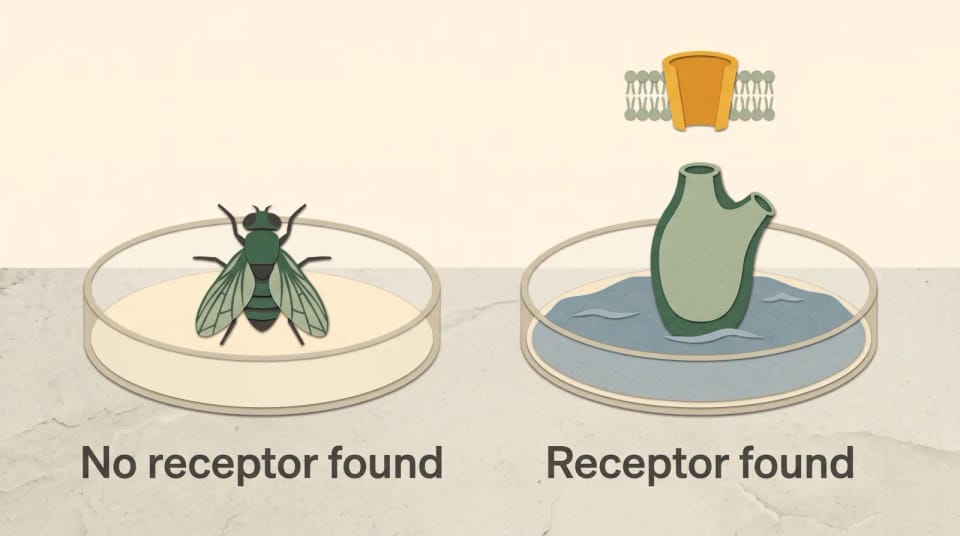
The receptor gene follows ancestry, not complexity. The sea squirt sits on the same branch of the family tree as vertebrates; insects do not.
Do worms, leeches and jellyfish relatives have one?
This is where the evidence splits, and the split is worth understanding. Two methods give two different answers.
Genome searches look for the gene. They find CB1/CB2-type receptors only in chordates, and none in the roundworm C. elegans or the fruit fly. Elphick, Satou and Satoh, 2003
Binding assays look for any site that grabs a cannabinoid drug. A 2006 study found specific binding in an earthworm, an onychophoran (a velvet worm), a crustacean and a free-living nematode, and none in a sea anemone or a sponge. Those authors proposed that cannabinoid receptors arose in the common ancestor of bilaterian animals and were later lost in insects and some others. McPartland et al., 2006 Both views are published. Until someone clones the receptor behind those binding sites, the question stays open for those animals.
The roundworm shows how an animal can respond without CB1. C. elegans has receptors that the researchers describe as cannabinoid orthologs, NPR-19 and NPR-32. THC reduced the worms’ response to harmful heat, and mutant worms suggested THC worked through these cannabinoid-like receptors while CBD worked through vanilloid ones. Boujenoui et al., 2024 Anandamide also cut the heat-avoidance response, with NPR-19 and NPR-32 as its main candidate targets. Abdollahi et al., 2024 That echoes how THC and CBD act differently on the system in people. It does not mean worms get high. The measured outcome was a heat reflex.
The leech uses 2-AG to weaken synapses, but through TRPV-type channels, not CB1 or CB2, according to the 2012 review. Elphick, 2012 This is part of the wider endocannabinoidome: the same molecules acting on other targets.
Hydra, a tiny freshwater relative of jellyfish, is the oldest-branching animal with positive results. A 1999 study found cannabinoid binding sites, both anandamide and 2-AG, and a FAAH-like enzyme. Anandamide cut its feeding response by up to 45%, and a CB1 blocker reversed that. De Petrocellis et al., 1999 The binding sites were never tied to a cloned receptor, so this case is open too.
Across all of these, one statement holds up: anandamide and 2-AG have been found throughout the animal kingdom, “at least in the species that have been analysed to date”. Paulsen and Burrell, 2019
How old is the endocannabinoid system?
Older than cannabis, and older than backbones, but no source gives the receptor a birthday. Here is what the papers support.
- The receptor family began in an invertebrate chordate. The sea squirt and lancelet receptors mean CB1/CB2-type receptors arose in a shared ancestor of tunicates, lancelets and vertebrates. Elphick, 2007
- CB1 and CB2 split later. The two receptors came from a gene duplication in a common ancestor of living vertebrates. Elphick, 2012
- Vertebrates have used it for a very long time. The 2012 review describes endocannabinoid signalling across “more than 400 million years of vertebrate brain evolution”. Elphick, 2012
- The tunicate line is at least about 500 million years old. A mid-Cambrian fossil from Utah shows the modern tunicate body plan already in place. Nanglu et al., 2023 That dates the animals, not the gene. If their shared ancestor with vertebrates carried the receptor, the family is at least that old.
You may see a single round number for the age of the ECS. The papers above do not supply one, so treat any exact figure with care. The molecules and some enzymes are older still, and FAAH relatives reach across all eukaryotes. McPartland et al., 2006
Did the system evolve because of cannabis? No. The receptors in sea squirts and fish long predate any cannabis plant. THC happens to fit a receptor that animals built for their own signals.
Why are dogs so sensitive to THC?
Dogs have a full mammalian ECS, and they react strongly to THC. Cornell’s veterinary college says plainly that “dogs are much more sensitive to the effects of cannabis than humans”. Signs can start 30 minutes to several hours after exposure and may last up to 72 hours. Cornell Riney Canine Health Center
The common explanation is that dogs have more CB1 receptors in key brain areas than people do. None of the studies reviewed for this lesson measured that comparison. A 2017 study mapped CB1 in five healthy dogs and found it in the expected regions, including the cerebellum and the medulla oblongata, but did not compare dogs with people. Freundt-Revilla et al., 2017 The 1990 receptor-mapping paper often cited for the density claim describes a distribution that is “unique and conserved” across the species it examined. Herkenham et al., 1990 So the sensitivity is well established. The density explanation is repeated more than it is shown. That does not make it false; it makes it unproven in the sources we opened.
The danger is real either way. In one Colorado case series of 125 dogs, two that ate butter made with medical-grade THC died. Meola et al., 2012 If your dog may have eaten cannabis, read what to do if your dog ate cannabis and call a vet or a pet poison line. This article gives no treatment advice. For CBD questions, see what the veterinary CBD research shows.
When to talk to a clinician: this lesson is about evolution, not health care. If you have symptoms after using cannabis yourself that worry you, contact a clinician, or emergency services if they are severe. For a pet, the vet is your clinician.
Key takeaways
- CB1/CB2-type receptors appear in genome searches only in chordates: vertebrates, sea squirts and lancelets.
- Insects tested have no cannabinoid receptors and lack several of the enzymes.
- Anandamide and 2-AG are far more widespread than the receptors, and some animals use them through other targets.
- Binding studies in worms, a crustacean and Hydra conflict with the genome view; those cases remain open.
- Dogs are much more sensitive to THC than people; the receptor-density explanation is not yet backed by a direct comparison.
FAQ
Do dogs and cats have an endocannabinoid system?
Yes. Dogs and cats are mammals, and every vertebrate group checked carries CB1 and CB2 receptor genes. In dogs, CB1 has been mapped across the brain and spinal cord. Species-specific receptor maps for cats were not part of the sources reviewed here.
Do fish, birds and reptiles have an endocannabinoid system?
Fish and birds do: zebrafish, pufferfish and the chicken all carry CB1 and CB2 type genes. Fish even carry extra copies. Reptiles were not named in the sources reviewed, but they sit inside the vertebrate group where the receptors are consistently found.
Which animal has the oldest endocannabinoid system?
Among animals with the classic receptor, sea squirts and lancelets hold the most ancestral version. Their receptors branch off before the CB1 and CB2 split. If you count only the signalling molecules, Hydra has positive results, but its receptor has not been identified.
Do bees or flies get high?
There is no receptor for THC to act on in the insects tested, including the honeybee and the fruit fly. That is the main reason researchers do not expect a cannabis high in insects. It does not mean every cannabis compound has zero effect on every insect.
Did humans evolve the endocannabinoid system because of cannabis?
No. CB1/CB2-type receptors exist in sea squirts and fish, lineages far older than any cannabis plant. THC works because it happens to fit a receptor animals already used for their own signals.
Sources
- Elphick MR. The evolution and comparative neurobiology of endocannabinoid signalling. Philosophical Transactions of the Royal Society B, 2012. doi:10.1098/rstb.2011.0394
- Elphick MR, Satou Y, Satoh N. The invertebrate ancestry of endocannabinoid signalling: an orthologue of vertebrate cannabinoid receptors in the urochordate Ciona intestinalis. Gene, 2003. PMID 12527200
- Elphick MR. BfCBR: a cannabinoid receptor ortholog in the cephalochordate Branchiostoma floridae (Amphioxus). Gene, 2007. PMID 17553639
- Egertova M, Elphick MR. Localization of CiCBR in the invertebrate chordate Ciona intestinalis. Journal of Comparative Neurology, 2007. PMID 17428001
- Matias I, McPartland JM, Di Marzo V. Occurrence and possible biological role of the endocannabinoid system in the sea squirt Ciona intestinalis. Journal of Neurochemistry, 2005. PMID 15934935
- McPartland J, et al. Cannabinoid receptors are absent in insects. Journal of Comparative Neurology, 2001. PMID 11447587
- McPartland JM, et al. Cannabinoid receptors in invertebrates. Journal of Evolutionary Biology, 2006. PMID 16599912
- McPartland JM, Matias I, Di Marzo V, Glass M. Evolutionary origins of the endocannabinoid system. Gene, 2006. PMID 16434153
- Elphick MR, Egertova M. The phylogenetic distribution and evolutionary origins of endocannabinoid signalling. Handbook of Experimental Pharmacology, 2005. PMID 16596778
- De Petrocellis L, et al. Finding of the endocannabinoid signalling system in Hydra, a very primitive organism. Neuroscience, 1999. PMID 10392859
- Paulsen RT, Burrell BD. Comparative studies of endocannabinoid modulation of pain. Philosophical Transactions of the Royal Society B, 2019. PMID 31544609
- Boujenoui F, et al. Cannabidiol and tetrahydrocannabinol antinociceptive activity is mediated by distinct receptors in Caenorhabditis elegans. Neurochemical Research, 2024. PMID 38141130
- Abdollahi M, et al. Anandamide modulates thermal avoidance in Caenorhabditis elegans through vanilloid and cannabinoid receptor interplay. Neurochemical Research, 2024. PMID 38847909
- Nanglu K, et al. A mid-Cambrian tunicate and the deep origin of the ascidiacean body plan. Nature Communications, 2023. doi:10.1038/s41467-023-39012-4
- Herkenham M, et al. Cannabinoid receptor localization in brain. PNAS, 1990. PMID 2308954
- Freundt-Revilla J, et al. Spatial distribution of cannabinoid receptor type 1 (CB1) in normal canine central and peripheral nervous system. PLoS One, 2017. PMID 28700706
- Meola SD, et al. Evaluation of trends in marijuana toxicosis in dogs living in a state with legalized medical marijuana: 125 dogs (2005–2010). Journal of Veterinary Emergency and Critical Care, 2012. PMID 23216842
- Cornell University College of Veterinary Medicine, Riney Canine Health Center. Cannabis (THC) intoxication in dogs. Updated December 22, 2025.





