Will Full-Spectrum CBD Oil Survive Dec 11? The Bottle Math
The full-spectrum CBD oil ban is really a 0.4 mg THC cap per bottle from Dec 11, 2026. Lab tests found typical oils far above it. Here is the math.

Federal law does not ban CBD, but from December 11, 2026, a CBD oil whose bottle holds more than 0.4 milligrams of total THC falls outside the federal definition of hemp. That is the whole test: THC per container, not CBD, and not a percentage. The catch is the size of that number. In one 80-product lab study, the median CBD oil with measurable THC held 0.64 mg of delta-9 THC in every milliliter. The new limit is 0.4 mg for the whole bottle. Johnson et al., 2022
So “Is full-spectrum CBD oil banned?” is the wrong question. The right one is “How much THC is in my bottle?” This page is the CBD oil buyer’s version of the new rule. It shows the bottle math, what lab studies actually measured, how to check a certificate of analysis, and where Congress stands today.
This is an explanation of federal law, not legal or medical advice. Statutes and congressional status checked October 29, 2026.
What does the December 11 rule actually say?
The rule comes from section 781 of Public Law 119-37, signed November 12, 2025. It keeps hemp defined as plant material at or under 0.3 percent total THC by dry weight. Then it carves out finished products: any “final hemp-derived cannabinoid product” with more than 0.4 milligrams combined total per container of THC (including THCA) and similar-effect cannabinoids is no longer hemp.
Three details in the text matter for oil buyers:
- “Container” means the bottle. The law defines it as the innermost packaging in direct contact with the product for retail sale, and lists bottles, jars and cartridges as examples.
- People and pets are both covered. The product definition reaches products intended for human or animal use.
- FDA-approved drugs are outside it. A prescription CBD medicine approved under section 505 of the Food, Drug, and Cosmetic Act is excluded.
The date moved once. Public Law 119-103, section 2019, applies the new definition until December 11, 2026 only to cannabinoids the plant cannot make on its own. Those changes took effect November 12; our explainer on the Nov 12 versus Dec 11 dates covers that track. Naturally occurring THC in CBD oil falls under the container cap on December 11.
Why is full-spectrum CBD oil in the crosshairs?
Because full-spectrum oil keeps the plant’s minor cannabinoids, including some THC, on purpose. That is what separates it from broad-spectrum and isolate; our guide to full-spectrum, broad-spectrum and isolate explains the three types.
The federal government says this out loud. Executive Order 14370, signed December 18, 2025, states that “some full-spectrum CBD products will once again be controlled as marijuana under the CSA” once section 781 takes effect, “because they contain THC levels above the per-container threshold.” The same order asks staff to work with Congress on a change that would allow “appropriate full-spectrum CBD products.” An executive order sets policy. It does not rewrite a statute.
What happens to a product that misses the cap? It is no longer hemp, and federal law excludes only hemp from the definition of marijuana. 21 U.S.C. 802(16) So the product falls back under the Controlled Substances Act. The Congressional Research Service puts it plainly: such products “will instead be classified as marijuana or CSA-regulated THC.” CRS Legal Sidebar LSB11381
How much THC is in a typical CBD oil?
More than 0.4 mg per bottle, in most lab samples with any THC at all. The best measured data comes from a 2022 study in Drug and Alcohol Dependence. Researchers bought 80 hemp-derived CBD oils from 51 brands, online and in Kentucky stores, in spring 2021. They measured delta-9 THC with LC-MS/MS. Johnson, Kilgore and Babalonis, 2022
What they found:
- 51 of the 80 products had measurable delta-9 THC.
- Among those 51, concentrations ran from 0.008 to 2.071 mg per mL. The median was 0.64 mg/mL.
- 21 products said “THC-free” on the label. Five of them contained 0.015 to 0.656 mg/mL.
Keep three limits beside those numbers. The study measured delta-9 only; the federal test counts total THC, which adds THCA, so real totals are equal or higher. The products date from 2021. And the study did not sort results by full-spectrum versus broad-spectrum labels.
Older and smaller studies point the same way. A 2017 JAMA letter found THC in 18 of 84 online CBD products, at up to 6.43 mg/mL. Bonn-Miller et al., 2017 A 2026 analysis of 18 tinctures found delta-9 THC in two products sold as broad-spectrum. Sullivan et al., 2026
Does the 0.4 mg limit apply per dose or per bottle?
Per bottle. The law counts the container, so the allowed THC concentration shrinks as the bottle grows. Here is the math, using the study’s median of 0.64 mg/mL.
| Bottle size | Most THC per mL that stays at or under 0.4 mg | THC at the study median (0.64 mg/mL) | Times over the limit |
|---|---|---|---|
| 10 mL | 0.040 mg/mL | 6.4 mg | about 16 |
| 15 mL | 0.027 mg/mL | 9.6 mg | about 24 |
| 30 mL | 0.013 mg/mL | 19.2 mg | about 48 |
Working: 0.4 mg ÷ bottle volume gives the allowed concentration. Median × volume gives the bottle total. Delta-9 THC only, from the 2021 sample.
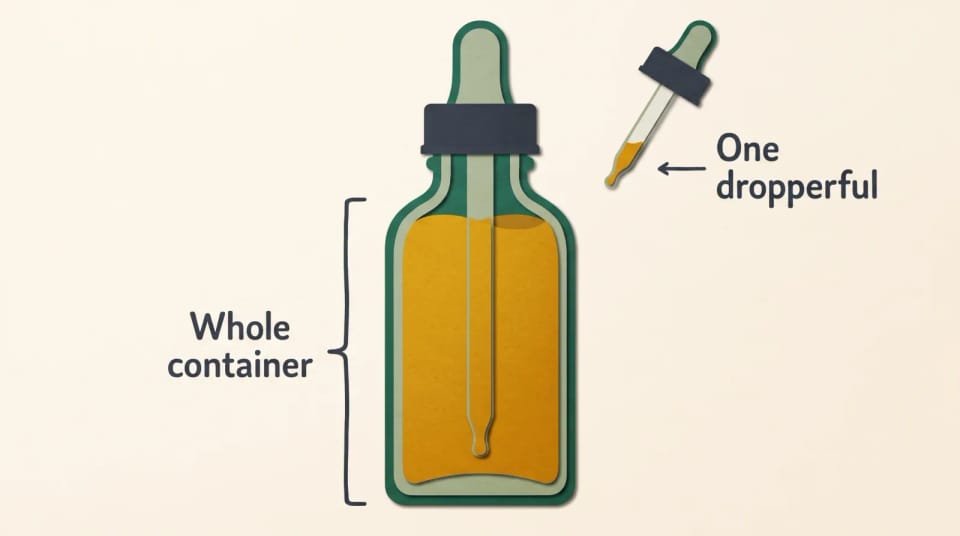
The federal test adds up all the THC in the bottle. A small dose from a large bottle does not lower the bottle’s total.
The same oil can pass in one size and fail in another. At the study’s lowest reading, 0.008 mg/mL, a 30 mL bottle holds about 0.24 mg and passes. At 0.015 mg/mL, the lowest reading among the mislabeled “THC-free” oils, a 10 mL bottle holds 0.15 mg and passes, but a 30 mL bottle holds 0.45 mg and fails. At the study’s highest reading, a 30 mL bottle holds about 62 mg, roughly 155 times the limit.
Another way to see it: a bottle with 1,000 mg of CBD can carry at most 0.4 mg of THC. That is a CBD-to-THC ratio of at least 2,500 to 1. The executive order itself floated per-serving limits and CBD-to-THC ratios as alternatives, which tells you the current rule is a hard line for oils. The same 0.4 mg cap on THC drinks works the same way: the can counts, not the sip.
Isn’t 0.3 percent THC the legal limit?
Not for a finished oil. The 0.3 percent figure is a dry-weight test for the plant and intermediate material. For a final product, the test is 0.4 mg per container. To see why the two are far apart, take a purely hypothetical 30 mL oil at 0.3 percent THC by volume: that is 0.3 g per 100 mL, or about 90 mg in the bottle, roughly 225 times the container limit. That is a ceiling for illustration, not a measurement of any real product.
Can broad-spectrum or isolate CBD oil still pass?
Yes, if the whole container holds 0.4 mg of total THC or less. Broad-spectrum and isolate products aim to remove THC, so they start with a big head start. A label alone does not prove it, though. In the 2022 study, five of 21 “THC-free” oils had measurable THC. A 2021 Mississippi study found only 3 of 25 hemp oils within 20 percent of their labeled CBD amount. Gurley et al.
The proof is the lab report. That brings us to the practical part.
How do you check your own bottle?
Use the certificate of analysis (COA), the lab report for the batch. Our guide on how to read a certificate of analysis explains the layout.
- Find the COA. Ask the seller, or scan the QR code on the package.
- Match the batch. The batch or lot number on the report has to match your bottle. Here is how to match the COA to your bottle’s batch.
- Read total THC, not delta-9 alone. If the report lists delta-9 THC and THCA separately, total THC equals delta-9 plus THCA × 0.877. Our explainer on how total THC counts THCA walks through the formula.
- Multiply by the bottle volume. If total THC is given in mg per mL, multiply by the mL on the label.
- Compare with 0.4 mg. At or under 0.4 mg for the whole bottle meets the federal limit. Over it does not.
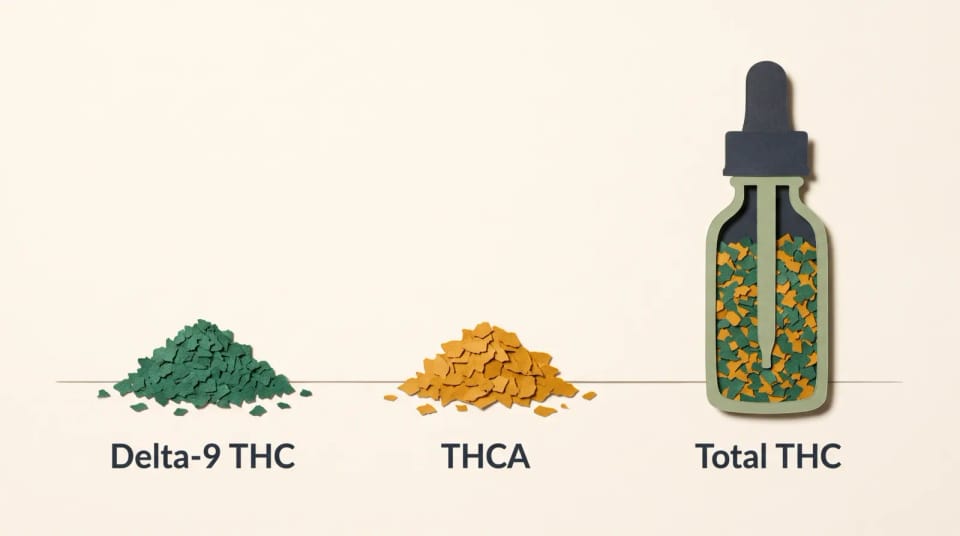
The container test counts both forms. A COA that shows only delta-9 THC can understate the bottle’s total.
Two traps on lab reports. “ND” means not detected above that lab’s reporting limit, so check the limit printed on the report. And a report that gives only a percentage or mg per gram needs one more conversion; ask the seller for total THC per container in writing. Do not confuse any of this with hemp seed oil, which comes from seeds and stays outside the marijuana definition. Our guide explains why hemp seed oil is a different product.
Will Congress change the rule before December 11?
Nothing has passed as of October 29, 2026. The Congressional Research Service lists delay bills (H.R. 7024, H.R. 7010, S. 3686), a repeal bill (H.R. 6209), proposals for a 1 percent total THC test (S. 2112, H.R. 9830), and regulatory framework bills. It also notes that the House fiscal 2027 agriculture bill (H.R. 8646) contains no delay. CRS In Focus IF13136
The newest public plan is one lawmaker’s. Rep. Morgan Griffith (R-Va.) said on October 26 he hopes to attach his hemp regulation bill to a reconciliation package after the November midterms. “I truly believe if we don’t do something before that December 11th deadline, that it’s going to create all kinds of issues,” he said. Cannabis Business Times That bill, the HEMP Act (H.R. 7212), targets intoxicating products with a per-serving and per-package limit. A plan is not a law, and we do not predict the outcome.
Two more open items. The statute told FDA to publish cannabinoid lists and more detail on the term “container” within 90 days. As of September 28, 2026, CRS reported the lists had not been published. And CRS says “it remains unclear if and how federal law enforcement will enforce the new prohibitions.” CRS Insight IN12620
Do state rules change the picture?
Yes, and some states are already stricter. California’s 2024 rules for hemp food, beverage and dietary products ban any detectable THC per serving, while leaving CBD products with no detectable THC alone. California Department of Public Health State rules vary widely; our overview of hemp rules versus state cannabis rules sets out the main differences.
When should you talk to a clinician?
If you use CBD oil for a health reason, talk to a clinician or pharmacist before you switch products, stop suddenly, or move to a state-licensed medical product. A new oil can carry a different CBD amount than its label claims, as the label studies above show. Bring the product and its COA. If you take prescription medicines, ask whether a new product changes anything for you. A prescription CBD medicine is a separate path from any shelf product and stays outside the hemp definition.
If a CBD product causes a side effect, here is how to report a CBD side effect. If you change products and want a record of how each one worked for you, the High IQ app lets you log that alongside what you used.
Key takeaways
- CBD is not banned. From December 11, 2026, the test is total THC per container: 0.4 mg or less.
- In a 2021 lab sample, the median oil with measurable THC held 0.64 mg of delta-9 THC per mL, about 48 times the limit in a 30 mL bottle.
- The cap does not grow with the bottle. The same oil can pass in 10 mL and fail in 30 mL.
- Broad-spectrum and isolate oils can pass, but only a matching COA showing total THC proves it.
- As of October 29, 2026, Congress has plans and bills, not a passed change.
FAQ
Is full-spectrum CBD oil banned on December 11?
No law names CBD. From December 11, a CBD product with more than 0.4 mg of total THC in its container is no longer hemp under federal law. Many full-spectrum oils carry more THC than that, so many will not meet the definition, but a very low-THC oil in a small bottle can.
Does the 0.4 mg limit apply per dose or per bottle?
Per bottle. The law counts the innermost container sold at retail, such as the bottle a dropper sits in. Dividing a bottle into small doses does not change its total.
Do CBD gummies, topicals and pet products count?
The definition covers final hemp-derived cannabinoid products intended for human or animal use, so the same per-container test applies to those formats. How FDA will apply the term “container” in detail had not been published as of late September 2026.
Could Congress change this before December 11?
It could, but as of October 29, 2026, nothing has passed. Delay, repeal and regulation bills are pending, and one lawmaker plans to try a post-election reconciliation bill. Check the date on any news you read, because this is changing week to week.
Does full-spectrum CBD oil make you fail a drug test?
It can, because many oils contain THC, and labels have been wrong in lab studies. Our guide on whether CBD shows up on a drug test covers how tests detect THC from CBD products.
Sources
-
U.S. Congress. Public Law 119-37, Division B, section 781. 139 Stat. 2025. GovInfo
-
U.S. Congress. Public Law 119-103, section 2019. 140 Stat. 2026. GovInfo
-
21 U.S.C. 802(16), definition of marihuana. GovInfo
-
Executive Order 14370, “Increasing Medical Marijuana and Cannabidiol Research.” December 18, 2025. White House
-
Congressional Research Service. “Changes to the Statutory Definition of Hemp and Implications for Agricultural Policy.” IF13136, updated September 28, 2026. Congress.gov
-
Congressional Research Service. “Change to Federal Definition of Hemp and Implications for Federal Enforcement.” IN12620, December 3, 2025. Congress.gov
-
Congressional Research Service. “Changes to the Federal Definition of Hemp: Legal Considerations Under the Controlled Substances Act.” LSB11381, December 2025. Congress.gov
-
Johnson E, Kilgore M, Babalonis S. “Cannabidiol (CBD) product contamination: Quantitative analysis of Δ9-tetrahydrocannabinol (Δ9-THC) concentrations found in commercially available CBD products.” Drug and Alcohol Dependence. 2022;237:109522. DOI: 10.1016/j.drugalcdep.2022.109522
-
Bonn-Miller MO, Loflin MJE, Thomas BF, Marcu JP, Hyke T, Vandrey R. “Labeling Accuracy of Cannabidiol Extracts Sold Online.” JAMA. 2017;318(17):1708-1709. DOI: 10.1001/jama.2017.11909
-
Gurley BJ, Murphy TP, Gul W, Walker LA, ElSohly M. “Content versus Label Claims in Cannabidiol (CBD)-Containing Products Obtained from Commercial Outlets in the State of Mississippi.” Journal of Dietary Supplements. 2020;17(5):599-607. DOI: 10.1080/19390211.2020.1766634
-
Sullivan Z, Lapierre C, Weiser Erlandson L, Pham L. “Substances of Health Concern: Label Accuracy of Cannabidiol and Tetrahydrocannabinol in Commercial Cannabidiol Tinctures from the United States.” Cannabis and Cannabinoid Research. 2026;11(6):452-459. DOI: 10.1089/can.2025.0016
-
Lange T. “US Rep. Lays Out Plan to Avert Federal Hemp THC Product Ban After Midterms.” Cannabis Business Times. October 27, 2026. Cannabis Business Times
-
California Department of Public Health. “California’s Ban on Intoxicating Hemp Products Now in Effect.” News release NR24-26, September 24, 2024. CDPH





