Vape Cart Not Hitting in Cold Weather? What the Viscosity Data Shows
A vape cart not hitting in cold weather usually has thick oil and a cold battery. See the viscosity data, and why the hair-dryer numbers have no source.

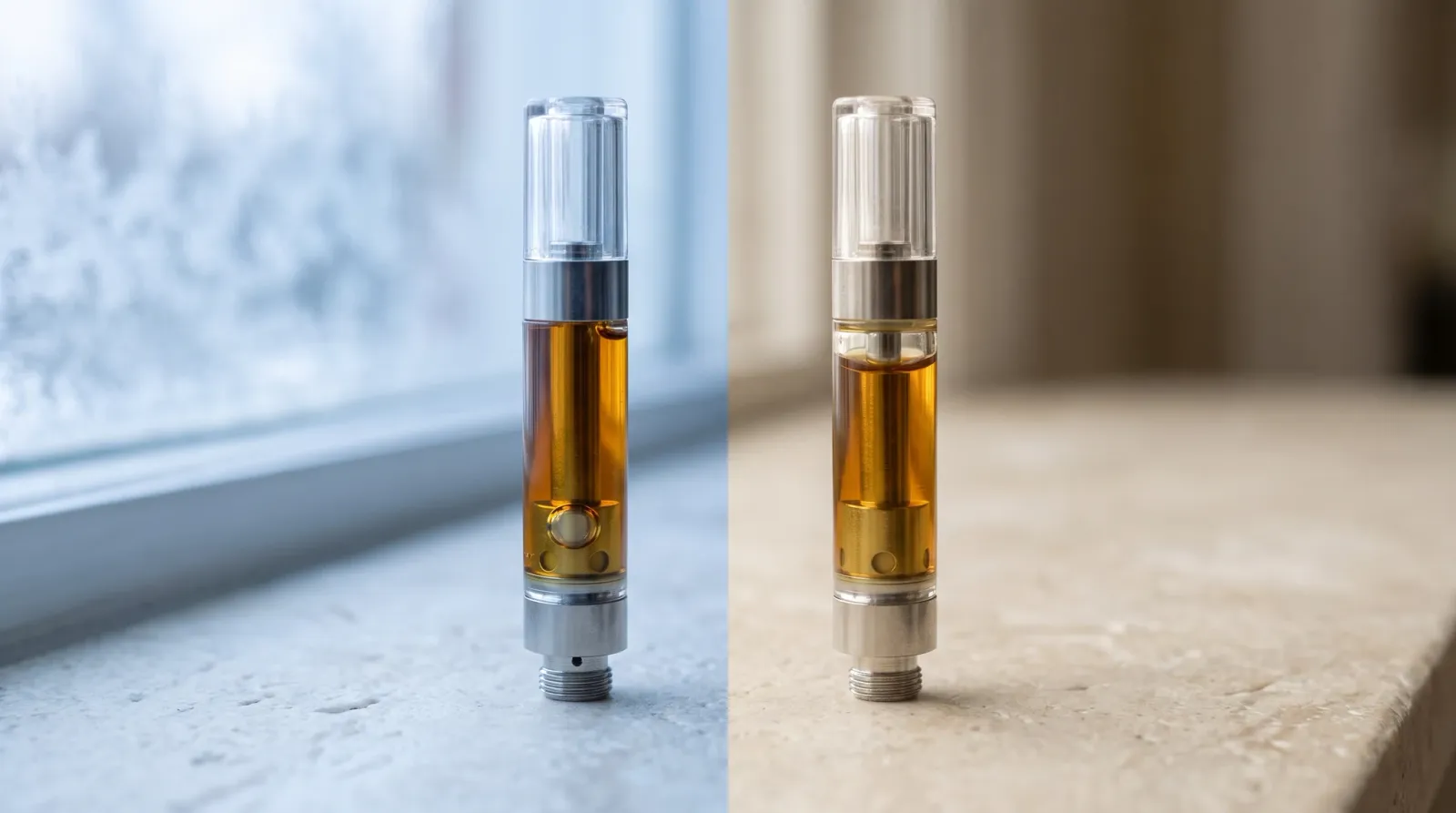
A cold vape cart usually won’t hit because its oil thickens steeply as it cools and its battery delivers less power, so bring both back to room temperature with body warmth, not a hair dryer. Time and a warm hand address both causes. No study we found shows that a heat tool does the job better or safely.
Here is the number worth sending to the friend who keeps blasting their cart with a hair dryer. A viscometer maker measured two commercial CO2-extracted THC oils as they cooled. At 70 °C (158 °F) they read about 170 and 199 centipoise. At 40 °C (104 °F) they read 5,666 and 8,060 centipoise, a jump of 33 to 40 times over just 30 degrees (vendor application note, 2019). And winter is far colder than 40 °C.
The second thing worth sending: every “warm it to 110 to 120 °F” rule on the retail pages is a number without a source. Research suggests nobody has published cannabis oil viscosity below 30 °C (86 °F); the data we found ends there. We found no published measurement of cart oil at winter temperatures, and no published safe hair-dryer time.
If your cart still will not draw once it is warm and charged, the weather is not the problem. A clogged vape cart needs a different diagnosis, and that guide covers the unclogging steps. This lesson stays on cold physics, the battery, and how far warming can safely go.
Why does my cart not hit in the cold?
Your cart does not hit in the cold because thick oil cannot reach the coil fast enough. A cartridge works by letting oil soak through small inlet holes into a wick that wraps the heating coil. When the oil is runny, the wick refills between puffs. When the oil is thick, the wick dries out after one pull, and you get a weak, burnt or empty hit. One cartridge hardware maker describes the same thing: cold oil thickens and restricts flow into the inlet holes (manufacturer explainer).
The measured temperature effect is large. In a second application note, the same viscometer maker tested three commercial THC oils, two of them made for vape cartridges, from 30 °C to 70 °C. Viscosity fell about a hundredfold across that span for every sample (vendor application note, 2020). The note itself says leaking can happen at high temperatures and dispensing gets hard in cold climates.
Two caveats keep this honest. Both notes come from an instrument vendor, not a peer-reviewed journal. And neither one measured oil below 30 °C. Thickening almost certainly continues as oil gets colder, but we will not print a winter number that nobody measured.
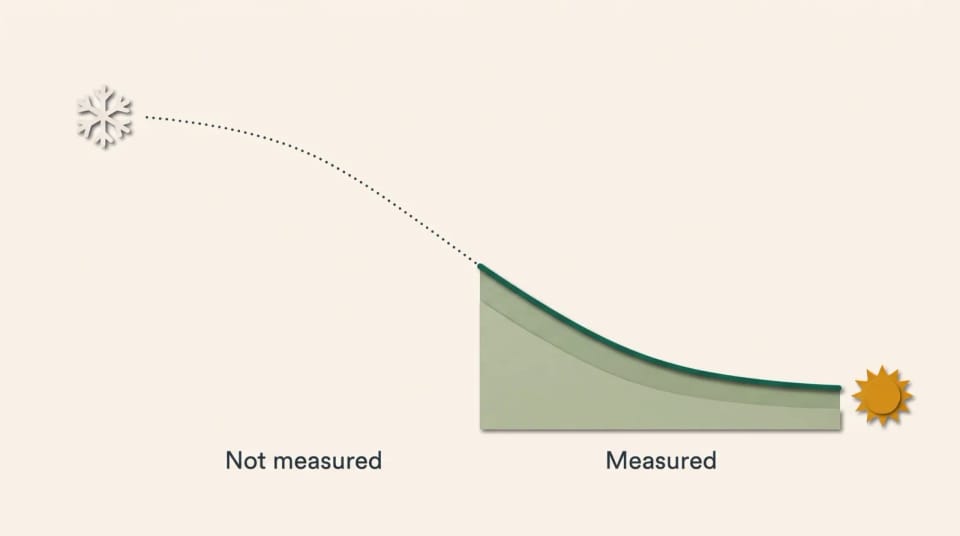
The published viscosity data for cannabis oil covers warm temperatures only. The dotted cold side is the part nobody has measured, which is exactly where winter carts misbehave.
Why does one cart freeze up while another one is fine?
Some carts fail in the cold and others shrug it off because oil recipes differ almost as much as temperatures do. In the 2020 vendor note, the two vape-cart oils were thinner than a multi-purpose oil, and formulations differed by up to about tenfold at the same 50 °C (vendor application note, 2020).
Peer-reviewed work points the same way. A 2026 study of two butane-extracted oils measured both at 45 °C and found one about 2.5 times as thick as the other. The thinner extract had a larger volatile fraction and less total cannabinoid. Wax content moved viscosity only about 10 to 13 percent (Sosa et al., ACS Omega, 2026). The authors work in the extraction and terpene industry, and they tested two extracts, not finished carts.
A separate lab study found that terpene content strongly changed the viscosity of THC and CBD samples (Idarraga-Velez et al., J Chem Eng Data, 2023).
So a terpene-rich live resin cart and a high-potency distillate cart can behave differently on the same cold bus stop. Our lessons on distillate versus rosin and live resin versus cured resin explain where those differences start.
| What changes | What it does in the cold | Source type |
|---|---|---|
| Temperature | Viscosity rises steeply as oil cools; about a hundredfold between 70 °C and 30 °C | Vendor application notes |
| Oil recipe | Two oils at the same temperature can differ 2.5 to 10 times in thickness | Peer-reviewed study and vendor note |
| Terpene share | More terpene and volatile content tends to mean thinner oil | Peer-reviewed studies |
| Wax content | Small effect, about 10 to 13 percent | Peer-reviewed study |
Do lithium vape batteries perform poorly in cold weather?
Yes, cold lithium-ion batteries deliver less. A 2022 review describes clear capacity loss, safety problems and shorter cycle life at low temperatures, especially below freezing. The causes are slower movement of lithium ions and a risk of lithium plating during charging (Luo et al., Materials, 2022). A 2019 cell experiment found internal resistance rose at 0 °C, capacity decayed faster under cold cycling, and an insulating wrap improved discharge (Ouyang et al., RSC Advances, 2019).
Neither study tested a small 510 vape battery, so we cannot give you a percentage. The direction is clear, though. A cold battery pushes less power to a coil that is already fighting thick oil. Two small problems stack into one dead puff.
Charging is where cold turns from annoying to risky. FDA tells vapers not to charge a vape in extreme temperatures, and to replace batteries that get damaged or wet (FDA vape battery tips). Let the battery warm up first, then plug it in.
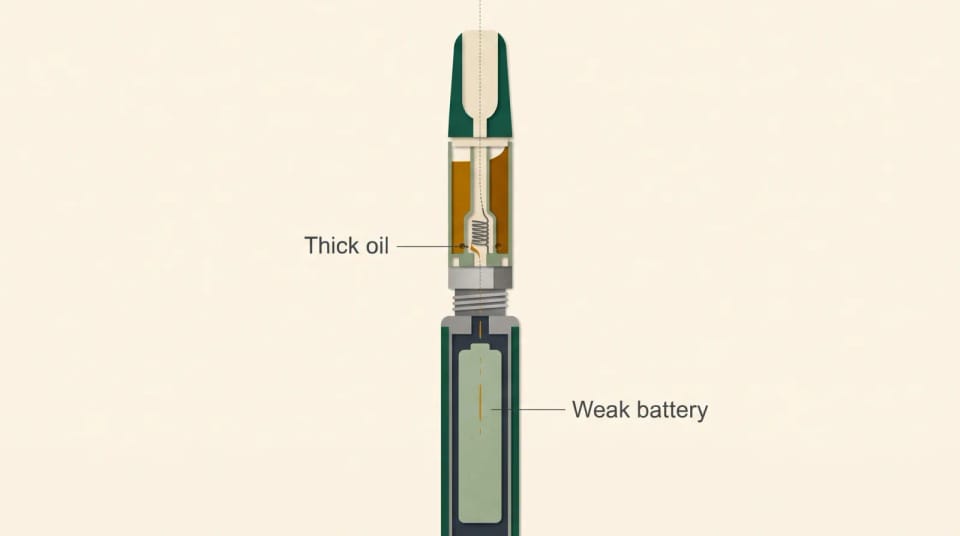
Cold hits a cart twice. Thick oil refills the wick slowly, and a cold battery sends less power to the coil. Warming both, not just the cart, addresses both causes.
How do you warm up a cold cart safely?
Warm a cold cart with time and body heat. These steps match what FDA and cartridge makers say, and they skip every method with an unknown downside.
- Bring it indoors and keep it upright. Stand the cart mouthpiece up so oil settles over the wick.
- Let it reach room temperature. Time is the only warming method with no known downside.
- Use body warmth, not a heat tool. Hold the cart in your hand or keep it in an inside pocket. An inside pocket also insulates the battery, which helped discharge in the cell experiment above (Ouyang et al., 2019).
- Charge only once the battery is warm. FDA advises against charging in extreme temperatures (FDA).
- Use one preheat cycle if your battery has one. A button-press preheat is the warm-up cartridge makers build in (manufacturer explainer). Follow your battery manual, run it once, then take a slow, gentle draw.
- Treat a warm cart that still fails as a clog. At that point, move to the clogged cart troubleshooting steps.
Do not turn the voltage up to “push through” the cold. Coil temperature during a puff already runs in the hundreds of degrees Celsius, and voltage alone was a poor predictor of it in thermal imaging tests (Oar et al., PLOS ONE, 2022). That study was written by employees of a device maker, but the archive lesson on why volts do not tell you the temperature explains the same point. More voltage on a dry wick is a recipe for a harsh, burnt hit, not a fix.
What about a hair dryer?
No published source sets a safe hair-dryer temperature, distance or time for a filled cartridge. The retail rules you see, such as a set number of inches, seconds or degrees, are not tied to any measurement we could find. That is why this guide does not repeat them.
What the evidence does show is narrower. Cannabinoids break down faster under sustained heat. One lab held cannabis resin at 50 to 80 °C for 35 days and found THC degradation and CBN formation rose with temperature (Jaidee et al., Cannabis Cannabinoid Res, 2022). Terpenes are the first compounds lost when cannabis is heated or processed (Eyal et al., Cannabis Cannabinoid Res, 2023).
Those are days and weeks of heat, not a minute of warm air. They do not prove a hair dryer ruins a cart. They do support a simple rule: do not park a cart on a radiator, a dashboard, or anywhere it sits hot for hours. Body warmth gets you a working cart with none of those questions.
What happens if you leave your vape in a cold car?
Leaving a vape in a cold car mostly costs you performance until it warms up, but it is still worth avoiding. FDA’s advice names this exact case: do not leave your vape in your car on a freezing cold night (FDA). The battery is the bigger concern, because cold cycling sped up capacity loss and damaged cell structure in lab tests (Ouyang et al., 2019).
The same advice runs the other way in summer, since a hot car is the sustained heat that speeds cannabinoid breakdown. Our guide to what storage does to a cart over months covers the long-term side. In short, keep carts upright, at room temperature, and out of the car.
When is it not the cold?
It is not the cold when the cart stays thick and silent after an hour indoors on a charged, warm battery. That points to a clog, a hardware fault, or the product itself. Start with the clogged cart guide. If the oil looks wrong, tastes wrong, or the packaging raises questions, read how to spot a counterfeit vape cart. Hardware quality matters too; our lesson on heavy metals in vape hardware explains why.
A cart that will not recover, or a battery that is damaged or got wet, is done. Retire both the right way with our guide to disposing of vape pens, carts and batteries.
When to talk to a clinician: if you notice coughing that does not settle, chest pain, wheezing or shortness of breath after vaping, stop and talk to a clinician. Those are health symptoms, not a hardware problem, and no hit is worth ignoring them.
If you switch carts over the winter, the High IQ app can track how each strain worked for you, so a cold-weather swap does not erase what you learned.
Sources
- RheoSense. Cannabis oil viscosity: dependence on composition and temperature. Application note APP27, 2019. Vendor data, not peer reviewed.
- RheoSense. Differentiating cannabis products with viscosity measurements. Application note APP34, 2020. Vendor data, not peer reviewed.
- Sosa ME, et al. Temperature control minimizes wax-derived alkane carryover in hydrocarbon cannabis extraction. ACS Omega (2026).
- Idarraga-Velez AM, et al. Densities and viscosities of cannabis extracts and distillates. J Chem Eng Data (2023).
- Luo H, et al. Lithium-ion batteries under low-temperature environment: challenges and prospects. Materials (2022).
- Ouyang D, et al. Influence of low temperature conditions on lithium-ion batteries and the application of an insulation material. RSC Advances (2019).
- Oar MA, et al. Thermography of cannabis extract vaporization cartridge heating coils. PLOS ONE (2022). Authors employed by a device maker.
- Jaidee W, et al. Kinetics of CBD, Delta9-THC degradation and cannabinol formation in cannabis resin. Cannabis Cannabinoid Res (2022).
- Eyal AM, et al. Vapor pressure, vaping, and corrections to misconceptions related to medical cannabis active ingredients. Cannabis Cannabinoid Res (2023).
- US Food and Drug Administration. Tips to help avoid vape battery fires or explosions. Last modified 2024.
Key takeaways
- Cold oil thickens steeply; measured viscosity rose 33 to 40 times between 70 °C and 40 °C in two THC oils.
- Nobody we found has measured cart oil at winter temperatures, and no safe hair-dryer number has a source.
- Cold lithium batteries deliver less power, and FDA says not to charge them in extreme temperatures.
- Warm carts with time, your hand or an inside pocket, then use one preheat cycle if your battery has one.
- A warm, charged cart that still will not draw is a clog or a product problem, not the weather.
FAQ
What happens if a vape gets too cold?
The oil thickens and the battery delivers less power, so hits get weak or stop. Once the cart returns to room temperature, the oil thins again. Repeated cold exposure is harder on the battery, which loses capacity faster under cold cycling in lab tests.
Can you hit a cart without preheating?
Yes. Preheat exists to warm cold or thick oil, so a cart at room temperature often hits fine without it. If your battery has a preheat mode, one cycle is enough; follow the manual rather than running it over and over.
Is it okay to leave a vape in the car?
Avoid it in both freezing and hot weather. FDA advises against leaving a vape in a car on a hot summer day or a freezing cold night. Cold costs performance and battery life, and sustained heat speeds up cannabinoid breakdown in the oil.
Do vape pens work in cold weather on the slopes?
They can, if you keep them warm. Carry the cart and battery in an inside pocket so body heat keeps the oil thinner and the battery stronger. A pen left in an outer pocket or a car is the one that fails.
Do disposables behave the same way in the cold?
Yes, the same physics applies: the oil and the built-in battery both get colder. The difference is that you cannot swap the battery, so warmth matters even more. Our comparison of cartridge versus disposable covers the other trade-offs.





