

What Is a Gravity Bong? How It Works and What the Evidence Shows
A gravity bong fills a chamber with smoke you inhale in one breath. The water never filters it, no study has measured a hit, and case reports show lung injury.

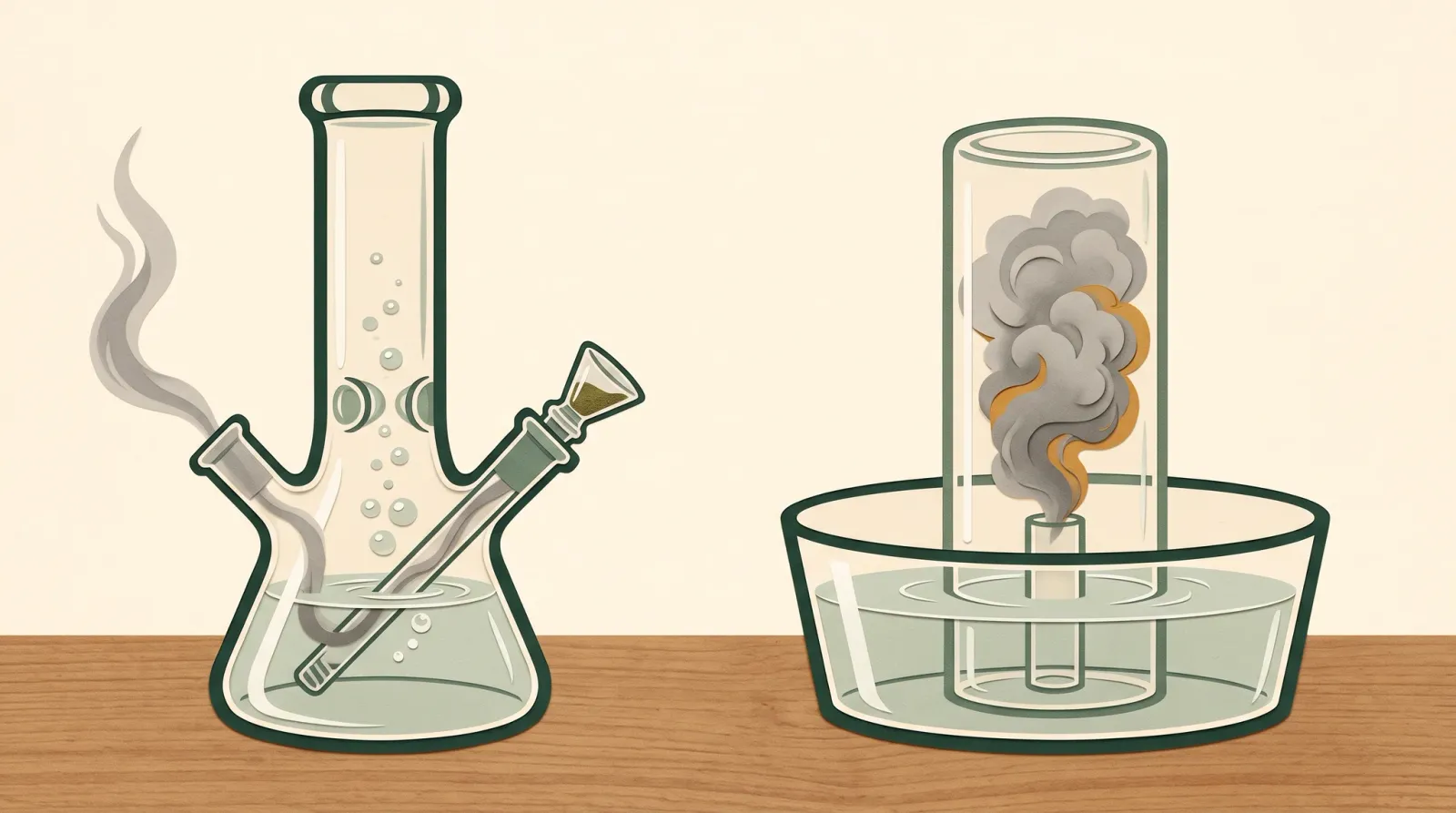
A gravity bong is a chamber that is lifted out of water so smoke from a burning bowl fills it, after which you inhale the whole chamber in one go. The water moves the smoke but never filters it. No study has measured what a gravity-bong hit delivers, and the documented harms are case reports of lung injury and poisoning.
Here is the fact worth sending to the friend who swears by one: a gravity bong is not a bong in the filtering sense. In a regular bong, smoke bubbles through water. In a gravity bong, the smoke collects in the air space above the water and never touches it. The water only controls how fast the chamber fills and how the smoke is pushed out. A forensic case report that describes the device in detail shows exactly this path (Neukamm et al., 2024).
This lesson in High School explains the mechanism with the physics checked, what the smoking studies say about a big breath of smoke, and what the clinical record actually contains. It is not a build guide, and it does not tell you how much to load.
How does a gravity bong work?
A gravity bong works by water displacement. A chamber with an open bottom sits in a larger container of water, and a bowl sits on top. As the chamber is raised, the water level inside it drops, air is drawn in through the bowl, and the chamber fills with smoke.
The forensic report describes a common homemade version, often called a bucket bong (Neukamm et al., 2024):
- A 1.5 litre plastic bottle with its base cut off sits in a bucket of water.
- Material on a perforated foil top is lit.
- The bottle is pulled slowly upward, which “causes an air flow through the burning drug and releases dense smoke into the bottle.”
- The top is removed, and the smoke is inhaled while the bottle is pushed back down into the water.
Variants use the same idea. A “waterfall” version drains water out of a bottle instead of lifting it. Some versions use no water at all. The physics of the bucket type is the clearest, so the rest of this lesson uses it.
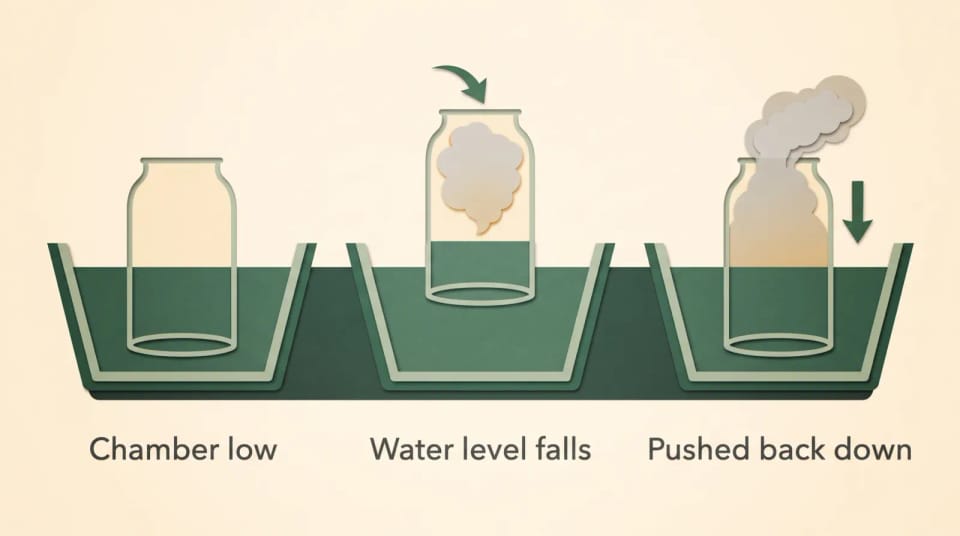
The water sets how fast the chamber fills and empties. The smoke stays above the water the whole time.
Is a gravity bong really a vacuum?
No. “Vacuum” is the word shop pages use, but the pressures involved are tiny. The pressure from a column of liquid follows one formula: pressure equals density times gravity times height (NASA Glenn Research Center).
Our own calculation from that formula: for water, each centimetre of level difference between the inside and outside of the chamber is about 98 pascals. That is roughly one thousandth of normal air pressure. A gap of several centimetres is a few hundred pascals. That pull is enough to draw air through a burning bowl. It is not a pump.
The push is the part nobody has measured. When you press the chamber down while inhaling, the extra pressure on the smoke depends on how hard and how fast you push. No published study gives a value for this device, so we will not invent one.
Does the water in a gravity bong filter the smoke?
No. In a gravity bong, the smoke sits above the water surface and is pushed out from above it (Neukamm et al., 2024). It does not bubble through.
That means the research on water pipes does not transfer. Even in a conventional bong, where smoke does pass through water, the cooling and filtering effects are smaller than most people think. Our lesson on whether bong water filters smoke covers that evidence. Health Canada also says water can lower smoke temperature and filter some substances, but that this does not make pipe smoking safe (Health Canada).
| Conventional bong | Gravity bong | |
|---|---|---|
| Where the smoke goes | Through the water, then into the chamber | Into the air space above the water |
| What the water does | Some cooling, some filtering | Moves the chamber; sets the fill rate |
| How you inhale | Draw through the mouthpiece as the smoke forms | Inhale a chamber that is already full |
| Measured dose per hit | Not standardised | Never measured |
Why does a gravity bong hit so hard?
The likely reason is volume, not pressure. A gravity bong puts a whole chamber of smoke into one inhalation, and that is a different event from an ordinary puff. But no study has measured the THC, carbon monoxide or smoke concentration of a gravity-bong hit. What follows is what the mechanism makes likely, not a measured result.
The best controlled evidence on smoke volume comes from a Johns Hopkins trial. Regular users smoked cannabis cigarettes with puffs of 30, 60 or 90 millilitres. Larger puffs produced dose-related rises in blood THC, carbon monoxide intake and the rated “high” (Azorlosa et al., 1995). The trial was small (seven people per experiment) and used cigarettes, not a water device.
Now the comparison. The chamber in the forensic report was a 1.5 litre bottle. By our arithmetic, that is about 17 times the largest puff in the trial. How much of that chamber is smoke, and how much reaches the lungs, has never been measured. Still, the direction is clear: a bigger volume of smoke in one breath means a bigger exposure in one breath.
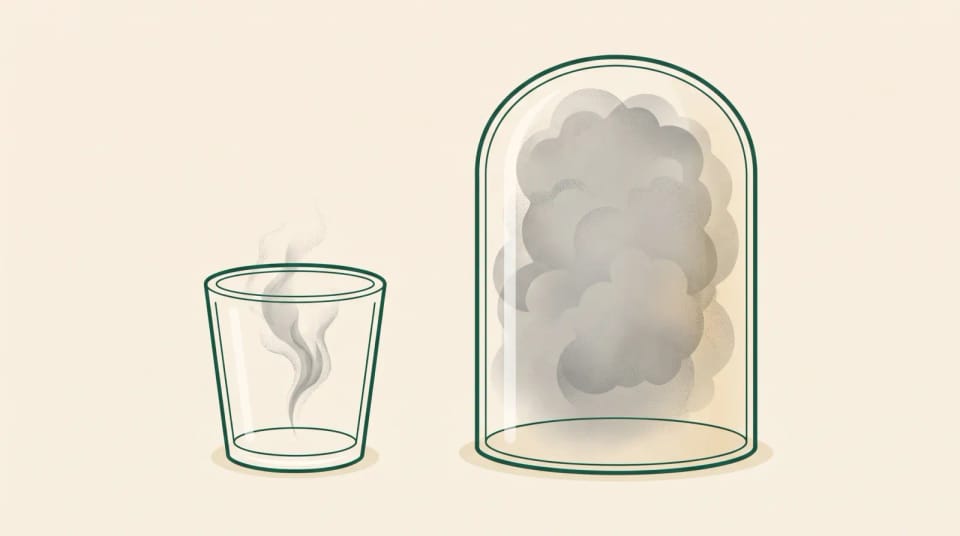
Not drawn to any measured dose. The point is scale: a full chamber is far more smoke than one ordinary puff, and it goes in as a single breath.
Two more points matter here:
- Holding it in adds little. In the same trial, breath-holding raised blood THC but not the rated high or carbon monoxide intake. Our lesson on what breath-holding studies found goes deeper.
- You lose the chance to stop partway. With a joint or a bong, people can take smaller puffs when the product is stronger. Our lesson on puff size and self-titration explains that habit. A full chamber removes most of that control.
Are gravity bongs dangerous?
Case reports describe serious lung injury after gravity-bong use, but they cannot show how often it happens or prove the device caused it. No smoking method is harmless. The CDC says smoked cannabis, “regardless of how it is smoked,” can harm lung tissue and damage small blood vessels (CDC).
What the clinical literature contains:
- Three patients in northern Australia. Clinicians in Darwin reported acute pneumonitis and a massive pneumothorax (collapsed lung) immediately after cannabis use with a bucket bong. Chest scans in one patient also showed emphysema-type damage with air pockets at the top of the lung, which points to existing lung damage (Heraganahally et al., 2023).
- Bleeding in the lungs with plastic-bottle water pipes. A French team reported a 19-year-old who coughed up blood and needed intensive care after heavy use of homemade bottle pipes. His lungs cleared after he stopped using the bottles. The team reviewed four earlier similar cases (Toquet et al., 2021). That device was a plastic-bottle water pipe, not shown to be a gravity bong.
- Pressure injury from a different homemade device. A man developed air leaks in the chest after repeated hard inhaling against the resistance of a narrow homemade bong (Hazouard et al., 2001). That device pulled against resistance, the opposite direction of a gravity bong’s push. It shows homemade devices can cause pressure-type injury, not that gravity bongs do.
- A death that was not about cannabis. The forensic report that describes the device concerns a man who died after smoking fentanyl and synthetic cannabinoids with a bucket bong. Both drugs were also found in the bucket water (Neukamm et al., 2024). Plant cannabis did not kill him. The case is a reminder that the device delivers whatever is in the bowl, all at once.
The French authors propose barotrauma plus inflammation as one explanation. Barotrauma is tissue damage from a pressure difference between a gas space in the body and its surroundings (Ioannidis et al., 2015). It is a hypothesis for these cases, not a proven cause, and no one has shown a gravity bong reaches a harmful pressure.
Is it bad to smoke out of a plastic bottle?
Health agencies advise against it, and the lab evidence is real but limited. Health Canada says to choose glass or ceramic, because “plastic and other materials can have harmful chemicals that can be inhaled when heated” (Health Canada). Poison Control’s toxicologist also calls glass a possibly safer alternative (Poison Control).
Here is what was actually tested. Earlier case reports suspected that heated plastic released chemicals called acid anhydrides. The French team heated PET bottle plastic to 180 °C in a lab and found no acid anhydrides. They did find acetaldehyde, other aldehydes, organic acids and propylene glycol (Toquet et al., 2021). Nobody has measured those compounds in smoke from a real bottle in use.
Two facts about the plastic itself: PET begins to soften at about 85 °C and melts near 255 °C (Panowicz et al., 2021). A burning bowl is much hotter, so plastic near it can soften. Whether a bottle neck reaches those temperatures in normal use has not been measured.
One myth to drop: “polymer fume fever” is linked to fluorinated plastics such as Teflon, not to drink bottles (Greenberg and Vearrier, 2015). For a broader look at materials, see pipe materials compared.
If you use one, how do you lower the risk?
You lower the risk mostly by slowing down and avoiding plastic. This is harm reduction for adults 21 and over where cannabis is legal, not an endorsement.
- Choose glass over plastic, in line with Health Canada’s guidance.
- Wait before the next hit. A chamber hit takes time to show its full effect. Our guide on how long to wait before the next hit explains why.
- Do not hold it in. The breath-hold evidence shows little extra effect and more time with smoke in the lungs.
- Change the water and clean the device. The bucket water in the forensic case held drug residue. Our guide to cleaning a bong covers the basics.
- Know what is in the bowl. The device delivers everything at once, including anything you did not expect.
If you want a record of how a session actually went, the High IQ app lets you log how a strain worked for you, which makes it easier to notice when a method hits harder than you planned.
Smoke of any kind still reaches your lungs. If you want to avoid combustion, our comparison of vaping versus smoking sets out what changes and what does not.
When to talk to a clinician
Get medical care right away for chest pain, sudden shortness of breath, or coughing up blood after any smoking session. These were the symptoms in the case reports above. Talk to a clinician about a cough that does not go away. Our lesson on why weed makes you cough and when to stop explains the ordinary kind and the warning signs.
Key takeaways
- A gravity bong fills a chamber with smoke by lifting it out of water, and you inhale the whole chamber at once.
- The smoke sits above the water. The water does not filter it.
- The “vacuum” is about 98 pascals per centimetre of water level, by our calculation. The likely reason it hits hard is volume.
- No study has measured what a gravity-bong hit delivers.
- Case reports describe lung collapse and bleeding after bucket-bong and plastic-bottle use. They show harm can happen, not how often.
- Health agencies advise glass or ceramic over plastic.
FAQ
Is a gravity bong the same as a bong?
No. A regular bong pulls smoke through water as you inhale. A gravity bong fills a chamber first, with the smoke sitting above the water, and you then inhale the full chamber. They share water, but the smoke takes a different path.
Does a gravity bong get you higher?
It probably delivers more smoke per breath, but that has never been measured. In a controlled trial, bigger puffs raised blood THC and the rated high. A gravity-bong chamber is far larger than those puffs, which is why a single hit can surprise people.
Is a gravity bong a vacuum?
No. By the standard fluid formula, each centimetre of water level difference is about 98 pascals, roughly one thousandth of normal air pressure. That is enough to draw air through a bowl, but it is not a vacuum.
Is it bad to smoke out of a plastic bottle?
Health Canada and Poison Control both point people toward glass instead. A lab test of heated bottle plastic found aldehydes and organic acids, though not the chemical earlier reports suspected. No one has measured what reaches the lungs from a bottle in use.
What is a waterfall bong?
A waterfall bong is a gravity bong variant that drains water out of a bottle instead of lifting a chamber out of a bucket. The falling water draws smoke into the space it leaves behind. The smoke still sits above the water rather than passing through it.
Sources
- Neukamm MA, Halter S, Auwärter V, Schmitt G, Giorgetti A, Bartel M. “Death after smoking of fentanyl, 5F-ADB, 5F-MDMB-P7AICA and other synthetic cannabinoids with a bucket bong.” Forensic Toxicology. 2024;42(1):82-92. DOI: 10.1007/s11419-023-00666-w. PMC
- Azorlosa JL, Greenwald MK, Stitzer ML. “Marijuana smoking: effects of varying puff volume and breathhold duration.” Journal of Pharmacology and Experimental Therapeutics. 1995;272(2):560-569. PubMed
- Heraganahally SS, Monsi E, Gadil E, Maze D, Lynch S. “Case Report: Catastrophic Effects of Using Cannabis Via Bucket Bong in Top End Northern Territory of Australia.” American Journal of Tropical Medicine and Hygiene. 2023;109(5):1199-1204. DOI: 10.4269/ajtmh.23-0393. PubMed
- Toquet S, Cousson J, Choiselle N, et al. “Alveolar hemorrhage due to marijuana smoking using water pipe made with plastic bottle: case report and narrative review of the literature.” Inhalation Toxicology. 2021;33(5):168-176. DOI: 10.1080/08958378.2021.1939465. HAL author manuscript
- Hazouard E, Koninck JC, Attucci S, et al. “Pneumorachis and pneumomediastinum caused by repeated Müller’s maneuvers: complications of marijuana smoking.” Annals of Emergency Medicine. 2001;38(6):694-697. PubMed
- Ioannidis G, Lazaridis G, Baka S, et al. “Barotrauma and pneumothorax.” Journal of Thoracic Disease. 2015;7(Suppl 1):S38-S43. PubMed
- Greenberg MI, Vearrier D. “Metal fume fever and polymer fume fever.” Clinical Toxicology. 2015;53(4):195-203. PubMed
- Panowicz R, Konarzewski M, Durejko T, et al. “Properties of Polyethylene Terephthalate (PET) after Thermo-Oxidative Aging.” Materials. 2021;14(14):3833. PMC
- NASA Glenn Research Center. “Fluids Pressure and Depth.” grc.nasa.gov
- Centers for Disease Control and Prevention. “Cannabis and Lung Health.” February 15, 2024. cdc.gov
- Health Canada. “Cannabis accessories for inhalation: Minimizing your risk when smoking, vaping and dabbing.” September 20, 2024. canada.ca
- Poison Control. “Is it dangerous to smoke a joint or use a bong?” poison.org





