What Is Cannabis Reclaim? The Lab Data on Dab Residue
Cannabis reclaim is the sticky oil left inside a dab rig. One lab test found 23% to 59% THC, falling as samples darkened and aged. Here is what is unknown.

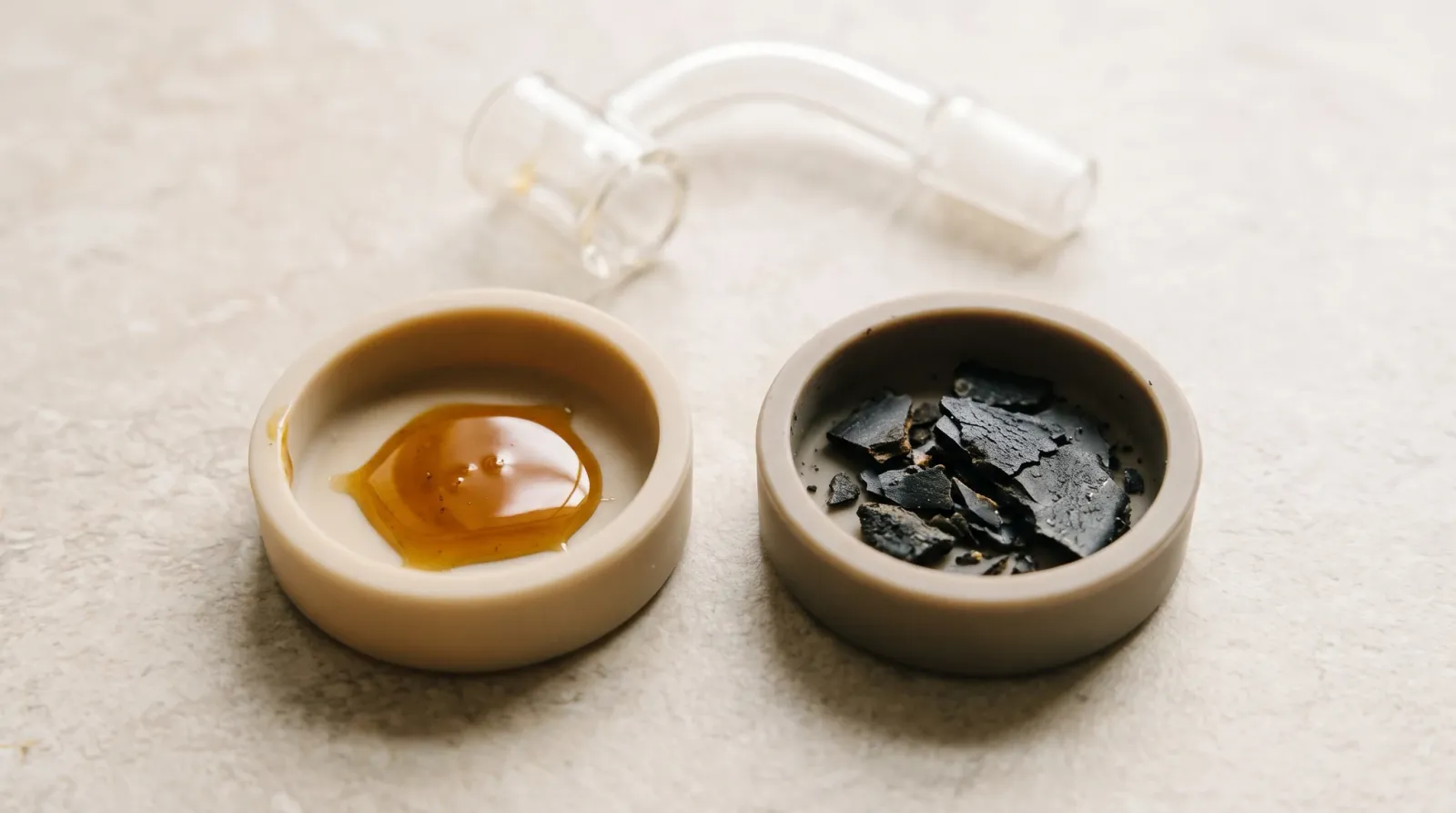
Cannabis reclaim is the sticky, dark oil that builds up inside a dab rig: concentrate that vaporized and condensed again on cooler glass, plus some that never vaporized at all. It still holds a lot of THC. In the only lab test of reclaim I could find, four samples ran from 23.3% to 58.5% THC. The darker and older the sample, the less THC and the more CBN it held. MCR Labs, 2014
That spread is the useful part. Many guides repeat that reclaim is “30 to 60 percent THC” and that it makes you sleepy. The real range in that test is wider, it came from just four samples, and the sleep claim has no human trial behind it. Nobody has measured what else the extra heat added.
This lesson covers what reclaim is, what the numbers say, what they leave out, and how people collect it with fewer risks. Here in High School, I keep “what was measured” and “what was assumed” in separate boxes.
What is reclaim in a dab rig?
Reclaim is residue from concentrate that went into the rig and did not reach your lungs. When you drop a dab on a hot banger, most of it turns to vapor. Some of that vapor touches cooler glass in the neck, the dropdown or the downstem and turns back into oil. Some concentrate also pools and never fully vaporizes. If you want a refresher on how a dab works and why a small dab holds a lot of THC, start there.
The lab that tested it defined reclaim as “the leftover, unvaporized/recondensed oil that collects in your rigs and dropdowns.” MCR Labs
Why so much is left behind: in one vapor-transfer experiment, at most about 40% of the THC available in a concentrate was recovered in the vapor. Raber et al., 2015 That experiment did not say where the rest went. Some stays on the glass, and some breaks down in the heat.
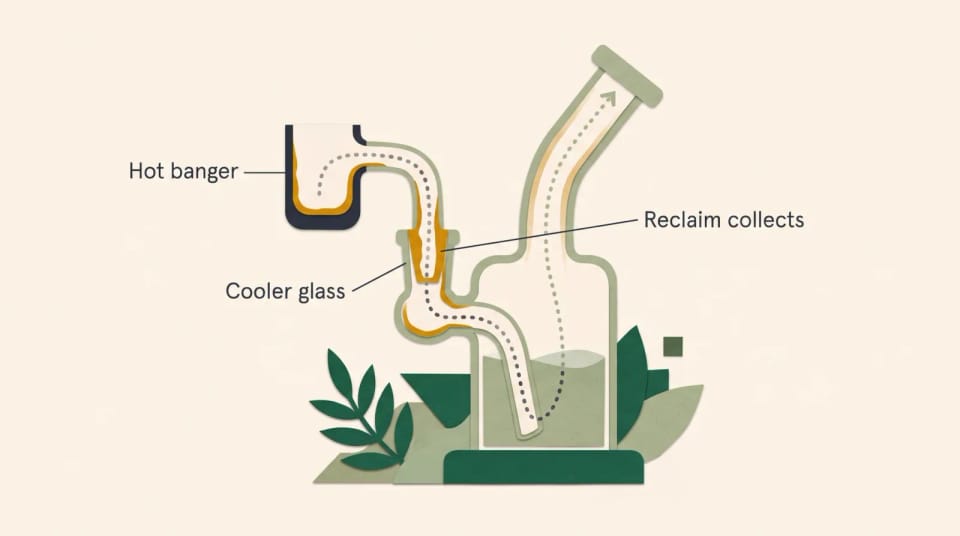
Reclaim forms where vapor cools and condenses. Some is also concentrate that never fully vaporized on the banger.
Reclaim is not the same thing as already vaped bud. AVB is dry flower after a vaporizer session. Reclaim is concentrate after a dab. They raise similar questions about strength, but they are different materials.
How much THC is in reclaim?
In the one test we have, a lot, and it varied by sample. MCR Labs ran four reclaim samples by HPLC-UV, the same method it used for routine cannabinoid profiles. MCR Labs, 2014
| Sample | How it looked and where it came from | Max THC | CBN | Total cannabinoids |
|---|---|---|---|---|
| 1 | Translucent amber, like dark honey, from a dropdown | 58.5% | 3.8% | 65.3% |
| 2 | Black, tar-like, scraped from a direct inject and nail coil, added to over time | 40.2% | 5.7% | 48.1% |
| 3 | Darker dropdown reclaim, sticky, slightly unpleasant smell | 50.3% | 7.5% | 61.7% |
| 4 | Black and brittle, torched out of a clogged rig, then stored over six months | 23.3% | 8.6% | 33.7% |
“Max THC” here means THC plus THCA counted as if fully decarboxylated. Between 97% and 98.9% of the measured cannabinoids were already in their active form. That fits what heat does: it converts THCA to THC, the same change you make on purpose when you decarboxylate cannabis.
Read the table with its limits in mind:
- Four samples, one lab, 2014. It is a lab blog post, not a peer-reviewed study.
- No starting concentrate was tested. So the test cannot say what share of the original THC survived. Any “reclaim keeps half the potency” figure has no source that I found.
- A third to two thirds of each sample was not cannabinoids. The lab did not identify the rest. It did not test terpenes, residual solvents, pesticides, metals or microbes.
- Color, age and collection method moved together. The darkest, oldest sample was also the one pulled out with a torch. The test cannot separate those causes.
So “your reclaim is about 50% THC” is a guess. A lab test of your own sample is the only way to know.
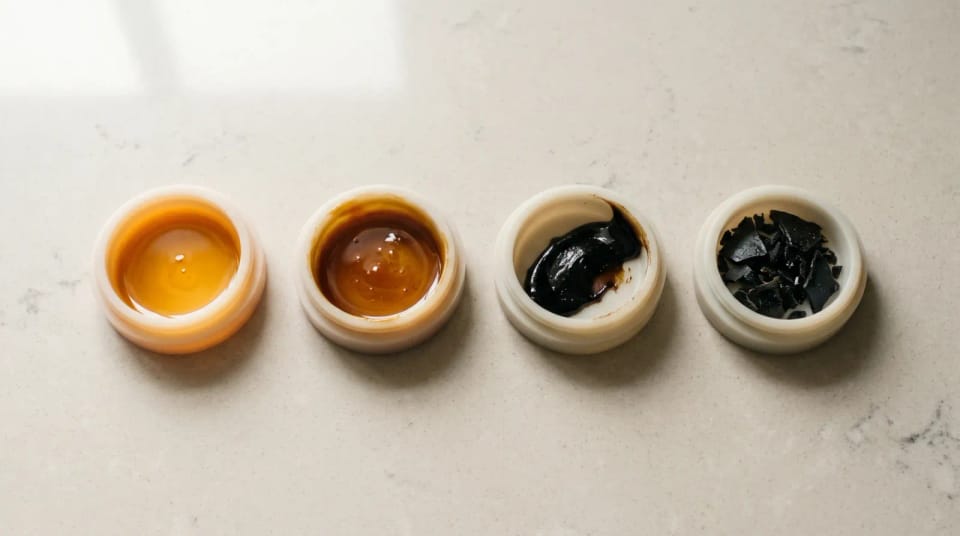
In the 2014 lab test, the lightest dropdown sample held the most THC and the oldest black sample held the least. Four samples cannot set a rule for yours.
Does reclaim make you sleepy because of CBN?
That claim is not supported by human evidence. Reclaim does hold more CBN than typical flower or extracts. All four MCR samples did, and CBN rose as THC fell. MCR Labs, 2014 That matches lab kinetics: when cannabis resin is held warm, THC breaks down and CBN forms faster at higher temperatures. Jaidee et al., 2022
More CBN is a chemistry fact. “CBN makes you sleepy” is an effect claim, and the effect evidence is thin:
- A 2021 review found no sleep trial of CBN using sleep-lab recordings or validated questionnaires and called the evidence insufficient. Corroon, 2021
- A 2026 crossover trial gave 20 adults with insomnia 30 mg or 300 mg of oral CBN, or placebo. Its main outcome, time awake after first falling asleep, did not change at either dose. Some secondary measures moved at 300 mg. Lavender et al., 2026
- An industry-funded 2023 trial of 20 mg CBN reported fewer nighttime awakenings, with no change in how fast people fell asleep. Bonn-Miller et al., 2023
Here is the arithmetic. The highest-CBN sample was 8.6% CBN, so a whole gram held about 86 mg. That is between the two oral doses in the 2026 trial, which did not move its main outcome. And nobody dabs a gram of reclaim at once. If reclaim feels heavier to you, the THC dose and the harsher hit are at least as likely to explain it. For the full trial-by-trial picture, see what the CBN sleep trials show.
Is dab reclaim safe to smoke?
Nobody has tested that, so neither “safe” nor “toxic” is an honest answer. Here is what the studies do and do not cover.
What heat does to cannabis compounds. Bench studies show that heating terpenes on a hot e-nail makes small toxic compounds such as methacrolein and benzene, and that hotter nails make more. Meehan-Atrash et al., 2017 THC on its own breaks down into some of the same compounds when dabbed at about 370 °C. Meehan-Atrash et al., 2019 Cannabinoids also oxidize and split apart in heated vape aerosol. Li et al., 2022 Our lesson on terpene breakdown products in dabbing studies explains those methods in more depth.
What those studies did not test. Every one used fresh, pure compounds on a bench rig. None tested reclaim or re-heated reclaim. Reclaim has already been through at least one heat cycle, and dabbing it adds another. That probably changes its chemistry, but the size and direction of the change are unmeasured.
A fair comparison. The 2019 study also ran a risk estimate on gas-phase compounds. Dabbing scored far lower than smoking cannabis on those measures. Meehan-Atrash et al., 2019 That estimate left out particles and used fresh THC, so it does not clear reclaim either.
What the starting concentrate brought in. In 57 California concentrates tested in 2015, before today’s state testing rules, more than 80% had residual solvent or pesticide contamination. Raber et al., 2015 Reclaim starts from whatever was in your concentrate. No one has measured how much of a solvent or pesticide survives into reclaim, so claims that reclaim “concentrates butane” have no data behind them. A lab report for the original product is the best clue you have; here is how to read residual solvents on a lab report.
When to talk to a clinician. If dabbing reclaim or anything else leaves you with a cough that will not settle, chest tightness, wheezing, shortness of breath or chest pain, stop and talk to a doctor. Get urgent care for severe trouble breathing.
How do you collect reclaim from a dab rig?
People collect it three common ways: heat, alcohol and hot water. These are common practice, not tested methods. Heat is the simplest, and it keeps solvent out of the picture. With an e-nail, steady temperature control also means less overshoot and less scorched residue.
- Swab or scrape the banger while warm. Hot quartz scorches residue; cold residue hardens. Our guide to swabbing a warm banger covers the timing.
- Remove the dropdown or reclaimer. Let the rig cool fully first.
- Warm the glass gently and let it drip. Aim for just enough heat to soften the residue onto parchment or a silicone dish. Heat glass evenly; sudden temperature changes can crack it.
- Keep alcohol and flame apart. Isopropyl alcohol has a flash point of 53 °F, so its vapor can ignite at room temperature. NIOSH If you rinse with alcohol, keep every torch, hot banger and open flame away, and ventilate. No test I found shows how much alcohol remains in rinsed reclaim, so evaporate it fully before you think about using it.
- Skip the water side. Residue that sat in rig water or the chamber is mixed with whatever the water collected. No test describes it.
- Label and store it. Use a closed container marked with the date, then clean the glass. The steps in our glass cleaning guide work for rigs too.
Is reclaim worth saving?
That depends on what you want from it. Three honest points help:
- Strength is unknown. Four samples ran from 23.3% to 58.5% THC. Start smaller than you would with fresh concentrate.
- Flavor and freshness are gone. Reclaim tastes harsh, and the lab never measured terpenes in it. Heat drives off volatile compounds, so expect less of the original strain character. That is an inference, not a measurement.
- Cooking with it breaks dose math. It is already decarboxylated, but its strength is unknown without a test. Our guide on why an unknown-strength ingredient breaks dose math explains why. I will not give a recipe or serving size here.
Many people decide the simpler path is to dab cooler, clean more often and let less reclaim build up. A good rig buyer’s guide can help you choose glass that is easy to clean. If you track sessions in the High IQ app, log reclaim as its own entry, not under the original strain. Its chemistry has changed, so its effects may differ.
Reclaim is cannabis under the law. The same local rules apply to it as to the concentrate it came from.
Key takeaways
- Reclaim is concentrate that re-condensed on cooler glass or never fully vaporized.
- The only lab test found 23.3% to 58.5% THC in four samples. The darker and older samples held less THC and more CBN.
- About a third to two thirds of each sample was unidentified material, and no toxicants were tested.
- The CBN sleep claim is not supported by human trials.
- Heat collection avoids solvents. Never bring a flame near alcohol.
FAQ
Can you smoke reclaim?
People do, but no study has tested what is in reclaim besides cannabinoids or what forms when it is heated again. Bench studies show heated terpenes and THC form small toxic compounds, and hotter nails make more. If you dab it, use a lower temperature and a smaller amount than with fresh concentrate.
Does reclaim get you as high as a fresh dab?
It can be strong, but it varies. In one lab test, reclaim ran from 23.3% to 58.5% THC, and darker, older samples were weaker. Without a lab test you cannot know how your reclaim compares with the concentrate it came from.
Can you eat reclaim, and do you need to decarb it?
Reclaim is already decarboxylated: 97% to 98.9% of the cannabinoids in the tested samples were in their active form. The problem is dose, because the strength of your reclaim is unknown. That makes edible dose math unreliable without a lab test.
Why does reclaim taste so harsh?
Reclaim has been through at least one heat cycle, and the lab test found that up to two thirds of each sample was not cannabinoids. The test did not identify that material or measure terpenes. Volatile flavor compounds are the most likely to leave in heat, so harshness fits, but the exact cause is untested.
Sources
- Wani J. “We Tested Reclaim, and This is What We Found.” MCR Labs blog, December 2, 2014. mcrlabs.com
- Raber JC, Elzinga S, Kaplan C. “Understanding dabs: contamination concerns of cannabis concentrates and cannabinoid transfer during the act of dabbing.” Journal of Toxicological Sciences 40(6):797-803, 2015. PubMed 26558460
- Meehan-Atrash J, Luo W, Strongin RM. “Toxicant Formation in Dabbing: The Terpene Story.” ACS Omega 2(9):6112, 2017. PubMed 28983528
- Meehan-Atrash J, Luo W, McWhirter KJ, Strongin RM. “Aerosol Gas-Phase Components from Cannabis E-Cigarettes and Dabbing: Mechanistic Insight and Quantitative Risk Analysis.” ACS Omega 4(14):16111, 2019. PubMed 31592479
- Li Y, Dai J, Tran LN, et al. “Vaping Aerosols from Vitamin E Acetate and Tetrahydrocannabinol Oil: Chemistry and Composition.” Chemical Research in Toxicology 35(6):1095-1109, 2022. PubMed 35559605
- Jaidee W, Siridechakorn I, Nessopa S, et al. “Kinetics of CBD, Delta9-THC Degradation and Cannabinol Formation in Cannabis Resin at Various Temperature and pH Conditions.” Cannabis and Cannabinoid Research, 2022. PubMed 34096805
- Corroon J. “Cannabinol and Sleep: Separating Fact from Fiction.” Cannabis and Cannabinoid Research 6(5), 2021. PubMed 34468204
- Lavender I, Marshall NS, McCartney D, et al. “Cannabinol for Acute Treatment of Insomnia Disorder in a Randomized Placebo-Controlled Crossover Trial.” Journal of Sleep Research, 2026. PubMed 41698831
- Bonn-Miller MO, Feldner MT, Bynion TM, et al. “A double-blind, randomized, placebo-controlled study of the safety and effects of CBN with and without CBD on sleep quality.” Experimental and Clinical Psychopharmacology, 2023. PubMed 37796540
- NIOSH Pocket Guide to Chemical Hazards: Isopropyl alcohol. Centers for Disease Control and Prevention. cdc.gov





