Does CBD Oil Expire? Rancid Oil and Weaker CBD Are Two Different Problems
Yes, CBD oil ages in two ways: the carrier oil can turn rancid and the CBD can break down. Here is what the label date, the studies and your nose can tell you.

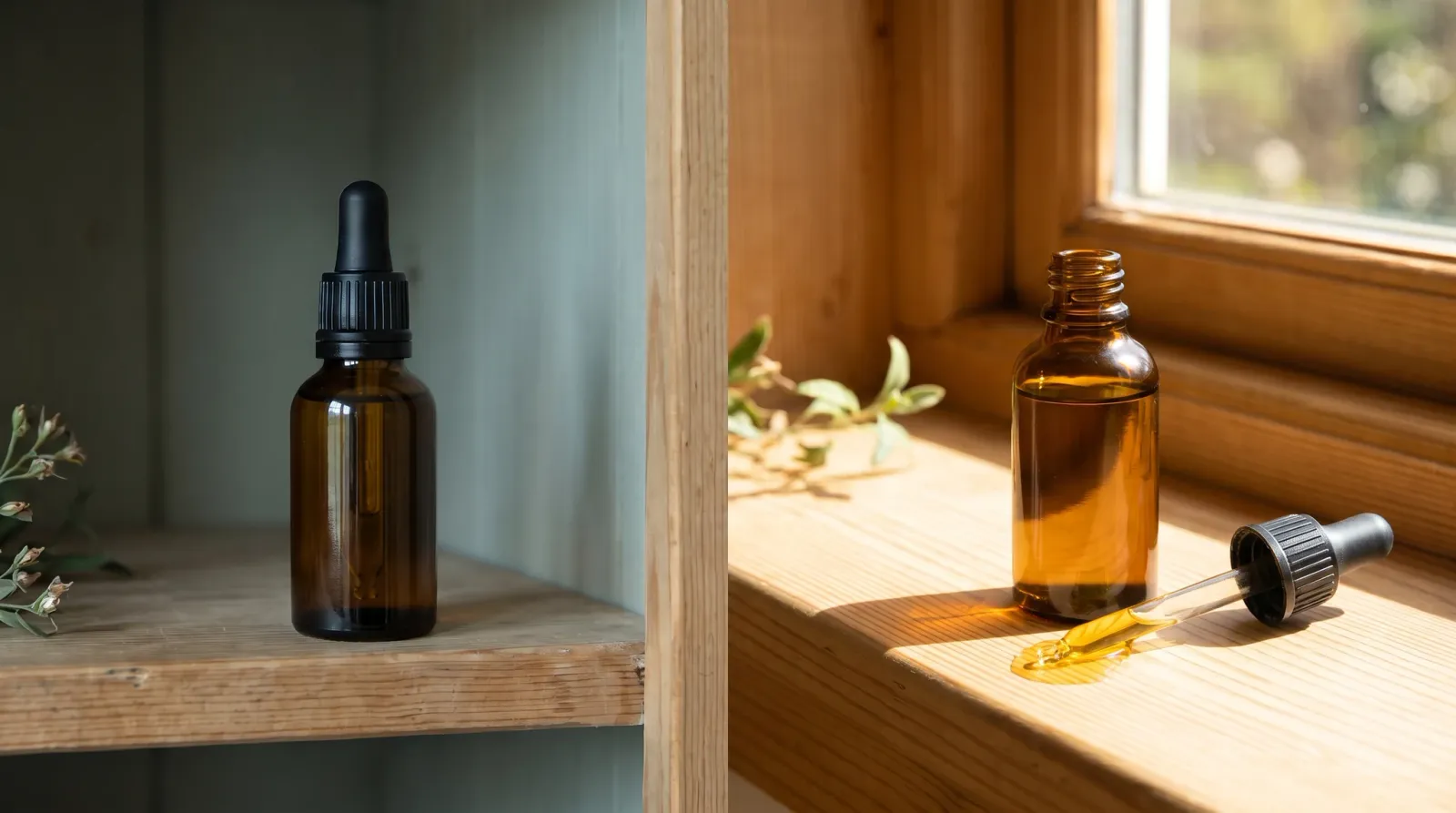
Yes, CBD oil expires, and it ages in two separate ways: the carrier oil can oxidize and turn rancid, and the CBD itself can break down with light, heat and oxygen. No study supports one universal shelf life for retail CBD oil. The evidence you have is the batch’s own date, how the bottle was stored, and your nose, each with limits.
Here is the detail worth sending to a friend. The only FDA-approved CBD oil, a prescription solution in sesame oil, tells patients to use it within 12 weeks of first opening the bottle, then discard the rest (FDA-approved Epidiolex label, section 16.2). That limit belongs to one product with its own formulation, amber bottle and stability testing. It is not a rule for the bottle in your cupboard. But it shows that a regulator-reviewed CBD oil comes with an opened-bottle clock, while the “lasts one to two years” figures you see on retail pages rarely point to any stability data.
Here in High School we already use a two-clock idea for edibles: food spoilage on one clock, potency on the other. CBD oil works the same way. This lesson covers oral CBD oils and tinctures in a fat-based carrier. Vape cart oil has its own dating and safety questions, so we leave inhaled oil there.
What actually goes bad in a bottle of CBD oil?
Two things age, and they age for different reasons.
Clock one: the carrier oil goes rancid. Most CBD oil is mostly carrier oil, such as MCT (a coconut-derived fat), olive, hemp seed or sesame oil. Fats react with oxygen and form rancidity compounds. Heat speeds this up, and traces of metals, water and chlorophyll push it along, while natural antioxidants such as tocopherols (vitamin E) slow it down (Penn State Extension on edible oils). This is the clock your nose can sometimes detect.
Clock two: the CBD breaks down. CBD is sensitive to heat, light, oxygen, some solvents and extreme pH, according to a 2026 review of CBD formulation science (Bazzo and Stulzer, 2026). This clock is usually silent. The oil can smell fine while holding less CBD than it did, and you cannot taste the difference.
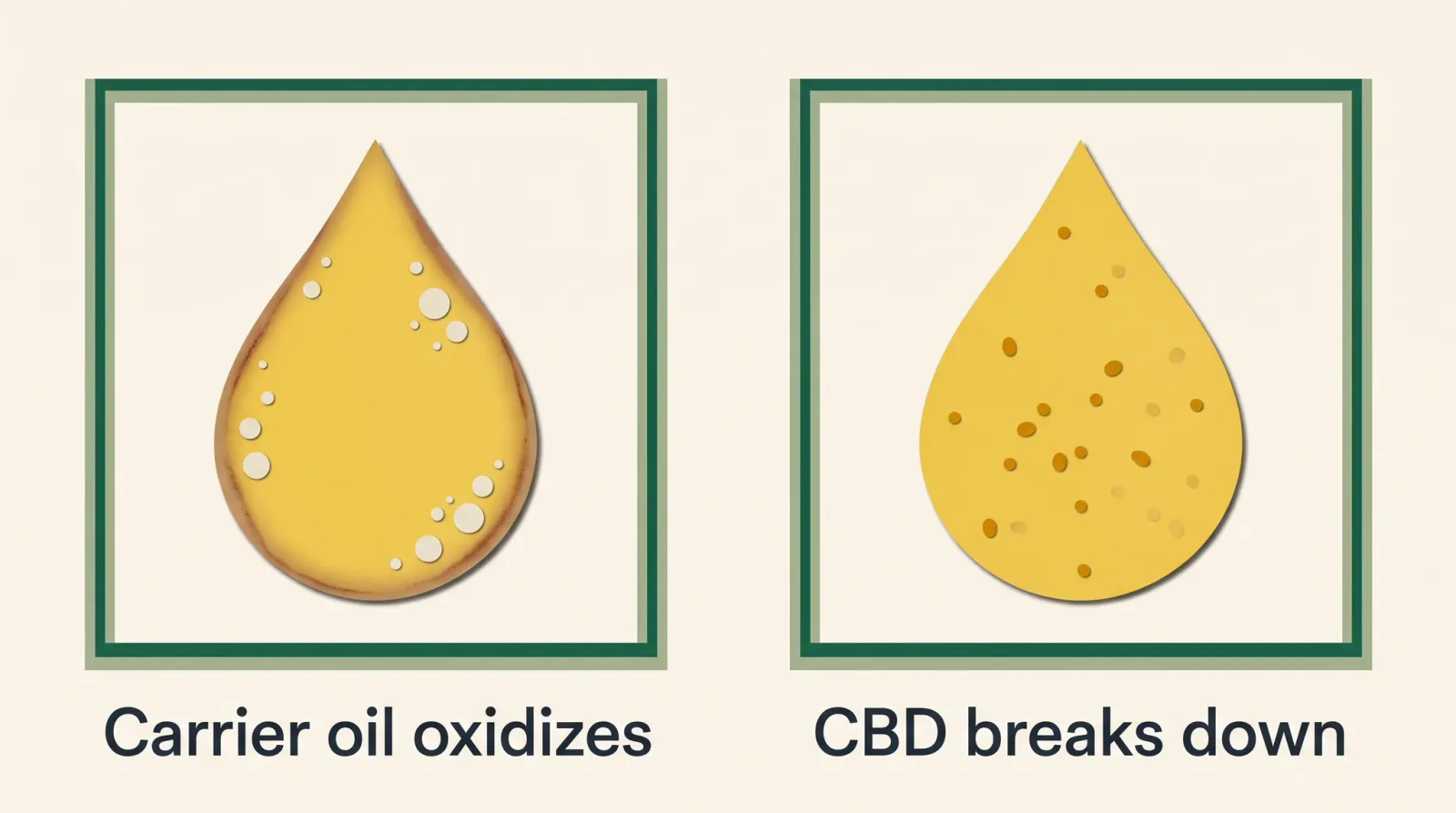
Two clocks run in the same bottle. Rancidity sometimes shows up as a smell; CBD loss usually shows up as nothing at all.
Are the two linked? Partly. The oxidation that turns fat rancid can also attack cannabinoids, and a 2018 analysis of European CBD oils discusses that link (Pavlovic et al., 2018). But no study we found measured both in the same retail bottle over time. So a rancid smell does not prove the CBD is gone, and a clean smell does not prove it is all there.
Does the carrier oil change how fast CBD oil goes bad?
It seems to, in the tests that exist. Oils rich in polyunsaturated fat, such as hemp seed oil, are prone to oxidation, and the CBD oil studies point the same way.
| Carrier oil | What the studies showed | The limit |
|---|---|---|
| MCT | In heat-aging simulations, MCT-based oils formed little or no free radicals, and CBD loss was smaller than in sunflower oil (Tonoyan et al., 2022). In a European market sample, the one MCT oil was almost free of oxidation markers (Pavlovic et al., 2018) | One retail MCT sample; the rest are lab simulations with heat |
| Olive | Showed free-radical formation in the same heat simulations; olive-based retail oils carried oxidation markers | Simulation and single time point, not real shelf aging |
| Sunflower | Largest CBD loss among the carriers in the heat simulation | Simulation only |
| Hemp seed | Hemp seed oil is high in polyunsaturated fat and prone to oxidation, also at room temperature. One of nine cold-pressed oils was already highly oxidized on day zero (Tura et al., 2022) | Tested without added CBD, in an accelerated oven test |
| Sesame | The FDA-approved CBD solution uses sesame oil and carries a 12-week opened limit | One product’s stability program, not a carrier ranking |
So, in these tests, MCT held up best and sunflower worst. That is not the same as proof that any MCT product lasts longer on your shelf. Accelerated heat tests are a shortcut researchers use; they are not the same as a bottle aging for months in a kitchen.
First, check what is actually in the bottle. Some products sold near CBD are plain hemp seed oil with little or no CBD. Our guide to hemp seed oil vs CBD oil labels shows how to tell. If you cook with infused oils, the guide to cannabis cooking oils covers how coconut, olive, avocado and MCT carriers differ.
Does CBD oil lose potency over time?
It can, but how fast depends on the formula, the light and the air. The studies disagree, and the honest answer is to show you the disagreement rather than average it.
- Slow loss in one long-term study. A University of Mississippi storage study reports that “CBD-only products demonstrated robust long-term stability even when maintained at room temperature,” while THC products degraded toward CBN. Freezer storage preserved cannabinoids best (Majumdar et al., 2026). The abstract does not give the storage time or the carrier oil.
- Measurable loss in solution. A Madrid lab study of CBD dissolved in ethanol found about 5% loss by roughly 117 days at room temperature. The same solution stayed stable for at least 12 months at 5 °C, and CBD was very sensitive to oxidizing conditions and light (Fraguas-Sánchez et al., 2020). Ethanol solution is not a retail oil.
- Large loss under strong light. In a 2026 lab test, CBD isolate in MCT oil kept only about a fifth of its CBD under intense light (8,000 lux), while the same CBD in a cyclodextrin powder kept more than 90% (Haidery et al., 2026). The exposure was strong, and the abstract does not give its duration.
One more thing: the CBD-only result may not carry over to a full-spectrum oil with terpenes and other cannabinoids. If you are not sure which kind you have, see our lesson on isolate, broad-spectrum and full-spectrum CBD.
There is also a baseline problem. A 2017 analysis of 84 CBD products sold online found that only about 31% held a CBD amount within 10% of the label; the rest held noticeably more or less (Bonn-Miller et al., 2017). Pavlovic’s 2018 study found that 9 of 14 European oils differed notably from their label. If the starting number was wrong, you cannot judge loss from the label alone.
What does the expiration date on a CBD bottle mean?
It is the maker’s claim, not a federally required test result. For dietary supplements, the FDA says expiration dating is not required, but a firm may include it “if it is supported by valid data demonstrating that it is not false or misleading” (FDA Dietary Supplement Labeling Guide). The FDA also says it is illegal under federal law to market CBD as a dietary supplement or food additive, and that CBD products may be of unknown quality (FDA consumer update on CBD). So there is no federal stability standard behind a retail CBD oil date. Some products carry no date at all; the oils in the Tonoyan study had none.
Compare that with a prescription drug. The Epidiolex label backs its dates with a stability program and also tells patients not to use the medicine after the expiration date on the package. Even a researched European market sample came with this note from its authors: storage stability “is not reported or available for any of the CBD preparations analysed” (Pavlovic et al., 2018).
What to do with a date you cannot verify:
- Treat a passed date as a reason to replace the bottle, not as a puzzle to argue with.
- Know the difference between dates. The test date, package date and expiry are different dates, and a lab report can be old even when the bottle is new.
- Match the lab report to the lot number on your bottle, then use our guide on how to read a lab report (COA) to find the measured CBD amount. If you would rather not squint at fine print, the High IQ app can scan a cannabis label and pull out what it says.
How should you store CBD oil?
Dark, closed, upright and at a steady room temperature is what the evidence supports. The table separates what the sources show from what they do not.
| Storage habit | What the evidence supports | What it does not show |
|---|---|---|
| Keep it out of light | Strong light cut CBD sharply in an MCT oil test (Haidery); light degrades CBD in solution (Fraguas-Sánchez). The approved product ships in amber glass | How much ordinary room light costs a retail bottle |
| Cap it tightly after each use | Oxygen drives both rancidity and CBD loss; the Epidiolex label says keep the cap tightly closed | A measured rate for an opened retail bottle |
| Avoid heat (cars, stovetops, sunny sills) | Heat speeds fat oxidation (Penn State) and drove CBD loss in heat simulations (Tonoyan) | Exact temperatures that matter for your product |
| Store upright | The Epidiolex label says store upright | Why, for retail droppers; it may simply protect the cap and dropper |
| Refrigerate it | Cold kept CBD stable in ethanol solution (Fraguas-Sánchez) | Any test of a retail CBD oil in a home fridge. The Epidiolex label says room temperature and do not freeze |
So the fridge is not proven either way. Follow the storage line on your own product’s label. The same light, heat and air logic applies to flower; our guide to storing cannabis covers that side.
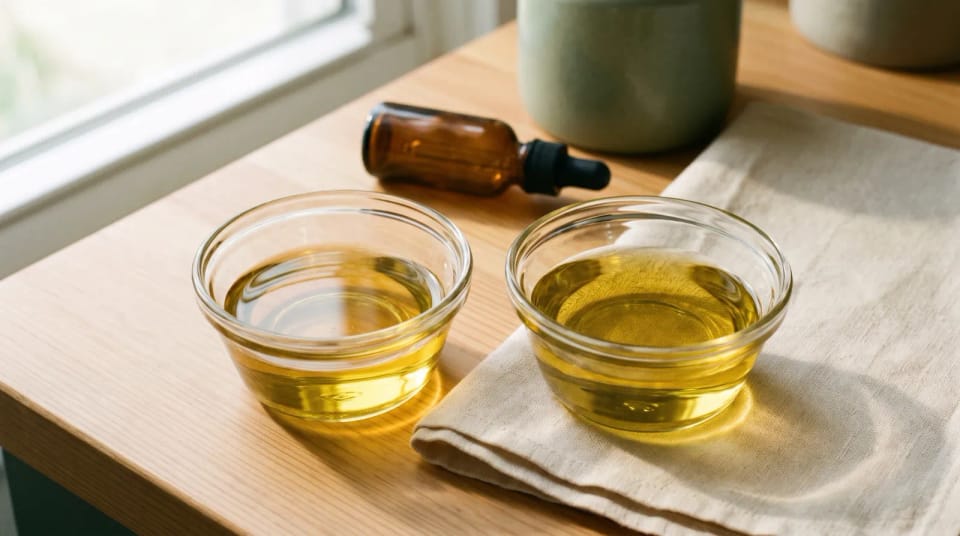
Look alike, may not smell alike. Rancid vegetable oil can smell slightly off without any visible change, so a clear color does not clear the oil.
How can you tell if CBD oil has gone bad?
Your nose catches the first clock better than your eyes, and nothing at home catches the second. Use these steps as a quick check.
- Read every date on the package. Note the expiration or best-by date, the lot number, and the day you opened it, if you wrote it down.
- Match the batch to its lab report. The measured CBD amount on the certificate for that lot is your only baseline.
- Think about how it was stored. Capped, upright and dark is a gentler life than open, in sun or in a hot car.
- Smell and taste a small amount. An off or stale smell, or a taste that has changed from what you remember, points to a rancid carrier oil.
- When in doubt, replace it. A passed date, an off smell or a missing batch record are each good reasons.
Know the limits of step four. University of Maine Extension notes that rancid vegetable oil “may have a slightly off smell, but may not look any different” (UMaine Bulletin #4385). Darker color alone is not a reliable test either way. And in the hemp seed oil study, simple oxidation tests missed some damage that volatile aldehyde testing caught, and one oil was oxidized before the test even started (Tura et al., 2022). A fresh-looking bottle is not a guaranteed fresh one.
Can expired CBD oil hurt you?
We did not find safety studies on using old or rancid CBD oil, so we cannot tell you it is harmless or that it is harmful. What we can say is that degraded oil is not the product you paid for, and a passed date or rancid smell is reason enough to replace it.
When to talk to a clinician: if you feel unwell after using any CBD product, stop using it and talk to a pharmacist or clinician, especially if you take other medicines. You can also report a side effect from a CBD product so regulators can track it.
Key takeaways
- CBD oil ages on two clocks: the carrier oil can turn rancid, and the CBD can break down.
- No study supports one universal shelf life for retail CBD oil. The only printed opened-bottle limit we found, 12 weeks, belongs to one prescription product.
- In the tests that exist, MCT carriers resisted oxidation best and sunflower worst.
- A retail date is the maker’s claim; the batch’s lab report is your best baseline.
- Store it capped, upright, dark and away from heat. The fridge is unproven for retail oils.
- An off smell suggests rancid oil, but no smell does not prove full-strength CBD.
FAQ
How long does CBD oil last once opened?
No study gives a reliable opened-bottle lifespan for retail CBD oil. The one regulator-reviewed example, a prescription CBD solution in sesame oil, says to discard it 12 weeks after first opening, but that limit belongs to that product. Follow your own label, write the opening date on the bottle, and keep it capped and dark.
Should you refrigerate CBD oil?
The evidence does not settle it for retail oils. Cold kept CBD stable in an ethanol solution in one lab study, but no study we found tested a retail CBD oil in a home fridge, and the FDA-approved CBD solution says to store it at room temperature and not freeze it. Follow the storage line on your product’s label.
Does CBD oil lose potency over time?
It can. Results range from little change in CBD-only products at room temperature to large losses under strong light in an MCT oil test. Light, heat, oxygen and the formula decide the rate, and only a lab test of your batch can show how much CBD it holds now.
Can you use CBD oil past the expiration date?
There is no safety data on using expired CBD oil, so we cannot recommend it. The date is the maker’s claim about quality, and past it you have no assurance about strength or freshness. Replacing the bottle is the simple choice; if an old product made you feel unwell, talk to a pharmacist or clinician.
Does a rancid smell mean the CBD is gone?
Not necessarily. A rancid smell tells you the carrier oil has oxidized; it does not measure the CBD. The reverse also holds: a bottle that smells fine can still hold less CBD than its label says.
Sources
- Pavlovic R, et al. Quality Traits of “Cannabidiol Oils”. Molecules, 2018.
- Tonoyan L, et al. Heating of consumer cannabis oils can lead to free radical initiated degradation. Free Radical Biology and Medicine, 2022.
- Tura M, et al. Evaluation of Hemp Seed Oils Stability under Accelerated Storage Test. Antioxidants, 2022.
- Majumdar CG, et al. Stability of Cannabinoids in Cannabis Under Different Storage Conditions. Cannabis and Cannabinoid Research, 2026.
- Fraguas-Sánchez AI, et al. Stability characteristics of cannabidiol. Journal of Chromatography B, 2020.
- Haidery QUA, et al. Matrix-dependent degradation kinetics of cannabidiol in polymeric and lipid preservation systems. Journal of Pharmaceutical and Biomedical Analysis, 2026.
- Bazzo GC, Stulzer HK. A review of emerging drug delivery strategies to protect cannabidiol from chemical degradation. Drug Development and Industrial Pharmacy, 2026.
- Bonn-Miller MO, et al. Labeling Accuracy of Cannabidiol Extracts Sold Online. JAMA, 2017.
- FDA. EPIDIOLEX (cannabidiol) oral solution prescribing information. Revised 2025.
- FDA. Dietary Supplement Labeling Guide, Chapter I.
- FDA. What You Need to Know About Products Containing Cannabis or Cannabis-derived Compounds, Including CBD.
- Penn State Extension. Processing Edible Oils.
- University of Maine Cooperative Extension. Bulletin #4385, Safe Homemade Flavored and Infused Oils.





