High-CBD Strains: What Counts and Why Lab Data Shows So Few
No law defines high-CBD. Researchers call flower CBD-dominant at 5 times more CBD than THC, and only 1.4% of 89,923 lab samples qualified.

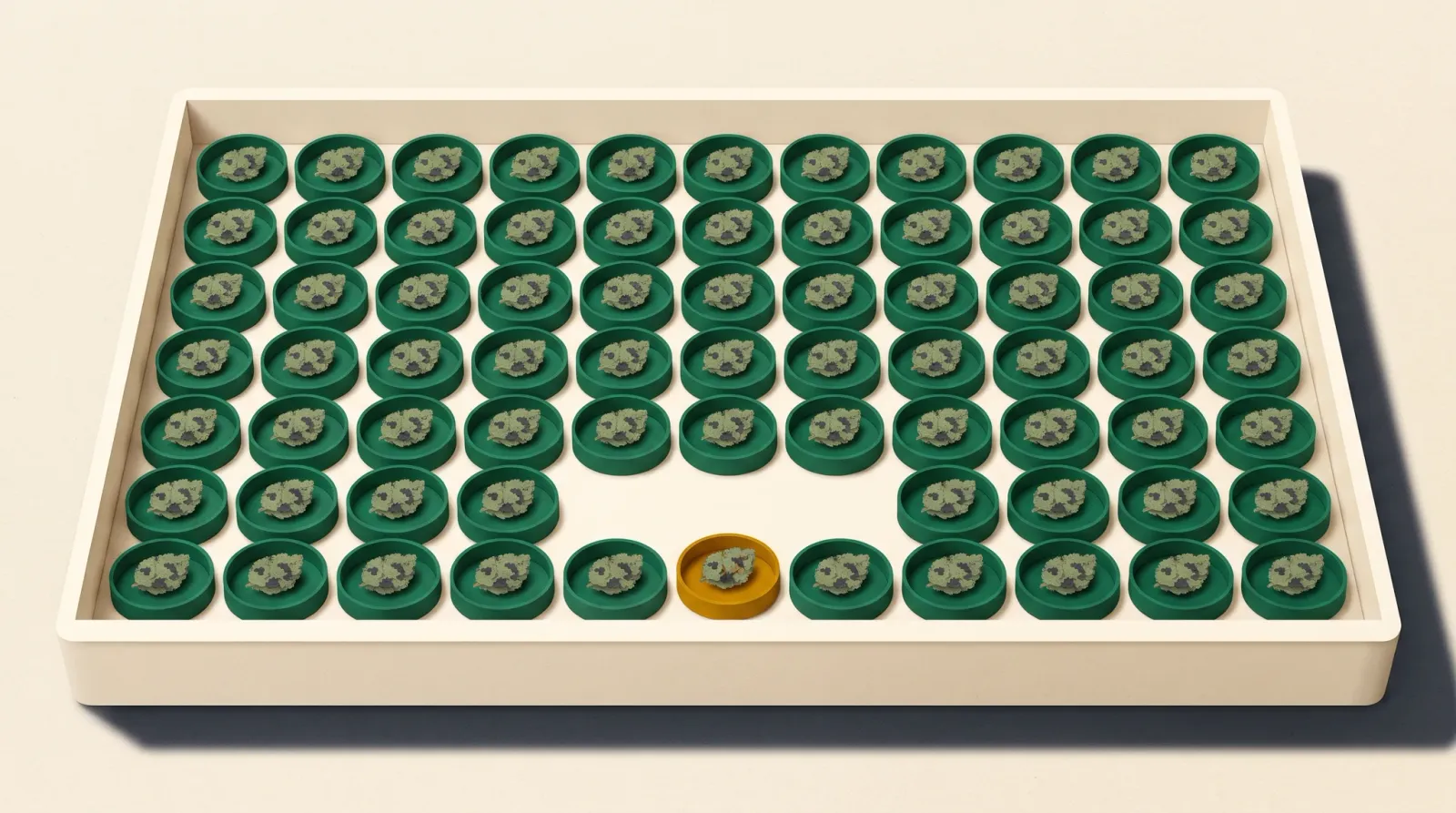
No law or lab standard defines a “high-CBD strain,” but researchers call flower CBD-dominant when it has at least 5 times more CBD than THC, and only 1.4% of 89,923 lab-tested flower samples from six U.S. states met that bar. That figure comes from a 2022 peer-reviewed analysis of compliance test results in Alaska, Oregon, Washington, Florida, Michigan and California. Smith et al., PLoS ONE, 2022
Put plainly, that is about 1 sample in 70. The other 96.5% were THC-dominant, and 2.2% were balanced. So if you have walked a dispensary looking for CBD-forward flower and come home with very little choice, the lab data agrees with you.
Here in High School, we will answer three things: what number makes flower “high-CBD,” why so little of it reaches the lab, and how to check a batch yourself without trusting the strain name. One warning before we start: the same “20:1” on a label or web page can point in either direction. We will fix that too.
What counts as a high-CBD strain?
There is no legal cutoff. The working definition comes from researchers, and the most common one is a CBD to THC ratio of 5:1 or higher. I did not find a state rule that defines “high-CBD” or “CBD-dominant” for flower, so treat the term on a menu as marketing until a number backs it up.
Two independent datasets use the same three chemotypes, sorted by ratio rather than by strain name. Smith et al., 2022 and Jikomes and Zoorob, Scientific Reports, 2018 both group flower like this:
| Chemotype | THC to CBD ratio | Plain meaning |
|---|---|---|
| Type I, THC-dominant | 5:1 or higher | At least 5 times more THC than CBD |
| Type II, balanced | Between 5:1 and 1:5 | Neither compound outweighs the other 5 times over |
| Type III, CBD-dominant | 1:5 or lower | At least 5 times more CBD than THC |
That three-way split is old botany, not a dispensary invention. A 2004 survey of 157 cannabis accessions found that a plant’s THC to CBD ratio falls into one of three chemotypes. Hillig and Mahlberg, American Journal of Botany, 2004
Other research teams draw the line in other places, which is why you will see different numbers online:
| Study | Their cutoff for “CBD-forward” | What they measured |
|---|---|---|
| Pennypacker et al., 2022 | THC to CBD of 1:6 or lower | 2018 online menus in nine states |
| Tassone et al., 2023 | 5% CBD per gram or more, their own label | Ontario’s government online store, 2022 |
| Bidwell et al., 2024 | Under 1% THC with about 24% CBD on the label | Legal-market flower chosen for a study |
So the honest answer is “it depends who is counting.” The 5:1 rule is the most useful one for shoppers because two large lab datasets share it. If you want the bigger picture on what each molecule does, start with how THC and CBD differ, and what mixing them changes.
Which way does a CBD ratio read?
A ratio reads in the order the compounds are named, and many pages never name them. “20:1” means 20 parts CBD to 1 part THC only if CBD comes first. Some product pages write it the other way, so the same numbers can describe two opposite flowers.
The fix is simple. Always write the ratio with both names: “CBD:THC 20:1” or “THC:CBD 1:20.” Both describe the same flower. If a menu or budtender says “20 to 1” with no names, ask which compound is first before you buy.
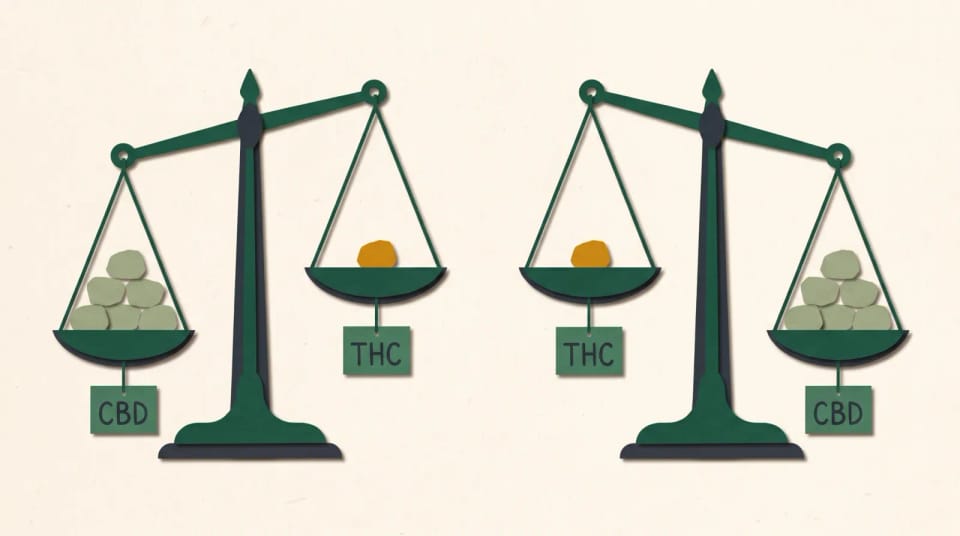
The same flower can be written CBD:THC 5:1 or THC:CBD 1:5. Check which side is heavy before you trust a bare ratio.
How rare is CBD-dominant flower?
Rare in every dataset I found, though each one counts something slightly different. None of them is a count of what sits on today’s shelves, so read each number with its label attached.
- Lab samples, six states. In Smith et al., 96.5% of 89,923 flower samples were THC-dominant, 2.2% balanced and 1.4% CBD-dominant, and the pattern held in each region. These were samples that growers submitted for state compliance testing, not a sales tally and not a national figure. Smith et al., 2022
- Washington lab results. An analysis of 304,123 test results from 2014 to 2017 found most commercial flower in the THC-dominant chemotype, and noted that landraces were more likely to be CBD-dominant. Jikomes and Zoorob, 2018
- Dispensary menus, nine states. In 8,534 flower products listed online in 2018, 58.5% gave no CBD figure at all. The most CBD-forward group, with CBD at least 6 times THC, held only 0 to 5% of products depending on the state. Pennypacker et al., 2022
- Ontario’s government store. Of dried flower on offer in early 2022, 94% listed 20% THC or more, and only 6% listed 5% CBD or more. Tassone et al., 2023
The Ontario figure matters because it comes from a different country and a government catalogue. The imbalance is not only a U.S. quirk. Still, menus are listings, not purchases, and the menu data is from 2018. Markets move.
Why are high-CBD strains so rare?
The likely answer has two parts: plant genetics makes CBD-dominant drug-type flower take deliberate breeding work, and historically breeders selected for THC instead. The data here cannot say which part matters more.
What the genetics shows
One gene region largely decides whether a plant makes mostly THC, mostly CBD or a mix. In a classic set of crosses between pure-CBD and pure-THC plants, every first-generation plant had a mixed chemotype. When those plants were self-pollinated, their offspring split roughly 1 pure CBD to 2 mixed to 1 pure THC. The authors proposed one locus with two codominant alleles, one for each product. de Meijer et al., Genetics, 2003
That is a simplification. Later mapping work found the ratio behaves like a single locus, but the gene sequences suggest several linked genes sit in that region. Weiblen et al., New Phytologist, 2015 The same team reported something sharper: drug-type cannabis carries a nonfunctional CBDA synthase, the enzyme that makes the CBD precursor. Its sequence suggests it was selected that way, which the authors link to stronger psychoactivity.
So where does modern CBD-rich flower come from? A 2021 genome study of a CBD-type cultivar found it was mostly marijuana in ancestry, but carried a working CBDA synthase brought in from hemp and lacked a complete THCA synthase. Grassa et al., New Phytologist, 2021 In other words, breeders had to pull a hemp gene region into THC-type lines and then select for it.
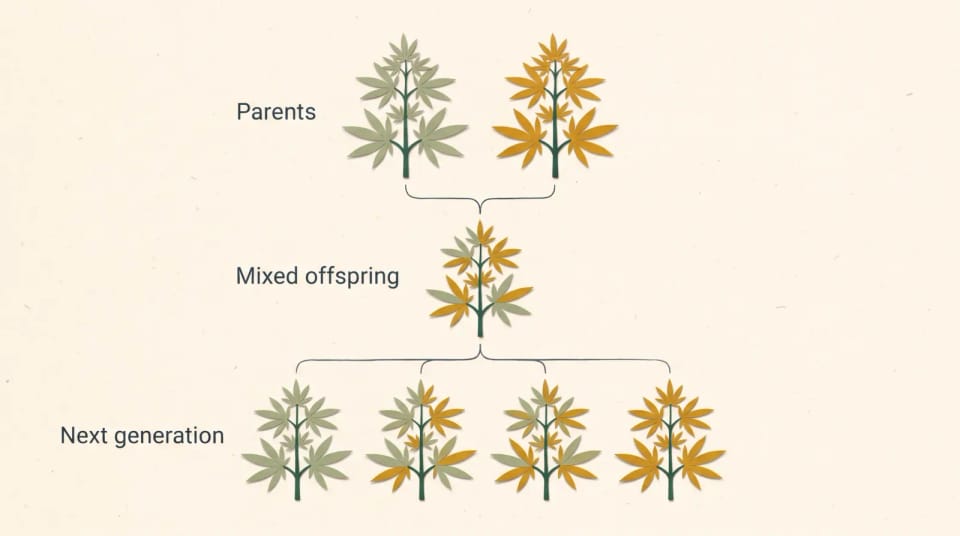
In the 2003 crosses, every first-generation plant was mixed. Pure-CBD plants returned in about a quarter of the next generation. Later work suggests several linked genes, not exactly one.
This is where how breeders select a phenotype becomes concrete. A grower who crosses a CBD plant into a favourite THC line gets mixed plants first, and has to grow out and test the next generation to find the CBD-dominant ones. Family trees built this way are what how strain family trees work traces.
What the market history adds
The authors of the six-state study write that the lack of diversity among high-CBD cultivars is “likely due to the historical focus on breeding high potency THC-dominant Cannabis in the US.” Smith et al., 2022 Note the word “likely.” It is their explanation, not something the study tested. Our piece on how the industry bred for THC percentage covers that pressure in more depth.
One finding cuts against the easy story that “nobody wants CBD flower.” In Washington’s early legal market, across more than 31 million flower purchases, price per gram rose with CBD content as well as with THC content. Smart et al., Addiction, 2017 That is an association in one state’s early years, not proof of strong demand. But it means scarcity is not simply a case of shoppers refusing to pay. I found no source that measures demand for CBD flower against THC flower directly.
Does the strain name tell you the CBD level?
No. The name is a weak guide to chemistry, so the batch test is the only number that counts. The six-state study found that commercial labels, including strain names and indica or sativa tags, did not consistently line up with what the lab measured. Smith et al., 2022 In Washington, the indica, sativa or hybrid label explained only about 1% of the variation in THC. Jikomes and Zoorob, 2018 That is why we say indica and sativa labels do not predict chemistry.
Some names come up again and again as CBD-forward families, such as ACDC, Harlequin, Cannatonic and Ringo’s Gift. Treat them as a starting point for your search, not a promise. Pages online quote different numbers for the same name, and batch results vary. For more on what a name can and cannot tell you, see what strain names actually mean.
How do you find CBD-forward flower at a dispensary?
Read the certificate of analysis, or COA, for the exact batch, and work out the ratio yourself. It takes about a minute once you know where to look.
- Get the COA for the exact batch. Ask for the report that matches the batch or lot number on the package. A report for the strain name in general tells you nothing about this jar. Our guide on how to read a certificate of analysis walks through each section.
- Find total CBD. Raw flower holds most of its CBD as the acid form, CBDA. Regulators in states such as New York and Oregon define Total CBD as CBD plus CBDA multiplied by 0.877. New York OCM testing limits and Oregon OAR 845-026-6000 If the report shows a Total CBD line, use it. If not, do the sum. The difference between the two forms is covered in CBDA versus CBD, raw versus activated.
- Find total THC. Use the Total THC line, or THC plus THCA multiplied by 0.877, on the same report.
- Divide CBD by THC. A result of 5 or more meets the CBD-dominant cutoff from the lab studies above.
- Write the ratio with CBD first. Note it as “CBD:THC” so you never misread it later.
Here is a made-up example, not a real product. A COA lists CBD 0.3%, CBDA 14.0%, THC 0.1% and THCA 1.0%. Total CBD is 0.3 + (14.0 × 0.877) = 12.6%. Total THC is 0.1 + (1.0 × 0.877) = 1.0%. That gives CBD:THC of about 13:1, so this batch clears the 5:1 bar easily.
Now notice the trap. If a jar label printed only “CBD 0.3%,” you would think the flower had almost none. The CBD is sitting there as CBDA. This is the single most common reason a CBD-rich batch looks CBD-poor on a quick glance.
If you track several batches, the High IQ app can scan a label and keep a note of how each strain worked for you, which makes it easier to spot when two jars with the same name tested very differently. For testing ratios against each other over time, see a step-by-step way to test THC to CBD ratios.
Is hemp flower the same thing?
No. Hemp flower and CBD-dominant dispensary flower are different legal products, even if both are CBD-rich. The six-state study excluded hemp, so the 1.4% figure says nothing about hemp shops. Hemp products follow their own rules; see hemp versus cannabis rules in 2026 before you compare the two.
When should you talk to a clinician?
If you are looking at CBD-dominant flower to manage a symptom, such as anxiety, pain or poor sleep, talk to a clinician first. None of the sources in this article tests high-CBD flower as a treatment, and this article is not medical advice. CBD-dominant flower still contains some THC, so do not assume it is free of THC or that it cannot impair you. A clinician can also check for interactions with any medicines you take.
If you do find the flower and want to use it in the kitchen, our guide to cooking with CBD-dominant flower covers that.
Key takeaways
- “High-CBD” has no legal definition. Researchers commonly call flower CBD-dominant at CBD:THC 5:1 or higher.
- In 89,923 lab-tested flower samples from six states, only 1.4% met that bar.
- Genetics makes CBD-dominant drug-type flower take deliberate breeding, and breeding has historically favoured THC.
- Strain names do not reliably predict chemistry. The batch COA does.
- Total CBD is CBD plus CBDA × 0.877. Always write the ratio with CBD named first.
FAQ
What is considered a high CBD strain?
No law defines it. In large lab datasets, researchers call flower CBD-dominant when it has at least 5 times more CBD than THC, written CBD:THC 5:1 or higher. Other studies use other cutoffs, so ask for the actual numbers.
Do high CBD strains get you high?
CBD-dominant flower still contains some THC, and none of the sources here tested whether it impairs. Do not assume it is non-intoxicating, especially before driving or work. Our guide to how THC and CBD differ covers what is known about mixing them.
Is hemp flower the same as a high CBD strain?
No. Hemp flower is sold under hemp rules, while CBD-dominant dispensary flower is regulated cannabis. The lab data in this article covers dispensary flower only.
Why does my dispensary label show so little CBD?
Raw flower stores most CBD as CBDA, and a label may print only the neutral CBD figure. Check the COA for a Total CBD line, or add CBD to CBDA multiplied by 0.877. The real total can be many times higher than the label suggests.
Sources
- Smith CJ, Vergara D, Keegan B, Jikomes N. The phytochemical diversity of commercial Cannabis in the United States. PLoS ONE, 2022.
- Jikomes N, Zoorob M. The cannabinoid content of legal cannabis in Washington State varies systematically across testing facilities and popular consumer products. Scientific Reports, 2018.
- Pennypacker SD, Cunnane K, Cash MC, Romero-Sandoval EA. Potency and therapeutic THC and CBD ratios: U.S. cannabis markets overshoot. Frontiers in Pharmacology, 2022.
- Tassone F, Di Ciano P, Liu Y, Rueda S. On offer to Ontario consumers three years after legalization: a profile of cannabis products, cannabinoid content, plant type, and prices. Frontiers in Psychiatry, 2023.
- Smart R, Caulkins JP, Kilmer B, Davenport S, Midgette G. Variation in cannabis potency and prices in a newly legal market: evidence from 30 million cannabis sales in Washington state. Addiction, 2017.
- de Meijer EPM, et al. The inheritance of chemical phenotype in Cannabis sativa L.. Genetics, 2003.
- Weiblen GD, et al. Gene duplication and divergence affecting drug content in Cannabis sativa. New Phytologist, 2015.
- Grassa CJ, et al. A new Cannabis genome assembly associates elevated cannabidiol (CBD) with hemp introgressed into marijuana. New Phytologist, 2021.
- Hillig KW, Mahlberg PG. A chemotaxonomic analysis of cannabinoid variation in Cannabis (Cannabaceae). American Journal of Botany, 2004.
- Bidwell LC, et al. Acute and extended anxiolytic effects of cannabidiol in cannabis flower: a quasi-experimental ad libitum use study. Cannabis and Cannabinoid Research, 2024.
- New York Office of Cannabis Management. Cannabis testing limits. Revision of February 9, 2026.
- Oregon Liquor and Cannabis Commission. OAR 845-026-6000 definitions. Oregon Administrative Rules, 2026.





