Cooking With CBD-Only Strains: Recipes and Rationale
Learn why high-CBD strains like ACDC and Charlotte's Web make non-intoxicating wellness edibles, plus decarb temps, infusion, dosing, and recipes.

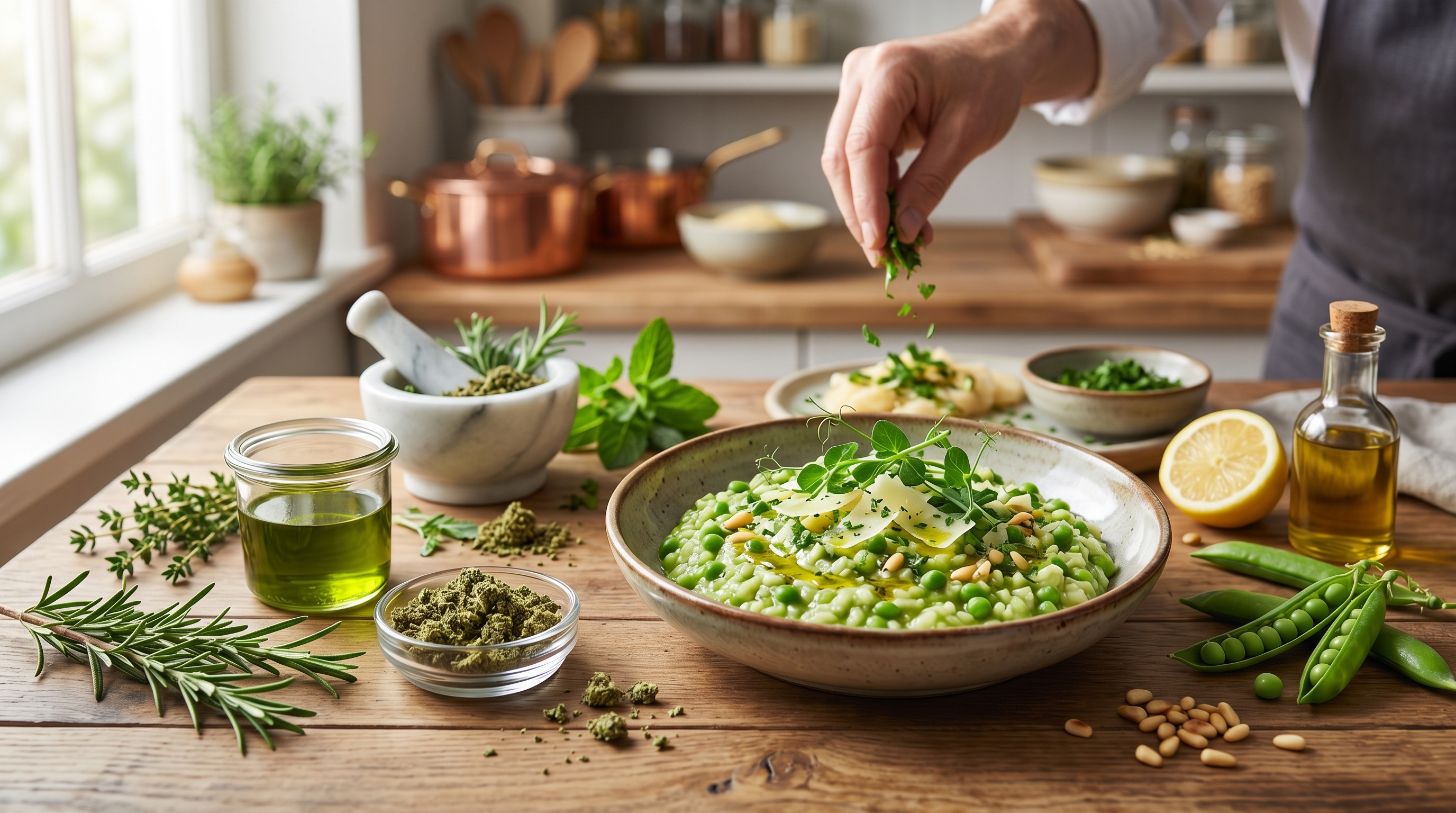
Most edible recipes are written for one outcome: getting high. But there is a whole branch of cannabis cooking that has nothing to do with intoxication. When you cook with CBD-dominant flower like ACDC, Charlotte’s Web, or Harlequin, you are making functional food, not party food. You can stir a tablespoon into your morning oatmeal, eat a square at your desk, and keep driving, working, and parenting like a normal human.
That is the appeal, and it is why high-CBD cooking deserves its own playbook. The chemistry is familiar if you have ever made cannabutter, but the goals are different: predictable dosing, daytime function, and a wellness profile that research is still mapping out. Let me walk you through the rationale first, then hand you a few simple recipes.
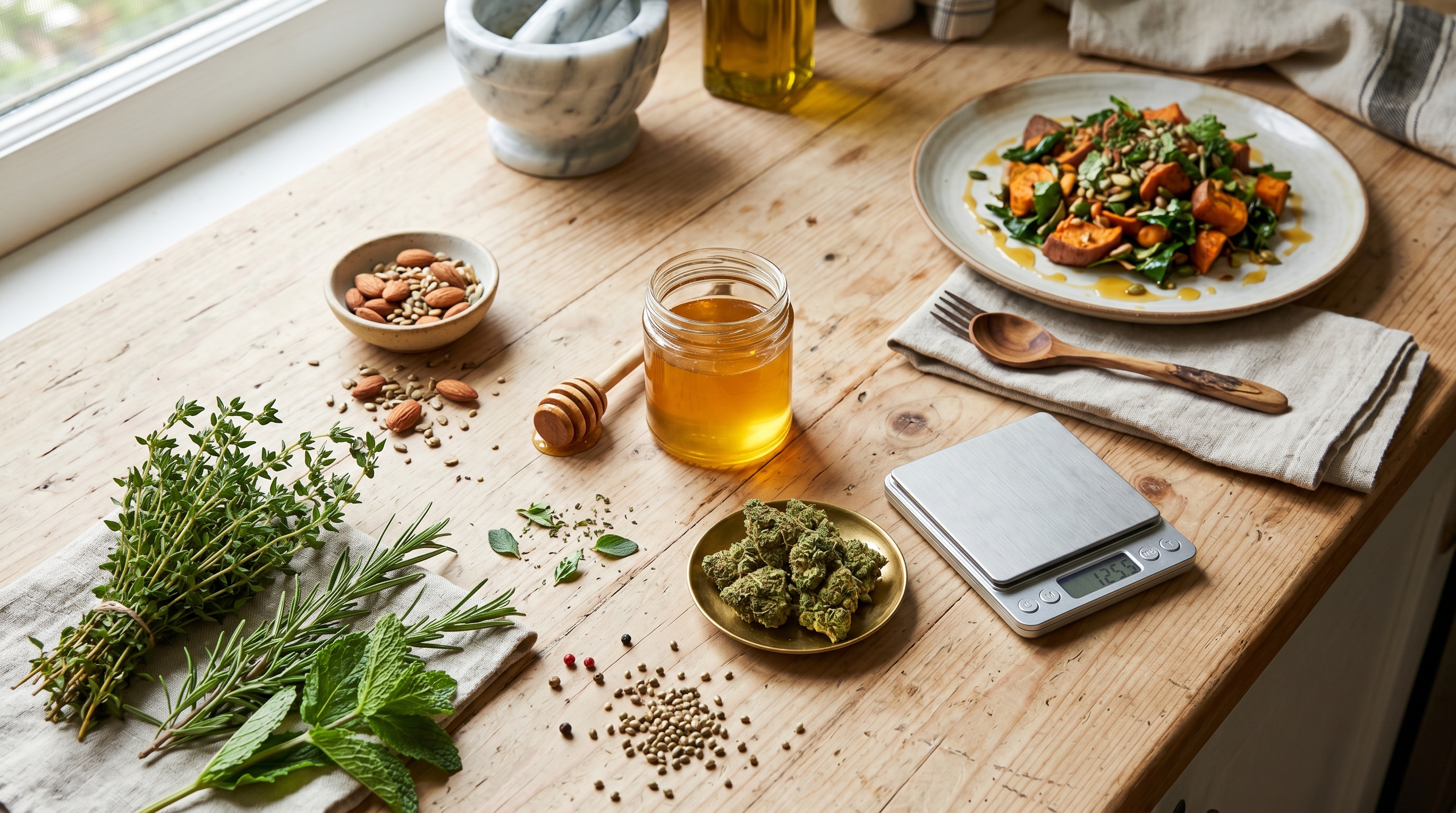
Why cook with CBD-only strains?
A CBD-dominant strain is one bred to produce far more cannabidiol than THC, often at ratios of 20:1 or higher. ACDC frequently tests near 20:1 CBD:THC, while Charlotte’s Web was bred specifically for high CBD and minimal THC. The practical result is a plant whose effects are described as calm and clear rather than stoned.
So why put it in food instead of just smoking it? A few reasons.
Non-intoxicating wellness. People reach for CBD edibles to support relaxation, post-workout recovery, and general comfort. The research here is genuinely promising but still early, so I will hedge honestly: studies suggest CBD may help with anxiety and inflammation, but it is not a proven cure for anything. Talk to a clinician for medical questions. For a deeper look at the evidence, see our piece on CBD that is stimulating, not sedating, at low doses.
Daytime, functional dosing. Because there is little to no THC, a CBD edible will not impair you. That makes it suitable for a workday in a way a THC brownie never will be. If you want the energizing-but-clear angle, our morning cannabis chemistry guide covers the daytime use case in detail.
Long-lasting, even delivery. Edibles release cannabinoids slowly through digestion, which many people find smoother than the spike-and-fade of inhaling. The tradeoff is a slow onset, which I will get to under dosing.
It is the same kitchen skill you already have. If you have made cannabutter or followed our cannabis cooking 101 guide, you already know 90% of this. CBD just changes the inputs, not the method.
Decarbing for CBD: CBDA becomes CBD
Here is the step almost everyone gets wrong. Raw cannabis flower does not actually contain much CBD. It contains CBDA (cannabidiolic acid), the acidic precursor. CBDA has its own intriguing properties, which we cover in CBDA and THCA: why raw cannabis has surprising therapeutic value. But if you want neutral, active CBD in your food, you have to convert CBDA into CBD with heat. That conversion is called decarboxylation.
Mechanically, heat knocks a carboxyl group (–COOH) off the molecule, releasing carbon dioxide and leaving behind the active cannabinoid. THCA becomes THC; CBDA becomes CBD. Our full primer on the process lives at decarboxylation explained.
The catch for CBD cooks: CBDA needs more energy than THCA to decarb. Lab work consistently shows it wants a higher temperature, a longer time, or both. A 2023 kinetics study in the Journal of Plant Biochemistry and Biotechnology [Stojanov, 2023] found the optimal point for converting CBDA to CBD in hemp was about 140°C (284°F) for roughly 30 minutes, after which CBD itself slowly begins to degrade. Earlier kinetics work mapping decarboxylation rates across temperatures reached similar conclusions [Wang, 2016] and [Citti, 2018]. In a home oven, where temperatures wobble, most experienced cooks land on a gentler window.
A reliable home protocol for CBD-dominant flower:
- Preheat your oven to 240°F (115°C) and verify with an oven thermometer (dials lie).
- Break the flower into pea-sized pieces. Do not grind to powder, which scorches.
- Spread on a parchment-lined tray, ideally covered with foil or in a lidded oven-safe dish to trap terpenes.
- Bake 60 to 90 minutes. CBD-dominant material wants the longer end of that range because CBDA converts more slowly than THCA. You are looking for a toasted, golden-brown color and a fragrant aroma.
- Cool completely before infusing.
CBD is a bit more forgiving than THC on the back end. THC degrades into CBN above roughly 300°F, but CBD is somewhat more heat-stable, so a slightly longer decarb is lower-risk. Still, do not crank the heat to rush it. Low and slow protects both the cannabinoid and the terpenes.
Infusion: the same fat-based method
This part is identical to THC cooking, because the underlying chemistry is the same. CBD, like THC, is lipophilic, meaning it dissolves in fat and oil but not in water. To get it into food, you bind it to a fat first. That is why there is no such thing as a credible water-only infusion without an emulsifier.
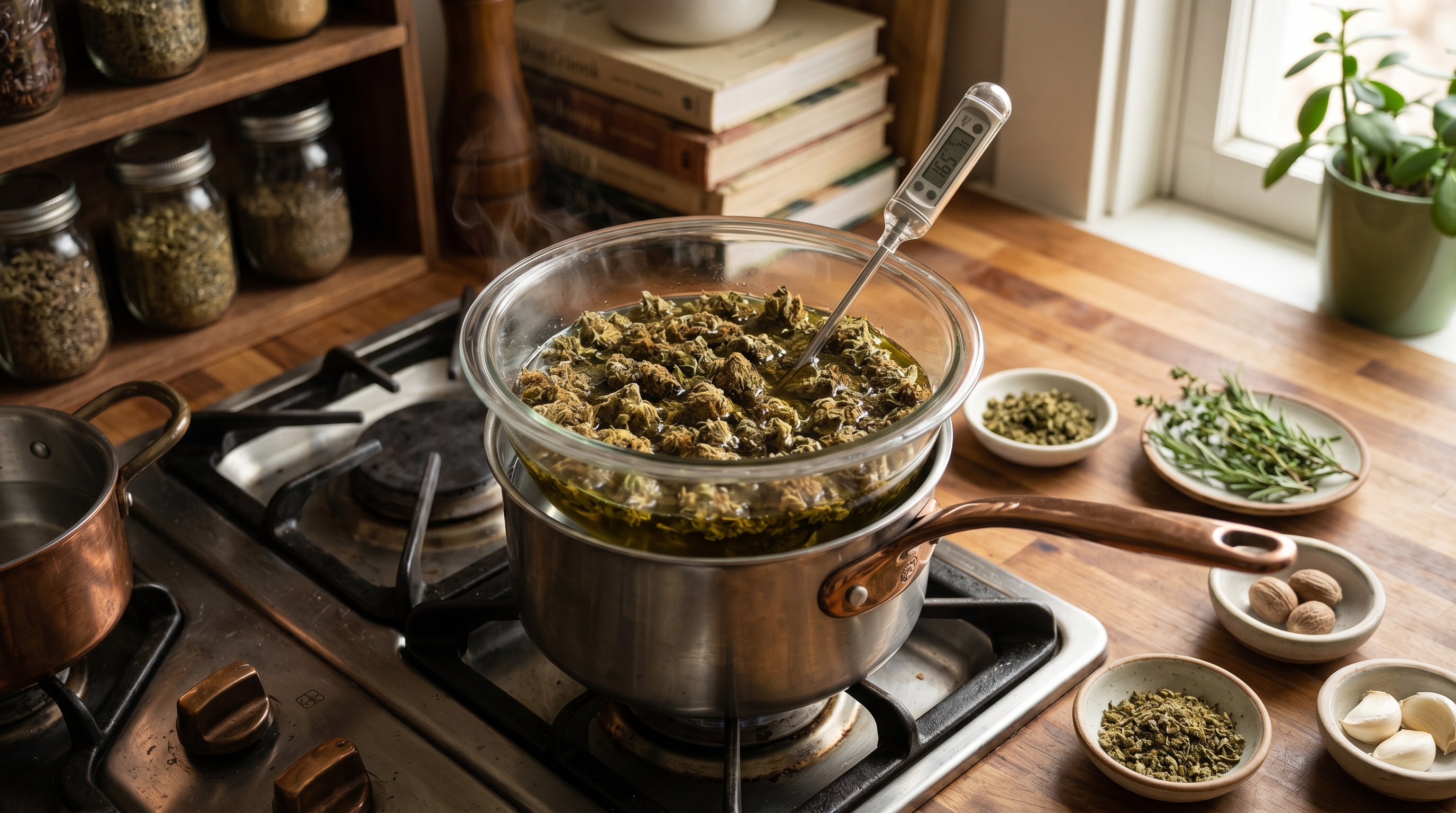
The basic infusion:
- Combine your decarbed CBD flower with a fat. A common ratio is 7 grams of flower per 1 cup (about 227g) of butter or oil. More fat means lower potency per spoonful but better extraction.
- Heat low and slow: 160 to 200°F (71 to 93°C) for 2 to 3 hours. Never let it boil. A double boiler, a slow cooker on low, or a mason jar in a simmering water bath all hold temperature well.
- Stir occasionally to keep plant matter moving through the fat.
- Strain through cheesecloth. Do not wring it out hard, or you will squeeze bitter chlorophyll into your oil.
Which fat? Coconut oil is the workhorse because its high saturated-fat content (over 80%) gives cannabinoids plenty of binding sites. Butter is the classic. Olive oil works but extracts a touch less efficiently. We break down the tradeoffs in choosing the right fat for cannabis infusions. If the grassy taste bothers you, our guide on edibles without the weedy taste has simple solutions.
Dosing without the high
This is where CBD cooking is both easier and trickier than THC cooking. Easier, because you are not worried about getting uncomfortably high. Trickier, because effective CBD doses are much larger than THC doses, so the math matters.
A standard THC edible dose is 5 to 10mg. CBD wellness doses, by contrast, are commonly in the 15 to 50mg range per serving, and some people use more. Because there is so little THC in a CBD-dominant strain, you can scale the CBD up without flirting with intoxication, but you should still calculate so your servings are consistent.
Quick potency math. Suppose you decarb 7 grams of ACDC testing at 15% CBDA:
- 7g = 7,000mg of flower. At 15% CBDA, that is about 1,050mg of CBDA.
- Apply the 0.877 conversion factor (CBDA loses mass as CO2 when it becomes CBD): ~921mg of potential CBD.
- Apply roughly 90% decarb efficiency and ~85% infusion efficiency: ~705mg CBD in your finished batch.
- Divide across 20 servings: about 35mg CBD per serving. Right in the wellness range.
If that feels like a lot of arithmetic, it is the same arithmetic as THC, just with bigger target numbers. Our edible dosing math for home cooks walks through every step, and beginners should also read the 2-hour rule for edible dosing. Even though CBD will not get you high, edibles still have a slow onset, so give any new batch time before deciding it “did nothing.”
One more honest note: homemade potency is an estimate. If precision matters to you, see how to test homemade edible potency at home and learn how to read cannabis lab results so your starting numbers are trustworthy.
Three simple CBD recipes
These are deliberately easy. Master these and you can adapt almost any recipe.
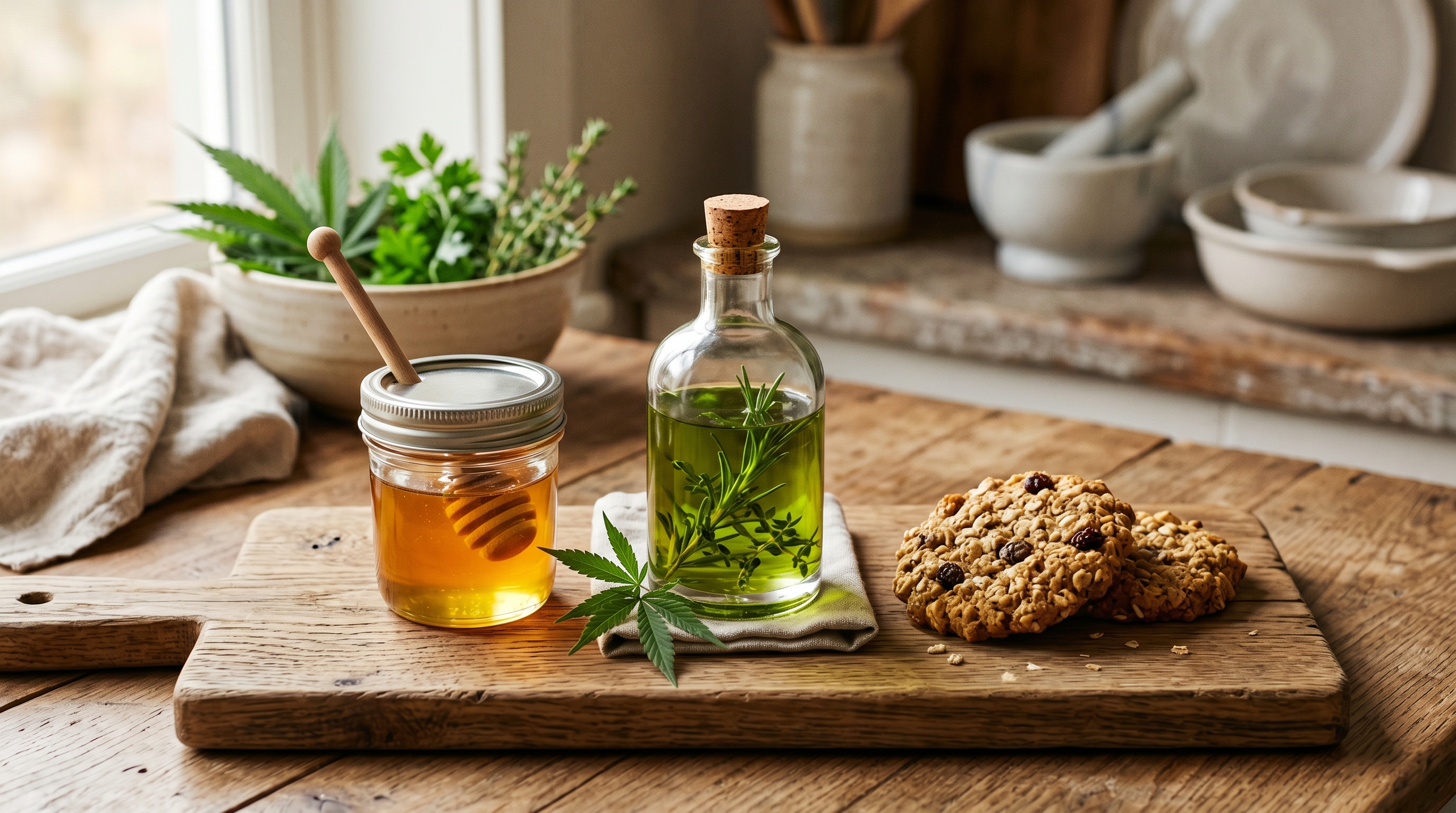
1. CBD-infused honey (sweet, versatile)
Honey is mostly sugar and water, so straight infusion needs help. The trick is to first make a CBD coconut oil or a small amount of lecithin-emulsified fat, then whisk it into gently warmed honey.
- Warm 1 cup of honey in a double boiler to about 180°F. Do not boil.
- Whisk in 2 to 3 tablespoons of strained CBD coconut oil plus a teaspoon of sunflower lecithin as an emulsifier.
- Stir continuously for 20 to 30 minutes, then jar and label with the per-teaspoon dose.
Stir it into tea, drizzle on toast, or take a spoonful straight. For a full walkthrough, follow our cannabis-infused honey recipe. It pairs naturally with the cannabis-infused coffee and tea microdose recipes.
2. CBD herb oil for savory cooking
A savory infused olive oil is the most useful thing in a CBD kitchen. Make a standard olive oil infusion with decarbed Harlequin or ACDC, then treat it as a finishing oil.
- Drizzle over roasted vegetables, soups, or grain bowls after cooking, not during high-heat searing.
- Whisk into salad dressings.
- Add at the end of a marinara or stir into guacamole for a wellness twist.
Because you are finishing rather than frying, you protect the CBD and the terpenes from degrading. Our pesto recipe is another good home for an herbaceous CBD oil.
3. CBD oatmeal cookies (a gentle baked good)
Baking is fine for CBD as long as you respect the heat. Oven air may be 350°F, but the interior of a moist cookie stays near 212°F because of water content, which keeps your cannabinoids mostly intact.
- Substitute your strained CBD butter or coconut oil for the fat your recipe calls for.
- Bake at 350°F as usual, but pull them as soon as they are set rather than over-baking.
- Portion the dough evenly so each cookie carries the same dose. This is the single biggest mistake home bakers make.
A soft, oat-forward cookie hides any grassy note well. If you want to push it further, our gummies guide shows how to dose precisely in a non-baked format (just remember gummies need an emulsifier since they are water-based).
CBD:THC ratio considerations
Even “CBD-only” strains are rarely pure. ACDC and Charlotte’s Web still carry trace THC, and many beloved cooking strains are actually balanced. Here is how the ratios play out in food.
- High-CBD / low-THC (20:1 and up): Effectively non-intoxicating. This is your daytime, functional, no-impairment category. ACDC and Charlotte’s Web live here.
- 1:1 (e.g., Harlequin leaning balanced, Canna-Tsu): Mild, gentle, body-forward. CBD appears to soften THC’s edges. A 5mg THC + 5mg CBD serving feels gentler to most people than 5mg THC alone.
- Custom blends: You can blend high-CBD hemp flower with a small amount of THC flower before decarbing to dial in any ratio you want.
Why does CBD soften THC? The leading explanation is the entourage effect, where cannabinoids and terpenes modulate one another. CBD appears to compete with THC at receptors and blunt some of its anxiety-provoking effects. We unpack the science in the entourage effect explained and the broader THC vs CBD differences.
If you are trying to find your own sweet spot, two reads will help: how to find your ideal THC to CBD ratio and the patient data in finding your THC:CBD sweet spot. And if you are deciding between cooking with flower versus buying isolate, see full spectrum vs broad spectrum vs isolate. Thinking about which strains to buy in the first place is its own skill; our High Families framework is a better lens than the indica/sativa label.
Frequently asked questions
Will a CBD edible get me high? A true high-CBD strain at a 20:1 ratio will not produce meaningful intoxication. The trace THC is too low. If you want zero THC, look at hemp-derived CBD or isolate.
Do I really have to decarb CBD flower? If you want active CBD, yes. Raw flower gives you CBDA, which has different (and not-yet-well-understood) properties. Cooking without decarbing produces a CBDA edible, not a CBD one.
Why is my CBD dose so much bigger than a THC dose? CBD is simply active at higher amounts. Wellness servings of 15 to 50mg are normal. Because there is little THC involved, scaling up does not risk getting you high.
Can I cook with infused CBD oil at high heat? Avoid high, prolonged heat. Bake at 350°F (the food interior stays cooler) and add CBD oils as a finishing touch to soups and sauces rather than frying with them.
Is CBD a treatment for my condition? Research is promising but early, and I am a pineapple in a lab coat, not your doctor. CBD may support relaxation and recovery, but it is not a proven cure. Check with a qualified clinician for anything medical.
Key Takeaways
Cooking with CBD-only strains is the same craft as making any edible, with the volume knob turned toward function instead of intoxication. Decarb a little hotter and longer to coax CBDA into CBD, infuse into fat exactly as you always have, do the dosing math with bigger target numbers, and finish your dishes gently to protect what you worked to activate. Whether that ends up as morning honey, a savory herb oil, or a desk-friendly cookie, you get the wellness profile without losing your afternoon. Track how each batch actually affects you, and over time you will learn your own ideal ratio far better than any label can tell you.
Sources
- Project CBD. “Decarboxylating Cannabis.” https://projectcbd.org/science/decarboxylating-cannabis/
- The Cannigma (Earlenbaugh, PhD). “What is Decarboxylation? How to Decarb Weed for Edibles.” https://cannigma.com/plant/what-is-decarboxylation/
- Journal of Plant Biochemistry and Biotechnology (2023). “Mechanism and kinetics of CBDA decarboxylation into CBD in hemp.” https://link.springer.com/article/10.1007/s13562-023-00847-z
- Emily Kyle, MS, RDN. “How to Decarb CBD Flower with Lab Tests.” https://emilykylenutrition.com/how-to-decarb-cbd-flower/
- PhenoDB. “Cannabis Decarboxylation Guide” and “Cannabis Edibles Guide.” https://phenodb.eu/decarboxylation-guide


