How to Clean a Dry Herb Vaporizer: Parts, Alcohol and How Often
How to clean a dry herb vaporizer: brush the oven after each session, clean the vapor path every 5 to 10 sessions, and dry it fully before you heat it.

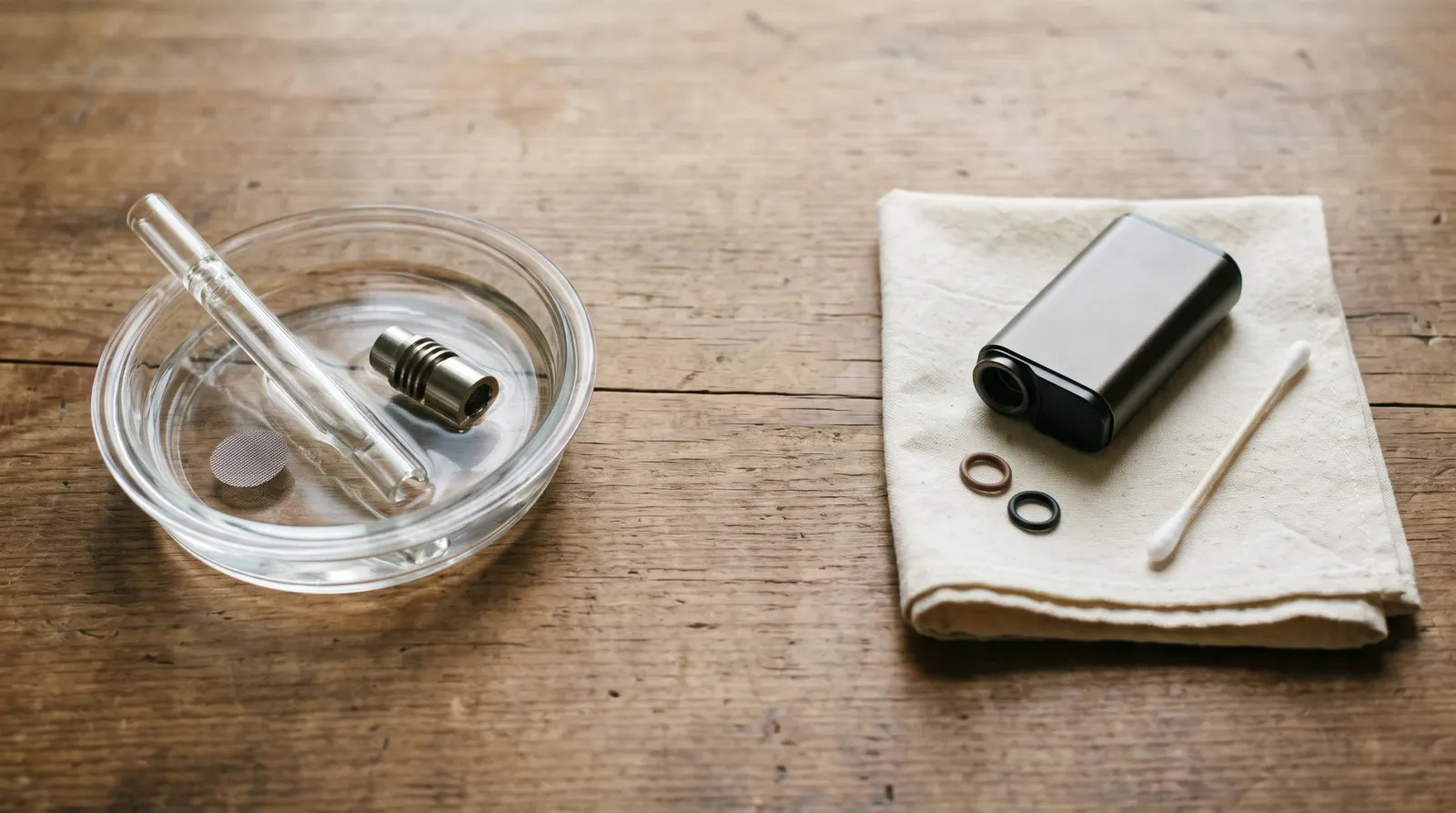
To clean a dry herb vaporizer, brush out the oven after every session, then clean the vapor path every 5 to 10 sessions: soak only the removable glass or metal parts your manual clears for alcohol, wipe the oven with a barely damp swab, rinse, and let everything dry fully before you heat it. If you use it daily, one maker says to clean the vapor parts no later than seven days after the last use. Storz & Bickel
Here is the part most cleaning guides skip. Four vaporizer makers name four different alcohol strengths. A Storz & Bickel medical-model page says 70% isopropyl alcohol. PAX says 90%. DaVinci says 91% or higher. Arizer says 99%. (Storz & Bickel, PAX, DaVinci, Arizer) The myth is that you need 99% alcohol and a long soak. The truth: no strength is universal, and one maker caps the soak at 30 minutes. Your own manual outranks every guide, this one included.
This lesson in High School is about flower vaporizers with an oven. If your device takes a 510 oil cartridge, a clog is a different problem; see the clogged vape cart guide instead.
How often should you clean a dry herb vaporizer?
Clean in two layers: a quick brush every session and a full clean on a schedule. Each maker sets its own schedule. None of them cites a measured threshold. Treat the numbers below as the makers’ instructions, not as test results.
| Part | Light clean | Full clean | Whose instruction |
|---|---|---|---|
| Oven (chamber) and screen | Empty and brush after every session | Swab every 5 to 10 sessions | DaVinci |
| Mouthpiece and vapor path | Brush when you see residue | No later than 7 days after last use, or when a brush no longer removes residue | Storz & Bickel |
| Cooling unit (medical model) | Brush | Weekly, or when residue shows | Storz & Bickel |
| Glass stems and whips | Rinse | Soak at least 30 minutes when residue shows | Arizer |
| Whole device | Clean with the maintenance kit “every few uses” | Same | PAX |
| Metal manual-heat vape, daily use | Tip and condenser weekly | Deep clean monthly | DynaVap |
| Screens | Brush | Replace when cleaning no longer clears them | Storz & Bickel |
DynaVap also says heavier, stickier material leaves more residue, so heavy users clean more often. A rule that fits every maker above: brush every time, and do a full clean weekly if you vape daily. Clean sooner if the draw feels tight.
What does residue do to flavor and airflow?
Makers say residue can affect airflow, flavor and performance. Storz & Bickel says this, and Storz & Bickel’s support page links regular cleaning to “proper operation and pure flavor.” Be honest about what that is: a manufacturer statement. My searches found no peer-reviewed study that measures how residue changes flavor, airflow, temperature or dose in a dry herb vaporizer. That is “not found,” not proof that no effect exists.
What you can observe yourself is simple. A screen packed with residue lets less air through, and you feel it as a harder pull. Does a tight, harsh draw make you cough? Our guide to why weed makes you cough covers the other common causes. A flat taste can also come from stale flower, which is a storage problem; see how to store cannabis.
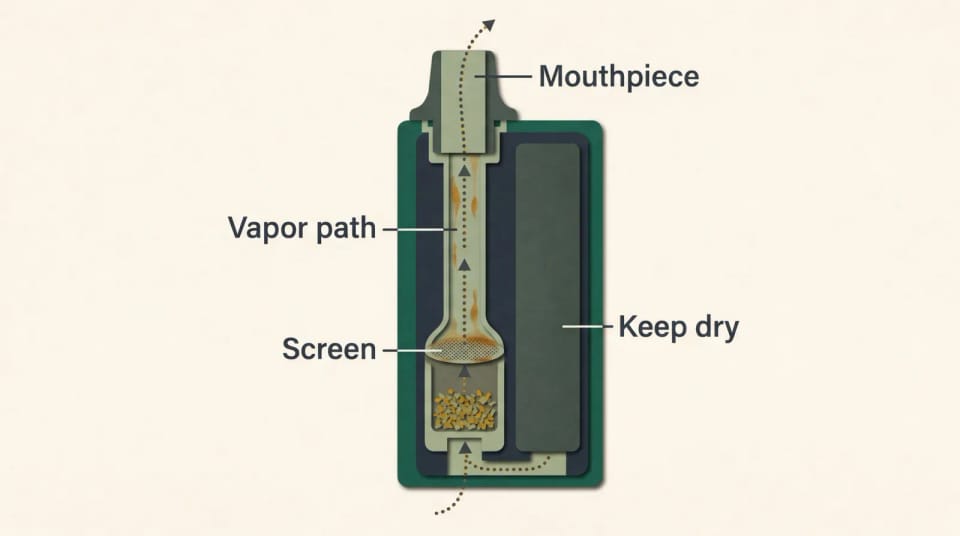
Residue builds on the screen and along the vapor path. Those parts get the full clean; the electronics never touch liquid.
What do you clean a dry herb vaporizer with?
You need a soft brush, cotton swabs, a small dish, and either isopropyl alcohol or warm water with a little mild dish soap. Storz & Bickel lists isopropyl alcohol first and warm water with mild detergent as the alternative. Storz & Bickel
That same page tells you what to skip. Avoid denatured alcohol, drinking alcohol, vinegar and harsh solvents “at all costs.” Skip pipe cleaners, rough brushes, scouring pads and toothbrushes too. Note the maker split here: PAX tells its owners to use a pipe cleaner or wire brush on its vapor path. PAX Use the tool your own maker names.
On soak time, the makers also disagree:
- 15 minutes for a PAX oven screen. PAX
- 15 to 30 minutes for removable non-electronic parts. DaVinci
- At least 30 minutes for Arizer glass. Arizer
- No more than 30 minutes for Storz & Bickel parts in alcohol, because plastics can soften, harden, crack or discolor. Storz & Bickel
The same solvent shows up in cleaning a bong with isopropyl alcohol and salt. But a vaporizer has electronics, seals and plastics. Do not borrow the bong method wholesale.
Which vaporizer parts should never go in alcohol?
Keep these out of any soak unless your manual says otherwise:
- The device body, battery and electronics. Arizer says do not submerge the unit, and Storz & Bickel says to clean the housing with a dry or slightly damp cloth only. (Arizer, Storz & Bickel)
- Lids the maker names. PAX says never to submerge its oven lid in any liquid. PAX
- O-rings and seals. DynaVap says to keep them out of long alcohol baths and to lubricate them afterward. DynaVap
- Coated or plated parts. DynaVap says to wipe these, not soak them. The same page says not to soak its cap.
- Plastic parts past the limit. Storz & Bickel caps plastic parts at half an hour in alcohol. Storz & Bickel
- Balloons. Arizer says its balloons “cannot be effectively cleaned” and are replaced instead. Arizer Balloon devices have their own quirks, covered in our piece on the filled Volcano balloon.
How do you clean a dry herb vaporizer step by step?
Follow these steps, then check each one against your manual before you start.
- Switch it off and let it cool. PAX tells owners of one model to let the device cool for 15 minutes first. PAX
- Empty and brush the oven. Tip out the used herb and brush the oven and screen. Save the brown herb if you like; it has uses, covered in what to do with already vaped bud.
- Remove only the parts your manual allows. That usually means the mouthpiece, cooling unit, glass stem or screen. Leave everything on the “never in alcohol” list attached or on a dry cloth.
- Clean each part with its own method. Soak removable glass or metal parts in alcohol or warm soapy water for your maker’s time. For the oven and the fixed vapor path, use a swab that is damp, not dripping. Storz & Bickel warns not to oversaturate the swab so alcohol stays out of the device. Storz & Bickel
- Rinse and dry everything fully. Storz & Bickel says to rinse soaked parts for at least one minute and dry them completely. Storz & Bickel DynaVap suggests a sniff test: if you can still smell alcohol, it is not dry. DynaVap
- Reassemble and check the draw. Put it back together, pull air through it cold, and check that the draw feels open. Inspect each part as you go; Storz & Bickel says to discard parts that are cracked, softened, brittle or discolored.
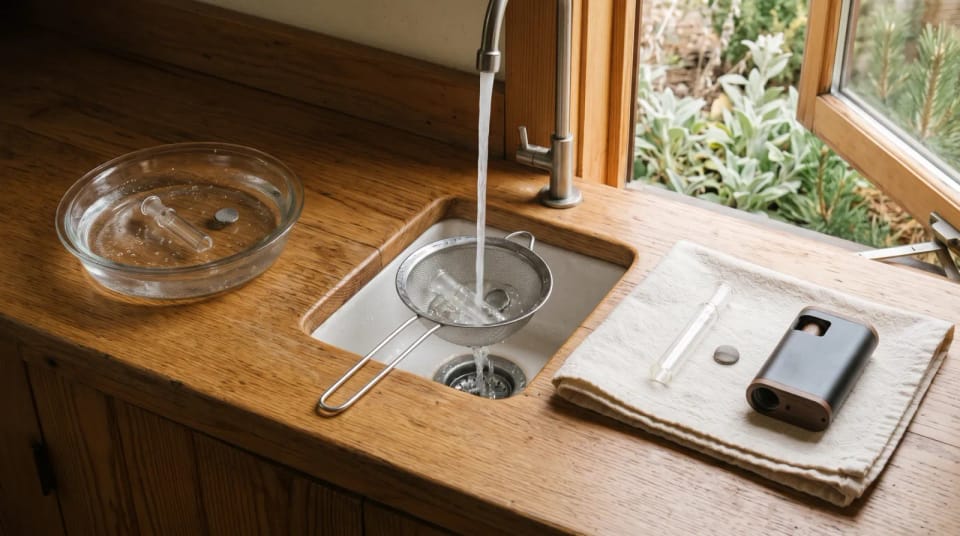
Soak, rinse, then air dry until you cannot smell alcohol. Drying, not heat, is the step that removes the solvent.
Is it safe to heat a vaporizer after cleaning with alcohol?
Only after every trace of alcohol is gone. Isopropyl alcohol is a flammable liquid with a flash point of 53 °F, according to the NIOSH Pocket Guide. Its vapor can also irritate the eyes, nose and throat and cause drowsiness or dizziness. CDC NIOSH So clean in a room with fresh air. Keep away from flames and from a hot or charging device.
The makers split on what comes next. Arizer, PAX and DaVinci each include a heat step after cleaning: Arizer heats its portables before shaking out the chamber, PAX heats the dry device once and lets it cool, and DaVinci calls an empty burn-off optional. DynaVap says never to run a device until every trace of alcohol has evaporated. (Arizer, PAX, DaVinci, DynaVap) The safe path: dry fully first. Then follow your own manual on whether to heat.
One more myth to retire: a hot cycle is not sterilization. In an FDA lab study, heating cannabis to 190 °C for 70 seconds in a commercial vaporizer did not significantly reduce microbial counts in the plant material. Sopovski et al., 2023 That study tested herb, not device surfaces, so it does not show that a dirty vape harbors germs. It does show that heat alone is not a cleaning step. Once the device is clean, the dry herb vaporizer temperature guide helps you pick your next setting.
When to talk to a clinician. If you get dizzy, nauseated or headachy while cleaning, stop, move to fresh air and let the room air out. If symptoms do not settle, or if someone swallows isopropyl alcohol, contact a clinician or your local poison center. A cough that persists for weeks is worth a medical visit no matter how clean your device is.
Should you clean the mouthpiece when someone else uses it?
Yes, according to one maker. Storz & Bickel says that “for hygienic reasons” its cooling and mouthpiece parts need cleaning when a different person is going to use the device. Storz & Bickel No study I found measured germs on a dry herb vaporizer mouthpiece, so this is a maker instruction, not a tested health finding. It costs a swab and a few minutes.
Still shopping? Parts that come off easily are worth weighing. Our guide on how to choose a cannabis vaporizer covers that checklist. Dry herb vs oil vaporizers compares the upkeep. And if you log sessions in the High IQ app, a note that every strain suddenly tastes flat is a good cue to check the screen before you blame the flower.
Sources
- Storz & Bickel. Vaporizer cleaning: preserving performance and flavor. Manufacturer page, read October 29, 2026.
- Storz & Bickel Support. Cleaning, cooling unit and filling chamber screen, Cleaning, cooling coil and mouthpiece and MIGHTY + MEDIC. Manufacturer support pages.
- Arizer. Cleaning and maintenance and cleaning your desktop vaporizer. Manufacturer pages.
- PAX Labs. How do I clean my PAX? and Squeaky-clean: how to care for 3 PAX products. Manufacturer pages.
- DaVinci. Step-by-step vaporizer maintenance guide. Manufacturer blog, 2025.
- DynaVap. How to clean metal vaporizers. Manufacturer blog that also sells cleaning products, updated 2026.
- CDC NIOSH. Pocket guide to chemical hazards: isopropyl alcohol and hazard communication for disinfectants.
- Sopovski DS, Han J, Stevens-Riley M, et al. Investigation of microorganisms in cannabis after heating in a commercial vaporizer. Front Cell Infect Microbiol. 2023;12:1051272. doi:10.3389/fcimb.2022.1051272. PubMed 36710966.
Manufacturer pages are primary instructions for their own devices. They are not independent tests of how well cleaning works.
Key takeaways
- Brush the oven and screen after every session.
- Full clean every 5 to 10 sessions, or weekly if you vape daily.
- Makers name 70%, 90%, 91%+ and 99% alcohol; follow your own manual.
- The body, battery, seals, coated parts and named lids stay out of alcohol.
- Dry every part until you cannot smell alcohol before you heat or charge it.
- Flavor and airflow benefits are maker statements, not measured results.
FAQ
Can you clean a vaporizer without isopropyl alcohol?
Yes. Storz & Bickel names warm water with mild dish detergent as an alternative to isopropyl alcohol, and its support page gives a soak of at least five minutes, a rinse of at least one minute and full drying. Check that your own manual allows water on the part first.
Can you use vinegar or vodka to clean a vaporizer?
Storz & Bickel says to avoid vinegar, drinking alcohol, denatured alcohol and harsh solvents “at all costs.” No maker cited here recommends them. Stick to isopropyl alcohol or mild soapy water as your manual directs.
Do you need to clean a new vaporizer before first use?
Storz & Bickel says its own factory-prepared devices do not need cleaning before first use. Other makers may differ, so read the first-use section of your manual. If it is silent, follow its regular cleaning steps.
When should you replace a vaporizer screen?
Replace a screen when brushing and soaking no longer clear it, or when it is heavily contaminated or clogged, as Storz & Bickel advises. DaVinci also suggests replacing a stained mouthpiece or a loose gasket.





