How to Put Out a Joint and Save It: What Changes Before You Relight
To put out a joint and save it, let the ember die or stub it gently, check it is cold, store it dark and closed, then relight the full rim.

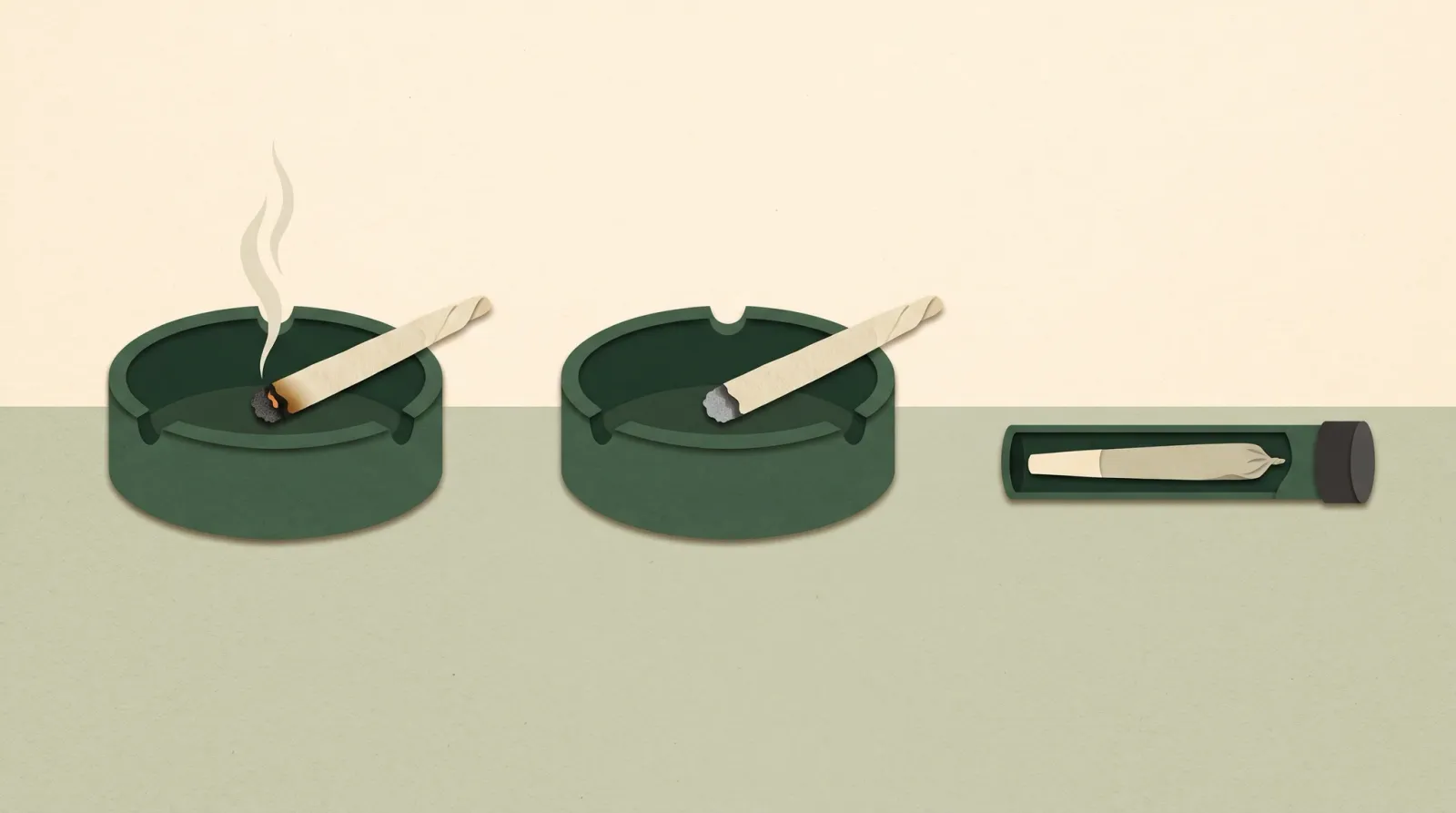
To put out a joint and save it, let the ember die or press it out gently in a deep ashtray, check that it is cold, store it dark and closed, and relight the full rim. That is the whole method. What most guides skip is what the evidence says about the second session: no study has ever tested a relit joint, for taste, harshness or potency.
Here in High School we sort every step by what backs it. Two steps rest on real sources: the fire step on official fire-safety guidance, and the storage step on stability studies of flower. The rest is craft habit. And one measured fact changes how you think about the saved half. The second half of a joint is a different smoke from the first, even if you never put it out. In a smoking-machine study, light terpenes reached the smoke first, while THC and heavier terpenes built up toward the mouth end and arrived later, so THC per puff rose as the joint burned (Eyal and colleagues, 2024).
So when someone tells you a relit joint “always tastes harsher”, you can tell them two things. Nobody has measured that. And the half they saved was never going to taste like the half they smoked.
How do you put out a joint without wasting it?
Put it out gently, confirm it is cold, then close it up. Here is the sequence, with the support for each step labelled.
- Rest it in a deep, sturdy ashtray. Stop drawing and set the joint down on a hard surface, away from anything that can burn. Fire officials give this advice for tobacco smoking materials: deep, sturdy ashtrays, kept away from things that burn, and never a potted plant or mulch as an ashtray (Oregon State Fire Marshal). The same fire logic applies to a cannabis ember.
- Let the ember die, or press it out gently. An unpuffed joint often fades on its own, but do not count on it. If you want it out now, press the lit tip lightly against the ashtray floor and turn it once. Press the tip, not the body: a crushed joint packs unevenly and burns badly next time. This step is craft habit; nobody has compared methods.
- Check that it is cold. Look for any glow and any thread of smoke. Wait until the tip is cool to the touch near the end. This step matters most. Smoking fires “can smolder undetected for a long time” before they burst into flames on a bed, sofa or chair (Massachusetts Department of Fire Services). A joint that is only mostly out does not go in a pocket, a bag or a closed tube.
- Store it dark and closed. Tap off the loose ash and put the joint in a small container with a lid. The reasons are in the storage section below.
- Relight the full rim. When you come back, hold the flame just off the tip and turn the joint so the whole rim catches, as in our canoe fix for uneven burns. Then take a couple of gentle puffs before a full draw.
If you are about to sleep, or you cannot tell whether it is out, use water and lose the joint. Both fire agencies above advise water or sand to make sure smoking materials are out before disposal. A wet joint is ruined. That is a fair trade for a house.
| Step | What backs it | Strength |
|---|---|---|
| Deep ashtray, away from things that burn | State fire-safety guidance for tobacco | Official guidance, applied by the same fire logic |
| Check it is cold before you close it | State fire-safety guidance on smoldering | Official guidance |
| Store it dark and closed | Stability studies of intact flower and resin | Measured, but not on joints |
| How to stub it, which tube to use, how to relight | Habit and convenience | Untested |
Why does the second half of a joint taste different?
Because it is a different smoke. In ten experiments on a smoking machine, cannabinoid content was higher in the sections of the joint nearer the mouth than nearer the lit end, and the cannabinoid content of the smoke went up as smoking progressed (Eyal and colleagues, 2024). Sesquiterpenes, the heavier terpenes such as caryophyllene, behaved the same way. Monoterpenes, which boil at lower temperatures, reached the smoke before both.
The authors propose a mechanism. Heat at the lit end converts and evaporates compounds. That vapour moves away from the hot zone, condenses in the cooler flower nearer the mouth, and evaporates again as the burn reaches it. Their conclusion: delivery from a joint “cannot be uniform”.
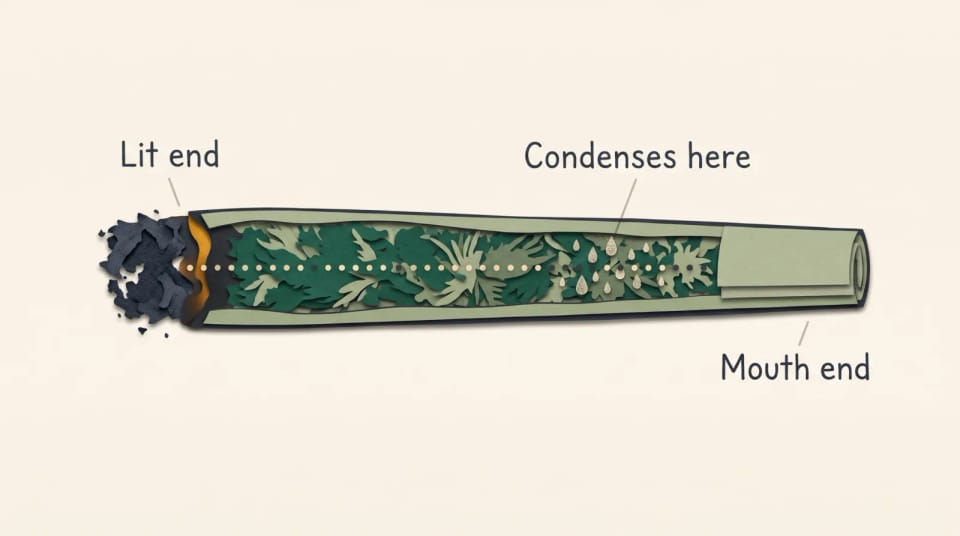
The proposed mechanism from a smoking-machine study: vapour from the hot zone condenses in the cooler flower ahead of it. It describes a joint smoked straight through, not one that was put out and relit.
Researchers have been asking this question for decades. A 1991 study had ten regular users smoke first halves and second halves of joints under controlled puffing, starting from earlier lab work that suggested THC concentrates in the unburnt portion as puffs go on (Tashkin and colleagues, 1991). Its results are not in the published abstract, so we leave them out here.
Two practical points follow. First, the machine data suggest that half the flower is not half the THC delivered, which is why our guide to how much THC is in a joint looks at the joint as a whole. Second, the lighter terpenes, the monoterpenes such as limonene and myrcene, reached the smoke first in the machine study. If you want to know which terpenes your flower carries, start with how to read a terpene profile.
Keep the limits in view. This was a machine, not people. We read the abstract, not the full paper. And it tested a joint smoked straight through. It did not test one that was stopped, stored and relit.
How do you store a half-smoked joint?
Keep it in the dark, in a closed container, at room temperature or cooler. That is as far as the evidence goes, and it comes from flower, not joints.
- Light is the biggest enemy. In a two-year storage study, light was the largest single factor in cannabinoid loss. Air oxidation also caused real losses, and well-filled, well-closed containers reduced them. Temperatures up to 20 °C had little effect (Fairbairn and colleagues, 1976).
- THC loss is slow, and light changes it. A four-year study found THC fell and CBN rose in samples kept at room temperature, with almost all THC gone by the end. Temperature changed only the speed of that conversion; light changed both the speed and what THC turned into (Zamengo and colleagues, 2019).
- Terpenes go first. In a year-long study, terpene levels fell quickly under every storage condition tested, and ground flower was among the worst cases for keeping them (Milay and colleagues, 2020). A joint is ground flower. So aroma and flavour are the fragile part of a saved joint, not the THC.
A small capped tube or a jar is fine. It keeps the ash smell off your pocket and keeps out light and air. No study shows one material beats another for a joint, so choose whatever closes well and is not see-through.
Skip the tricks. Do not rewet a joint with water or saliva, add damp cotton, or put a humidity pack in the tube. Humidity packs belong in jars of whole flower, as our humidity pack guide explains, not with half-burnt paper. We also do not recommend the fridge or freezer, for the reasons in our guide to storing flower.
Can you relight a joint, and is it bad for you?
Yes, you can relight it, and relighting is no safer or riskier in any way that has been measured for cannabis. Nobody has studied relit joints for exposure or health effects.
The only relighting research is on tobacco cigarettes, and it does not settle much. One set of surveys found that about 45 percent of smokers relight, and called it a common yet understudied habit (Heckman and colleagues, 2021). A 2026 analysis found that relighters smoked fewer cigarettes a day but had higher total nicotine intake. After adjusting for who relights, no per-cigarette biomarker difference held up (Strayer and colleagues, 2026). An earlier study found no significant link between relighting and blood cotinine or exhaled carbon monoxide (Allen and colleagues, 2019). These are tobacco smokers, measured at one point in time, and they cannot be read across to cannabis.
What we can say plainly: saving a joint is about not wasting flower. It is not harm reduction. The CDC states that smoked cannabis, “regardless of how it is smoked, can harm lung tissues” (CDC, Cannabis and Lung Health).
If you smoke and notice a cough that will not clear, wheezing, chest pain or shortness of breath, talk to a clinician. Tell them what you smoke and how often; that is the information they need.
If you want to find out whether your second session lands differently from the first, the High IQ app lets you log how a strain worked each time, so you can compare your own notes instead of guessing.
What has nobody tested?
More than the confident guides suggest. These searches came up empty, which is not proof that nothing exists:
- Whether a relit joint tastes harsher, staler or the same.
- Whether relighting raises, lowers or does not change the THC you get.
- How long a half-smoked joint keeps, in a tube, a jar or a bag.
- Whether glass, plastic or metal containers make any difference.
- Whether rewetting, a humidity pack, a fridge or a freezer helps a saved joint.
- Whether “toasting” the tip or resting a joint before relighting does anything.
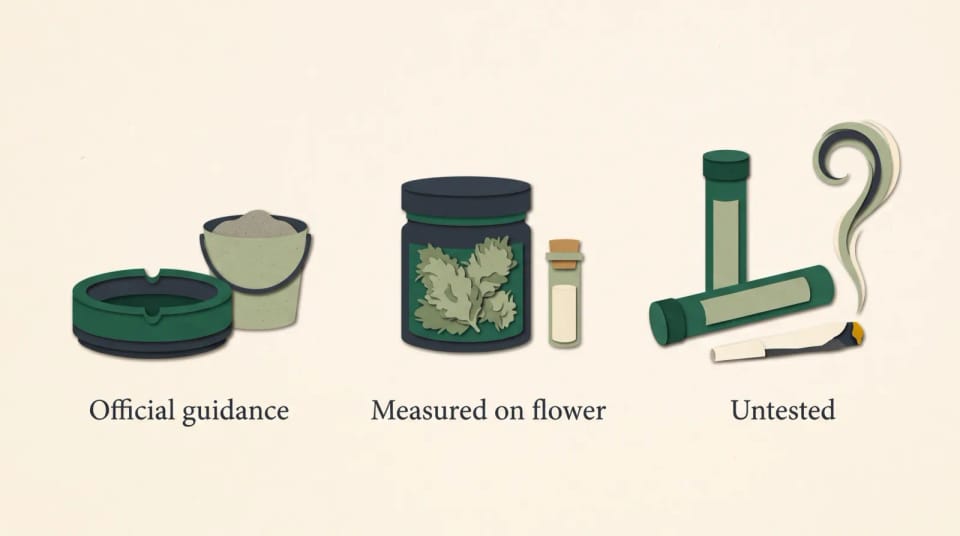
Fire-safety advice is official, storage advice comes from studies of flower, and the relight claims you see online have not been tested on joints at all.
How do you avoid saving half a joint at all?
Roll smaller. A joint sized for one session never needs saving, and our guide to rolling a joint that finishes evenly shows how to scale it down. Your paper and cone choices also change how fast a joint burns between puffs. If you mostly buy pre-rolls, the same steps apply, and pre-rolls versus hand-rolled joints covers how they differ in construction.
The ash you tap off before storing tells you little about quality, whatever its colour. Our article on white ash versus black ash explains why.
Sources
- Eyal AM and colleagues. Inconsistency in the composition of the smoke of a cannabis cigarette as smoking progresses. Cannabis and Cannabinoid Research, 2024.
- Tashkin DP and colleagues. Tar, CO and delta 9THC delivery from the 1st and 2nd halves of a marijuana cigarette. Pharmacology Biochemistry and Behavior, 1991.
- Fairbairn JW and colleagues. The stability of cannabis and its preparations on storage. Journal of Pharmacy and Pharmacology, 1976.
- Zamengo L and colleagues. The role of time and storage conditions on the composition of hashish and marijuana samples. Forensic Science International, 2019.
- Milay L and colleagues. Metabolic profiling of cannabis secondary metabolites for evaluation of optimal postharvest storage conditions. Frontiers in Plant Science, 2020.
- Heckman CJ and colleagues. Cigarette relighting: a series of pilot studies. International Journal of Environmental Research and Public Health, 2021.
- Strayer LG and colleagues. Effects of relighting cigarettes on biomarkers of carcinogen and toxicant exposures. Nicotine and Tobacco Research, 2026.
- Allen SI and colleagues. Characteristics of adult cigarette smokers who relight. Nicotine and Tobacco Research, 2019.
- Oregon State Fire Marshal. Smoking materials: put it out, all the way, every time.
- Massachusetts Department of Fire Services. Smoking fire safety.
- Centers for Disease Control and Prevention. Cannabis and lung health.
Key takeaways
- Rest it in a deep ashtray, let it die or press the tip out gently, and confirm it is cold before it goes anywhere.
- If you cannot confirm it is out, use water and lose the joint.
- Store it dark and closed; light and air are the measured enemies, and terpenes fade first.
- The second half of any joint is a different smoke, paused or not.
- No study has tested a relit joint for taste, potency or safety.
FAQ
Can you put out a joint with water?
Yes, and it is the surest way to make it safe, but it ruins the joint. Fire-safety agencies advise water or sand to make sure smoking materials are fully out. Use it whenever you cannot confirm the ember is dead, especially before sleep.
How long can you keep a half-smoked joint?
Nobody has measured it. Stability studies on intact flower show cannabinoid losses play out over months and years, not days, but terpenes fade faster, and a joint is ground flower. Keep it dark and closed, and expect the aroma to fade before anything else.
Does relighting a joint get you higher or less high?
No study has tested it. What has been measured is that THC per puff rises as a joint burns, because THC builds up toward the mouth end. Whether a pause changes that has never been studied.
Can you save a blunt the same way?
The same fire steps apply: a deep ashtray, a gentle press on the tip, and a cold check before storing. Many blunt wraps are made from tobacco leaf, and no study has tested saving or relighting one. Do not seal it until it is fully cold.





