Cannabis Simple Syrup: The Base That Actually Mixes Into Drinks
Cannabis oil floats on water. Here is how to build a simple syrup that mixes in: emulsifiers, dosing math, shelf life and five drinks.

Professor High
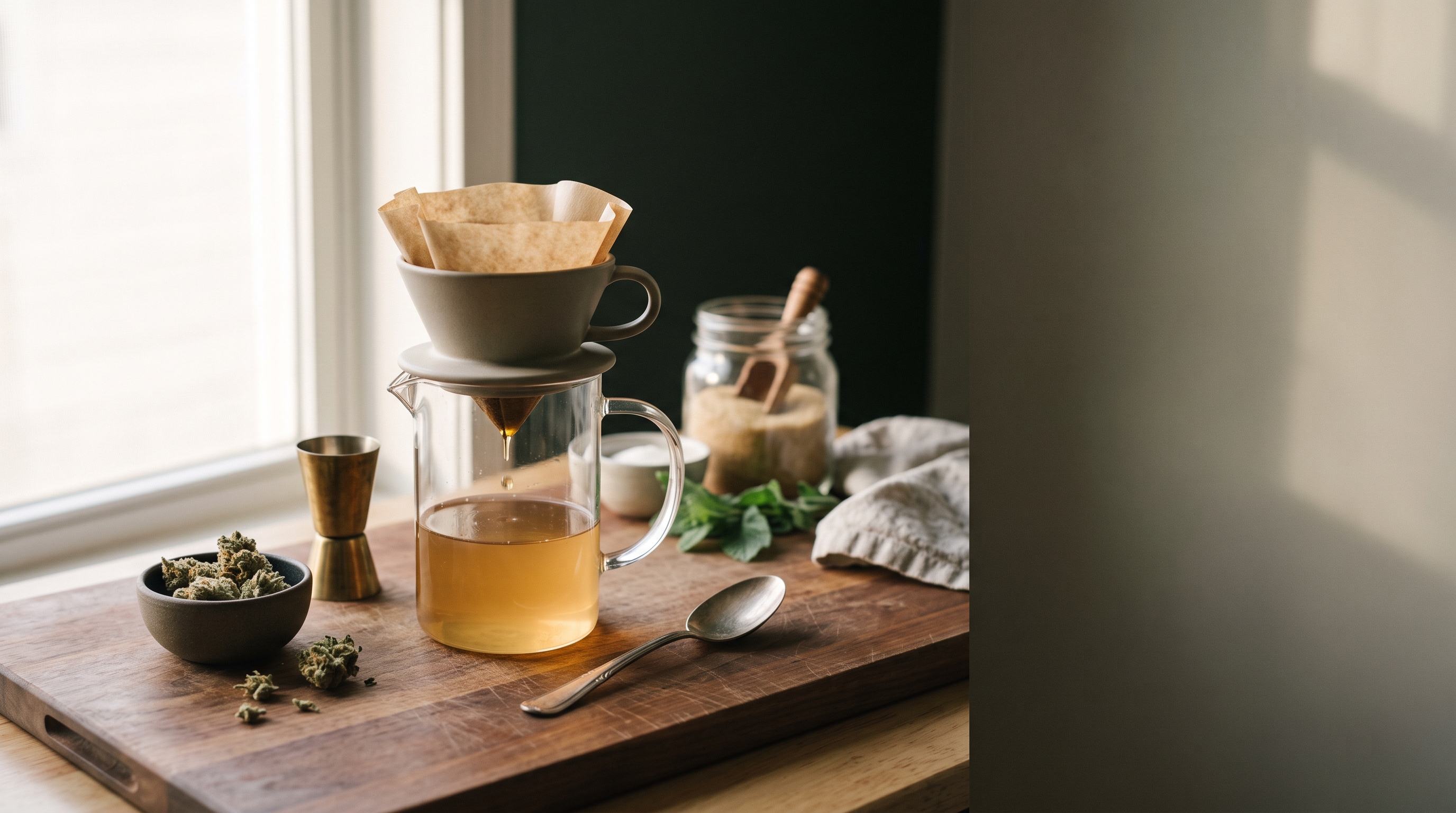
You stirred a dropper of tincture into a glass of lemonade and watched it do exactly what oil does in water: bead up, drift to the top, cling to the side of the glass. Half your dose is now a smear on the rim. The other half is a slick you taste in the first sip and not at all in the last one.
That is the entire problem with infused drinks, and it is a physics problem, not a recipe problem. Cannabis simple syrup is the standard fix — a sweet, viscous, pre-emulsified base you pour into anything cold. Done well, it is the most useful thing in an infused kitchen. Done badly, it is an expensive way to make oily lemonade.
Why cannabinoids refuse to join the party
THC and CBD are lipophilic. They dissolve happily in fat, alcohol and other cannabinoids, and they are practically insoluble in water. This is not new — the physicochemical properties and solubility of THC were characterised in the pharmaceutical literature back in 1974 (Garrett & Hunt).
Simple syrup is sugar dissolved in water. From a cannabinoid’s point of view, that is still water. Sugar does not make syrup better at dissolving THC; it makes it thicker and sweeter.
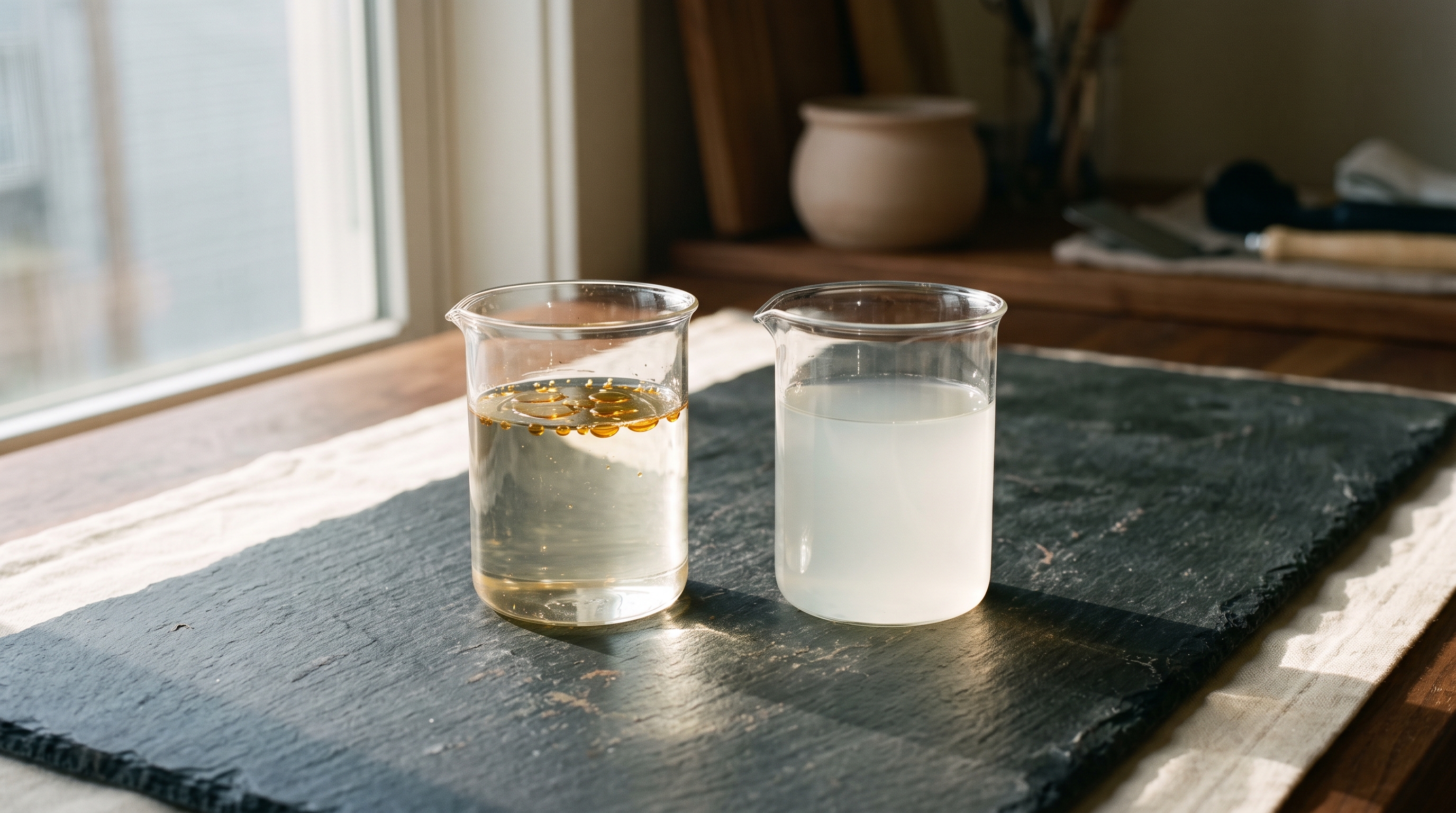
So when you drop an oil-based tincture into syrup, three things happen in sequence. Stirring disperses the oil into droplets, and briefly it looks mixed. Then the droplets cream — oil is less dense than sugar water, so they rise, and big droplets rise fast. Finally they coalesce, merging into a visible layer.
You cannot stop this permanently. You can slow it down enough that it does not matter over the life of a bottle. That is what an emulsifier does — and it is why syrup beats tincture-in-water in the first place. Sugar raises viscosity, and viscosity slows creaming.
The three things people use to fix it
Lecithin
Lecithin is a phospholipid mixture, usually from soy or sunflower. One end of the molecule likes water, the other likes oil, so it parks itself at the boundary and lowers the surface tension between them. That much is settled food science — it is why lecithin is in your chocolate and your salad dressing.
What is not settled is the folk claim that lecithin makes edibles stronger. You will read this everywhere. I could not find a human trial testing it. Treat “it boosts your high” as an unproven bonus, not a reason to buy it. Liquid sunflower lecithin is easier to work with than granules and milder-tasting than soy.
Gum arabic
Gum arabic (acacia gum) is the workhorse of the beverage industry — the emulsifier behind citrus-oil flavour emulsions in soft drinks. It does two jobs at once: a small protein fraction anchors it at the oil–water interface, and the bulk polysaccharide thickens the water phase around each droplet.
For home syrup that means two practical advantages. It is nearly flavourless at working concentrations, and it stays stable in acid — exactly what you need if the syrup is going into lemonade.
Commercial water-soluble THC
The honest shortcut. “Water-soluble” cannabinoid powders and liquids are not really soluble — they are pre-made emulsions, usually nano-scale, stabilised by surfactants and sometimes spray-dried onto a carrier. Stir one into plain syrup and you get a clear or faintly hazy base with no separation at all.
They are made with high-pressure homogenisers or ultrasonicators. A blender cannot do this. Your immersion blender produces a coarse emulsion with droplets in the micrometre range: cloudy, stable for weeks rather than years. A true nanoemulsion sits around 20–200 nm, which is why commercial seltzers can be transparent.
Want a clear drink? Buy the emulsion. Want to control your own input material and tolerate cloudy? Keep reading. More on the engineering in our piece on nano-emulsified THC and on water-soluble live rosin.
About that “fast onset” claim
Beverage marketing leans hard on onset speed. Here is what the human data actually show.
Conventional oral THC is slow and inefficient. Oral bioavailability has been reported in the range of roughly 4–20%, and in the older studies Huestis reviewed, plasma THC peaked around four to six hours after a 15–20 mg oral dose.
Modern products do better. In a crossover study of five commercially available edibles, each containing 10 mg THC, time-to-peak plasma THC ranged from 35 to 90 minutes across products, and the products differed measurably from each other in the first 20–30 minutes (Ewell et al., 2021). Formulation clearly matters.
Self-emulsifying delivery systems move it further:
| Study | What was compared | Median or mean Tmax | Peak concentration |
|---|---|---|---|
| Atsmon et al., 2018 (n=14) | Self-emulsifying THC/CBD capsule vs. oromucosal spray | 1.3 h vs. 3.5 h | 1.6× higher |
| Knaub et al., 2019 (n=16) | Self-emulsifying CBD vs. CBD in MCT oil | 1.0 h vs. 3.0 h | 4.4× higher |
Both are real, published human crossover studies. Both are also small, and both carry caveats worth stating plainly. Atsmon’s comparator was an oromucosal spray, not a brownie — so it is not a clean “emulsion vs. normal edible” test. Knaub’s study used CBD only and was sponsored by the formulation company (disclosed in the paper). Neither tested a beverage, and neither tested anything you can make at home.
So: engineered emulsions genuinely shift the peak earlier, and the effect looks consistent across independent groups. But the best human numbers land around one hour to peak — not five minutes, not fifteen. A 2024 critical review of the cannabis beverage literature found only 29 eligible studies and described the field as marked by “paucity and inconsistency” (Froude et al., 2024). Anyone quoting a precise onset figure for a drink is quoting a marketing deck, not a trial.
For a homemade blender syrup, expect the ordinary edible range. Compare routes in our bioavailability rankings and the sublingual vs. edible onset comparison.
The recipe
This makes roughly 350 ml (about 12 fl oz, or 24 tablespoons) of cloudy, pourable syrup.
You need: 2 g cured flower · 60 ml (¼ cup) MCT or refined coconut oil · 200 g white sugar · 200 ml water · 1 tsp gum arabic powder · 1 tsp liquid sunflower lecithin · cheesecloth · an immersion blender · an amber glass bottle.
1. Decarboxylate
Grind coarsely — not to powder — spread on parchment, cover loosely with foil, and bake at 110 °C / 230 °F for 30–40 minutes.
The kinetics here are genuinely first-order, with the rate rising sharply with temperature (Wang et al., 2016). One useful detail from that study: THCA converts roughly twice as fast as CBDA at a given temperature, so a high-CBD chemovar needs longer. Note also that Wang’s temperatures were measured in a vacuum oven. A domestic oven swings 10–15 °C and its dial lies — use a thermometer. Full method in how to decarb perfectly every time and the chemistry behind it.
2. Concentrate into oil
You cannot extract cannabinoids into sugar water, so extract into fat first. Combine the decarbed flower with the oil and hold at 85 °C for two hours — a sous vide bath in a sealed jar is ideal, a double boiler is fine, a saucepan on direct heat is how people scorch things. Strain through two layers of cheesecloth and squeeze; expect about 50 ml back. Same technique as infused coconut oil and cannabutter, at a smaller scale.
3. Build the syrup
Combine sugar and water in a saucepan. Heat and stir until fully dissolved and the liquid runs clear. Do not let it boil hard — you are making syrup, not caramel, and reducing it changes your dosing maths.
4. Emulsify
Drop the heat to around 65 °C. Sprinkle the gum arabic across the surface while blending — dumped in one spot it forms gel lumps that never disperse. Add the lecithin, then the infused oil. Run the immersion blender a full two to three minutes, moving it around the pot. It should go opaque and stay opaque; if oil is still visible after two minutes, blend longer.
5. Cool and bottle
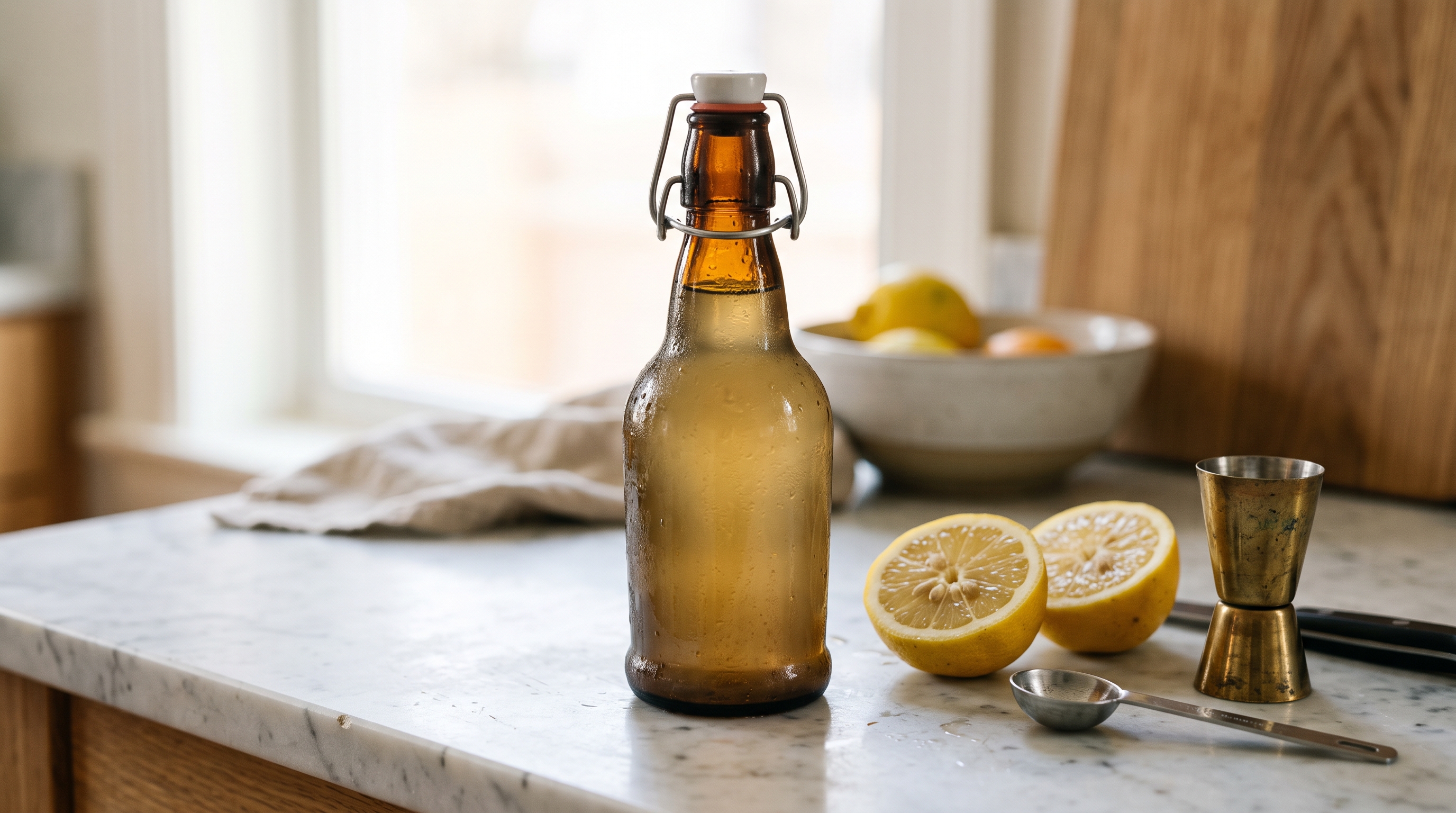
Cool fast — a cold water bath in the sink works — which locks the droplets in place before they have time to cream. Bottle in amber glass, label with the date and calculated dose per tablespoon, refrigerate.
Potency maths
Work from your flower’s certificate of analysis, not from the strain name.
The formula:
total mg THC ≈ grams × %THCA × 10 × 0.877 × efficiency
The 0.877 is real chemistry, not a fudge factor. THCA sheds a carbon dioxide molecule during decarboxylation, and THC’s molecular weight is about 87.7% of THCA’s. That mass is gone.
The efficiency term is the honest guess. It bundles incomplete decarboxylation, incomplete extraction into the oil, and everything left in the cheesecloth. Assume 50%. Some kitchens do better; assuming you did is how people get uncomfortable.
Worked example — 2 g of flower at 20% THCA:
| Step | Calculation | Result |
|---|---|---|
| THCA in the flower | 2 × 20 × 10 | 400 mg |
| Theoretical THC after decarb | 400 × 0.877 | 351 mg |
| Realistic yield at 50% | 351 × 0.5 | ~175 mg |
| Concentration in 350 ml | 175 ÷ 350 | 0.5 mg/ml |
| Measure | Volume | Approximate THC |
|---|---|---|
| 1 teaspoon | 5 ml | 2.5 mg |
| 1 tablespoon | 15 ml | 7.5 mg |
| 2 tablespoons | 30 ml | 15 mg |
Two points before you pour anything. That 50% is an assumption, not a measurement — the only way to know is to test it, so see how to test homemade edible potency at home. Until then, start at one teaspoon and treat the table as an upper bound. And if 7.5 mg per tablespoon is more than you want, halve the flower rather than diluting the finished bottle. More on running these numbers in edible dosing math for home cooks and the microdose vs. high dose guide.
Shelf life and storage
Sugar concentration drives everything. A 1:1 syrup by volume is around 50% sugar by weight, which leaves enough free water for mould to establish. A rich syrup at 2:1 sugar to water pushes past 65% and lasts substantially longer — the standard bartender’s trade-off. That said, yours is not a pure sugar syrup: it contains plant lipids and residual botanical matter, both of which shorten its life.
| Format | Refrigerated | Notes |
|---|---|---|
| 1:1 syrup | 2–4 weeks | Shake before every pour |
| 2:1 rich syrup | Up to ~2 months | Thicker, sweeter, more stable emulsion |
| Frozen in cube trays | 6+ months | One cube ≈ 15 ml; portioned doses, no shaking |
| Room temperature | Don’t | Warmth accelerates both creaming and spoilage |
An ounce of high-proof neutral spirit per 12 oz of syrup extends shelf life and helps hold the emulsion, but it makes the bottle alcoholic — which matters if you are serving someone who chose a mocktail on purpose.
Discard on any off smell, any change in cloudiness that shaking does not resolve, or any visible fuzz. Light and heat degrade THC over time, which is the case for amber glass and a cold dark shelf — same logic as storing flower properly and storing finished edibles.
Five drinks that actually work
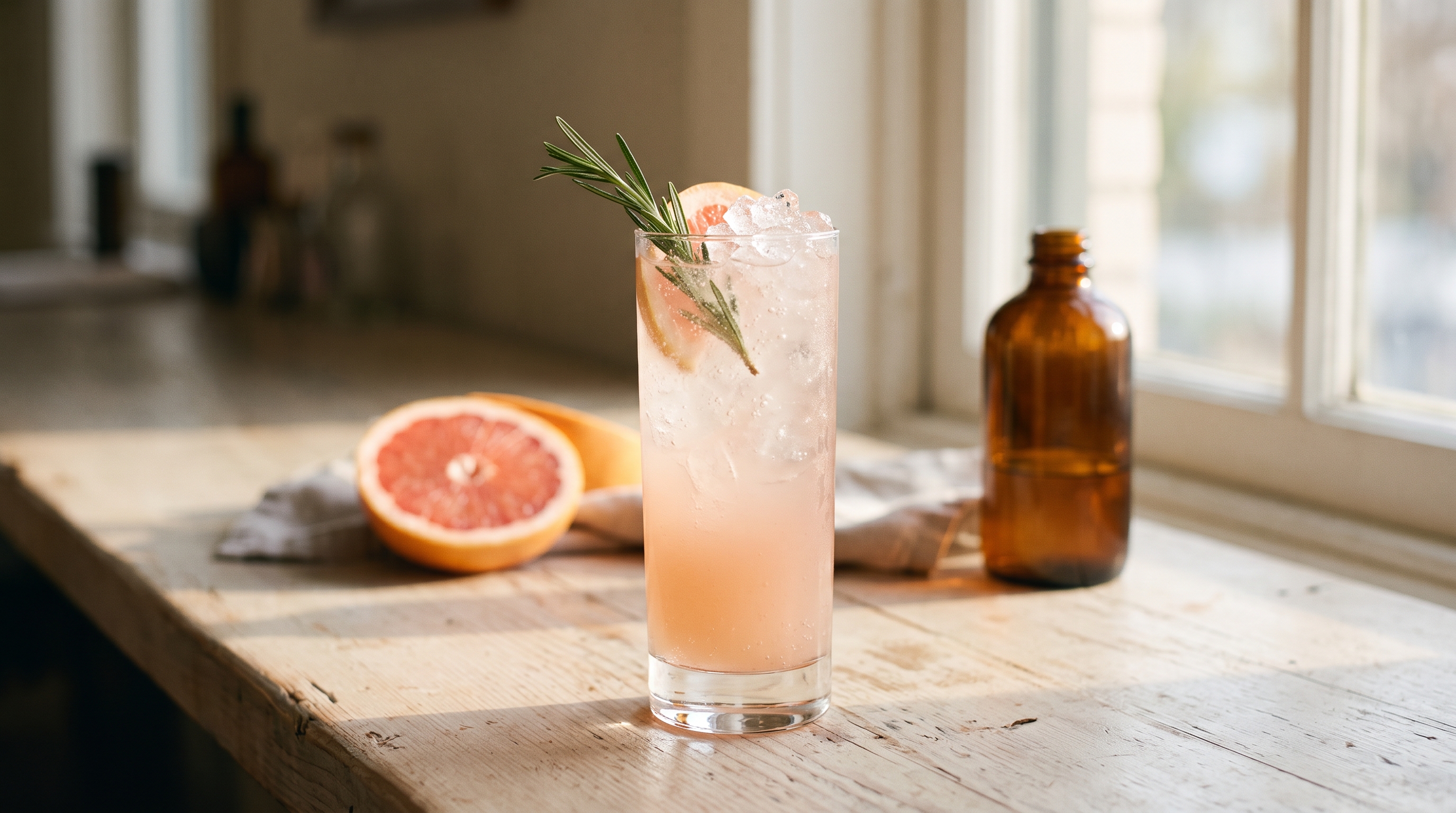
1. Grapefruit spritz. 15 ml syrup, 90 ml fresh grapefruit juice, soda water, ice, rosemary. Bitterness covers the vegetal note better than sweet juices do. Build on more mocktail formats here.
2. Infused iced tea. Brew strong black tea, chill, then add syrup to the cold tea. Tannins and cannabis flavour get along. Half tea, half lemonade makes an infused Arnold Palmer.
3. Coffee — with one rule. Add the syrup to steamed milk, then combine with the espresso. Poured straight into very hot black coffee the emulsion can break, leaving a ring of oil on top; milk fat gives the cannabinoids somewhere to go. Compare with the morning microdose approach.
4. Lemonade. Where gum arabic earns its place — it holds up at low pH where other emulsifiers fall apart. See the dedicated lemonade method.
5. Cream soda float. Syrup, soda water, a splash of vanilla, vanilla ice cream. The ice cream’s fat stabilises everything; the most forgiving application on this list.
Flavour direction comes from the terpenes in your starting flower. A limonene-forward chemovar like Super Lemon Haze, Tangie, Lemon Skunk or Clementine suits citrus drinks. Something myrcene-heavy like Granddaddy Purple leans evening and relax-high; a pinene-forward Jack Herer or Blue Dream sits closer to uplift-high. Chasing a specific calm or uplifted result? The terpene numbers on the COA tell you more than the name on the jar. If the plant flavour is what you object to, this piece on masking it is the better fix.
The safety part, which is not optional
Infused drinks are the format most likely to catch someone out, and the reason is behavioural rather than pharmacological.
A glass is a socially normal unit that invites topping up. Nobody eats a second brownie absent-mindedly. Everyone refills a glass absent-mindedly. The drink tastes like a drink, the ice melts, you top it up, and you have taken three doses in forty minutes without one deliberate decision.
Liquid doses are impossible to eyeball. A “splash” is anywhere from 5 ml to 25 ml — a 5 mg swing on this recipe. Use a measuring spoon or jigger every single time; a dosing device costs less than one bad evening.
Faster onset is not the same as safer. It narrows the window in which people re-dose out of impatience, which is genuinely useful. But even the fastest engineered formulations in the trials above peaked around an hour. The two-hour rule still stands.
Commercial beverages are not a reliable benchmark. The 2024 review found inaccurate cannabinoid labelling among beverage products, and reported aversive acute subjective and physiological effects in healthy, infrequent users (Froude et al., 2024).
Do not stack it with alcohol. A mocktail that is secretly a double is not a good surprise for anyone.
Label the bottle and keep it off the fridge door. A pale bottle of syrup beside the maple syrup is an accident waiting to happen. Write “INFUSED” and the mg per tablespoon on the front. If someone does overdo it, this guide covers what actually helps.
Where this leaves you
The name on the jar tells you almost nothing about what ends up in your glass. The COA percentage, your decarb temperature, your extraction efficiency and your choice of emulsifier all move the final number more than the strain does — and two jars sold under the same name can differ enough to halve your dose. Chemistry and your own individual response are what actually matter here.
Which is the argument for keeping notes: batch, calculated mg per tablespoon, how much you poured, when it landed, how it felt. Four batches in, you will know your real efficiency figure rather than my conservative 50%. Log it in the High IQ app and let the pattern surface on its own.
FAQ
Can I skip the oil step and infuse flower directly into sugar water? You can steep flower in hot syrup, and you will get colour, flavour and a genuinely pleasant herbal note. You will get very little THC, because cannabinoids do not dissolve in water. Treat direct-steeped syrup as a flavouring, not a dose.
Does lecithin make edibles stronger? It is an excellent emulsifier — that part is well established. The claim that it increases potency or absorption is repeated constantly and, as far as I can find, has not been tested in a human trial. Use it for texture and stability. Do not adjust your dose upward expecting it to do more.
Will my syrup be clear like a shop-bought THC seltzer? No. Transparency requires droplets small enough to stop scattering light, which needs a high-pressure homogeniser or ultrasonicator. A blender gets you a stable cloudy emulsion, which works fine — it just looks homemade. Only a commercial water-soluble emulsion will give you clarity.
Can I use a glycerin tincture instead of infused oil? You can, and it disperses more easily. But cannabinoids are not especially soluble in glycerin either, so glycerin tinctures generally carry less THC per millilitre than oil or alcohol ones. You will need more, and it is sweeter. The maple syrup method covers this route in more detail.
How long until I feel it, and can I store it in the cupboard? Plan for the standard edible range and be pleasantly surprised if it is quicker — the published human numbers for engineered fast-onset formulations cluster around an hour to peak, and a blender emulsion is not an engineered formulation. Wait two hours before considering more. As for storage: refrigerate or freeze. The oil and plant matter make this a poor candidate for the cupboard regardless of sugar content.
Sources
- Garrett, E.R., & Hunt, C.A. (1974). “Physiochemical properties, solubility, and protein binding of delta9-tetrahydrocannabinol.” Journal of Pharmaceutical Sciences, 63(7), 1056–1064. DOI: 10.1002/jps.2600630705 · PMID: 4853640
- Huestis, M.A. (2007). “Human cannabinoid pharmacokinetics.” Chemistry & Biodiversity, 4(8), 1770–1804. DOI: 10.1002/cbdv.200790152 · PMID: 17712819
- Wang, M., Wang, Y.H., Avula, B., Radwan, M.M., Wanas, A.S., van Antwerp, J., Parcher, J.F., ElSohly, M.A., & Khan, I.A. (2016). “Decarboxylation Study of Acidic Cannabinoids: A Novel Approach Using Ultra-High-Performance Supercritical Fluid Chromatography/Photodiode Array-Mass Spectrometry.” Cannabis and Cannabinoid Research, 1(1), 262–271. DOI: 10.1089/can.2016.0020 · PMID: 28861498
- Atsmon, J., Cherniakov, I., Izgelov, D., Hoffman, A., Domb, A.J., Deutsch, L., Deutsch, F., Heffetz, D., & Sacks, H. (2018). “PTL401, a New Formulation Based on Pro-Nano Dispersion Technology, Improves Oral Cannabinoids Bioavailability in Healthy Volunteers.” Journal of Pharmaceutical Sciences, 107(5), 1423–1429. DOI: 10.1016/j.xphs.2017.12.020 · PMID: 29287930
- Knaub, K., Sartorius, T., Dharsono, T., Wacker, R., Wilhelm, M., & Schön, C. (2019). “A Novel Self-Emulsifying Drug Delivery System (SEDDS) Based on VESIsorb Formulation Technology Improving the Oral Bioavailability of Cannabidiol in Healthy Subjects.” Molecules, 24(16), 2967. DOI: 10.3390/molecules24162967 · PMID: 31426272
- Ewell, T.R., Abbotts, K.S.S., Williams, N.N.B., Butterklee, H.M., Bomar, M.C., Harms, K.J., Rebik, J.D., Mast, S.M., Akagi, N., Dooley, G.P., & Bell, C. (2021). “Pharmacokinetic Investigation of Commercially Available Edible Marijuana Products in Humans: Potential Influence of Body Composition and Influence on Glucose Control.” Pharmaceuticals, 14(8), 817. DOI: 10.3390/ph14080817 · PMID: 34451914
- Froude, A.M., Pangborn, N., Britz-McKibbin, P., MacKillop, J., & Balodis, I. (2024). “Potential Risks from Cannabis-Infused Beverages: A Critical Review.” Cannabis, 7(3), 134–166. DOI: 10.26828/cannabis/2024/000271 · PMID: 39781553
