Is Pipe Resin Safe to Smoke? What a Lab Test of Bowl Scrapings Found
Can you smoke resin? No study shows it is safe. One lab test of bowl scrapings found real THC but never identified the other 85%. Here is what is known.

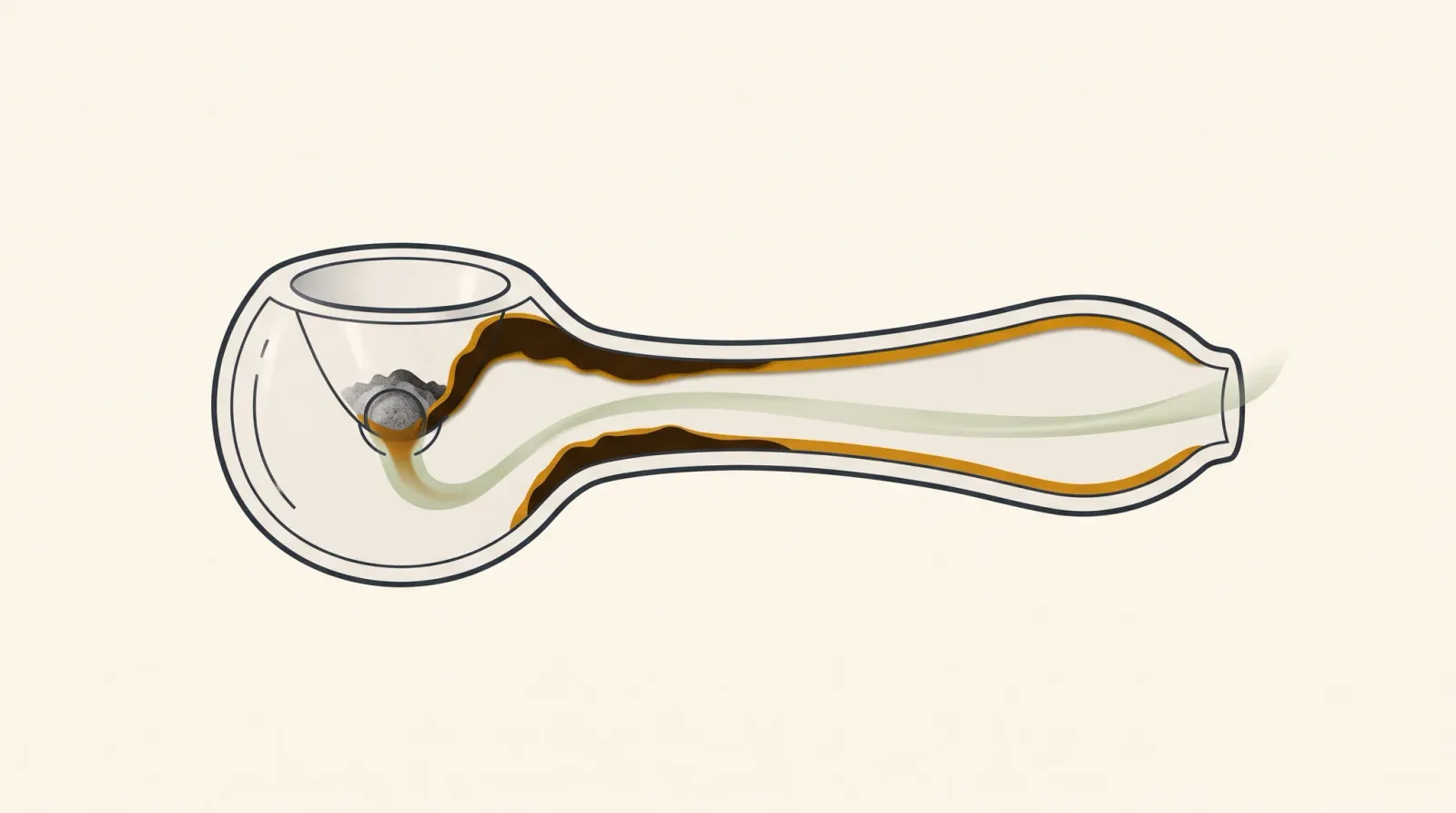
No study has shown that pipe resin is safe to smoke: the one lab test of bowl scrapings found real THC, but it never identified the rest of the residue, and that residue has already been through a flame once. So the honest answer to “can you smoke resin?” is that people do, and nobody has measured what they are inhaling when they do.
Here is the specific worth knowing. A cannabis testing lab once scraped about 140 mg of resin and ash out of a glass bowl and ran it through a cannabinoid test. It found 14.8% cannabinoids by weight, 11.9% of it THC (MCR Labs blog, 2014). So the popular line that pipe resin has “almost no THC” is wrong for the only sample anyone seems to have tested. The other roughly 85% was never identified. That breaks two myths at once: resin is not empty, and it is not harmless leftovers either.
This lesson covers hand pipes and bongs used for flower. If you use a dab rig, dab reclaim is a different material with its own lab numbers.
What is the black resin in a pipe?
Pipe resin is the dark, sticky deposit that builds up inside a pipe or bong as smoke cools on the glass. It forms along the path the smoke travels: the bowl hole, the stem and the mouthpiece. It gets thicker the longer you go between cleanings.
Smoke carries tar and cannabinoids together, and some of both stick to the piece on the way through. Dale Gieringer’s water pipe report names “adhesion to the pipestem and bowl” as one place THC goes when cannabis is burned (MAPS Bulletin, 1996). That report quotes an older figure that 60% to 80% of the THC burned in joints or water pipes is lost to several routes combined, but the figure is secondhand and lumps adhesion together with smoke that drifts away and THC destroyed by heat. It does not tell you how much ends up in resin.
Resin is also not the same as ash. Ash is what is left in the bowl after the plant burns. Ash color is its own myth, and it says little about the flower. Resin is what the smoke leaves on the glass.
How fast it builds depends on the piece. Narrow stems clog first, which is why one-hitters clog fastest and why some hand pipe shapes need cleaning more often than others. Material matters too; see which pipe materials hold residue.
What did the lab actually find in bowl resin?
In 2014, a research scientist at MCR Labs, a Massachusetts cannabis testing lab, scraped his own glass bowl with a metal knife. He described the bowl as overdue for a cleaning. The lab measured six cannabinoids with a standard HPLC method (MCR Labs blog, 2014).
| Compound | Share of the scraping by weight |
|---|---|
| THC | 11.9% |
| CBN | 1.4% |
| CBD | 0.9% |
| THCA | 0.5% |
| CBDA | 0.1% |
| Delta-8 THC | under 0.1% |
| Total cannabinoids measured | 14.8% |
| Everything else | Not identified |
Two things stand out. Most of the cannabinoid content was THC, already activated by heat, with only a little THCA left. CBN, which forms as THC breaks down, also showed up.
Now the limits, because they matter as much as the numbers:
- It is one sample. One bowl, one person, one scraping of about 140 mg, mixed with ash.
- It is a lab blog post, not a peer-reviewed study. The author is clear about that.
- It only looked for six cannabinoids. The author writes that the test “does not inform what other compounds are present.”
- It measured nothing about effects. No one smoked the sample for the test.
So do not repeat this as “pipe resin is 15% THC.” Repeat it as “the only test found real THC, and it did not look for anything else.”
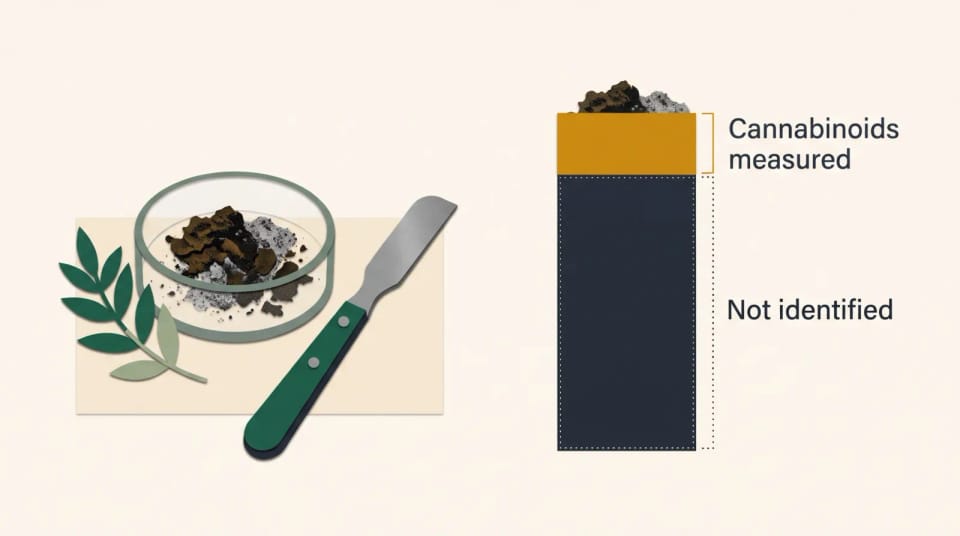
The 2014 lab test looked for six cannabinoids only. The larger share of the scraping was never identified, so no one can say from this test what it contains.
What is in the other 85% of pipe resin?
Nobody has published a measurement of it that I could find. That is the plain answer. Searches of the medical literature for analyses of cannabis pipe or bong residue turned up nothing on its toxicant content. That is not proof no such study exists, but it means anyone who lists the exact poisons in your pipe resin is guessing.
What is measured is the smoke that the resin comes from. Burning cannabis makes smoke with many of the same harmful chemicals as tobacco smoke:
- A Health Canada team machine-smoked cannabis and tobacco cigarettes side by side. Cannabis smoke had up to 20 times the ammonia of tobacco smoke, three to five times the hydrogen cyanide and some nitrogen oxides, and known carcinogens were present in both (Moir et al., 2008).
- A small 1988 study of 15 men found that a cannabis cigarette delivered about three times as much inhaled tar as a tobacco cigarette, and about a third more tar stayed in the lungs (Wu et al., 1988).
- California lists marijuana smoke under Proposition 65 as a chemical known to cause cancer (OEHHA, 2009).
Notice what every one of those sources measured: smoke, not residue. You will see pages claim that resin “concentrates” PAHs, benzene or carbon monoxide. No source behind them measured that, and carbon monoxide is a gas, so it does not collect in resin at all. For more on that gas, see what else is in cannabis smoke.
Is smoking resin worse than smoking flower?
That has not been tested. There is a reasonable worry behind the question, but a worry is not a result.
The worry goes like this. Resin is material that has already been near a flame once. Heating cannabis compounds makes new ones. Bench studies that heated THC and terpenes in dab and vape setups found products such as benzene and methacrolein forming (Meehan-Atrash et al., 2017; Meehan-Atrash et al., 2019). Those studies used fresh THC and terpenes, though, not old pipe resin. Whether burning resin a second time makes more of anything is a sensible hypothesis that nobody has measured.
The same honesty runs the other way. A 2018 review of cannabis and the lungs found that regular smoking is linked to cough and bronchitis symptoms, but large studies have not shown a clear link to lung cancer (Tashkin, 2018). That review is about smoking flower. It says nothing about resin either way.
So the fair comparison looks like this:
| Question | Flower smoke | Pipe resin |
|---|---|---|
| Cannabinoids measured? | Yes, in many studies | Once, in one bowl scraping |
| Toxicants in the smoke measured? | Yes (Moir et al., 2008) | No |
| Classified as a carcinogen? | Marijuana smoke is listed in California | Not classified or tested |
| Human health outcomes studied? | Yes, with mixed findings | No |
| Heated before? | No | Yes, the deposit comes from smoke |
People often say resin smoke is harsh, tastes bad and gives them a headache or sore throat. Those are common user reports. No study has tested them.
Does pipe resin get you high?
It contains THC, so it can deliver some. Beyond that, there is no human data. The lab author recalled a “sub-par buzz” from scraping a bowl in his youth, but that is one memory, not a measurement, and he called smoking scrapings “pretty desperate, not something you should do” (MCR Labs blog, 2014).
There is also no way to judge a dose. A crumb of resin is mostly material no one has identified, and its THC share will differ from pipe to pipe. If a strain or product you care about worked well for you, the High IQ app lets you log how it went so you can find it again instead of chasing what is stuck to the glass.
Is pipe resin the same as reclaim, rosin or live resin?
No. The shared word “resin” is the source of most of the confusion.
- Pipe resin is a deposit from burned flower smoke on the inside of a pipe or bong. That is this lesson.
- Dab reclaim is concentrate that condenses in a dab rig after vaporizing. Four reclaim samples tested by the same lab held between 23.3% and 58.5% THC, and older, darker samples had less THC and more CBN (MCR Labs blog, 2014). Our cannabis reclaim lesson covers it.
- Rosin and live resin are concentrates made on purpose from fresh or frozen plant material. They are products, not leftovers.
- Already vaped bud is another leftover entirely; see what to do with already vaped bud.
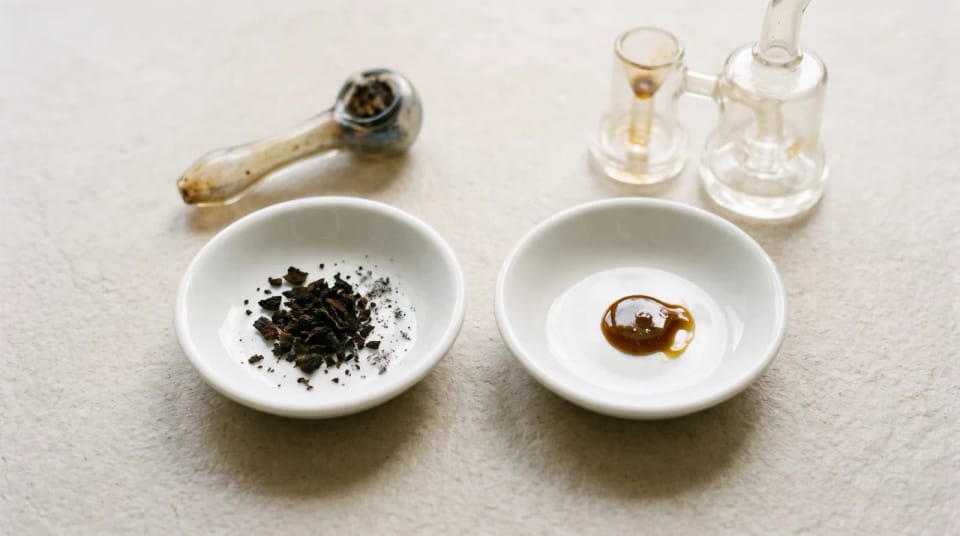
Both get called resin, but they come from different processes. Lab numbers for dab reclaim do not describe what builds up in a flower pipe.
What should you do with pipe resin instead?
Clean it out. Our bong cleaning guide walks through the alcohol and coarse salt method and how often to do it, and the same idea works for hand pipes. Cleaning often keeps the deposit thin, which makes the job faster and keeps airflow open.
If you mostly use a bong, an ash catcher changes where ash and resin end up, so less of it lands in the main piece. For the smoke itself, water pipes and the tar-to-cannabinoid ratio covers what water filtration does and does not do.
When should you talk to a clinician?
Talk to a doctor or other clinician if you have a cough that does not go away, wheezing, chest pain, shortness of breath, or you are coughing up blood. Those symptoms deserve a proper look whatever you smoked, and being open about cannabis use helps a clinician help you. If smoke makes you cough day to day, why cannabis makes you cough explains the common reasons.
Key takeaways
- No study has shown pipe resin is safe to smoke, and no study has measured its toxicants.
- The one lab test of bowl scrapings found 14.8% cannabinoids by weight, mostly THC. “Almost no THC” is wrong for that sample.
- That test was one sample from one bowl, posted on a lab blog, and it looked only for cannabinoids.
- Cannabis smoke contains known toxicants, and California lists it as a carcinogen. Those findings describe smoke, not resin.
- Pipe resin is not dab reclaim, rosin or live resin. Clean it out rather than smoke it.
FAQ
Can you smoke resin from a pipe or bong?
You physically can, and some people do. No study has shown it is safe, and the only lab test of bowl resin did not measure anything except six cannabinoids. Cleaning the piece is the option with no unknowns attached.
Is bong resin bad for you?
No one has measured what bong resin contains beyond cannabinoids, so no one can give it a safety score. What is known is that cannabis smoke, the source of the resin, contains many of the same harmful chemicals as tobacco smoke. Treat the resin as an untested leftover of that smoke.
What is the black tar in my pipe made of?
It is a deposit left by cooling smoke on the glass. One lab test of scrapings found about 15% cannabinoids by weight, mostly THC, mixed with ash. The rest of it was not identified, so any detailed ingredient list you see is a guess.
Does pipe resin have THC in it?
Yes, at least in the one sample that was tested. Scrapings from a glass bowl held 11.9% THC by weight. That is one bowl, so your pipe could hold more or less.
Is pipe resin the same as reclaim?
No. Pipe resin builds up from burned flower smoke in a pipe or bong. Reclaim is vaporized concentrate that collects in a dab rig, and tested reclaim samples held far more THC. Lab numbers for one do not apply to the other.
Sources
- MCR Labs blog post on a dirty glass bowl, S. Churchill, 2014. One bowl scraping, cannabinoid panel only, not peer reviewed.
- MCR Labs blog post testing dab reclaim, J. Wani, 2014. Four dab-rig reclaim samples.
- Moir and colleagues on marijuana and tobacco smoke chemistry, Chemical Research in Toxicology, 2008. DOI: 10.1021/tx700275p
- Wu and colleagues on the pulmonary hazards of marijuana and tobacco, New England Journal of Medicine, 1988. DOI: 10.1056/NEJM198802113180603
- Gieringer water pipe and vaporizer report, MAPS Bulletin, 1996.
- OEHHA Proposition 65 listing of marijuana smoke, California Office of Environmental Health Hazard Assessment, 2009.
- Tashkin review of marijuana and lung disease, Chest, 2018. DOI: 10.1016/j.chest.2018.05.005
- Meehan-Atrash and colleagues on toxicants formed in dabbing, ACS Omega, 2017. DOI: 10.1021/acsomega.7b01130
- Meehan-Atrash and colleagues on gas-phase products from cannabis vaping and dabbing, ACS Omega, 2019. DOI: 10.1021/acsomega.9b02301





