How to Make Weed Last Longer: What the Measurements Say
Measured joints hold 0.07 to 0.88 g of flower, so one eighth is 4 to 50 joints. See which ways to make weed last longer have evidence and which do not.

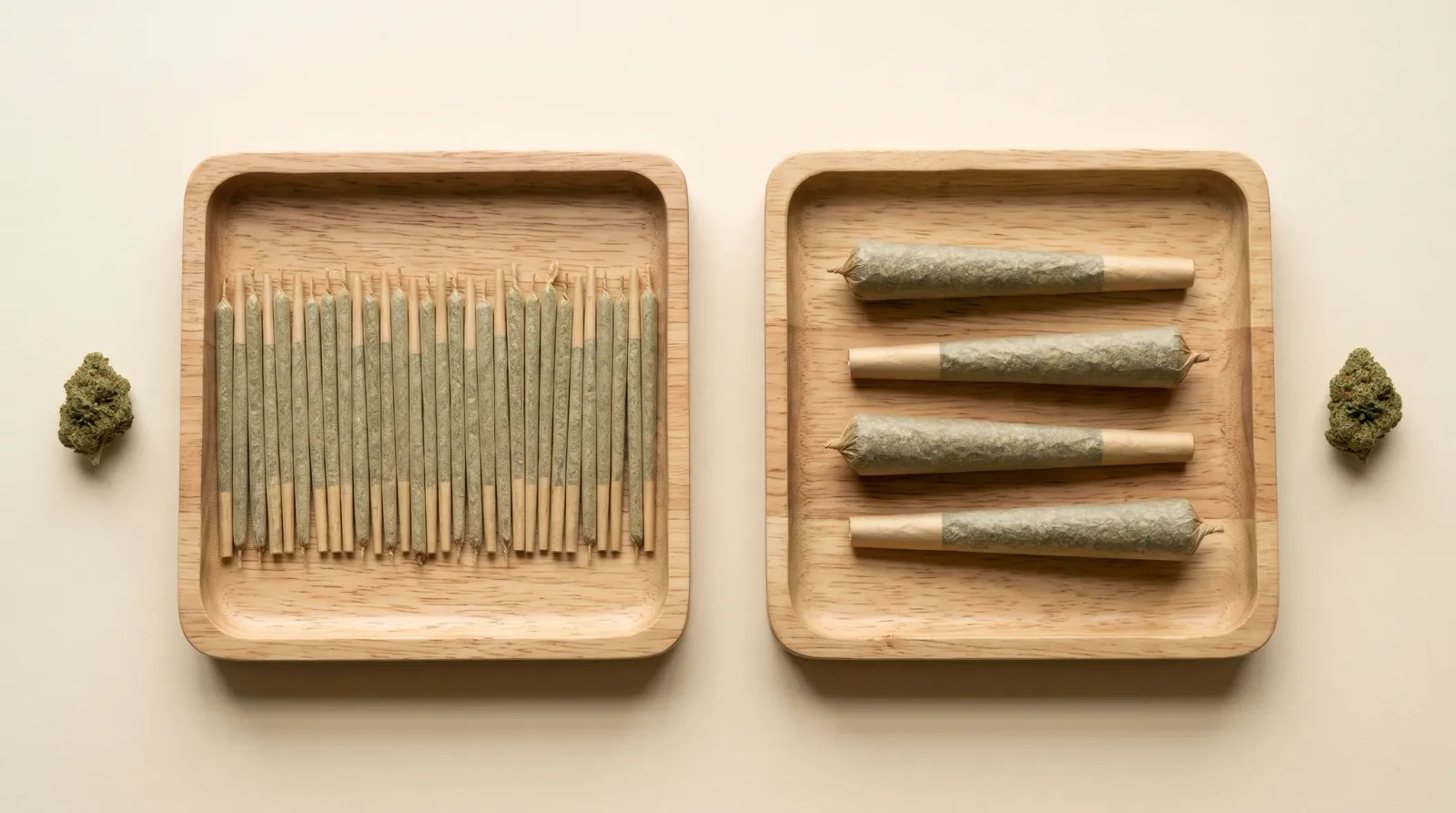
The biggest lever is how much flower you put in each session, because measured joints range from 0.07 to 0.88 grams, which makes one eighth anywhere from about 4 to about 50 joints. Most popular tips, such as vaping, storage jars, stronger weed and tolerance breaks, have weaker evidence than that one simple measurement.
Here is the number to send a friend who says an eighth “should” last a week. Researchers in the Netherlands weighed the joints that 106 frequent users rolled from their own cannabis. The lightest held 0.07 g and the heaviest held 0.88 g (van der Pol and colleagues, 2013). Same habit, same name for it, a twelve-fold difference in flower. No tip about jars or lighters comes close to that.
This lesson is about lawful adult use where cannabis is legal. Below, I sort each popular tip into three groups: measured, mechanism only, and not tested. If you need the units first, see what an eighth and an ounce weigh.
Studies checked October 29, 2026.
How long does an eighth of weed last?
No study can tell you, because the answer depends mostly on how much you use each time and how often. Tables that say “an eighth lasts 3 to 5 days” have no measurement behind them.
The measurements we do have show spread, not a typical number. In an Australian experiment, 31 participants rolled joints “as they would typically” with oregano standing in for cannabis. Their joints weighed 0.10 to 1.25 g, and daily users rolled about three times as much into a joint as non-daily users (Dawson and colleagues, 2023). In large US online surveys, people who used only flower reported a median of 1 to 1.5 g per using day (Borodovsky and colleagues, 2025). That is self-report from a mostly daily-use sample, so it tells you about that group, not about you.
So I will not give you a day count. I will give you arithmetic you can run on your own habit.
Worked arithmetic: joints per eighth and per ounce
This table is our calculation from the measured range above. It is not data from a study, and no row is “typical”. The cost column uses a round $10 per gram only to show the math; it is not a market price.
| Flower per joint | Joints from 3.5 g (an eighth) | Joints from 28 g (an ounce, rounded) | Cost per joint at $10 per gram |
|---|---|---|---|
| 0.07 g | 50 | 400 | $0.70 |
| 0.1 g | 35 | 280 | $1.00 |
| 0.25 g | 14 | 112 | $2.50 |
| 0.5 g | 7 | 56 | $5.00 |
| 0.88 g | about 4 | about 32 | $8.80 |
The formula is short: cost per session = price per gram × grams per session. For real prices, use our dated state price data. A true ounce is 28.35 g; I rounded to 28 g to keep the math clean.
How do I find out how much I use per session?
Count how many joints or bowls you get from one gram, then divide. If one gram makes four joints, each joint is about 0.25 g.
This sounds crude, but it held up. In the Dutch study, a “joints per gram” question estimated the group’s average dose per joint accurately when compared with weighed joints. A prompt card with pictures underestimated it (van der Pol and colleagues, 2013). Individual answers were less precise than the group average, so a kitchen scale beats a guess when you have one.
Do not count “hits” instead. In a US survey of 2,381 adults, people’s own grams-per-hit figures were often 50 percent larger or smaller than the 0.06 g per hit that earlier research assumed (Borodovsky and colleagues, 2023). A hit is not a fixed amount of flower.
Does a smaller bowl or a one-hitter save weed?
It uses less flower per session, which is the measured lever, but no trial has tested whether it changes how long a supply lasts for a given person. That gap matters, because a smaller session only saves weed if you do not add more sessions.
The Australian study gives a sense of scale. Packed bong cones held 0.03 to 0.41 g, far less than the joints in the same study (Dawson and colleagues, 2023). A one-hitter and dugout works on the same idea: a small, fixed load.
Cornering a bowl, which means lighting one edge instead of the whole surface, has never been measured as a way to save flower. Our guide to cornering a bowl explains why it is still sensible: flower that burns while nobody is drawing becomes smoke that no one inhales.
Where does the flower in a joint actually go?
Much of the THC in a joint never reaches the smoker, and how much does depends heavily on how the joint is smoked. That is why technique and method can matter as much as the weed.
Three things take a share. Some THC is destroyed by burning. Some leaves in sidestream smoke from the lit end between pulls. Some stays in the roach. A review of human data reports smoked THC bioavailability from 2 to 56 percent, partly because people smoke so differently, and estimates about 8 to 24 percent for typical delivery (Huestis, 2007). An older review gives an average near 30 percent (McGilveray, 2005). A machine-smoking study recovered about 19 to 27 percent of the THC in flower, and its authors noted that real joints lose more to sidestream smoke (Hädener and colleagues, 2019).
Those figures disagree, and that is the honest answer. No one number describes your joint. Our ranking of bioavailability by method covers the other routes.
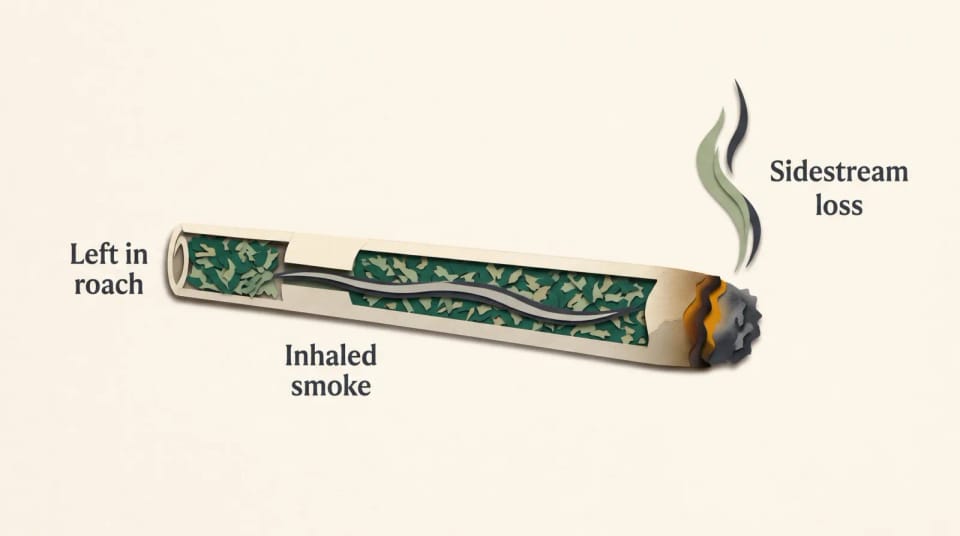
Burning, sidestream smoke and the roach all take a share of a joint. Studies disagree on how big each share is, so the diagram shows the paths, not the amounts.
Does a vape use less weed than a joint?
In one controlled trial, the same THC dose gave higher blood THC when vaporized than when smoked, but the gap was about 1.4 times, not the “half the weed” figure you see repeated. Another trial found little difference.
In a double-blind crossover trial, 17 healthy adults who rarely used cannabis took 25 mg of THC in flower both ways. Peak blood THC averaged 14.4 ng/mL vaporized and 10.2 ng/mL smoked, and most effects were stronger after vaping (Spindle and colleagues, 2018). An earlier pilot with 18 inpatients found similar peak blood THC from a vaporizer and a smoked cigarette (Abrams and colleagues, 2007).
Bench tests add a device caveat. Four electric vaporizers released between 54.6 and 82.7 percent of the THC in flower into their vapor, depending on the device (Lanz and colleagues, 2016). Vapor in a machine is not THC in a person, so that range tells you devices differ, not how much reaches you.
Put together: a vaporizer may get more out of the same flower, and it avoids burning between pulls. No study has measured whether vaping makes a supply last longer. If you try it, our dry herb vaporizer temperature guide helps you avoid wasting the first session. When you finish, already vaped bud still has uses.
Does stronger weed last longer?
Not reliably, because studies disagree on whether people roll less of stronger cannabis. “Buy stronger and use less” is a hope, not a finding.
The evidence points both ways:
| Study | Who | What happened with stronger cannabis |
|---|---|---|
| Freeman and colleagues, 2014 | 247 UK users, own cannabis weighed and tested | Rolled slightly less per joint |
| van der Pol and colleagues, 2014 | 98 Dutch heavy users, own cannabis | Rolled slightly more per joint, inhaled less smoke, and still took in more THC |
| Dawson and colleagues, 2023 | 31 Australian participants, oregano task | Adjusted for stated potency, but not in proportion and not the same way across joints, spliffs and cones |
| Borodovsky and colleagues, 2025 | 8,158 US survey respondents | Within flower, higher THC went with larger amounts, which the authors suspect reflects tolerance |
A review of studies from 1973 to 2020 found “some evidence” that occasional users adjust their dose to potency and “less evidence” that regular users do (Leung and colleagues, 2021). If you want the label math behind a joint, see potential THC in a joint.
Does a tolerance break save money?
It might, because tolerance is real, but no study has measured grams saved after a break. That claim is a reasonable guess built on a mechanism.
A systematic review found that acute effects are generally weaker in regular users and that tolerance develops more for some effects than others (Colizzi and Bhattacharyya, 2018). Brain imaging has shown that CB1 receptor changes in daily smokers can reverse (Hirvonen and colleagues, 2012). Whether that turns into fewer grams per week for you has not been tested.
For the timing and what to expect, read our guide to a tolerance break, and see why feeling less high is only one measure of tolerance.
Does storage make weed last longer?
Storage protects potency, but it does not stretch a supply. A sealed jar keeps what you have closer to what you bought; it does not add sessions.
The loss is slow. In a four-year study of seized high-potency samples, THC fell and CBN rose at room temperature, and almost all the THC was gone after four years. Heat sped up the change, and light changed both its speed and its products (Zamengo and colleagues, 2019). In Austrian seized flower, warm storage pushed THCA to convert to THC, while cold storage changed it little (Taschwer and Schmid, 2015). That conversion is a change of form, not a loss of total potency.
These are forensic samples, not kitchen jars, so I will not give you a shelf life in months. For containers and humidity, see how to store cannabis and our guide to humidity packs.
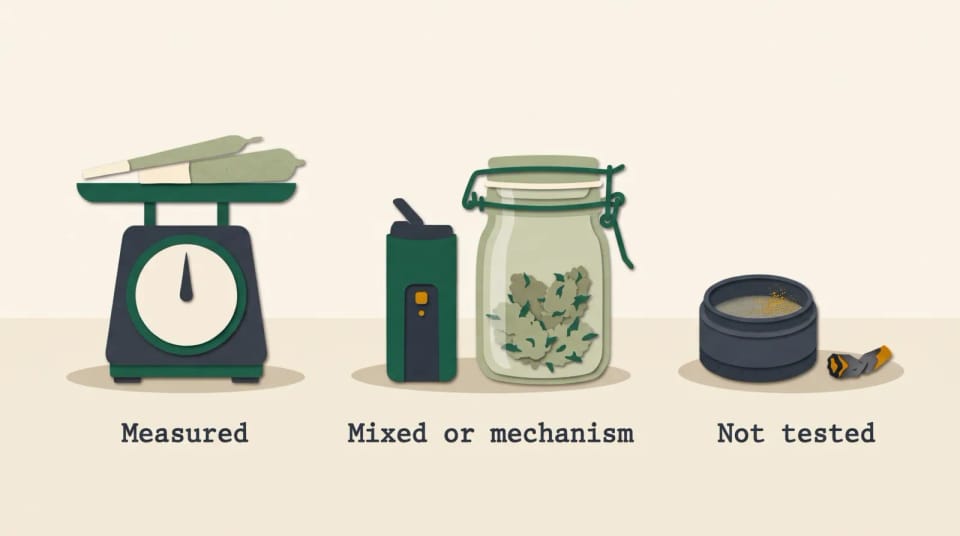
Session size has been measured. Vaping rests on mixed trials, and storage and tolerance breaks rest on mechanisms. Kief and saved roaches have not been tested as ways to stretch a supply.
Do kief, shake and roaches really help?
They use flower you already paid for, but no study has tested them as a way to make a supply last. They are thrift, not evidence.
The kief in a grinder catcher is trichome material that would otherwise sit unused. Our guide to what to do with kief covers how people use it. Food tricks are a different matter. The mango claim has no human evidence that a fruit stretches a high.
How to make weed last longer, step by step
- Find your grams per session. Count joints or bowls per gram, then divide one gram by that count.
- Put less in each session. Roll thinner, or use a smaller bowl, cone or one-hitter. Keep the number of sessions the same.
- Burn less between pulls. Light one edge and take the flame away when nobody is drawing.
- Consider a dry herb vaporizer. One trial found more THC delivered from the same flower; another found little difference.
- Store the rest cool, dark and sealed. This slows potency loss; it does not add grams.
- Use what you already collected. Kief and already vaped bud are flower you paid for.
If you want to see whether a smaller session still works for you, the High IQ app lets you log how a strain worked each time, so you are comparing notes instead of memories.
When should you talk to a clinician?
“Make it last longer” should mean less per week, not the same amount spread thinner and used more often. If you keep using more than you intended, find it hard to cut back, or feel irritable, anxious or unable to sleep when you stop, talk to a clinician. A clinician can talk through options without judgement. This lesson is about everyday habits, not medical dosing; if you use cannabis for a health condition, change your dose only with your clinician.
Key takeaways
- The amount per session is the measured lever: weighed joints ran from 0.07 to 0.88 g.
- One eighth works out to about 4 to 50 joints, depending on joint size. That is arithmetic, not a typical figure.
- Vaping delivered about 1.4 times more blood THC than smoking at the same dose in one trial; another trial found similar levels.
- Studies disagree on whether people use less of stronger cannabis.
- Tolerance breaks and storage rest on mechanisms, not on measured grams saved.
FAQ
How long should an eighth last a daily user?
No study gives a reliable answer, because amounts per session vary so much. Weighed joints ranged from 0.07 to 0.88 g in one study, so the same eighth can be 4 sessions or 50. Count your joints per gram and run the arithmetic for your own habit.
Does a vape really use half as much weed?
No study shows that. In one trial, vaporized flower gave about 1.4 times the peak blood THC of the same smoked dose, and an earlier pilot found similar levels. A vaporizer may get more from the same flower, but the size of the saving is not established.
Are ounces cheaper than eighths?
Not always. A larger package can cost less per gram, but a discount on a smaller package can reverse that, and buying more can also mean using more. Check the price per gram on the menu, and see our price guide for dated state figures.
How long does weed stay fresh?
It loses potency slowly, faster in heat and light. Forensic studies tracked samples for years and found almost all the THC gone after four years at room temperature. Cool, dark, sealed storage slows the change, but no study supports a shelf life in a set number of months.
Sources
- Abrams DI and colleagues. “Vaporization as a smokeless cannabis delivery system: a pilot study.” Clinical Pharmacology & Therapeutics, 2007. PubMed 17429350
- Borodovsky JT and colleagues. “Exploring survey methods for measuring consumption quantities of cannabis flower and concentrate products.” American Journal of Drug and Alcohol Abuse, 2023. PMC10795727
- Borodovsky JT and colleagues. “Self-titration of cannabis consumption: an epidemiological perspective.” Journal of Psychiatric Research, 2025. PMC12919386
- Colizzi M, Bhattacharyya S. “Cannabis use and the development of tolerance: a systematic review of human evidence.” Neuroscience & Biobehavioral Reviews, 2018. PubMed 30056176
- Dawson D and colleagues. “How much cannabis is used in a joint in Australia? An experimental investigation into use by potency and frequency.” Drug and Alcohol Review, 2023. PubMed 37717253
- Freeman TP and colleagues. “Just say ‘know’: how do cannabinoid concentrations influence users’ estimates of cannabis potency and the amount they roll in joints?” Addiction, 2014. PubMed 24894801
- Hädener M and colleagues. “A preliminary investigation of lung availability of cannabinoids by smoking marijuana or dabbing BHO and decarboxylation rate of THC- and CBD-acids.” Forensic Science International, 2019. PubMed 30638755
- Hirvonen J and colleagues. “Reversible and regionally selective downregulation of brain cannabinoid CB1 receptors in chronic daily cannabis smokers.” Molecular Psychiatry, 2012. PubMed 21747398
- Huestis MA. “Human cannabinoid pharmacokinetics.” Chemistry & Biodiversity, 2007. PMC2689518
- Lanz C and colleagues. “Medicinal cannabis: in vitro validation of vaporizers for the smoke-free inhalation of cannabis.” PLoS ONE, 2016. PubMed 26784441
- Leung J and colleagues. “Do cannabis users reduce their THC dosages when using more potent cannabis products? A review.” Frontiers in Psychiatry, 2021. PubMed 33679486
- McGilveray IJ. “Pharmacokinetics of cannabinoids.” Pain Research & Management, 2005. PubMed 16237477
- Spindle TR and colleagues. “Acute effects of smoked and vaporized cannabis in healthy adults who infrequently use cannabis: a crossover trial.” JAMA Network Open, 2018. PubMed 30646391
- Taschwer M, Schmid MG. “Determination of the relative percentage distribution of THCA and Δ9-THC in herbal cannabis seized in Austria.” Forensic Science International, 2015. PubMed 26247127
- van der Pol P and colleagues. “Validation of self-reported cannabis dose and potency: an ecological study.” Addiction, 2013. PubMed 23627816
- van der Pol P and colleagues. “Cross-sectional and prospective relation of cannabis potency, dosing and smoking behaviour with cannabis dependence: an ecological study.” Addiction, 2014. PubMed 24628797
- Zamengo L and colleagues. “The role of time and storage conditions on the composition of hashish and marijuana samples: a four-year study.” Forensic Science International, 2019. PubMed 30901710





