What to Do With Weed Roaches: What Is Left and What Nobody Has Tested
A weed roach still holds THC, but no study has tested smoking, cooking or storing one. Here is what a lab measured and how to throw roaches away safely.

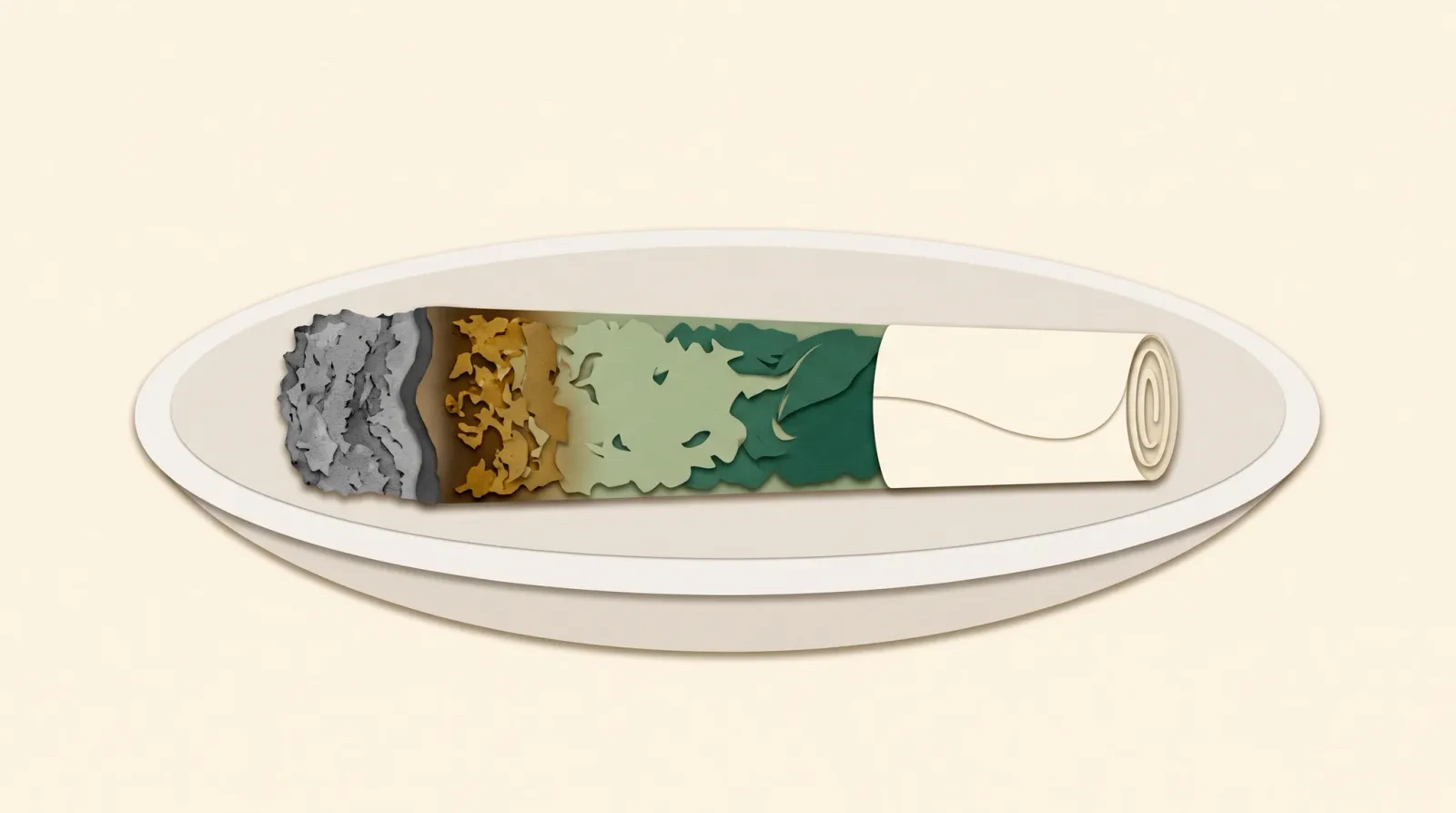
A roach is not empty: in a smoking-machine study, the unsmoked end of a cannabis cigarette held more THC per gram than the flower it started as, but no study has tested smoking, cooking or storing roaches, so the only option with official guidance is to throw them away safely. That is the honest short answer. Everything else people do with roaches, from re-rolling to roach butter, is folk practice that nobody has measured.
Here is the part worth sending to the friend with a jar of roaches on the shelf. In a 2024 study, after three quarters of a cannabis cigarette was smoked by machine, the leftover end had a higher THC concentration than unsmoked flower. Much of its THCA had already converted to THC. Heavier terpenes such as caryophyllene were richer, and lighter ones such as myrcene and limonene were lower. Eyal et al., 2024
So the leftover end is not spent. It is also not a known quantity. This High School lesson sorts every option into three groups: what has official guidance, what was measured in a lab, and what is simply habit.
What is actually left in a roach?
A roach is the burned-down end of a joint or blunt, and the flower inside it is changed, not used up. As a joint burns, heat moves ahead of the flame. It converts some THCA to THC and moves compounds toward the mouth end.
The clearest measurement comes from Eyal and colleagues. They filled commercial cone tubes with ground flower and smoked them on a machine with fixed puff settings. Then they analysed the unsmoked part after one quarter, one half or three quarters had burned. Eyal et al., 2024, PubMed
What they found in that leftover material:
- THC concentration went up. Every residue held more THC per gram than the unsmoked control flower. Total THC was significantly higher after half or three quarters had burned.
- THCA went down. After three quarters burned, THCA was lower than in the control, because heat had converted it. In the section nearest the burn, the share of total THC already in active form rose from about 5 percent to about 47 percent after just one quarter was smoked.
- The terpene mix shifted. Linalool, caryophyllene, humulene and several other heavier terpenes were higher than in the control. Myrcene and limonene were lower.
The authors propose a mechanism: heat near the burn converts and evaporates compounds, which then condense in the cooler unburned section and evaporate again later. That is their explanation, not a separate finding. If you want the background on why light terpenes behave differently from heavy ones, see how to read a terpene profile.
The idea is not new. A 1991 study of joint smoking described earlier lab work suggesting that THC becomes concentrated in the unburned part as puffs go on. It linked this to the habit of leaving a longer butt on a joint than on a tobacco cigarette. Tashkin et al., 1991
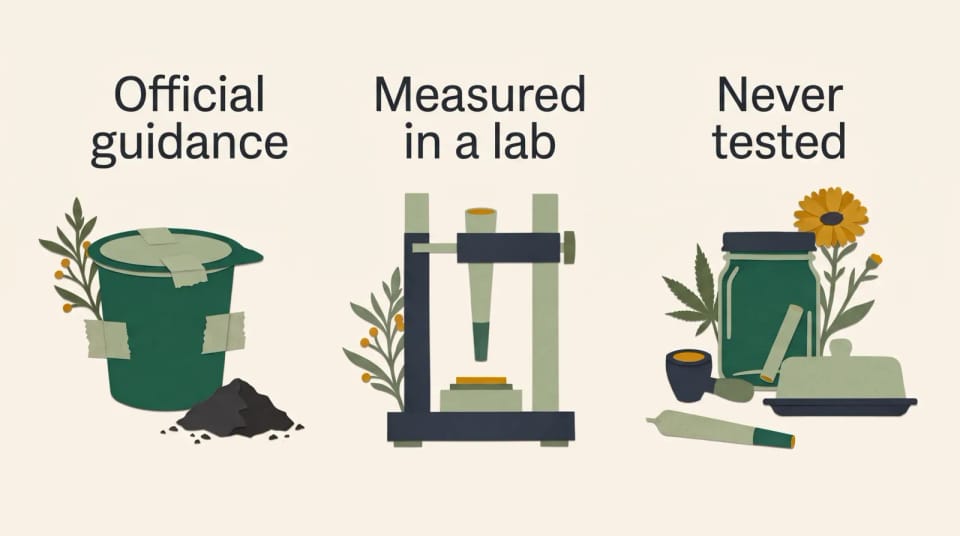
Only disposal has official guidance. The lab work measured what is in the leftover end; nobody has tested what happens when people reuse it.
What the study does not tell you
Hold these limits next to the finding:
| What it measured | What it did not measure |
|---|---|
| THC and terpene concentration per gram of leftover flower | How high a person feels from smoking that material |
| A machine with fixed puff settings | Human puffing, or a joint relit days later |
| Ground flower in commercial tubes with filters | A hand-rolled joint with a crutch, or a roach crushed in an ashtray |
| Small groups (three to seven cigarettes each) | Tar, “resin” or toxicants in a roach |
The authors work for a medical cannabis manufacturer and reported no funding for the study. More concentrated THC per gram also does not mean a roach holds much THC in total. A roach is small. For why a whole joint’s dose is already hard to pin down, see why a joint’s dose is hard to predict, and for the burn, sidestream and roach split, see where the flower in a joint actually goes.
Can you smoke a roach again?
People do re-roll roaches or crumble them into a bowl, but no study has tested how that smoke compares with fresh flower for strength, harshness or toxicants. Claims that roaches are “stronger”, “harsher” or “full of tar” all go past the evidence. The machine study measured concentration in the leftover flower. It did not measure smoke from re-burning it.
One thing is clear from public health guidance. The CDC says smoked cannabis, “regardless of how it is smoked, can harm lung tissues and cause scarring and damage to small blood vessels.” Cannabis smoke carries many of the same toxins and irritants as tobacco smoke. CDC, Cannabis and Lung Health Re-smoking a roach is still smoking. It is not a lower-harm method.
A roach is also a different leftover from already vaped bud. Vaped flower was heated below combustion. A roach sat right behind an open flame. Uses that suit one do not automatically transfer to the other.
If you plan to relight a joint you paused, that is a separate question with its own answer in how to put out a joint and save it. This lesson starts after the joint is finished.
Can you make edibles or butter from roaches?
Roach material is already partly decarboxylated, but no study has tested infusing it, so the dose of anything you make from it is unknowable. The Eyal study showed heat had converted THCA in the leftover flower. Separate lab work shows that heating converts THCA to THC at measured, predictable rates. That work used extracts in a vacuum oven, not a roach near a flame. Wang et al., 2016
What nobody has measured is how much THC a roach infusion recovers, or what combustion by-products from the charred paper and edge end up in the fat. A roach also mixes flower that sat right behind the burn with flower that barely warmed. So there is no recipe here, and no temperature or ratio to trust.
If you want to understand the steps people use for flower, start with how decarboxylation works and cannabutter and its dosing limits. Neither lesson can give you a dose for roach material, because the input is unknown.
How long can you keep roaches?
Nobody has tested how long roaches keep, or whether a jar, tin or bag protects them. The nearest real evidence is about flower in general.
A 2023 review of fungal contamination in cannabis flower describes lung infections with Aspergillus in people who smoked cannabis while living with cancer or other immune compromise. It also notes that the source of most infections could not be traced to a cannabis product. Gwinn et al., 2023 That review did not test roaches. It does tell you who carries the documented risk.
If you keep any cannabis around, the principles in how to store flower are the best guide available, though that guide is written for flower, not burned ends. Discard anything fuzzy, damp or musty rather than test it.
When to talk to a clinician: if you have a weakened immune system, ask your care team before you smoke any stored cannabis. Also see a clinician for a cough that does not go away, wheezing, chest pain or shortness of breath after smoking.
How do you throw away a roach safely?
New York State’s health department lists roaches by name as cannabis waste and gives a four-step method: crush it, mix it with waste that rots, seal it, and put it in the regular trash. The reason it gives is safety: openly discarded cannabis puts children and pets at risk. New York State Department of Health, How to Safely Discard Cannabis Waste
That is New York guidance, not national law, and your state may differ. One fire-safety step comes first, borrowed from tobacco guidance by the same logic.
- Put it all the way out. Fire services advise wetting butts with water before they go in the trash, and never putting them in plant pots, mulch or landscaping. Oregon State Fire Marshal Massachusetts fire officials warn that smoking materials can smolder unnoticed for a long time before they burst into flame. Massachusetts Department of Fire Services Both pages are about tobacco; the same physics applies to a roach.
- Crush it. Crush, chop or grind the roach into fine bits. (New York guidance)
- Mix it with waste that rots. Stir it into coffee grounds, food waste, garden trimmings, soil or kitty litter so no one can recognize or use it. (New York guidance)
- Seal it. Put the mixture in a taped, sealed container such as an empty yogurt cup. (New York guidance)
- Bin it out of reach. Put it in the regular trash. Do not flush it. New York’s cannabis office adds that cannabis “should be thrown out in a secure location,” because young people and pets sometimes find it in open trash. New York State Office of Cannabis Management
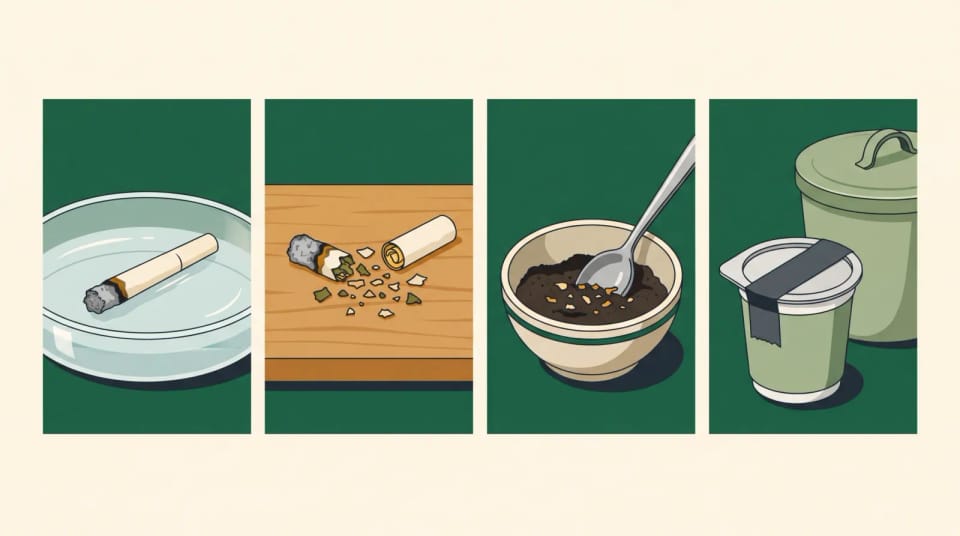
Put it out first, then crush, mix with waste that rots, and seal. The water step comes from tobacco fire guidance; the other steps follow New York State health guidance.
Why not compost it or toss it in the yard?
No official source this research found says a household can compost a roach, and pets have been poisoned by both discarded joint butts and compost. In a survey of 251 veterinarians across North America, vets named “discarded joint butts” and “compost” among the sources of cannabis poisoning they had seen in pets. Amissah et al., 2022 The survey does not count how many cases came from butts. Most pets recovered fully.
If a dog has already eaten a roach, go to if a dog ate weed or call your vet. If a child may have eaten cannabis, New York’s guidance gives the Poison Center line, 1-800-222-1222, and says to call 911 if the child is unconscious or has trouble breathing. New York State Department of Health
For hardware leftovers, the rules are different again; see how to dispose of vape pens.
What has nobody tested?
Searches of PubMed and the wider web turned up no study on any of these. That is not proof no study exists, but it means nobody can give you a measured answer:
- Whether smoking roach material is stronger, harsher or carries more toxicants than fresh flower.
- How much tar or resin a roach holds.
- How much THC an oil, butter or alcohol soak recovers from roaches, and what else comes along.
- How long roaches keep, and whether any container helps.
- Whether saliva on a roach makes it less safe to keep.
How do you end up with fewer roaches?
Roll smaller, and roll so the joint burns evenly. A joint that canoes or runs leaves an uneven, partly unburned end, so the advice in why your joint burns unevenly can leave you a smaller end. A tighter, smaller joint from how to roll a joint that finishes cleanly leaves less behind in the first place. Noting how a strain worked in the High IQ app can also help you roll a size you actually finish.
The grinder tray leaves its own leftover, too; see what to do with kief.
Key takeaways
- A roach is not empty. In a machine study, the leftover end held more THC per gram than unsmoked flower, and much of its THCA was already converted.
- Nobody has tested smoking, infusing or storing roaches, so claims about strength, harshness, tar or shelf life are guesses.
- Re-smoking a roach is still smoking; the CDC says smoked cannabis harms the lungs however it is smoked.
- The only official guidance is disposal: put it out, crush it, mix it with waste that rots, seal it, and bin it out of reach of children and pets.
FAQ
Can you still get high from smoking a roach?
The leftover end still contains THC, and in a machine study it held more THC per gram than unsmoked flower. But a roach is small, and no study has measured how high people get from smoking one. The amount of THC you would actually inhale is unknown.
Are roaches more potent than a fresh joint?
Not in any way that has been measured in people. The lab finding is about concentration per gram in the leftover flower, under fixed machine settings. It does not show a stronger effect, and the total amount in a roach is much smaller than in a whole joint.
Is it bad to smoke roaches?
No study has looked at roach smoke specifically. What is known is that smoked cannabis, however it is smoked, can harm lung tissue, according to the CDC. Re-smoking a roach does not make smoking safer.
Can you compost roaches?
No official source this research found approves composting roaches at home. New York State’s health department says to mix cannabis waste with rotting waste, seal it, and put it in the trash. A veterinary survey lists compost among the sources of cannabis poisoning in pets.
How do you dispose of roaches properly?
Make sure the roach is fully out, ideally wet with water. Then crush it, mix it with coffee grounds or food scraps, seal it in a taped container, and put it in a bin that children and pets cannot reach. Do not flush it.
Sources
- Eyal AM, Hen-Shoval D, Schlesinger D, Berneman-Zeitouni D, Raz N. Inconsistency in the composition of the smoke of a cannabis cigarette as smoking progresses. Cannabis and Cannabinoid Research. 2024;9(5):1235-1249. DOI 10.1089/can.2023.0123.
- Tashkin DP, et al. Tar, CO and delta 9THC delivery from the 1st and 2nd halves of a marijuana cigarette. Pharmacology Biochemistry and Behavior. 1991;40(3):657-661.
- Wang M, et al. Decarboxylation study of acidic cannabinoids. Cannabis and Cannabinoid Research. 2016;1(1):262-271.
- Gwinn KD, et al. Fungal and mycotoxin contaminants in cannabis and hemp flowers. Frontiers in Microbiology. 2023;14:1278189.
- Amissah RQ, et al. Prevalence and characteristics of cannabis-induced toxicoses in pets. PLOS ONE. 2022;17(4):e0261909.
- Centers for Disease Control and Prevention. Cannabis and lung health.
- New York State Department of Health. How to safely discard cannabis waste.
- New York State Office of Cannabis Management. Consumers.
- Oregon State Fire Marshal. Smoking materials: put it out.
- Massachusetts Department of Fire Services. Smoking fire safety.





