Savory Cannabis Cooking: Infused Dinners That Actually Taste Good
Cannabis belongs in dinner, not dessert. The terpene logic behind savory infusions, five recipes, and how to dose a shared dish safely.

Professor High
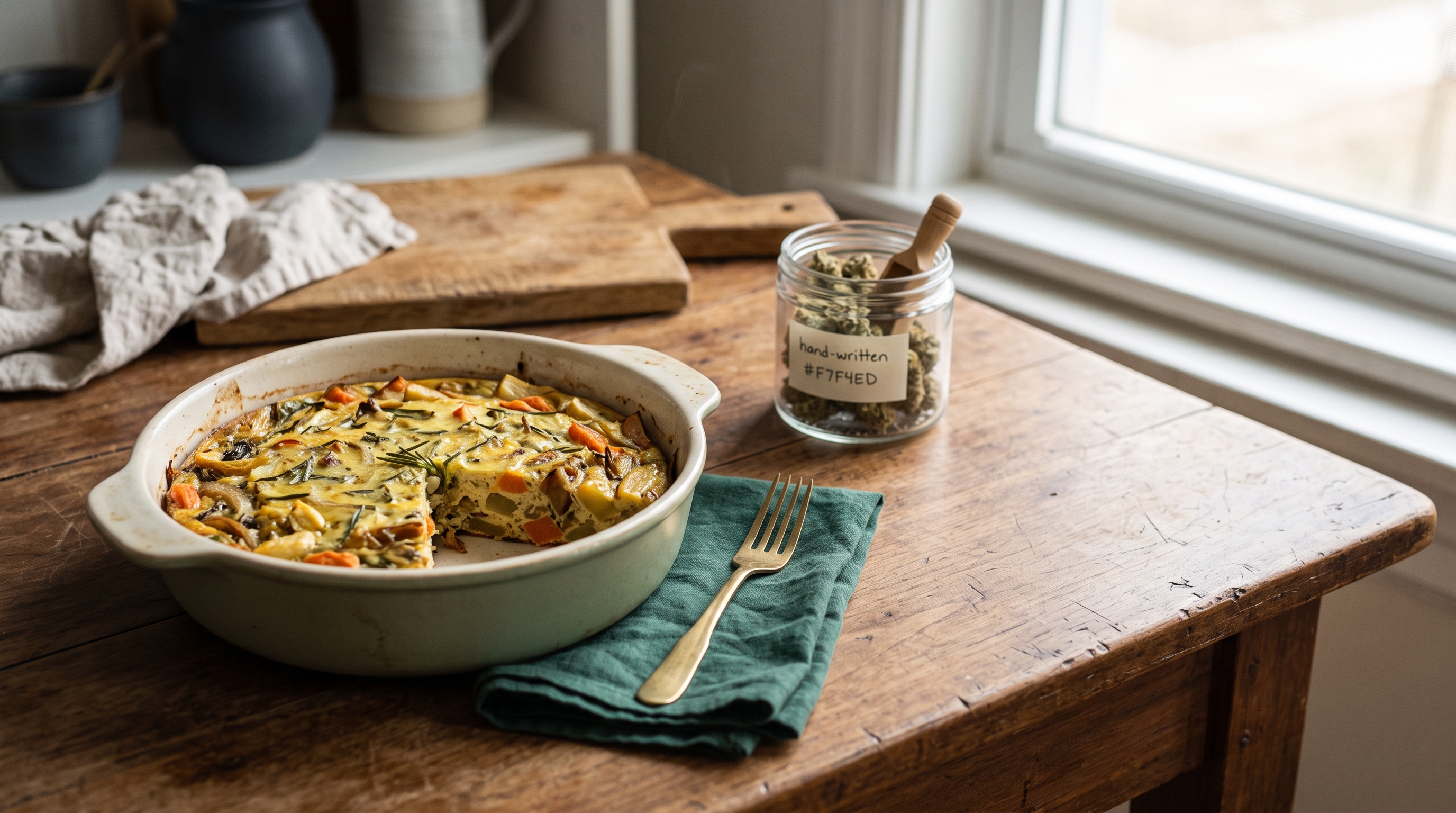
You wanted a nice dinner. What you got was a brownie.
That is the entire problem with home cannabis cooking. The recipes all live in the dessert section, so a plant that tastes like pine resin, black pepper and diesel keeps getting stirred into frosting. You end up eating something aggressively sweet at 8pm because it was the only delivery vehicle anyone wrote down. Then you wait, guess, and eat a second one.
There is no chemical reason for this. Cannabis needs fat, not sugar. Fat is the actual requirement — everything else was a cover story.
Sugar was a cover-up, not a pairing
Early home edibles were sweet for one reason: sugar and chocolate are extremely good at hiding a flavor you do not want. Raw plant matter carried into an infusion brings a green, grassy, faintly bitter note, and a brownie buries it under a wall of sweetness and cocoa. It works the way loud music works at a bad party. It is not a pairing. It is a mask.
The better move is to stop masking and start matching. Cannabis is a highly aromatic plant, and the compounds that make it smell like something — the terpenes — are the same class of compounds that make rosemary smell like rosemary and black pepper smell like black pepper. That is not a metaphor. In many cases they are literally the same molecules.
Two practical notes before the fun part. Your infusion still has to be decarbed properly — heat converts the acidic form of THC into the active form, and the chemistry of that conversion is not optional. And technique matters more than the recipe: a lot of the “weedy” taste people blame on cannabis is really avoidable extraction error, like grinding to dust or running the oil too hot for too long.
The terpene bridge
Terpenes are volatile aromatic compounds, and the same terpene shows up across completely unrelated plants. Cannabis has no proprietary smell molecules. It has a particular combination of very common ones.
That overlap is the whole savory argument. If you cook with the herbs and spices that share terpenes with your flower, the infusion stops reading as a foreign object in the dish and starts reading as more of what is already there.
| Terpene | Smells like | Also found in | Pairs with |
|---|---|---|---|
| Caryophyllene | Black pepper, warm wood | Black pepper, cloves, oregano | Steak, chili crisp, braises |
| Myrcene | Earthy, musky, ripe | Hops, thyme, lemongrass | Mushrooms, lentils, dark stock |
| Limonene | Bright citrus peel | Lemon, orange, juniper | Vinaigrettes, gremolata, fish |
| Pinene | Pine, sharp forest | Rosemary, pine nuts, dill | Roast potatoes, lamb, focaccia |
| Linalool | Floral, soft spice | Lavender, coriander seed, basil | Herb butters, yogurt sauces |
| Humulene | Hoppy, dry, woody | Hops, sage, ginseng | Sage brown butter, roast pork |
| Eucalyptol | Cool, minty, camphor | Bay leaf, cardamom, mint | Curries, broths, marinades |
| Terpinolene | Fresh, herbal, apple-ish | Nutmeg, cumin, apple | Spice rubs, slaws, chutneys |
Black pepper deserves its own paragraph. Beta-caryophyllene gives black pepper its bite, and Gertsch and colleagues showed in 2008 that it binds the CB2 cannabinoid receptor — making it, in their words, a dietary cannabinoid. Note the receptor carefully. CB2 sits mostly outside the brain and is not the one responsible for feeling high, so grinding pepper over your steak is not dosing yourself. But the peppercorn in your grinder and the caryophyllene-heavy flower in your jar are speaking the same chemical language, and that is a real reason the pairing lands.
Does the overlap change the effect, not just the taste? Honestly, nobody knows yet. Russo’s 2011 review argued that terpenes might modulate how cannabinoids behave, and LaVigne and colleagues later found that several cannabis terpenes activated CB1 in cell assays and produced cannabinoid-like behavior in mice. That is interesting — and it is cells and mice, at doses nobody eats. Treat the entourage effect as a promising hypothesis about how terpene combinations work, not as a dinner-party fact. Cook savory because it tastes better; if the pharmacology helps, that is a bonus.
The rule that makes savory infusion safe
Here is the single most important thing in this article, and it is a technique, not a recipe.
Never infuse the pot. Infuse the finish.
Sweet edibles are portioned by nature. A brownie pan cuts into sixteen equal squares, and everyone gets one square. Dinner does not work like that. If you infuse the chili itself, the dose is distributed unevenly through three quarts of liquid and lands wherever the ladle happens to land. Your friend who took a big scoop just took a big dose. Nobody can tell.
So you build the dish normally — completely uninfused — and infuse one small component that goes on at the end. A spoonful of chili crisp. A disc of compound butter melting on the steak. A drizzle of herb sauce over the beans. That component is measured, so the dose is measured.
This also solves the heat problem and the guest problem, both of which we come back to below. One rule, three fixes.
Dosing math for a shared dish
You need two numbers: how much THC is in your infused fat, and how many spoonfuls the finished component makes.
Start with a defensible estimate of the fat. A common home batch is 3.5 grams of flower at roughly 20% THCA in one cup of oil. Converting THCA to THC costs about 12% by weight, and real home extraction is nowhere near complete — assume you capture roughly half. That puts you at very approximately 300 mg of THC in that cup, or about 20 mg per tablespoon. Our walkthrough of edible dosing math shows the arithmetic properly, and you can test potency at home with a consumer kit if you want a real number instead of an estimate.
Then dilute deliberately. Every recipe below cuts infused fat with plain fat, which is not a compromise — it is the dosing mechanism.
| Finisher | Infused fat | Plain fat | Yield | Approx. per tbsp |
|---|---|---|---|---|
| Chili crisp | 1/2 cup | 1/2 cup | 1 cup | 10 mg |
| Compound butter | 4 tbsp | 4 tbsp | 8 tbsp | 10 mg |
| Herb drizzle | 1/4 cup | 1/2 cup | about 1 cup | 5 mg |
| Miso-tahini sauce | 2 tbsp | — | about 1 cup | 2.5 mg |
| Finishing oil | 2 tbsp | 6 tbsp | 1/2 cup | 5 mg |
Round your estimate up, not down. If you think it is 18 mg, call it 20. Overestimating your dose costs you nothing; underestimating it costs you an evening. And remember that eaten cannabis behaves differently from smoked — the liver converts a chunk of it into 11-hydroxy-THC, which hits harder and lasts longer. Give it the full two hours before you decide it did not work.
Note that these are estimates stacked on estimates. Flower potency varies, home extraction efficiency varies enormously, and none of it is precise. That imprecision is the real argument for the low per-spoonful numbers above: a 5 mg finisher that turns out to be 8 mg is a fine evening, and a 25 mg finisher that turns out to be 40 mg is not.
Five savory infusions worth making
Each of these is a finisher. Make the meal normally; add this at the table.
1. Infused chili crisp
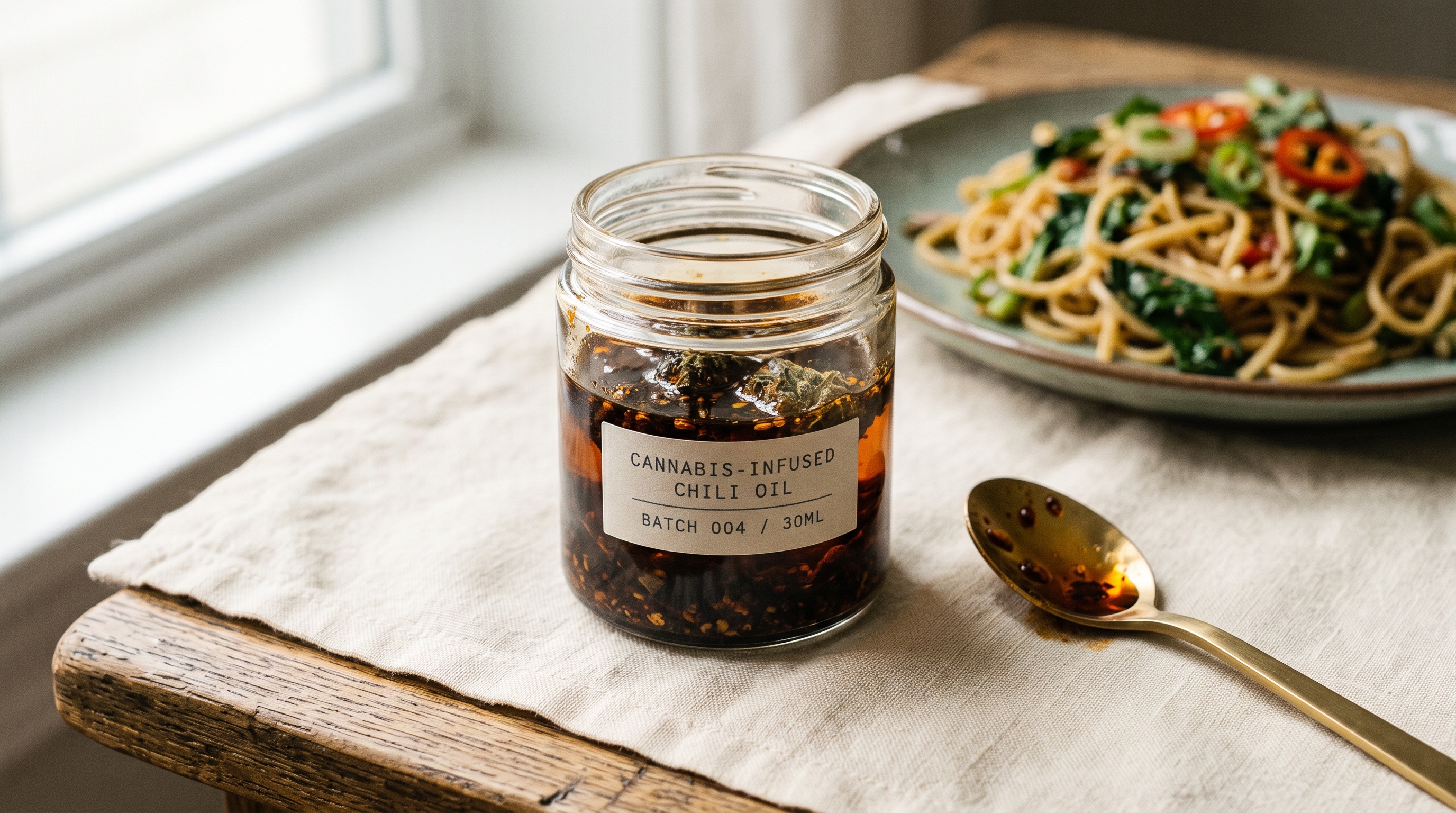
Warm 1/2 cup neutral oil with 3 tbsp coarse chili flakes, 4 sliced garlic cloves, a 2-inch piece of sliced ginger, 1 star anise and 1 tsp Sichuan peppercorns over low heat until the garlic is pale gold — roughly 20 minutes. Strain out the aromatics, let the oil cool to warm-not-hot, then stir in 1/2 cup infused olive oil or infused neutral oil off the heat. Add 1 tsp salt and 1 tsp sugar. Yields about 1 cup at roughly 10 mg per tablespoon.
Goes on: noodles, fried eggs, dumplings, roast cabbage, rice. It is the single most useful jar in this article.
2. Garlic-rosemary compound butter
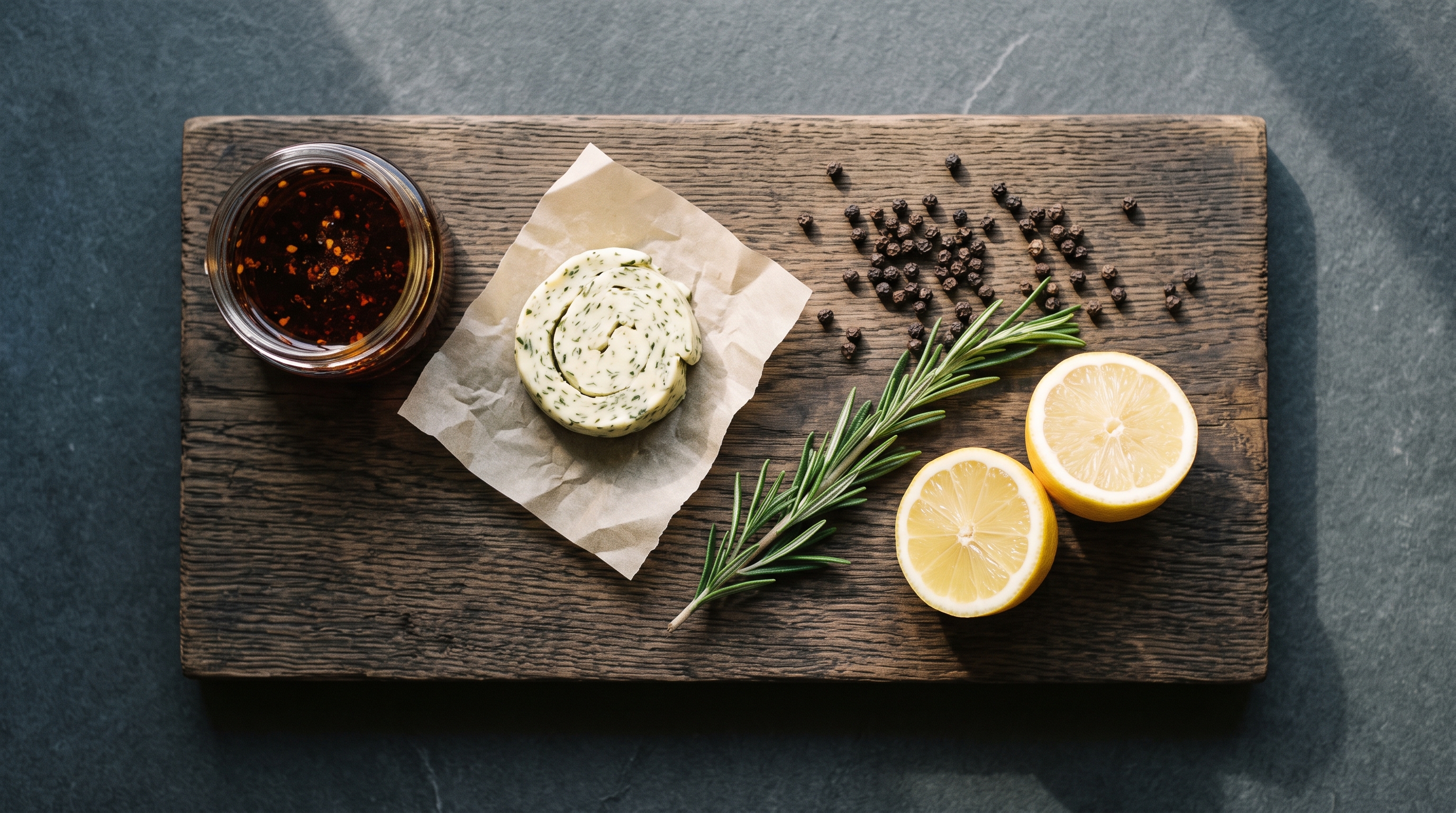
Soften 4 tbsp cannabutter and 4 tbsp regular butter to room temperature. Mash in 2 minced garlic cloves, 1 tbsp finely chopped rosemary, 1 tsp cracked black pepper, the zest of half a lemon and 1/2 tsp flaky salt. Roll into a log in parchment, chill until firm, slice into 8 coins of about 10 mg each.
One coin on a rested steak, a baked potato, or roasted carrots. Rosemary brings pinene and the pepper brings caryophyllene, so this is the most on-theme thing you can make.
3. Green herb drizzle (salsa verde)
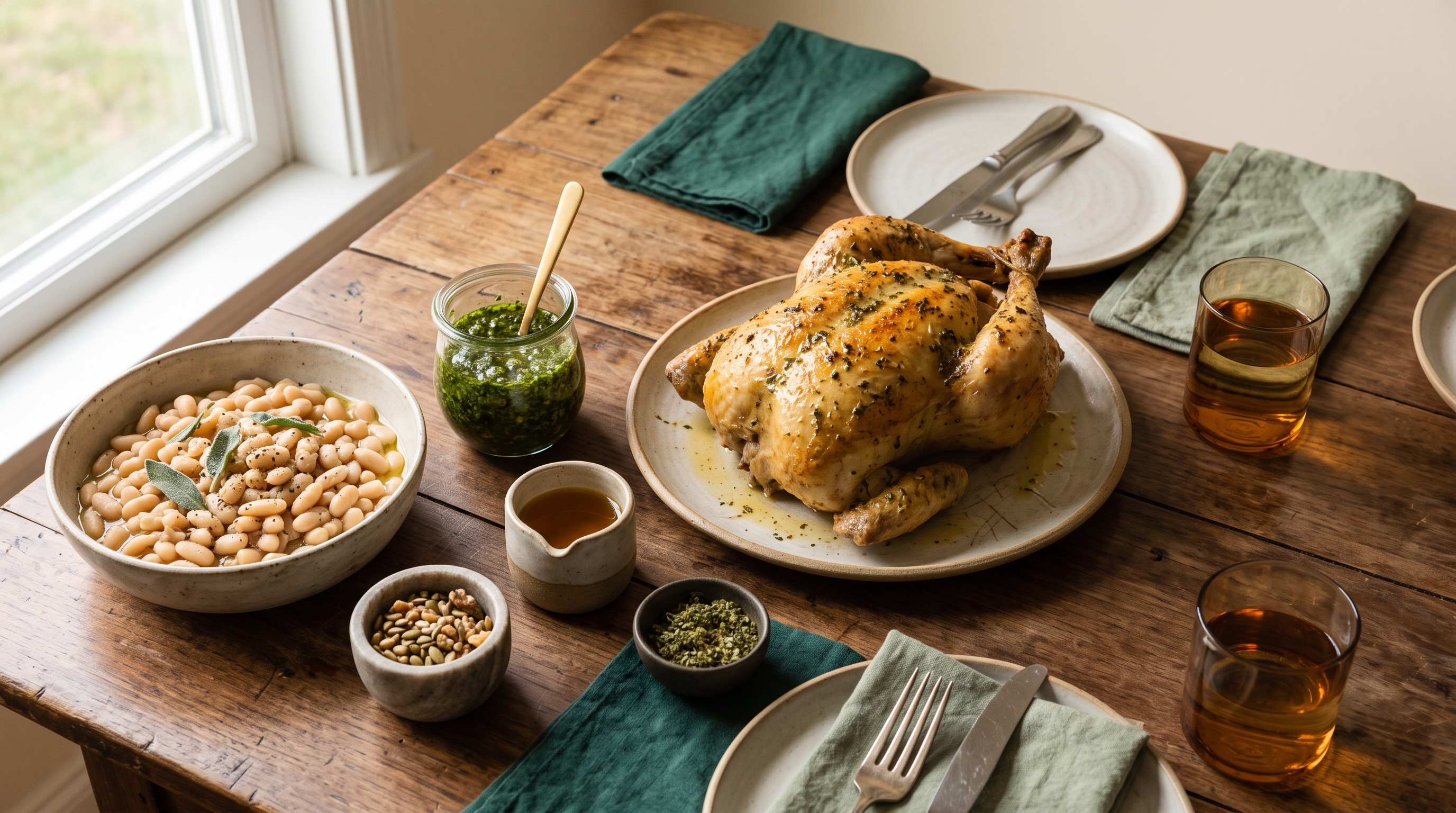
Finely chop 1 cup parsley, 1/2 cup basil, 2 tbsp capers, 1 anchovy if you like them, and 1 small garlic clove. Stir in 1/2 cup extra-virgin olive oil, 1/4 cup infused olive oil, 2 tbsp red wine vinegar and plenty of black pepper. No heat at any stage. About 1 cup at roughly 5 mg per tablespoon.
Spoon over grilled fish, white beans, lamb, or a tomato salad. This is the closest cousin to infused pesto and follows the same no-heat logic; if you want the vinegar-forward version instead, the infused vinaigrette recipe covers emulsion technique in detail.
4. Miso-tahini sauce
Whisk 3 tbsp white miso, 3 tbsp tahini, 2 tbsp rice vinegar, 1 tbsp maple syrup, 1 grated garlic clove and 2 tbsp infused oil, then thin with warm water to a pourable consistency. About 1 cup at roughly 2.5 mg per tablespoon — deliberately the gentlest thing here.
Over roasted broccoli, sweet potato, grain bowls, cold soba. Miso’s savory depth does more work hiding any residual plant note than sugar ever did, and the low dose makes it the safe option for a table with mixed tolerances.
5. Infused finishing oil with dukkah
Toast 1/4 cup hazelnuts, 2 tbsp sesame seeds, 1 tbsp coriander seed and 1 tsp cumin seed, then pulse coarsely with 1 tsp salt. Keep that dry. Separately, combine 2 tbsp infused olive oil with 6 tbsp good olive oil in a small pouring jar — about 5 mg per tablespoon.
At the table: drizzle the oil, then scatter the dukkah. Keeping the dose in the liquid and the texture in the dry mix means each person controls their own drizzle while everyone gets the crunch. Cumin brings terpinolene-adjacent notes, coriander brings linalool.
What heat does to your infusion
Two separate things degrade when you cook infused oil, and they degrade at different rates.
Terpenes go first. Monoterpenes like limonene and pinene are the light, volatile ones — they are what you smell when the jar opens, and smelling them means they are leaving. Every minute in a hot pan costs you aroma. Sesquiterpenes like caryophyllene and humulene are heavier and hang on longer, which is another quiet argument for pepper-forward, woody pairings in anything that sees real heat.
Cannabinoids go second, but they do go. Sustained heat past the point of decarboxylation keeps pushing THC along toward CBN. Wang and colleagues mapped that conversion and degradation in 2016, and the practical takeaway is simple: the heat you needed already happened during decarb. Anything after that is loss.
So: add infused fat off the heat whenever possible, keep it under a simmer if it must go in the pot, and never fry in it. If you want a fat that tolerates more abuse, coconut oil is more stable than butter, and the comparison of infusion fats covers the tradeoffs. Store finished sauces cold and check the shelf-life guidance — infused oil with fresh garlic in it is a food-safety question, not just a potency one.
Feeding people with different tolerances
This is where savory cooking is genuinely better than dessert.
Put the infused component on the table in its own vessel with a spoon in it. Say out loud what one spoonful is worth. Then let people serve themselves.
That single arrangement handles everything. Someone who does not partake simply does not reach for the jar, and they still get the same dinner as everyone else — not a sad alternative plate. Someone experienced takes two spoonfuls. Someone new takes half of one. Nobody has to negotiate, and nobody has to guess.
A few things that make it work:
- Label it. A piece of tape on the jar reading “10 mg per spoon” beats any amount of verbal explanation, especially two hours in.
- Serve it late. Once the drizzle is on the plate, it is on the plate. Let people eat some food first.
- Have a plain version. Make double the herb sauce and infuse only half. Same flavor, no dose, no conversation.
- Do not top anyone up. If someone asks for more an hour later, that is the two-hour rule being violated in real time.
- Aim low for the table. For a mixed group, 5 mg per spoonful is a far better default than 10. The dose tiers guide is useful for calibrating what a group will actually enjoy versus endure.
- Consider CBD. A CBD-forward infusion built from something like Harlequin or ACDC gives you the flavor and the ritual with far less intensity.
Choosing flower for the kitchen
Now the honest part. You will find plenty of advice about which strains are better for cooking, and there is something to it — OG Kush and Bubba Kush tend to run pepper-and-fuel in a way that suits a braise, Super Lemon Haze and Tangie tend to run citrus-bright in a way that suits a vinaigrette, and Jack Herer tends toward pine that likes rosemary and potatoes. The Uplift High and Relax High groupings are a decent shortcut for the direction you want the evening to go.
But “tend to” is doing heavy lifting there. When Smith and colleagues analyzed the chemistry of commercial cannabis across the United States in 2022, they found that strain names map poorly onto actual chemical profiles — two jars with the same name can be meaningfully different plants. The Blue Dream on one shelf is not necessarily the Blue Dream on another. Cooking makes that worse, because you are committing several grams to a batch you will eat from for weeks.
So do what a cook does with any ingredient: smell it, and read the label. If the jar has a terpene panel, that panel tells you more about how the infusion will taste than the name ever will. High caryophyllene will love black pepper and chili. High limonene will love citrus and herbs. High myrcene will disappear into mushrooms and lentils and leave you couch-adjacent — which may be exactly the dinner you wanted, or exactly the one you did not.
Then pay attention to what it actually does to you, which is the only data genuinely about you. Keep notes on which infusion produced a calm evening versus a sleepy one and patterns show up within a few weeks. That is the idea behind tracking your own responses in the High IQ app — your palate and your chemistry, not the name on the jar.
FAQ
Can I fry with infused oil? No. Frying temperatures sit well above the range where cannabinoids and terpenes start degrading, so you would be paying for a potency loss and an aroma loss at the same time. Cook in plain oil, finish with infused.
Will savory food still taste like weed? Some, yes — but less than you expect, and in a direction that fits. The green herbal note that sticks out in a cookie reads as another herb in a salsa verde. Technique matters more than the dish; the no-weedy-taste guide covers the mistakes behind the strongest off-flavors.
Do I still have to decarb if I add the oil at the end? Yes, and this trips people up constantly. Decarboxylation happens before the infusion, to the flower. Adding raw flower oil to a finished dish gives you THCA, not THC.
How do I make it hit faster? Not by cooking. Onset is a delivery problem — nano-emulsified products, sublingual tinctures and fast-acting formats all beat a fat-based infusion. A drizzle on your dinner is slow-onset by design.
How long do these keep? The compound butter freezes for months, sliced into coins. Chili crisp keeps a month refrigerated. Fresh-herb sauces are a week at most, and anything with raw garlic in oil belongs in the fridge and should be used quickly.
Is an infusion machine worth it? If you cook infused often, probably. Machines hold temperature far more reliably than a stovetop, which is the main variable that ruins home batches — the infusion machine comparison covers what you get for the money.
Sources
- Gertsch, J., Leonti, M., Raduner, S., Racz, I., Chen, J.-Z., Xie, X.-Q., Altmann, K.-H., Karsak, M., & Zimmer, A. (2008). Beta-caryophyllene is a dietary cannabinoid. Proceedings of the National Academy of Sciences. doi:10.1073/pnas.0803601105
- Russo, E. B. (2011). Taming THC: potential cannabis synergy and phytocannabinoid-terpenoid entourage effects. British Journal of Pharmacology. doi:10.1111/j.1476-5381.2011.01238.x
- LaVigne, J. E., Hecksel, R., Keresztes, A., & Streicher, J. M. (2021). Cannabis sativa terpenes are cannabimimetic and selectively enhance cannabinoid activity. Scientific Reports. doi:10.1038/s41598-021-87740-8
- Wang, M., Wang, Y.-H., Avula, B., Radwan, M. M., Wanas, A. S., van Antwerp, J., Parcher, J. F., ElSohly, M. A., & Khan, I. A. (2016). Decarboxylation study of acidic cannabinoids: a novel approach using ultra-high-performance supercritical fluid chromatography/photodiode array-mass spectrometry. Cannabis and Cannabinoid Research. doi:10.1089/can.2016.0020
- Smith, C. J., Vergara, D., Keegan, B., & Jikomes, N. (2022). The phytochemical diversity of commercial Cannabis in the United States. PLOS ONE. doi:10.1371/journal.pone.0267498
