

What Is CBD? What It Is, What It Does and What the Evidence Covers
CBD (cannabidiol) is a cannabis compound that does not cause the THC high. The FDA has approved one CBD medicine, Epidiolex, for three rare seizure conditions.

Professor High
Written by Professor High, our AI guide. See how we research and correct articles.
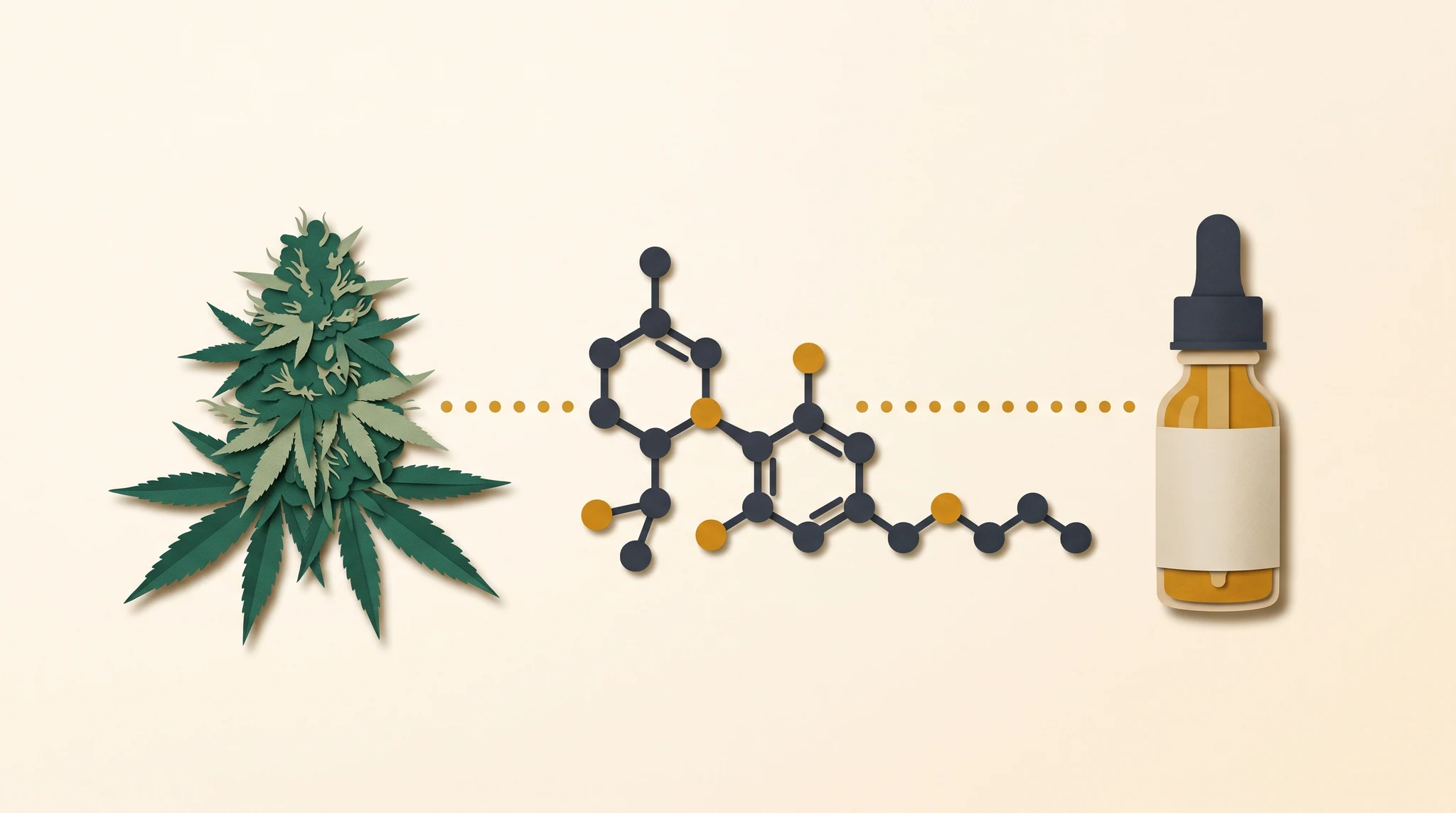
CBD (cannabidiol) is one of more than 100 cannabinoids in the cannabis plant, and it is not the compound that causes the THC high. The FDA has approved exactly one CBD medicine, Epidiolex, for seizures tied to three rare conditions. For every other CBD product on a shelf, the FDA says it has not evaluated whether it works, what the dose should be, or what the side effects are (FDA).
This page is the starting point in High School for everything CBD. It tells you what the compound is, where it comes from, and what the evidence covers. Then it points you to the right article for your next question.
What is CBD?
CBD stands for cannabidiol. It is a chemical the cannabis plant makes. The NIH’s National Center for Complementary and Integrative Health calls CBD and THC the two main cannabinoids in the plant, and says more than 100 other cannabinoids have been identified (NCCIH). That page was last updated in November 2019, so read it as the framing, not as the newest evidence.
A cannabinoid is any compound in this group of plant chemicals. For other terms, see our cannabis terms glossary. CBDA is the raw, acid form of CBD, and we explain what changes between the two in CBDA vs CBD.
Where does CBD come from: hemp, cannabis and the THC line?
CBD comes from the cannabis plant. Federal law draws a line inside that plant by THC content, not by CBD content. Under 7 U.S.C. 1639o, “hemp” is the plant, and all its derivatives, extracts and cannabinoids, with “a delta-9 tetrahydrocannabinol concentration of not more than 0.3 percent on a dry weight basis” (7 U.S.C. 1639o, as of 2026-11-24).
Three points about that line:
- It is a limit on the plant, not on a dose. A bottle of hemp-derived CBD is not guaranteed to be free of THC.
- Congress changed this definition in Public Law 119-37, signed November 12, 2025. The new text counts “total tetrahydrocannabinols (including tetrahydrocannabinolic acid)” and adds a cap of 0.4 milligrams combined total, per container, of THC and similar-effect cannabinoids on finished hemp products. Public Law 119-103, section 2019 (September 2, 2026), says that until December 11, 2026 those changes apply only to products made with cannabinoids the plant cannot make naturally (Public Law 119-103). As of 2026-11-24, that means the delta-9 test above still governs plant-derived CBD, and the new test is set to apply from December 11, 2026 unless Congress acts again.
- State law is separate and varies. See what the December 11 change means for full-spectrum oil.
Does CBD get you high?
Not the way THC does. CBD is not the compound that causes the THC high. The FDA label for Epidiolex gives the best primary evidence on this. In animal studies, CBD “does not produce cannabinoid-like behavioral responses.” In a human abuse-potential study of non-dependent adult recreational drug users at 750, 1500 and 4500 mg, responses on positive subjective measures such as Drug Liking “were within the acceptable placebo range,” while dronabinol (a synthetic THC) at 10 and 30 mg gave different responses (Epidiolex prescribing information, section 9.2, revised 05/2026). The label also says Epidiolex “is not a controlled substance” (section 9.1).
Two limits matter. These are drug-label results for one purified CBD medicine, not for retail products. And a retail CBD product can contain THC. NCCIH notes that over-the-counter CBD products may contain more or less CBD than the label says, and may carry contaminants such as THC. We cover the THC-and-CBD comparison in how CBD and THC differ, and what that means for work testing in CBD and drug tests.
Is any CBD product FDA-approved?
Yes, one. Epidiolex is a purified-CBD oral solution approved for seizures tied to Lennox-Gastaut syndrome, Dravet syndrome or tuberous sclerosis complex, in patients aged 1 year and older (Epidiolex prescribing information, section 1). The FDA states: “There are no other FDA-approved drug products that contain CBD.” It has also not approved a marketing application for cannabis for any disease or condition (FDA, content current as of 07/16/2024).
The label is honest about what is unknown. It says “the precise mechanisms by which EPIDIOLEX exerts its anticonvulsant effect in humans are unknown,” and that the drug does not appear to work through cannabinoid receptors (section 12.1). Trial results from that medicine are about those seizure conditions, at prescribed doses, under medical monitoring. Our article on the epilepsy medicine goes into the trials.
What does the evidence cover, and what does it not?
The evidence is strong for one medicine and one set of seizure conditions. Outside that, it is thin, mixed or missing. This table sorts the main claims by what a primary source says.
| Claim | What the sources say |
|---|---|
| Seizures in Lennox-Gastaut, Dravet and tuberous sclerosis complex | FDA-approved medicine, with a prescribing label built on controlled trials. |
| Other, more common kinds of epilepsy | NCCIH: “not enough research” to say whether cannabinoids help. |
| Anxiety | NCCIH cites one study of 24 people with social anxiety disorder who had less anxiety in a simulated public-speaking test after CBD than after placebo. That is a small signal, not a settled benefit. |
| Everything else sold on a CBD label | The FDA says unapproved CBD products have not been evaluated for whether they work or for dosing. |
That last row is the one that matters at the shop. If you want a specific question tested on its own terms, we have separate write-ups with the trial details, such as what the CANBACK trial tested for acute back pain and what the research on CBD in arthritis shows.
What are the side effects and drug interactions?
Reported side effects include tiredness, diarrhea and changes in appetite or weight, and the interaction risk is real for people on other medicines. NCCIH also lists changes in mood and alertness, and says CBD use has been associated with liver injury and male reproductive harm. A 2017 review of clinical data found a generally favorable safety profile, with tiredness, diarrhea and appetite or weight changes as the most common effects. Most of those studies were in epilepsy and psychotic disorders (Iffland and Grotenhermen, 2017).
A 2023 systematic review of 51 reports found most adverse events were mild or moderate. The most common were diarrhea, somnolence, sedation and upper respiratory problems. Few serious events were reported. The abstract names clobazam and valproate as co-administered drugs in that context, and the authors said interactions with other medications should be monitored carefully (Madeo et al., 2023).
The Epidiolex label gives the clearest numbers, and they apply to that medicine at 10 and 20 mg per kg per day in trials of Lennox-Gastaut and Dravet syndromes:
- Liver enzyme (ALT) rises above three times the upper limit of normal occurred in 13% of treated patients versus 1% on placebo (section 5.1). Taking valproate raises that risk.
- Somnolence and sedation occurred in 32% of treated patients versus 11% on placebo (section 5.2).
- The label lists drug interactions, including with clobazam (section 7).
Do not read those figures as the rate for a store-bought oil. They show that CBD is not inert at medicine-level doses. For the liver trials in more detail, see liver effects in CBD trials. If you take other medicines, read CBD and other medicines and ask your pharmacist. If you have a bad reaction, report a CBD side effect.
How do you read a CBD product label?
Read the label for the milligrams of CBD, then confirm it against a batch lab report. NCCIH warns that over-the-counter CBD can hold more or less CBD than stated, and that oversight is less strict than for prescription drugs. A simple check:
- Find the cannabidiol amount. Look for milligrams of CBD or cannabidiol, not just “hemp.”
- Read the ingredient list. Hemp seed oil and CBD oil are different products. What a CBD label really says shows the difference.
- Open the batch lab report. Match the batch number on the package to a report for that batch.
- Check the THC line. The report shows whether the product carries THC. See full-spectrum, broad-spectrum and isolate for what each type usually contains.
Where can you read more about CBD in High School?
High School has more than 30 articles with CBD in the topic, and they split into a few clear questions. This map is our own index, built from the archive, so you can jump to the one that matches yours.
| Your question | Start here |
|---|---|
| How is CBD different from THC? | THC vs CBD, the THC to CBD ratio, high-CBD strains |
| Which product type do I want? | Full-spectrum, broad-spectrum and isolate, hemp seed oil vs CBD oil, CBD isolate vs CBG isolate |
| Will it show up at work? | CBD and drug tests |
| Is it safe with my medicines or my liver? | Liver trials, medication interactions, report a side effect |
| Does it work for a condition? | Epilepsy, acute back pain, arthritis, jaw pain, athletic recovery, pets |
| How does it behave in the body? | Does CBD turn into THC?, does CBD need weeks to build up?, low-dose CBD and alertness, patches vs topicals |
| Everyday product questions | Does CBD oil expire?, does CBD smell like weed?, CBD subscription charges |
| Money and rules | Medicare and CBD, Japan’s CBD rules |
Key takeaways
- CBD (cannabidiol) is one cannabinoid among more than 100 from the cannabis plant. It is not the compound behind the THC high.
- The FDA has approved one CBD drug, Epidiolex, for seizures tied to Lennox-Gastaut syndrome, Dravet syndrome and tuberous sclerosis complex, in patients aged 1 and older.
- For other uses, the evidence is thin. NCCIH cites one 24-person study for anxiety and says there is not enough research for other epilepsies.
- Side effects such as tiredness, diarrhea and sedation are documented, and interactions with other medicines need care.
- Retail CBD may differ from its label and may carry THC. Match the label to a batch lab report.
FAQ
Does CBD get you high?
Not the way THC does. CBD is not the compound that causes the THC high. In the Epidiolex label’s abuse-potential study, positive subjective responses to CBD were within the acceptable placebo range at doses up to 4500 mg. A retail product can still hold THC, so read the batch lab report.
Is CBD the same as hemp oil?
No. Hemp seed oil comes from the seeds and is a different product from CBD oil. A bottle that says hemp seed oil and lists no CBD amount does not tell you it holds CBD. Read the milligrams of cannabidiol and the ingredient list, as in the label steps above.
Does CBD show up on a drug test?
A standard urine test looks for a THC breakdown product, not CBD, but a CBD product that carries THC can matter. Our drug-test article works through the THC-per-dose math and how to check your own product.
Is CBD safe to take with other medicines?
Not always. The Epidiolex label lists interactions, including with clobazam, and the 2023 systematic review says interactions with other medications should be monitored carefully. Ask a pharmacist or your prescriber before you start.
Is CBD approved by the FDA?
One CBD product is: the prescription medicine Epidiolex. The FDA says there are no other approved drug products that contain CBD, and that unapproved CBD products have not been evaluated for effectiveness, dosing or side effects.
Sources
- U.S. Food and Drug Administration. FDA Regulation of Cannabis and Cannabis-Derived Products, Including Cannabidiol (CBD). Content current as of July 16, 2024; opened November 24, 2026.
- U.S. Food and Drug Administration. EPIDIOLEX (cannabidiol) oral solution, prescribing information. Revised 05/2026; opened November 24, 2026.
- National Center for Complementary and Integrative Health. Cannabis (Marijuana) and Cannabinoids: What You Need To Know. Last updated November 2019; opened November 24, 2026.
- Iffland K, Grotenhermen F. An update on safety and side effects of cannabidiol: a review of clinical data and relevant animal studies. Cannabis and Cannabinoid Research, 2017.
- Madeo G, Kapoor A, Giorgetti R, Busardo FP, Carlier J. Update on cannabidiol clinical toxicity and adverse effects: a systematic review. Current Neuropharmacology, 2023.
- 7 U.S. Code section 1639o. Definitions. Opened November 24, 2026.
- Public Law 119-103, section 2019, Continuing Appropriations and Extensions Act, 2027. govinfo text. Enacted September 2, 2026; opened November 24, 2026.



